

Machine learning is one of the most important technologies in modern software development. It allows computers to learn from data, identify patterns, make predictions, and support decision-making without being explicitly programmed for every situation. From recommendation systems and fraud detection to healthcare applications and self-driving vehicles, machine learning is transforming industries.
However, building a machine learning model is not just about choosing an algorithm and training it with data. Developers must understand data quality, model evaluation, feature selection, overfitting, and other techniques that help produce reliable results.
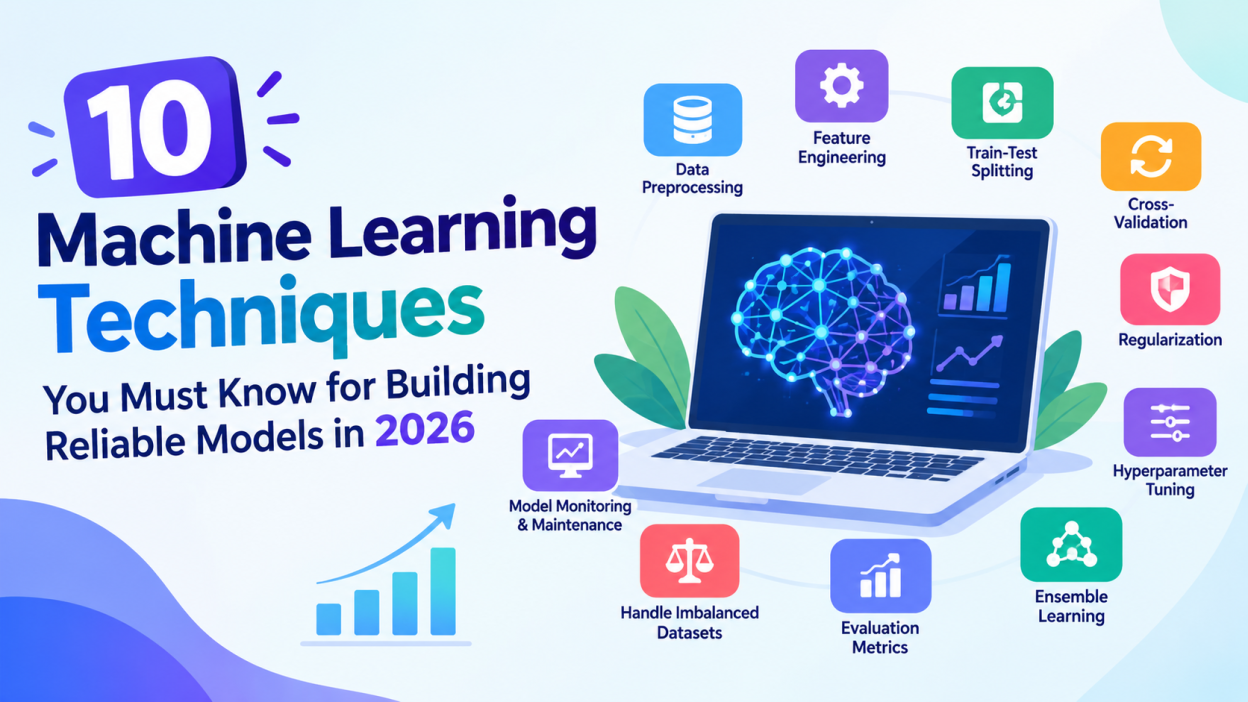
In this article, we will explore ten important machine learning techniques, explain how they work, and discuss how they can help you build accurate and dependable models.
What Is Machine Learning?
Machine learning is a branch of artificial intelligence that enables systems to learn from historical data and improve their performance on specific tasks. Instead of writing rules for every possible situation, developers train algorithms using relevant datasets.
For example, an email spam detection system learns from previously classified emails. After training, it can identify patterns in new messages and predict whether an email is spam.
Machine learning is generally divided into three major categories:
- Supervised learning: Uses labeled data to predict outcomes, such as house prices or spam emails.
- Unsupervised learning: Finds patterns and relationships in unlabeled data, such as customer segments.
- Reinforcement learning: Learns through interactions with an environment and feedback in the form of rewards or penalties.
Understanding these categories provides a foundation for selecting suitable techniques for different machine learning problems.
10 Important Machine Learning Techniques
1. Data Preprocessing
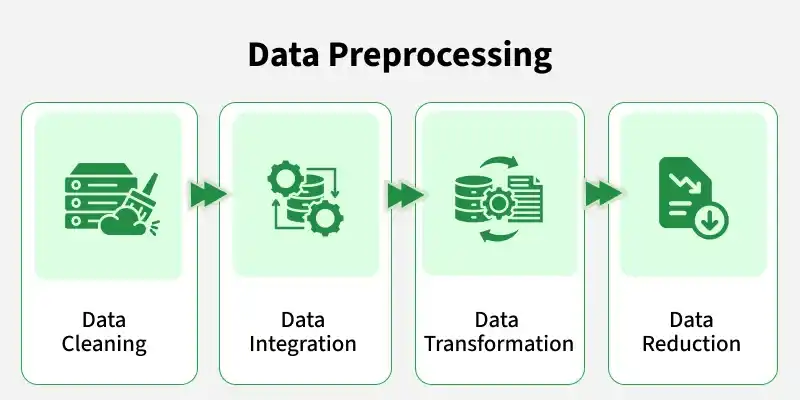
Data preprocessing is the process of preparing raw data before using it to train a machine learning model. Real-world datasets frequently contain missing values, duplicate records, inconsistent formats, and incorrect information.
Poor-quality data can reduce model performance, even when developers use advanced algorithms.
Common preprocessing activities include handling missing values, removing duplicates, encoding categorical variables, and scaling numerical features. For example, a dataset containing customer ages, salaries, and purchase histories may require cleaning and transformation before training.
Python libraries such as Pandas, NumPy, and Scikit-learn help automate these tasks.
2. Feature Engineering
Feature engineering involves creating, selecting, or transforming input variables to improve a model’s ability to identify meaningful patterns.
For example, an online shopping dataset may contain purchase dates. Developers can extract additional features such as purchase month, day of the week, or time since the previous purchase.
These new features may help a model understand customer behavior more effectively.
Good feature engineering requires domain knowledge and experimentation. However, unnecessary or irrelevant features can introduce noise and increase computational complexity. Developers should evaluate whether each feature contributes useful information.
3. Train-Test Splitting
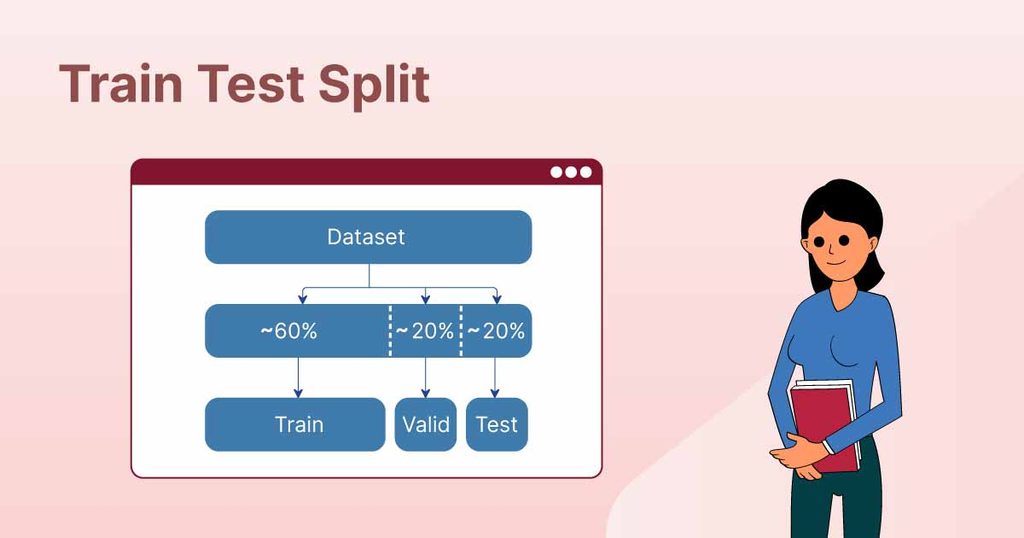
Train-test splitting is an important technique for evaluating how well a machine learning model performs on unseen data.
The dataset is divided into separate portions. The training set is used to teach the model, while the test set evaluates its performance after training.
A common approach is an 80:20 split, although the appropriate ratio depends on dataset size and project requirements.
Developers may also use a validation set to compare models and tune their parameters.
It is important to prevent data leakage, which occurs when information unavailable during real-world prediction accidentally influences training. For time-dependent datasets, chronological splitting is often more appropriate than random splitting.
4. Cross-Validation
Cross-validation provides a more reliable estimate of model performance by evaluating it across multiple data partitions.
In k-fold cross-validation, the dataset is divided into k sections. The model is trained repeatedly, using one section for validation and the remaining sections for training. Each section serves as the validation set once.
For example, five-fold cross-validation divides the data into five parts and performs five training and validation rounds.
This technique helps developers understand whether a model performs consistently across different subsets of data.
Cross-validation is particularly useful when datasets are small. However, time-series data and grouped observations may require specialized splitting strategies to avoid misleading results.
5. Regularization

Regularization helps prevent overfitting by discouraging unnecessarily complex models.
Overfitting happens when a model learns the training data too closely, including random noise, and performs poorly on new examples.
Two popular regularization techniques are L1 and L2 regularization.
- L1 regularization: Can push some model coefficients to zero, supporting feature selection in suitable models.
- L2 regularization: Penalizes large coefficients, encouraging more moderate parameter values.
Regularization is widely used in linear regression, logistic regression, and neural networks.
Choosing an appropriate regularization strength helps balance model complexity and predictive performance.
6. Hyperparameter Tuning
Hyperparameters are settings chosen before or during the training configuration process rather than learned directly as model parameters.
Examples include the learning rate of a neural network, the maximum depth of a decision tree, and the number of neighbors in a K-nearest neighbors model.
Hyperparameter tuning involves testing different configurations to identify settings that perform well on validation data.
Common approaches include grid search, random search, and Bayesian optimization.
Scikit-learn provides tools such as GridSearchCV and RandomizedSearchCV for many traditional machine learning workflows.
Developers should tune hyperparameters using training and validation data, keeping the final test set separate until the final evaluation.
7. Ensemble Learning
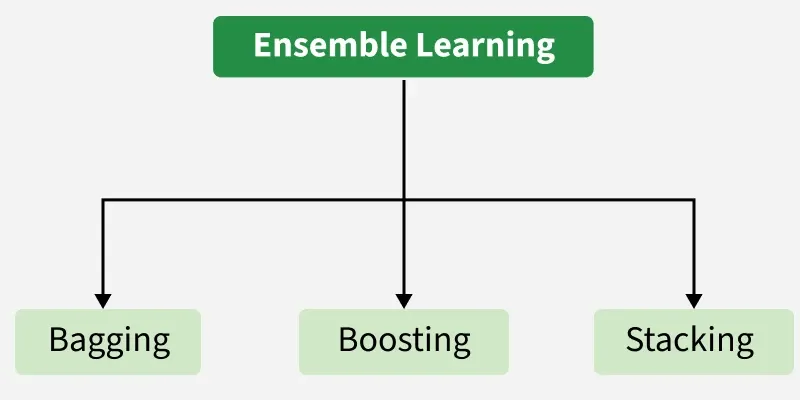
Ensemble learning combines multiple models to produce predictions that may be more accurate or stable than those of individual models.
Popular ensemble techniques include bagging, boosting, and stacking.
Random Forest uses multiple decision trees and combines their predictions. Gradient boosting builds models sequentially to improve performance on previous errors. Stacking combines predictions from different models using another model called a meta-model.
Ensemble methods are useful for classification and regression tasks, including fraud detection, customer churn prediction, and risk assessment.
However, ensembles may require more computing resources and can be harder to interpret than simpler models.
8. Selecting Appropriate Evaluation Metrics
Accuracy alone does not always provide a complete picture of model performance. Developers must select evaluation metrics based on the problem and the consequences of incorrect predictions.
For classification, commonly used metrics include precision, recall, F1-score, and ROC-AUC.
For regression, common metrics include Mean Absolute Error (MAE), Mean Squared Error (MSE), and Root Mean Squared Error (RMSE).
For example, in fraud detection, missing fraudulent transactions can be costly. Recall may therefore be particularly important, although precision must also be considered to control false alarms.
Choosing suitable metrics ensures that model evaluation reflects real business requirements.
9. Handling Imbalanced Datasets
An imbalanced dataset contains significantly more examples from one class than another. This is common in fraud detection, medical screening, and equipment failure prediction.
For instance, if only 1% of transactions are fraudulent, a model that predicts every transaction as legitimate can achieve 99% accuracy while failing to detect any fraud.
Developers can address this issue using class weights, oversampling, undersampling, or methods such as SMOTE.
Evaluation should include precision, recall, F1-score, and a confusion matrix rather than relying exclusively on accuracy.
Resampling must be performed carefully within the training data to avoid data leakage.
10. Model Monitoring and Maintenance

Machine learning does not end when a model is deployed. Real-world data and user behavior can change over time, reducing prediction quality.
Model monitoring involves tracking prediction performance, input data quality, latency, and changes in data distributions.
For example, a customer recommendation system may become less effective when shopping preferences change. Monitoring helps identify these changes and determine when retraining or model updates are necessary.
Developers can use logging, performance dashboards, automated testing, and model versioning to support reliable deployment.
Regular monitoring helps maintain model quality and ensures that unexpected problems are identified early.
Best Practices for Building Reliable Machine Learning Models
To build dependable machine learning solutions, developers should follow a systematic process.
- Collect relevant, representative, and high-quality data.
- Separate training, validation, and test datasets appropriately.
- Establish a simple baseline before experimenting with complex algorithms.
- Select evaluation metrics that match the project’s objectives.
- Prevent data leakage during preprocessing, feature selection, and tuning.
- Document experiments, datasets, model versions, and configuration changes.
- Monitor deployed models and evaluate their performance regularly.
Developers should also consider fairness, privacy, explainability, and security, especially when models influence financial, educational, or healthcare decisions.
Conclusion
Reliable machine learning models require more than advanced algorithms. Data preprocessing, feature engineering, cross-validation, regularization, hyperparameter tuning, and appropriate evaluation metrics all contribute to better model development.
Ensemble learning and imbalance-handling techniques can improve results for challenging datasets, while model monitoring helps maintain performance after deployment.
For beginners, the best approach is to learn these techniques using Python and Scikit-learn, practise with real-world datasets, and compare different models using suitable evaluation metrics. By combining strong fundamentals with continuous testing and monitoring, developers can build machine learning systems that are more accurate, reliable, and useful in real-world applications.
Want to Learn More About Python & Artificial Intelligence ?, Kaashiv Infotech Offers Full Stack Python Course, Artificial Intelligence Course, Data Science Course & More Visit Their Website course.kaashivinfotech.com.
Related Reads:
Artificial Intelligence vs Human Intelligence: A Deep Dive into Minds Made and Minds Born
Top 10 AI Tools for Content Creation in 2026 You Shouldn’t Miss.


