

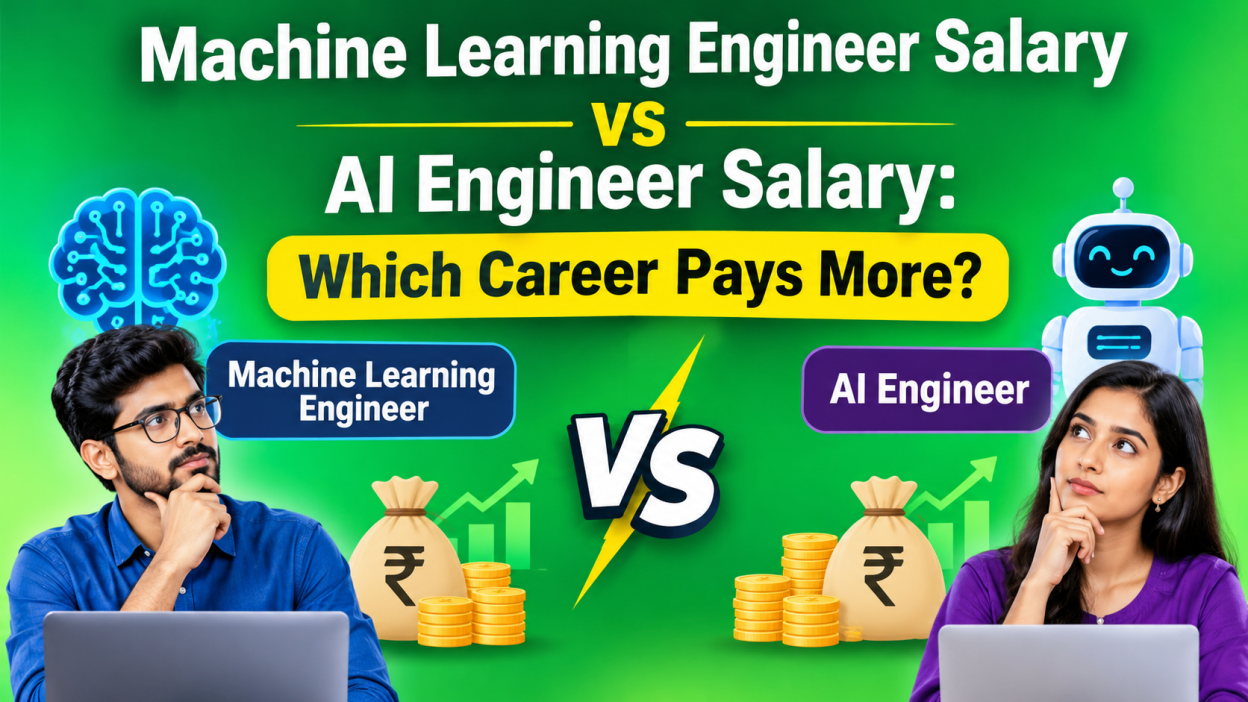
Machine Learning Engineer Salary vs AI Engineer Salary – Artificial Intelligence (AI) and Machine Learning (ML) are among the fastest-growing fields in the technology industry. Companies across healthcare, finance, education, e-commerce, manufacturing, and software development are hiring professionals who can build intelligent systems, automate processes, and analyze large amounts of data.
Two popular career options in this field are Machine Learning Engineer and AI Engineer. Although both professionals work with intelligent technologies, their responsibilities, technical skills, and salary expectations can differ.
If you are planning to enter the AI industry, understanding the salary differences between these two careers can help you choose the right career path.
What Is a Machine Learning Engineer?

A Machine Learning Engineer is a technology professional who develops, trains, tests, and deploys machine learning models. Their primary responsibility is to create systems that can learn from data and make predictions or decisions without being explicitly programmed for every task.
Machine Learning Engineers work with algorithms, statistical techniques, programming languages, and large datasets to develop practical ML applications.
Common responsibilities include:
- Developing and training machine learning models.
- Collecting, cleaning, and preparing datasets.
- Selecting appropriate ML algorithms.
- Evaluating model accuracy and performance.
- Deploying models into production environments.
- Monitoring models and improving their performance.
- Building automated machine learning pipelines.
Machine Learning Engineers commonly work with Python, TensorFlow, PyTorch, Scikit-learn, SQL, cloud platforms, Docker, and MLOps tools.
Some popular applications include recommendation systems, fraud detection, predictive analytics, customer behavior analysis, and image recognition.
What Is an AI Engineer?

An AI Engineer develops software applications and systems that use artificial intelligence technologies to solve real-world problems. Their work may involve traditional machine learning, deep learning, generative AI, natural language processing, computer vision, and AI-powered automation.
AI Engineers often focus on integrating AI models into products, applications, and business workflows.
Their responsibilities may include:
- Developing AI-powered applications.
- Building chatbots and virtual assistants.
- Integrating Large Language Models (LLMs).
- Developing generative AI solutions.
- Implementing natural language processing.
- Creating AI automation workflows.
- Integrating APIs and AI services into software applications.
- Deploying and maintaining AI systems.
AI Engineers may use Python, JavaScript, APIs, LangChain, vector databases, cloud AI services, TensorFlow, PyTorch, and frameworks for building generative AI applications.
Examples of AI applications include AI chatbots, document summarization, intelligent search engines, AI coding assistants, content generation systems, and automated customer support platforms.
Machine Learning Engineer Salary vs AI Engineer Salary
Salaries for both careers depend on experience, location, company size, technical skills, educational qualifications, and industry demand. AI Engineers working with generative AI and large language models may receive higher compensation in some companies, while experienced Machine Learning Engineers with strong production and infrastructure skills can also earn competitive salaries.
Salary in India
The following figures represent approximate annual salary ranges and can vary considerably between employers and locations.
| Experience Level | Machine Learning Engineer | AI Engineer |
|---|---|---|
| Fresher (0–2 years) | ₹4–8 LPA | ₹5–10 LPA |
| Mid-Level (2–5 years) | ₹8–18 LPA | ₹10–22 LPA |
| Experienced (5–8 years) | ₹18–30 LPA | ₹20–35 LPA |
| Senior (8+ years) | ₹30–50+ LPA | ₹35–60+ LPA |
Professionals working in major technology companies, product-based companies, multinational organizations, and AI startups may receive higher salaries depending on their expertise and interview performance.
Salary in the United States
The United States offers higher salary opportunities for AI and Machine Learning professionals, particularly in technology companies and organizations developing advanced AI products.
| Experience Level | Machine Learning Engineer | AI Engineer |
|---|---|---|
| Entry-Level | $90,000–$130,000 | $100,000–$140,000 |
| Mid-Level | $130,000–$180,000 | $140,000–$200,000 |
| Experienced | $180,000–$230,000 | $190,000–$250,000+ |
| Senior | $220,000–$300,000+ | $250,000–$350,000+ |
These are illustrative market ranges, not guaranteed salaries. Total compensation at some large technology companies may also include bonuses, stock options, and other benefits.
Recent salary data also shows that the difference between these roles is not always significant. In India, AI Engineer salaries can be slightly higher in some experience groups, while Machine Learning Engineers may earn more in certain product companies and specialized roles. Employer type and technical expertise often have a greater impact than the job title alone. Masai School+2
Key Differences Between AI Engineer and Machine Learning Engineer

| Category | Machine Learning Engineer | AI Engineer |
|---|---|---|
| Primary focus | Building and improving ML models | Building AI-powered applications |
| Main technologies | ML algorithms, deep learning, MLOps | Generative AI, LLMs, APIs, AI agents |
| Programming | Python, SQL | Python, JavaScript, Python APIs |
| Mathematics | Statistics, probability, linear algebra | AI fundamentals, model understanding |
| Main projects | Prediction, classification, recommendation | Chatbots, AI assistants, automation |
| Deployment | Model deployment and monitoring | AI application deployment and integration |
| Career opportunities | ML Engineer, MLOps Engineer, ML Scientist | AI Engineer, GenAI Engineer, LLM Engineer |
Skills Required for Machine Learning Engineers
Machine Learning Engineers need strong programming and mathematical knowledge to build reliable models. Python is one of the most important programming languages for this career.
Important skills include:
Python Programming: Understanding functions, classes, libraries, data structures, and object-oriented programming.
Mathematics and Statistics: Knowledge of probability, statistics, linear algebra, and basic calculus helps professionals understand how ML algorithms work.
Machine Learning Algorithms: Learning regression, classification, clustering, decision trees, random forests, and other algorithms.
Deep Learning: Understanding neural networks and frameworks such as TensorFlow and PyTorch.
Data Processing: Working with SQL, Pandas, NumPy, and data preprocessing techniques.
MLOps and Cloud: Deploying models, monitoring performance, managing pipelines, and using cloud platforms.
These skills help professionals develop scalable machine learning systems for real-world applications.
Skills Required for AI Engineers
AI Engineers need programming knowledge combined with practical AI application development skills. They must understand how to integrate AI models into software applications and solve business problems.
Important skills include:
Python Programming: Used for AI development, automation, data processing, and model integration.
Generative AI: Knowledge of LLMs, prompt engineering, model APIs, and AI-powered applications.
Natural Language Processing: Understanding text processing, embeddings, semantic search, and language-based AI systems.
AI Frameworks: Working with tools such as LangChain, Hugging Face, and frameworks for AI application development.
Vector Databases: Understanding vector search and databases used in retrieval-augmented generation (RAG) systems.
Cloud Computing: Deploying AI applications using AWS, Azure, Google Cloud, and other cloud services.
AI Engineers who combine software development skills with generative AI, automation, and deployment knowledge can improve their career opportunities.
Which Career Has Better Job Opportunities?

Both Machine Learning Engineers and AI Engineers have strong career opportunities. However, the types of jobs available differ based on company requirements.
Machine Learning Engineers are commonly hired by companies working on predictive analytics, recommendation engines, fraud detection, autonomous systems, computer vision, and data-driven products.
AI Engineers are increasingly hired by companies developing AI chatbots, generative AI applications, intelligent automation, AI agents, customer support tools, and enterprise AI solutions.
The growth of generative AI has created opportunities for professionals with skills in LLM integration, RAG, AI agents, and AI application development. However, traditional machine learning remains important for organizations that require forecasting, classification, optimization, and data-driven decision-making.
Professionals who understand both machine learning fundamentals and modern generative AI technologies can apply for a wider range of roles.
Which Career Should You Choose?
Choosing between Machine Learning Engineer and AI Engineer depends on your interests, technical background, and career goals.
Choose Machine Learning Engineering if you enjoy mathematics, statistics, data analysis, algorithms, model training, experimentation, and improving model accuracy. This career is suitable for people interested in building intelligent models from data.
Choose AI Engineering if you enjoy software development, building applications, integrating APIs, developing chatbots, working with generative AI, and automating business processes. This career is suitable for software developers who want to specialize in AI technologies.
If your goal is to enter the AI industry quickly, AI application development can be a practical starting point for software developers. If you enjoy data, algorithms, and mathematical problem-solving, machine learning can be a rewarding long-term career.
How to Start Your Career in AI or Machine Learning
Follow these steps to build your skills:
- Learn Python programming and basic problem-solving.
- Understand mathematics, statistics, and data structures.
- Learn NumPy, Pandas, and data visualization.
- Study machine learning algorithms and model evaluation.
- Learn deep learning and neural networks.
- Build projects such as prediction systems, recommendation engines, and chatbots.
- Learn cloud deployment, APIs, Git, and Docker.
- Create a portfolio and apply for internships and entry-level positions.
For AI Engineering, additionally learn LLM APIs, prompt engineering, RAG, vector databases, and AI agents. For Machine Learning Engineering, focus more on model training, feature engineering, evaluation, model deployment, and MLOps.
Conclusion
Machine Learning Engineer and AI Engineer are both promising technology careers with excellent long-term potential. Machine Learning Engineers focus more on developing, training, and deploying models, while AI Engineers focus on building intelligent applications using AI technologies.
In some companies, AI Engineers may earn higher salaries, particularly when working with generative AI and LLMs. In other organizations, Machine Learning Engineers may earn more because of their expertise in model development, infrastructure, and production systems.
The best career choice is not simply the one with the highest salary. Developing strong technical skills, building real-world projects, gaining experience, and continuously learning new technologies can help you achieve a higher salary in either career.
Want to Learn More About Python & Artificial Intelligence ?, Kaashiv Infotech Offers Full Stack Python Course, Artificial Intelligence Course, Data Science Course & More Visit Their Website course.kaashivinfotech.com.
Related Reads:
Artificial Intelligence vs Human Intelligence: A Deep Dive into Minds Made and Minds Born
Top 10 AI Tools for Content Creation in 2026 You Shouldn’t Miss.