
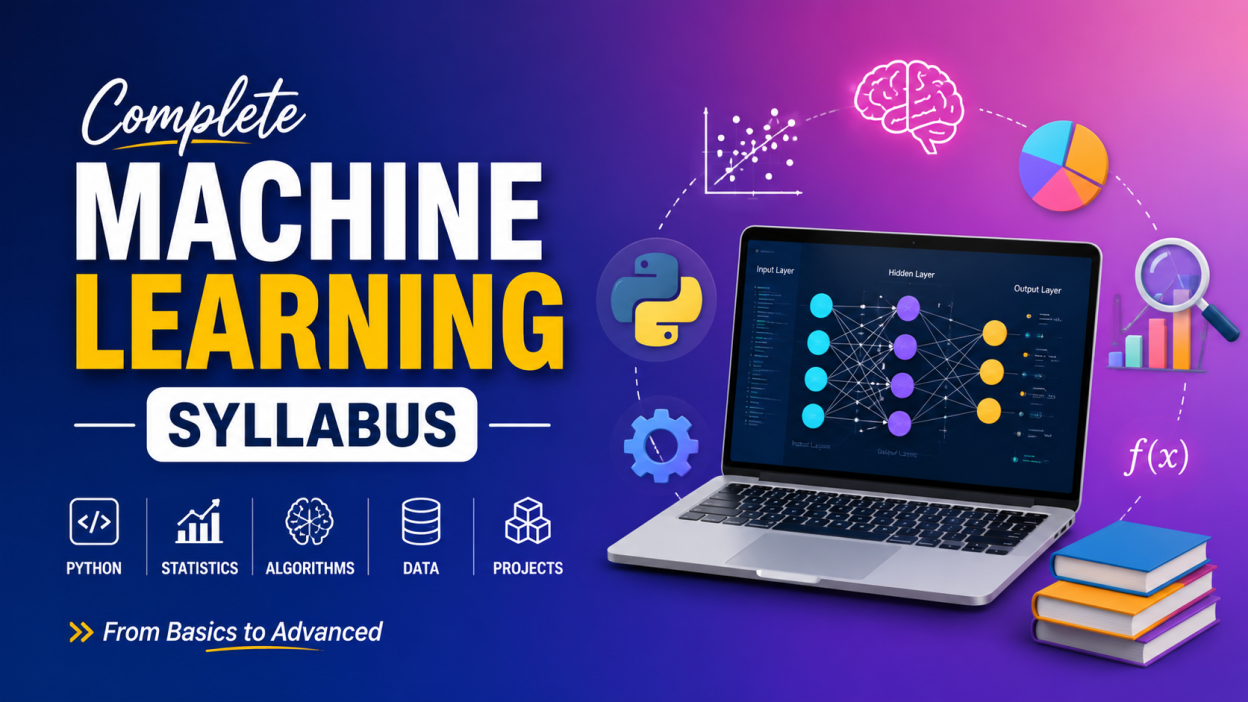
Machine Learning Syllabus is one of the first things I recommend checking before starting a career in Machine Learning. Why? Because ML is a huge field. If you simply start watching random videos about algorithms, neural networks, and AI, you can quickly feel lost.
I have seen beginners jump directly into Linear Regression, Neural Networks, or Deep Learning without understanding the basics. After a few days, they ask the same question: “What should I learn next?”
That is exactly why I put together this Machine Learning Syllabus.
This guide covers the important topics you should learn step by step — from Python, mathematics, and statistics to supervised learning, unsupervised learning, deep learning, model evaluation, NLP, computer vision, and ML projects.
The good news? You don’t need to learn everything in one day.
Let’s break it down. 👇
Key Highlights of the Machine Learning Syllabus
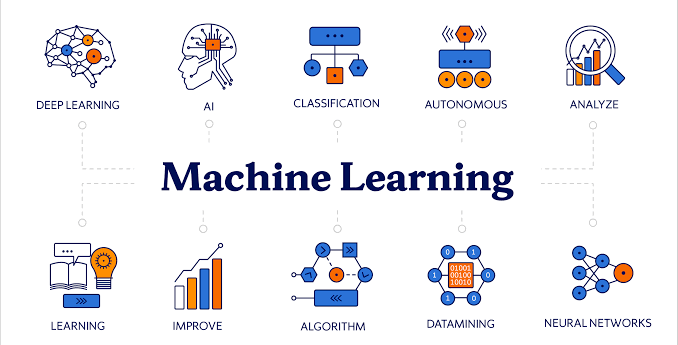
Before getting into the detailed topics, here is what you can expect from this Machine Learning Syllabus:
- 🐍 Python Programming for Machine Learning
- 📊 Statistics and Probability
- 📐 Mathematics for Machine Learning
- 🧹 Data Cleaning and Preprocessing
- 📈 Exploratory Data Analysis (EDA)
- 🎯 Supervised Learning
- 🔍 Unsupervised Learning
- ⚙️ Feature Engineering
- 📏 Model Evaluation
- 🔄 Cross-Validation
- 🌳 Decision Trees and Ensemble Learning
- 🧠 Neural Networks and Deep Learning
- 👁️ Computer Vision
- 💬 Natural Language Processing
- 🚀 Model Deployment and MLOps basics
- 🛠️ Real-world Machine Learning Projects
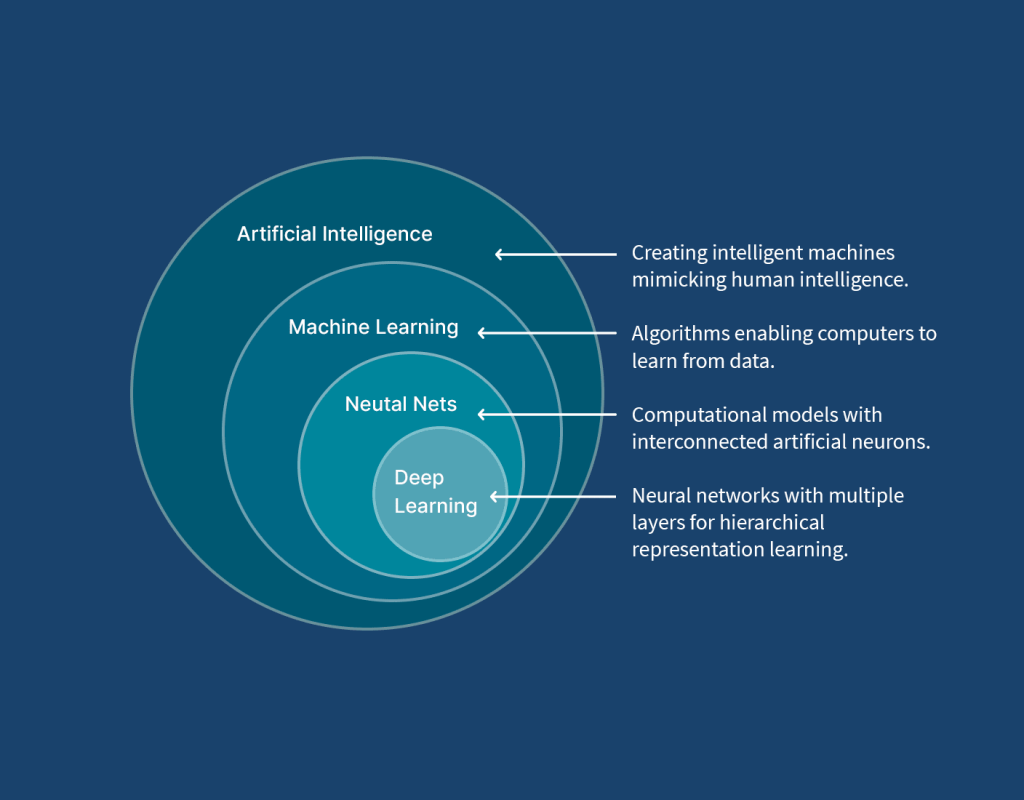
What Is Machine Learning?
Before following a Machine Learning Syllabus, I think it is important to understand what Machine Learning actually means.
In traditional programming, we normally give the computer rules + data, and it produces an output.
In Machine Learning, we give the system data and examples, and the algorithm learns patterns from that data to make predictions or decisions.
For example, imagine I want to predict house prices.
I could provide a dataset containing:
- House size
- Number of bedrooms
- Location
- Number of bathrooms
- Age of the house
- Previous selling price
The ML model studies these examples and learns the relationship between the features and the house price.
Later, when I give it information about a new house, the model can estimate its price.
That’s the basic idea.
And honestly, once you understand this simple example, many complicated ML concepts start becoming easier.
1. Python Programming for Machine Learning 🐍
The first major section of a good Machine Learning Syllabus should be Python.
You don’t need to become a Python expert before starting ML, but you should be comfortable writing basic programs.
Learn these Python topics:
- Variables
- Data types
- Operators
- Conditional statements
- Loops
- Functions
- Lists
- Tuples
- Sets
- Dictionaries
- Strings
- List comprehension
- Exception handling
- File handling
- Modules and packages
- Object-oriented programming basics
After that, move toward Python libraries used heavily in Machine Learning.
Important Python libraries
NumPy
Used for numerical operations and working with arrays.
Pandas
Used for loading, cleaning, manipulating, and analyzing datasets.
Matplotlib
Used for creating visualizations.
Seaborn
Useful for statistical data visualization.
Scikit-learn
One of the most important libraries for traditional Machine Learning. It provides tools for preprocessing, model training, model selection, evaluation, supervised learning, and unsupervised learning.
If you’re completely new to Python, don’t worry. Learn the basics first and then gradually connect Python with data.
2. Mathematics for Machine Learning 📐
This is the section that scares many beginners.
When someone says Machine Learning Mathematics, people immediately imagine pages of complicated equations.
Don’t panic.
You don’t necessarily need advanced mathematics to start building ML models. But understanding the underlying concepts will make you a much better ML practitioner.
Important mathematics topics:
- Linear Algebra
- Vectors
- Matrices
- Matrix operations
- Dot product
- Eigenvalues
- Eigenvectors
- Calculus basics
- Derivatives
- Partial derivatives
- Gradients
- Gradient Descent
- Optimization
For example, Gradient Descent is an important concept behind many ML optimization techniques.
Instead of simply memorizing:
I prefer understanding the intuition:
The model makes an error → calculates how to reduce that error → adjusts its parameters → repeats the process.
That makes the topic much easier to remember.

3. Statistics and Probability 📊
Statistics is another important part of the Machine Learning Syllabus.
Machine Learning deals with data, and statistics helps us understand that data.
Learn these statistics topics:
- Mean
- Median
- Mode
- Range
- Variance
- Standard deviation
- Percentiles
- Correlation
- Covariance
- Distribution
- Normal distribution
- Sampling
- Population and sample
- Outliers
Probability topics
You should also understand:
- Basic probability
- Conditional probability
- Bayes’ theorem
- Probability distributions
- Independent and dependent events
- Expected value
For example, Bayes’ theorem becomes useful when we want to calculate the probability of an event based on previously available information.
You don’t have to become a statistician. You simply need enough statistics to understand your dataset and your model’s results.
4. Data Collection and Data Preprocessing 🧹
Here is something beginners often underestimate:
Real-world data is messy.
Very messy.
You might download a dataset and find:
- Missing values
- Duplicate records
- Incorrect data types
- Outliers
- Categorical values
- Inconsistent formatting
- Irrelevant columns
Before training a model, we need to clean this data.
Data preprocessing topics
Learn:
- Loading datasets
- Handling missing values
- Removing duplicates
- Handling outliers
- Encoding categorical variables
- Feature scaling
- Normalization
- Standardization
- Train-test split
- Data leakage
For example, suppose a dataset contains:
Gender = Male, Female
A machine learning model cannot simply treat those words as numerical values in many algorithms. We may need techniques such as One-Hot Encoding or other suitable encodings.
Data preprocessing is not the glamorous part of Machine Learning.
But trust me, it matters enormously.
5. Exploratory Data Analysis (EDA) 🔎
Once the data is cleaned, we need to understand it.
That’s where Exploratory Data Analysis comes in.
EDA helps us discover patterns, relationships, unusual values, and trends in our dataset.
Important EDA topics:
- Understanding datasets
- Data summaries
- Univariate analysis
- Bivariate analysis
- Multivariate analysis
- Correlation analysis
- Histograms
- Box plots
- Scatter plots
- Bar charts
- Heatmaps
For example, if I am working with house-price data, I might ask:
Does house size affect price?
A scatter plot could help me visualize that relationship.
This is where tools like Pandas, Matplotlib, and Seaborn become extremely useful.
6. Supervised Learning 🎯
Now we reach one of the biggest sections of the Machine Learning Syllabus.
In Supervised Learning, the training data contains known target values.
For example:
| House Size | Bedrooms | Price |
|---|---|---|
| 1000 sq.ft | 2 | ₹50 lakh |
| 1500 sq.ft | 3 | ₹75 lakh |
| 2000 sq.ft | 4 | ₹1 crore |
Here, the price is the target.
Supervised Learning mainly includes Regression and Classification.
Regression
Regression is used when we predict a numerical value.
Examples:
- House price prediction
- Salary prediction
- Sales forecasting
- Temperature prediction
Regression algorithms
Learn:
- Linear Regression
- Multiple Linear Regression
- Polynomial Regression
- Ridge Regression
- Lasso Regression
- Elastic Net
Classification
Classification predicts a category or class.
Examples:
- Spam or not spam
- Fraud or genuine
- Pass or fail
- Disease classification
- Customer churn prediction
Classification algorithms
Learn:
- Logistic Regression
- K-Nearest Neighbors (KNN)
- Decision Tree
- Random Forest
- Support Vector Machine (SVM)
- Naive Bayes
Scikit-learn’s current documentation includes a broad collection of supervised learning methods, including linear models, SVMs, nearest neighbors, Naive Bayes, decision trees, random forests, gradient boosting, and neural-network models.
7. Unsupervised Learning 🔍
The next major topic in the Machine Learning Syllabus is Unsupervised Learning.
Here, we don’t have predefined target labels.
Instead, the algorithm tries to discover patterns or groups within the data.
Important topics:
- Clustering
- Dimensionality Reduction
- Association Rules
Clustering algorithms
Learn:
- K-Means Clustering
- Hierarchical Clustering
- DBSCAN
- Gaussian Mixture Models
For example, imagine an online store has thousands of customers.
Instead of manually labeling them, we could use clustering to discover groups such as:
- Frequent buyers
- Occasional buyers
- High-value customers
- Discount-focused customers
That’s where unsupervised learning becomes useful.
8. Feature Engineering ⚙️
This is one of those topics that looks small on the syllabus but becomes extremely important in real projects.
Feature engineering means creating or transforming input features so that a model can learn more effectively.
For example, suppose I have:
Date of Birth = 15-06-1998
Instead of giving the raw date to the model, I might create:
Age = 28
That feature may be much more useful for a particular prediction problem.
Learn:
- Feature creation
- Feature transformation
- Feature selection
- Encoding
- Scaling
- Dimensionality reduction
- Removing irrelevant features
9. Model Evaluation and Validation 📏
Building a model isn’t enough.
We need to know:
Is the model actually performing well?
This is where model evaluation comes in.
Regression metrics
Learn:
- MAE
- MSE
- RMSE
- R² Score
Classification metrics
Learn:
- Accuracy
- Precision
- Recall
- F1-score
- Confusion Matrix
- ROC-AUC
For example, imagine I build a fraud detection model.
If only 1% of transactions are fraudulent, a model that predicts “not fraud” every time could achieve very high accuracy.
But it would be practically useless.
That’s why we cannot blindly depend on accuracy.
10. Overfitting and Underfitting
These two concepts should definitely be included in your Machine Learning Syllabus.
Overfitting
The model learns the training data too closely, including its noise.
It performs very well on training data but poorly on new data.
Underfitting
The model is too simple and fails to learn important patterns.
The goal is to build a model that generalizes well to unseen data.
You should learn:
- Bias
- Variance
- Bias-variance tradeoff
- Overfitting
- Underfitting
- Regularization
11. Cross-Validation 🔄
Instead of depending on one train-test split, we can use Cross-Validation to get a better idea of how a model performs.
One popular technique is K-Fold Cross-Validation.
The dataset is divided into multiple parts. The model trains and validates on different combinations of those parts.
This helps us evaluate the model more reliably.
Cross-validation, pipelines, missing-value handling, categorical variables, and data leakage are also covered in Kaggle’s Intermediate Machine Learning course.
12. Ensemble Learning 🌳
Once you’re comfortable with basic algorithms, move toward ensemble methods.
Instead of relying on a single model, ensemble techniques combine multiple models or learners.
Important topics:
- Bagging
- Boosting
- Random Forest
- Gradient Boosting
- AdaBoost
- XGBoost
- LightGBM
- Stacking
- Voting
Random Forest is a particularly useful algorithm for beginners because it helps introduce the idea of combining multiple decision trees.
13. Dimensionality Reduction
Sometimes datasets contain hundreds or even thousands of features.
Working with all of them can make models slower and harder to understand.
That’s where dimensionality reduction techniques become useful.
Learn:
- PCA
- LDA
- t-SNE
- UMAP
You don’t need to master every technique immediately.
Start with PCA, understand the intuition, and then explore the others.
14. Deep Learning and Neural Networks 🧠
After learning traditional Machine Learning, you can move into Deep Learning.
This is where neural networks enter the picture.
Learn:
- Artificial neurons
- Perceptron
- Neural network architecture
- Input layer
- Hidden layers
- Output layer
- Activation functions
- Forward propagation
- Backpropagation
- Loss functions
- Optimizers
- Epochs
- Batch size
- Learning rate
- Regularization
- Dropout
Popular frameworks include:
- TensorFlow
- Keras
- PyTorch
TensorFlow’s learning resources emphasize four important areas for developing ML skills: coding, mathematics, ML theory, and building projects.
15. Natural Language Processing (NLP) 💬
If you want to work with human language, add NLP to your Machine Learning Syllabus.
NLP is used in applications such as:
- Chatbots
- Sentiment analysis
- Text classification
- Spam detection
- Search systems
- Text summarization
- Language translation
NLP topics
Learn:
- Text preprocessing
- Tokenization
- Stop words
- Stemming
- Lemmatization
- Bag of Words
- TF-IDF
- Word embeddings
- Sequence models
- Transformers
- BERT basics
You don’t need to jump into Transformers on day one.
Start with simple text processing first.
16. Computer Vision 👁️
If you’re interested in images and videos, learn Computer Vision.
Important topics:
- Image processing basics
- Image classification
- Object detection
- Image segmentation
- Convolutional Neural Networks (CNNs)
- Transfer learning
- Data augmentation
A simple beginner project could be cat vs dog image classification.
Once you understand that, you can move toward more advanced applications.
17. Generative AI and Modern Machine Learning 🤖
A modern Machine Learning Syllabus should also introduce learners to Generative AI.
You don’t need to become an expert in Large Language Models immediately, but understanding the basics is valuable.
Learn:
- Generative AI basics
- Large Language Models
- Transformers
- Embeddings
- Vector databases
- Retrieval-Augmented Generation (RAG)
- Prompt engineering
- Fine-tuning basics
- AI agents basics
Keep this section after your ML foundations.
Otherwise, you’ll end up memorizing AI terminology without understanding what’s happening underneath.
18. Machine Learning Deployment 🚀
This is where many learners stop.
They build a model in Jupyter Notebook and say:
“My ML project is complete.”
Not quite.
In the real world, we often need to make the model available to an application or users.
Learn the basics of:
- Model serialization
- APIs
- Flask or FastAPI
- Docker basics
- Cloud deployment
- Model monitoring
- Version control
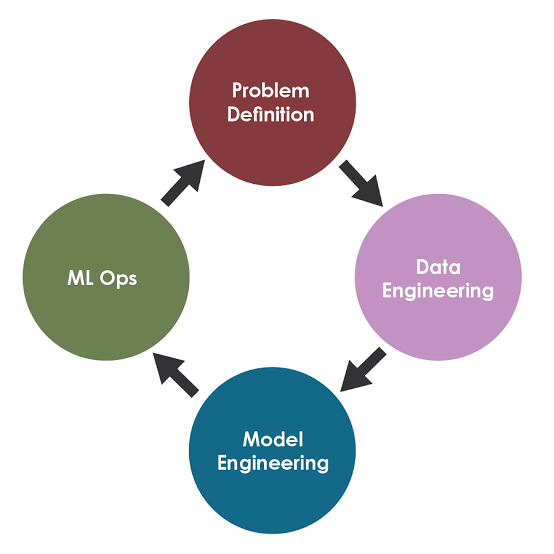
- ML pipelines
- MLOps basics
TensorFlow also provides resources covering production-oriented ML workflows and deployment technologies.
19. Machine Learning Projects 🛠️
If you’re learning Machine Learning for a job, projects are extremely important.
Don’t just collect certificates.
Build things.
Here are some beginner-friendly project ideas:
Beginner projects
- House Price Prediction
- Student Score Prediction
- Iris Flower Classification
- Titanic Survival Prediction
- Spam Email Detection
Intermediate projects
- Customer Churn Prediction
- Credit Card Fraud Detection
- Movie Recommendation System
- Customer Segmentation
- Sales Prediction
Advanced projects
- Image Classification
- Sentiment Analysis
- Object Detection
- Recommendation Engine
- RAG-based chatbot
- End-to-end ML deployment project
Kaggle’s introductory ML course itself follows a practical sequence covering model building, data exploration, validation, overfitting, random forests, and competitions.
That practical approach is something I strongly recommend.
Machine Learning Syllabus: Tools You Should Learn
You don’t need 50 different tools.
Start with the essentials.
| Category | Tools |
| Programming | Python |
| Data Analysis | Pandas, NumPy |
| Visualization | Matplotlib, Seaborn |
| ML | Scikit-learn |
| Deep Learning | TensorFlow/Keras, PyTorch |
| Notebook | Jupyter Notebook |
| Version Control | Git, GitHub |
| Deployment | Flask/FastAPI, Docker |
| Cloud | AWS/Azure/GCP basics |
| Practice | Kaggle |
Recommended Machine Learning Learning Order 🗺️
If I were starting Machine Learning from scratch today, I wouldn’t randomly jump between topics.
I’d follow this order:
Python → NumPy → Pandas → Statistics → Mathematics → Data Preprocessing → EDA → Supervised Learning → Unsupervised Learning → Feature Engineering → Model Evaluation → Ensemble Learning → Deep Learning → NLP/Computer Vision → Generative AI → Deployment → Projects
This order makes much more sense than trying to learn everything simultaneously.
How Long Does It Take to Learn Machine Learning?
There is no magical number.
It depends on how many hours you study and how much practice you do.
For someone who already knows Python and basic mathematics, a reasonable learning path could look like this:
- Month 1: Python + NumPy + Pandas
- Month 2: Statistics + Mathematics
- Month 3: Data preprocessing + EDA
- Month 4: Supervised Learning
- Month 5: Unsupervised Learning + Feature Engineering
- Month 6: Model Evaluation + Advanced ML
- Month 7: Deep Learning
- Month 8: NLP/Computer Vision
- Month 9: Projects + Deployment
Don’t treat this as a strict deadline.
Some learners move faster. Others need more time. That’s completely normal.
Best Resources to Learn Machine Learning
I recommend mixing theory + coding + projects rather than relying on only one course.
1. Scikit-learn Documentation
The official Scikit-learn documentation is excellent once you start implementing traditional ML algorithms. It covers supervised and unsupervised learning, preprocessing, model selection, evaluation, and more.
2. Kaggle Learn
Kaggle Intro to Machine Learning
Kaggle is particularly useful because you can learn concepts and immediately practice them with datasets and exercises.
3. TensorFlow Learning Resources
TensorFlow Machine Learning Education
TensorFlow’s learning resources cover coding, mathematics, ML theory, projects, and deep learning.
4. TensorFlow Tutorials
These tutorials include hands-on notebooks that can be run through Google Colab, which makes experimentation easier for beginners.
Common Mistakes Beginners Make ❌
I’ve noticed a few mistakes that repeatedly slow people down.
1. Learning only theory
Reading about algorithms for months won’t make you comfortable with ML.
Write code.
2. Jumping directly into Deep Learning
Neural networks look exciting, but your fundamentals matter more.
3. Ignoring statistics
Statistics helps you understand your data, metrics, distributions, and model behavior.
4. Building only one project
Build several projects with different datasets and problems.
5. Memorizing algorithms
Don’t just memorize:
Ask:
Why would I use it? When would it perform well? What are its limitations?
That’s a much better way to learn.
Final Thoughts on the Machine Learning Syllabus ❤️
The Machine Learning Syllabus may look huge when you see everything written down in one place.
I understand that feeling.
When I first look at a technology roadmap with dozens of topics, my immediate thought is usually, “Where am I even supposed to start?”
The trick is not to learn everything at once.
Start with Python.
Then learn NumPy and Pandas.
Move into statistics and mathematics.
After that, learn data preprocessing and EDA.
Then start building actual models with Scikit-learn.
Once the basics become comfortable, move toward Deep Learning, NLP, Computer Vision, Generative AI, and deployment.
Most importantly, build projects along the way.
Because Machine Learning becomes much easier when you stop treating it like a list of definitions and start treating it like a problem-solving skill.
And remember this:
You don’t need to know everything before building your first ML project.
Start small. Make mistakes. Fix them. Build another project.
That’s how the Machine Learning Syllabus turns from a long list of topics into an actual career roadmap. 🚀
Want to Learn More About Python & Artificial Intelligence ?, Kaashiv Infotech Offers Full Stack Python Course, Artificial Intelligence Course, Data Science Course & More Visit Their Website course.kaashivinfotech.com.
Related Reads:
Artificial Intelligence vs Human Intelligence: A Deep Dive into Minds Made and Minds Born
Top 10 AI Tools for Content Creation in 2026 You Shouldn’t Miss.
Top 6 Essential Prerequisites for Machine Learning: A Complete Beginner’s Guide
Learn LangGraph and Build Conversational AI with Python – My Journey Into the Future of Chatbots