
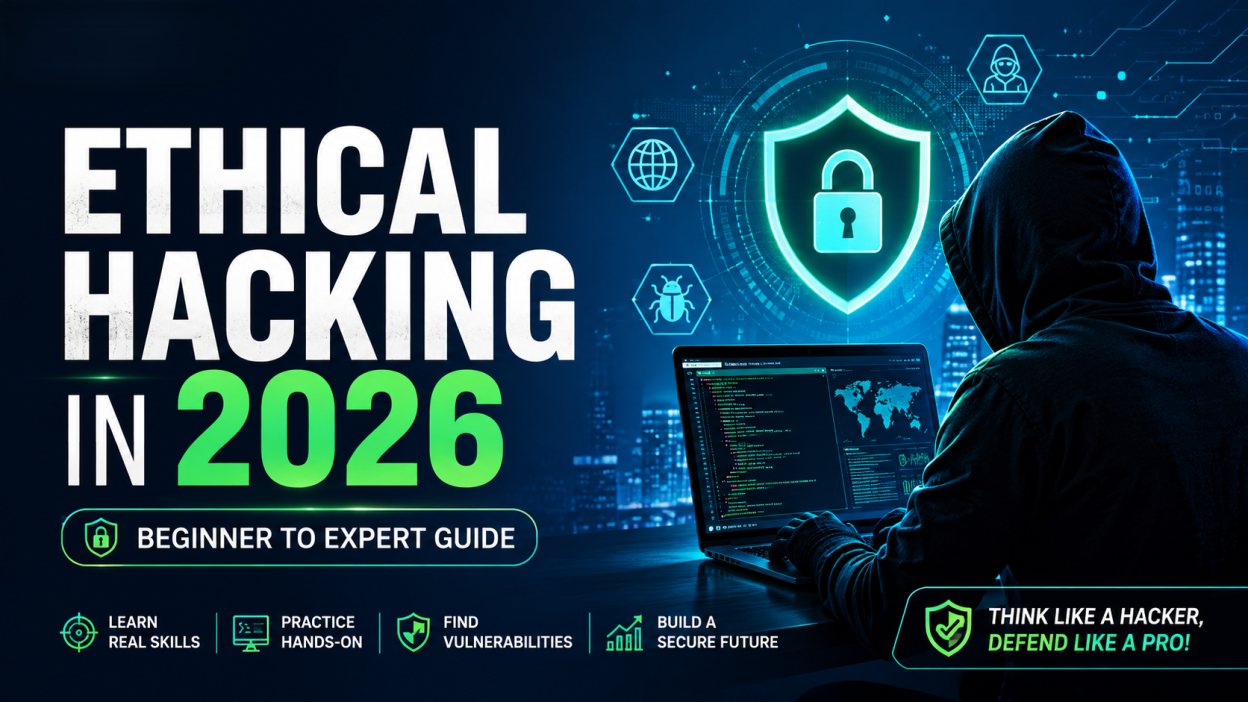
Ethical hacking in 2026 – has evolved into one of the most powerful and future-proof career paths in the tech industry. In 2026, as digital systems continue to grow, so do cyber threats. Every application, website, and organization needs security—and that’s where ethical hackers come in.
If you’ve ever been curious about hacking, cybersecurity, or protecting systems from attacks, this guide will give you a complete, real-world understanding of how to get started and grow in ethical hacking.
Understanding Ethical Hacking
Ethical hacking is the process of identifying vulnerabilities in systems, networks, or applications—but doing it legally and with permission. The goal is not to harm, but to protect.
An ethical hacker thinks like an attacker but acts as a defender. This mindset is what makes ethical hacking unique. You don’t just learn tools—you learn how systems break, why they fail, and how to fix them.
There are different types of hackers, but in the professional world, ethical hackers are often called “white hat hackers.” They are hired by companies to test their security before real attackers can exploit weaknesses.
Why Ethical Hacking Matters More Than Ever
In 2026, cybersecurity is not optional—it is essential. Businesses are moving online faster than ever, and this rapid digital growth has created countless entry points for cyber attacks.
From banking systems to healthcare applications, everything depends on secure infrastructure. Even a small vulnerability can lead to massive data breaches, financial loss, and reputation damage.
This is why ethical hackers are in high demand. Companies are actively hiring professionals who can proactively identify risks and secure their systems before attackers find them.
In India, the demand is especially strong, with startups, IT companies, and government sectors investing heavily in cybersecurity.
The Core Foundations You Must Master
To become a successful ethical hacker, you need to build strong fundamentals. Without these, learning tools alone won’t help you in real-world scenarios.
Networking: The Backbone of Hacking
Every attack and every defense in cybersecurity depends on networking. You need to understand how devices communicate, how data travels, and where vulnerabilities can exist.
Concepts like IP addressing, DNS resolution, HTTP/HTTPS communication, and TCP/IP protocols form the base of everything you will do later.
When you understand networking deeply, tools like scanners and sniffers start making sense instead of feeling confusing.
Operating Systems: Your Working Environment
Ethical hackers work extensively with Linux systems, especially Kali Linux, which comes preloaded with hundreds of security tools.
At the same time, understanding Windows is equally important because most real-world systems run on it. You should know how files, permissions, and processes work in both environments.
This dual knowledge helps you think like both an attacker and a defender.
Programming: Thinking Like a Developer
You don’t need to become a hardcore developer, but programming helps you understand how applications are built—and how they can be broken.
Languages like Python allow you to automate tasks, while JavaScript helps you understand browser-based attacks like XSS. Bash scripting is useful for working efficiently in Linux environments.
When you know how code works, vulnerabilities become easier to identify.
Cybersecurity Concepts: The Real Core
Beyond tools and coding, you must understand security principles. Concepts like encryption, authentication, authorization, and the CIA triad (Confidentiality, Integrity, Availability) are critical.
These concepts help you analyze systems logically instead of randomly testing them.
Tools Every Beginner Should Explore

Ethical hacking tools are powerful, but they are only effective when you understand their purpose. Beginners often make the mistake of jumping directly into tools without learning the basics.
Tools like Nmap help you discover devices and open ports in a network. Burp Suite is widely used for testing web applications, especially for finding vulnerabilities like SQL injection and XSS. Wireshark allows you to capture and analyze network traffic, giving deep insight into how data flows. Metasploit provides a framework for testing exploits in a controlled environment.
Instead of memorizing commands, focus on understanding what each tool does and why you are using it. That’s what separates beginners from professionals.
A Practical Roadmap to Learn Ethical Hacking
Learning ethical hacking is not about rushing—it’s about consistency and practice. A structured approach can make your journey much smoother.
In the beginning, spend time understanding networking, Linux basics, and security fundamentals. This phase builds your foundation and prepares you for hands-on work.
Once you are comfortable, move into practical labs. Platforms like TryHackMe and Hack The Box provide safe environments where you can practice real-world scenarios. This is where your skills truly start developing.
As you progress, focus on web application security and network attacks. Learn how vulnerabilities like SQL injection, cross-site scripting, and man-in-the-middle attacks work in real scenarios.
Eventually, start building your own projects. Test applications in controlled environments, document vulnerabilities, and create professional reports. This step is crucial because it prepares you for real job roles.
Certifications That Can Boost Your Career

Certifications are not mandatory, but they can significantly improve your credibility in the job market.
For beginners, certifications like CEH and CompTIA Security+ provide a strong foundation and help you understand industry standards. For advanced learners, OSCP is highly respected because it focuses on practical, hands-on skills.
However, remember that certifications alone are not enough. Real-world practice and problem-solving ability matter more in the long run.
Career Opportunities in Ethical Hacking
Ethical hacking opens the door to multiple career paths. You can work as a penetration tester, where you simulate attacks on systems, or as a security analyst, where you monitor and defend against threats.
Some professionals choose the bug bounty route, where they earn rewards by finding vulnerabilities in real applications. Others become consultants, helping organizations design secure systems.
With experience, you can even move into advanced roles like security architect or cybersecurity lead.
Common Mistakes Beginners Should Avoid
One of the biggest mistakes beginners make is focusing too much on tools and ignoring the fundamentals. Without understanding networking and system behavior, tools become ineffective.
Another common issue is lack of practice. Ethical hacking is a skill-based field—you need consistent hands-on experience to improve.
Some learners also try to experiment on real systems without permission, which is illegal and can lead to serious consequences. Always practice in legal environments.
Final Thoughts
Ethical hacking is not just a career—it’s a mindset. It requires curiosity, patience, and a willingness to continuously learn.
In 2026, the opportunities in cybersecurity are massive, but success depends on how well you build your foundation and how consistently you practice.
Start with the basics, move step by step, and focus on real-world skills. If you stay committed, you can transform from a complete beginner into a skilled ethical hacker within a year.
Want to learn about Cyber Security?, Kaashiv Infotech Offers, Cyber Security Course, or Networking Course & More, Visit www.kaashivinfotech.com.