
In today’s hyper-connected world, scrolling through a feed isn’t just about entertainment; it’s often where we discover our next favorite product. If you run a business, you know that traditional billboards and TV spots are no longer enough. You need to meet customers where they spend their time most: online.
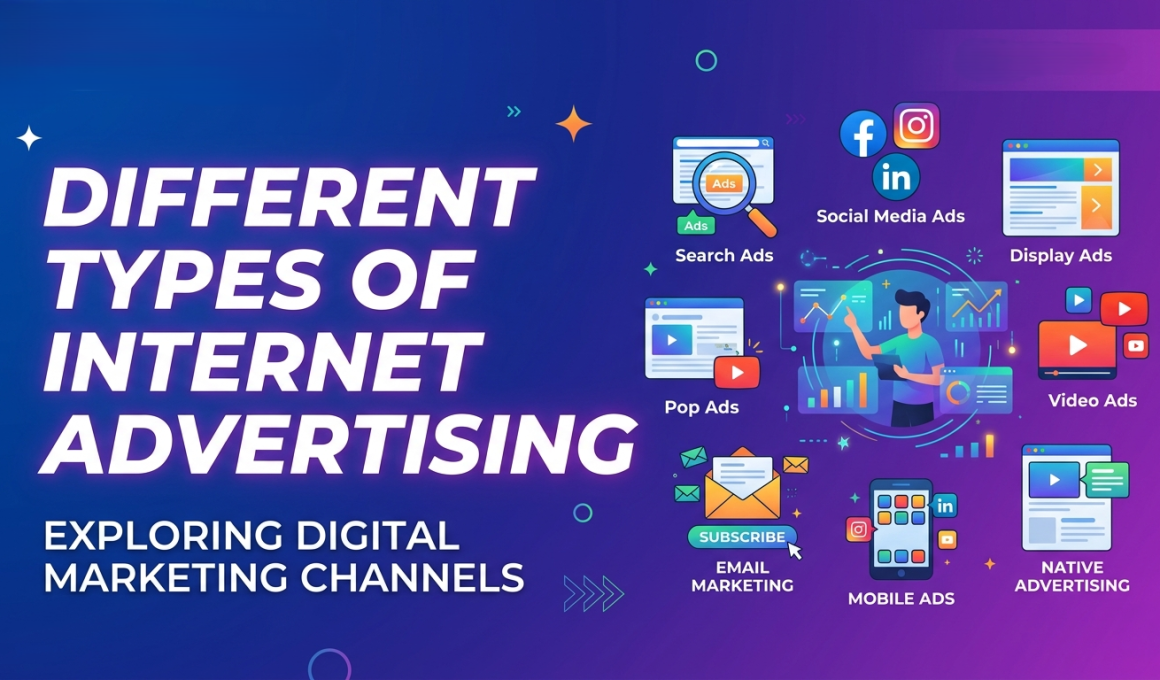
Understanding the different types of internet advertising is crucial for any brand looking to scale. Whether you are a small startup or an established enterprise, choosing the right channel can mean the difference between a wasted budget and a roaring success. In this article, we break down the eight main forms of online advertising to help you build a robust digital strategy.
What is Internet Advertising?
Before diving into the specifics, let’s clarify what we mean when we talk about internet advertising, often referred to as online advertising. Simply put, it is the practice of promoting products, services, or brands via the web. Instead of relying on physical locations or broadcast schedules, businesses leverage websites, search engines, social media platforms, and mobile apps to deliver messages.
What sets this apart from traditional methods is precision. With internet advertising, you aren’t just shouting into the void; you are targeting specific audiences based on demographics, interests, location, and even past online behavior.
This form of marketing offers measurable results. Unlike a newspaper ad where you only know how many papers were printed, online ads provide real-time data on clicks, views, conversions, and ROI. This adaptability allows advertisers to tweak campaigns instantly for better performance.
Marketing Fundamentals & Strategies
To truly master advertising, it helps to understand the broader context of marketing. Here are some fundamental concepts related to online promotion that complement your ad strategies:
- Define Marketing
- Marketing Concept
- Marketing Mix & 4 Ps of Marketing
- Growth Marketing
- Omnichannel Marketing
- Inbound vs. Direct Marketing
- Remarketing
- Mobile Marketing Strategies
- E-Marketing Types
- Tracking Codes
Grasping these concepts ensures your different types of internet advertising align with your overall business goals rather than operating in a silo.
8 Main Types Of Online Advertising
Now, let’s get to the meat of the discussion. The digital landscape is vast, but there are eight primary methods businesses use to connect with audiences. Each serves a unique purpose, from building brand awareness to driving immediate sales.
1. Product Listing Ads (PLAs)
Product Listing Ads, commonly known as Shopping Ads, are visual advertisements that appear at the top or side of search engine result pages (SERPs). Unlike text-based links, PLAs show a high-quality image of the product, its title, price, and the store name.
These are predominantly used on platforms like Google Ads. When a user searches for “running shoes,” they don’t just see text links; they see actual photos of the shoes available for purchase.
- Best For: E-commerce businesses and retailers.
- Why It Works: They capture users who are already in the mindset to buy, offering a direct path to checkout.
2. Banner Ads
Banner Ads are perhaps the most recognizable form of online promotion. These are graphic displays—either static images or animated GIFs—placed on third-party websites. You’ve likely seen them at the top of a news site or along the sidebar of a blog.
While effective for visibility, banner ads face a challenge known as “banner blindness,” where users subconsciously ignore areas they perceive as ads. To combat this, modern banners use interactive elements or dynamic creative optimization to stand out.
- Best For: Brand awareness and retargeting campaigns.
- Why It Works: High volume impressions help keep your brand top-of-mind across the web.
3. Demand-Side Platforms (DSP)
A Demand-Side Platform (DSP) is less of an “ad format” and more of a tool used to manage buying ads across multiple channels. Think of it as a central dashboard where advertisers can purchase inventory from various ad exchanges using automated technology.
With a DSP, you aren’t negotiating with individual website owners. Instead, you set your parameters (budget, audience, placement), and the platform uses algorithms to bid on ad space in real-time for you. This efficiency makes it essential for large-scale programs.
- Best For: Large enterprises managing cross-channel campaigns.
- Why It Works: Automation saves time and ensures you pay the optimal price for the best traffic.
4. Affiliate Ads
Affiliate advertising operates on a performance basis. In this model, a business partners with third-party creators, bloggers, or influencers (affiliates) to promote their products. The affiliate earns a commission only when a sale or lead is generated through their unique link.
This creates a low-risk environment for advertisers because you are essentially paying for results. It leverages the trust that affiliates have built with their own audiences to sell your product.
- Best For: Businesses with strong margin potential looking for scalable growth.
- Why It Works: It expands your reach without needing a massive in-house marketing team.
5. Native Ads
Native advertising is designed to blend in. These ads match the look, feel, and function of the content surrounding them. For example, a sponsored article on a news site that looks just like the editorial content next to it is a native ad.
Because they don’t interrupt the user experience, native ads tend to perform better than intrusive pop-ups or loud banners. They provide value through information or storytelling while subtly promoting a brand.
- Best For: Content marketing and lead generation.
- Why It Works: Higher engagement rates due to lower intrusiveness and better trust.
6. Social Media Ads
Social Media Ads are promotions appearing directly within feeds on platforms like Facebook, Instagram, LinkedIn, Twitter, and TikTok. These can take many shapes: carousel posts, stories, reels, or sponsored tweets.
The power of social ads lies in the granular targeting data available on these platforms. You can target users based on their job titles, hobbies, relationship status, or recent life events. This makes them incredibly powerful for B2B (LinkedIn) or B2C (Instagram) strategies alike.
- Best For: Community building, brand loyalty, and viral content.
- Why It Works: Leverages rich user data to reach highly specific segments of the population.
7. Video Ads
Video is king in the digital realm. Video ads can appear as pre-roll clips before YouTube videos, mid-roll interruptions, or auto playing snippets on social feeds. Formats vary from short 15-second loops to long-form explainer videos.
Video engages multiple senses, allowing for storytelling and emotional connection that text cannot achieve. Brands often use this to demonstrate how a product works or to showcase customer testimonials.
- Best For: Storytelling, tutorials, and brand personality.
- Why It Works: Captures attention quickly and retains viewership longer than static images.
8. Email Ads
Don’t underestimate the inbox. Email advertising involves sending promotional content to a curated list of subscribers. This isn’t just spam; it is permission-based marketing where users have opted in to hear from you.
Modern email marketing uses segmentation to send personalized offers. For instance, if a user abandoned their shopping cart, they might receive an email reminder with a discount code. It is one of the highest ROI channels available.
- Best For: Retention, repeat purchases, and nurturing leads.
- Why It Works: Direct communication with interested parties who have already shown intent.
Types Of Internet Advertising FAQs
To wrap up our guide, here are answers to common questions found in “People Also Ask” on Google regarding this topic.
How do search engine ads work?
Search engine ads operate on a Pay-Per-Click (PPC) model. Advertisers bid on specific keywords relevant to their business. When a user searches for that term, the auction takes place instantly, and the winning ads appear at the top of the results. Advertisers only pay when someone actually clicks on their ad.
What are display ads and where do they appear?
Display ads are graphical banners shown on websites within the Google Display Network or other ad networks. They appear on news sites, blogs, forums, and partner websites. Their goal is usually to build visual brand awareness rather than immediate sales.
What makes social media ads effective?
Social media ads are effective because of the depth of data available. Platforms track user interests, behaviors, and connections, allowing advertisers to target very niche audiences. Additionally, social features like likes and shares allow ads to spread organically beyond paid reach.
What are video ads and how do they work?
Video ads are promotional content formatted as video files. They work by embedding themselves into content streams. Users may encounter them as unskippable intros, skippable trailers, or in-feed stories. They are effective because video consumes cognitive bandwidth more deeply than text or images.
Is email advertising still relevant in 2026?
Yes, absolutely. Despite the rise of social media, email remains a primary way consumers communicate. Email ads are highly relevant because the inbox is personal. With proper segmentation and personalization, email marketing continues to offer one of the highest returns on investment compared to other digital channels.
Conclusion
Navigating the digital landscape requires knowledge and strategy. By understanding the different types of internet advertising, you can stop guessing and start planning. Whether you choose the visual impact of Product Listing Ads, the storytelling power of Video Ads, or the directness of Email Marketing, each method has a place in a balanced portfolio.
Remember, the key is not to use all eight types at once, but to choose the ones that align with your specific business goals and budget. Test, measure, and optimize. With the right mix of these online advertising strategies, your brand can not only reach a global audience but also convert them into loyal customers.
How do search engine ads work?
Search engine ads operate on a Pay-Per-Click (PPC) model. Advertisers bid on specific keywords relevant to their business. When a user searches for that term, the auction takes place instantly, and the winning ads appear at the top of the results. Advertisers only pay when someone actually clicks on their ad.
What are display ads and where do they appear?
Display ads are graphical banners shown on websites within the Google Display Network or other ad networks. They appear on news sites, blogs, forums, and partner websites. Their goal is usually to build visual brand awareness rather than immediate sales.
What makes social media ads effective?
Social media ads are effective because of the depth of data available. Platforms track user interests, behaviors, and connections, allowing advertisers to target very niche audiences. Additionally, social features like likes and shares allow ads to spread organically beyond paid reach.
What are video ads and how do they work?
Video ads are promotional content formatted as video files. They work by embedding themselves into content streams. Users may encounter them as unskippable intros, skippable trailers, or in-feed stories. They are effective because video consumes cognitive bandwidth more deeply than text or images.
Is email advertising still relevant in 2026?
Yes, absolutely. Despite the rise of social media, email remains a primary way consumers communicate. Email ads are highly relevant because the inbox is personal. With proper segmentation and personalization, email marketing continues to offer one of the highest returns on investment compared to other digital channels.