
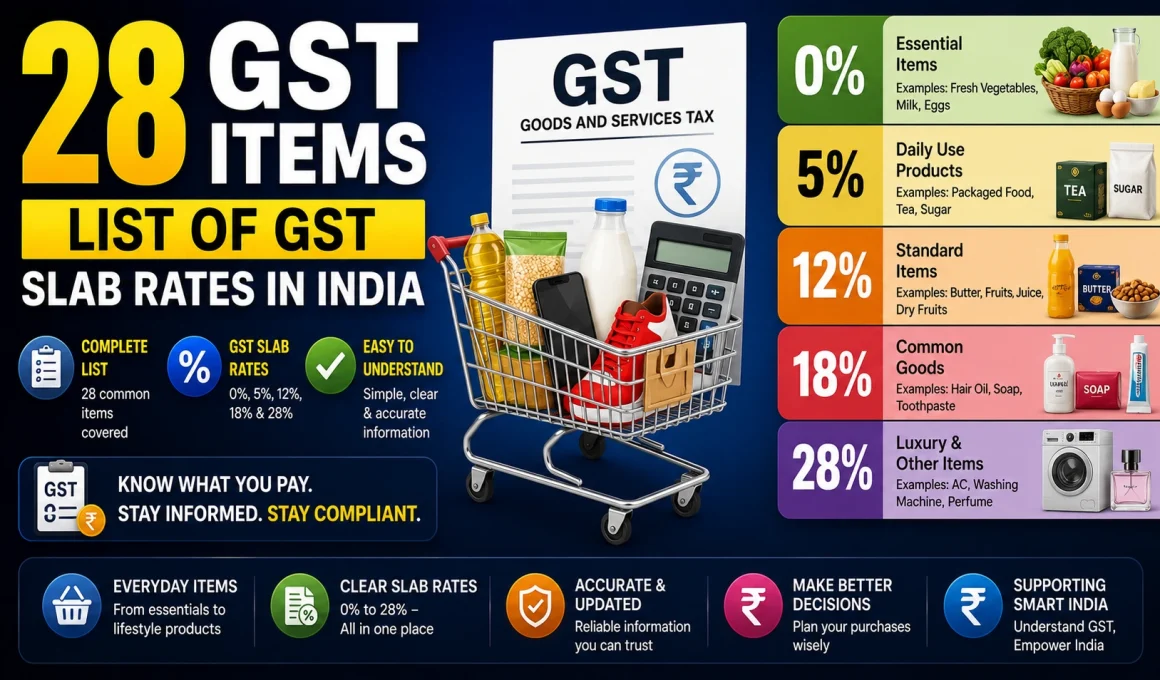
Let’s be honest: navigating taxes in India used to feel like solving a puzzle blindfolded. Then came GST (Goods and Services Tax) in 2017, and suddenly, the chaotic web of VAT, excise, and service taxes got streamlined into one unified system. But even with that simplification, figuring out which product falls under which tax slab can still leave you scratching your head. That’s exactly why we’re breaking down the 28 GST Items – List of GST Slab Rates in India in plain, everyday language. Whether you’re a small business owner, a freelancer, or just a curious consumer, this guide will help you understand what you’re paying, why you’re paying it, and how to stay compliant without the stress.
Understanding GST Slab Rates in India
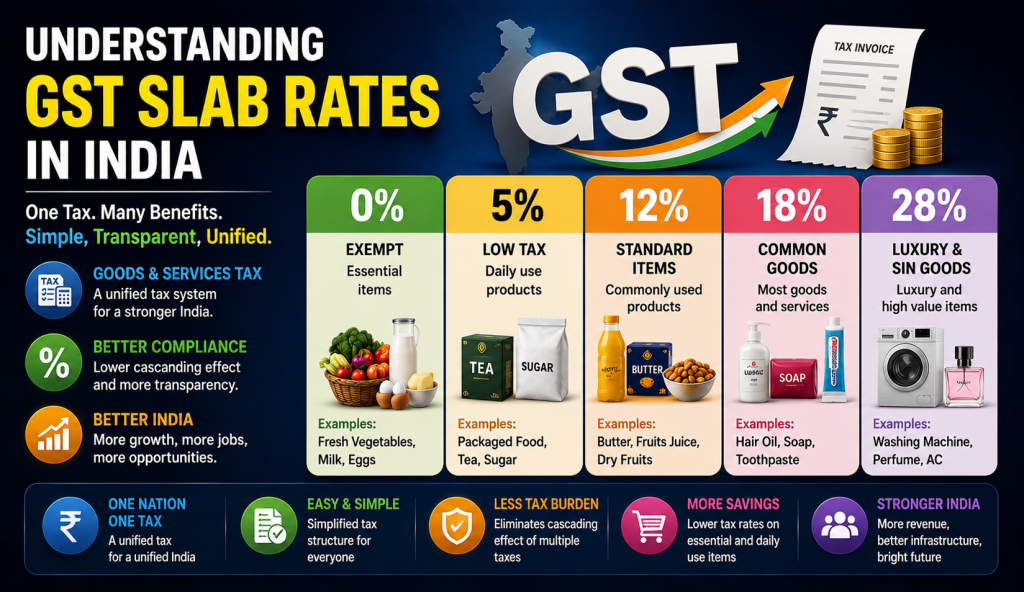
Before we dive into the specific items, let’s quickly clear up how GST actually works. Instead of random percentages slapped onto products, the government categorizes goods and services into five main slabs:
- Nil (0%): Essential daily items that shouldn’t carry extra tax burden
- 5%: Basic necessities and affordable household goods
- 12%: Standard consumer products and mid-range services
- 18%: Premium goods, electronics, and most professional services
- 28%: Luxury items, sin goods (like tobacco and aerated drinks), and high-end automobiles
This tiered approach ensures that everyday essentials remain affordable while higher-end or non-essential items contribute proportionally more to public revenue. Now, let’s look at where everyday products actually fall.
The Complete 28 GST Items List & Their Rates
Instead of dumping a confusing spreadsheet on you, we’ve organized the most commonly searched and traded goods into clear categories. Here’s what you need to know about the 28 GST Items – List of GST Slab Rates in India:
Dairy, Beverages & Food Essentials
- Buttermilk, lassi, and curd → Nil
- Yogurt & fermented dairy → 5%
- Natural honey (unbranded/unpackaged) → Nil
- Branded natural honey → 5%
- Condensed milk → 18%
- Beverages containing milk → 12%
- Ice and snow → 5%
Grains, Flours & Bakery
- Unbranded cereals, wheat, rice, pulses → Nil
- Wheat or meslin flour (loose) → Nil
- Atta, maida, besan (no packaging) → Nil
- Bread (except pizza base) → Nil
- Pizza base bread → 5%
- Rusks, toasted bread → 5%
- Doughs for bread/pastry → 5%
Sweets, Snacks & Confectionery
- Sweetmeats (traditional mithai) → 5%
- Namkeens, bhujia, mixtures, chabena → 12%
- Sugar confectionery & chocolates → 18%
- Cocoa chocolates & cocoa butter/fat → 28%
- Chewing gum & white chocolate → 28%
- Custard powder & malt extract → 28%
Spices, Condiments & Pan Masala
- Turmeric, saffron, ginger (dried), cumin, coriander → 5%
- Ketchup, sauces, mustard sauces → 12%
- Mustard flour & related sauces → 28%
- Pan masala & churan → 28%
Meat, Fish & Animal Feed
- Fresh/refrigerated fish (unprocessed) → Nil
- Frozen, salted, dried, or smoked meat/fish → 12%
- Fish, prawn & shrimp seeds → Nil
- Animal feed (aquatic, poultry, cattle) → Nil
- Meat/fish pellets & flour for animals → 5%
Coffee, Tea & Extracts
- Raw coffee beans & tea leaves → 5%
- Roasted chicory & coffee substitutes → 12%
- Tea/coffee concentrates & extracts → 18%
- Coffee concentrates & essences → 28%
Preserves, Jams & Oils
- Pickles, murabba, chutney, jam, jelly → 12%
- Frozen/preserved fruits & nuts → 5%
- Vegetable oils (sunflower, olive, groundnut, palm) → 5%
- Fruit & vegetable juices → 12%
- Vinegar & substitutes → 18%
Alcoholic & Industrial Items
- Ethyl alcohol & spirits → 18%
- Glucose/lactose syrups & refined sugar → 28%
Notice a pattern? The more processed, branded, or luxury an item is, the higher the slab. Essentials stay light on tax, while indulgences carry the weight.
How to Quickly Calculate GST on Any Product
You don’t need a calculator app or a tax consultant to figure out your final bill. The formula is beautifully simple:
GST Amount = (Original Price × GST %) ÷ 100
Final Price = Original Price + GST Amount
Example: You’re buying a ₹2,000 mixer grinder taxed at 18%.
GST = (2000 × 18) ÷ 100 = ₹360
Final Price = ₹2,000 + ₹360 = ₹2,360
Works for 5%, 12%, 18%, or 28% every single time.
What’s New in GST for 2025?
The GST Council doesn’t sit still. Here are the freshest updates you should know this year:
- Several processed food items shifted from 18% down to 12%, making everyday snacks slightly lighter on your wallet.
- Clearer guidelines on Input Tax Credit (ITC) for micro and small businesses, reducing rejection rates during filing.
- Rule 29 updates now streamline cross-state invoicing and ITC distribution for companies with multiple branches.
- E-invoicing thresholds have been lowered, pushing more SMEs into digital compliance.
Staying updated isn’t just about avoiding penalties; it’s about claiming every legitimate tax benefit you’re entitled to.
Key GST Concepts Made Simple
What is Input Tax Credit (ITC) and Why It Matters?
Imagine you run a bakery. You pay 18% GST on flour, butter, and packaging. When you sell cakes, you collect 5% GST from customers. Instead of paying the full 5% to the government, ITC lets you subtract the tax you already paid on inputs. You only pay the difference. It stops “tax on tax” and keeps business cash flow healthy.
Tax Invoice vs. Regular Bill: What’s the Difference?
A tax invoice isn’t just a receipt. It’s a legal document that must include:
- Invoice number & date
- Seller & buyer GSTINs
- HSN/SAC codes
- Itemized GST breakdown (CGST/SGST/IGST)
Without it, your buyer can’t claim ITC, and you risk compliance notices.
GST vs. VAT: Why the Shift Happened?
VAT was a state-level tax that created a fragmented system. You’d pay different rates crossing from Maharashtra to Karnataka, with endless entry taxes and paperwork. GST replaced that chaos with a single national framework, split into:
- CGST (Central)
- SGST/UTGST (State/Union Territory)
- IGST (Interstate)
One country. One tax. Simpler compliance.
What About Section 76 & Rule 29?
- Section 76 ensures that if a seller collects GST but doesn’t deposit it, the government can recover it with interest. Transparency isn’t optional.
- Rule 29 guides Input Service Distributors (ISDs) on how to fairly distribute ITC across branches sharing the same PAN. Crucial for corporate and franchise setups.
Are These GST Rates Applicable Nationwide?
Absolutely. The beauty of GST is uniformity. Whether you’re buying spices in Kerala, electronics in Delhi, or textiles in Gujarat, the slab rates remain the same. The GST Council ensures that tax rates, compliance rules, and return formats don’t change at state borders. This eliminates the old “tax arbitrage” and makes interstate trade seamless.
Which Items Are Completely GST-Free?
Not everything gets taxed. The government keeps essential items in the Nil category to protect household budgets. These include:
- Unbranded wheat, rice, millets, and pulses
- Fresh fruits & vegetables
- Loose flour, atta, besan, and maida
- Natural honey (unbranded)
- Milk, curd, buttermilk, lassi
- Bread (except pizza base)
- Prasadam distributed at religious institutions
- Fresh fish, meat, and eggs (unprocessed)
Knowing these helps consumers budget better and helps businesses correctly classify exempt vs. taxable supplies.
Why Mastering Tools Like Tally is a Game-Changer for GST Professionals
Let’s face it: manual GST tracking is a recipe for errors. That’s where accounting software like Tally steps in. With Tally, you can:
- Auto-apply correct GST slabs to thousands of SKUs
- Generate compliant tax invoices with HSN codes
- Track ITC claims and match GSTR-2B data
- File returns directly without switching platforms
For accountants, tax consultants, and business owners, Tally proficiency isn’t just a nice-to-have skill anymore; it’s a career multiplier. Understanding the 28 GST Items – List of GST Slab Rates in India is step one. Automating compliance is step two.
Become A Front End Developer With Kaashiv Infotech
Looking to dive into the world of web development and carve your path to success? Kaashiv Infotech is here for you! Our Comprehensive Front End Development Inplant Training (IPT) is specially designed by experts to equip you with practical skills and real-world experience that will help you set your foot in the competitive Web development industry.
Let’s break down our course offerings to see what makes our program stand out
- Live Industry Projects + Capstone: You’ll work on 2 real-time live industry projects to build a solid portfolio and enhance your learning with a capstone project that showcases your front-end mastery.
- Hands-on Coding Practice: Get intensive daily coding exercises that enhance your syntax fluency and help you master key frontend concepts like HTML, CSS, and JavaScript frameworks.
- Expert Mentorship Sessions: Our regular doubt-clearing sessions ensure that no question goes unanswered, giving you clarity of complex architectural concepts guided by mentors.
- Kaashiv Workspace: Access our exclusive virtual workspace for code execution and polish your development skills in a production-like environment.
- Modern Curriculum: Learn industry-relevant frontend technologies and techniques that are directly applicable to real-world scenarios and current market demands.
- Triple Certification: Earn a Triple Certification upon completion (Internship Certificate, IPT Certificate, and Industrial Exposure Certificate) that is recognized and valued by employers.
- Community Forum: Engage with fellow batchmates and instructors in our dedicated community forums to exchange ideas, seek advice, and collaborate on open-source contributions.
- Instructor-Led Sessions: Benefit from interactive sessions led by experienced Microsoft MVPs and Google-recognized experts who guide you every step of the way.
- Interview Preparation: Gain access to mock interviews and career guidance utilizing comprehensive interview question banks to help you land your dream job in development.
- 100% Job Assistance Guarantee + Career Support: We’re offering 100% job assistance along with ongoing ATS-friendly resume tools and alumni support to propel your career forward.
So what are you waiting for? Launch your career with confidence! Join the Kaashiv Infotech Front End Development Program and unlock your potential today.
Conclusion
Taxes don’t have to be intimidating. Once you understand how slabs work, which items fall where, and how to calculate your liabilities accurately, GST becomes just another business routine rather than a monthly headache. The 28 GST Items – List of GST Slab Rates in India covers everything from your morning chai ingredients to weekend indulgences, each placed thoughtfully under 0%, 5%, 12%, 18%, or 28% brackets. Keep your invoices clean, claim your ITC, stay updated with council notifications, and leverage tools that do the heavy lifting for you. Tax compliance isn’t about paying more; it’s about paying right.
Frequently Asked Questions (Based on People Also Ask)
1. What is the full form of GST?
GST stands for Goods and Services Tax, a unified indirect tax introduced in India on July 1, 2017, to replace multiple cascading taxes with a single national system.
2. Which products fall under the 18% GST slab?
Most standard electronics, restaurant dining (non-AC), telecom services, financial services, cosmetics, and many packaged food items are taxed at 18%.
3. Why is GST charged in India?
GST eliminates tax-on-tax, simplifies interstate trade, increases transparency, broadens the tax base, and ensures a fairer distribution of revenue between the Centre and States.
4. Can small businesses claim GST Input Tax Credit?
Yes, but only if they’re registered under the regular GST scheme (not composition). Proper tax invoices, timely filing, and matching supplier data are mandatory to claim ITC.
5. Is GST applicable on all food items?
No. Unbranded staples, fresh produce, milk, and loose grains are GST-free. Branded, processed, or restaurant-served food attracts 5%, 12%, or 18% depending on the category and packaging.