

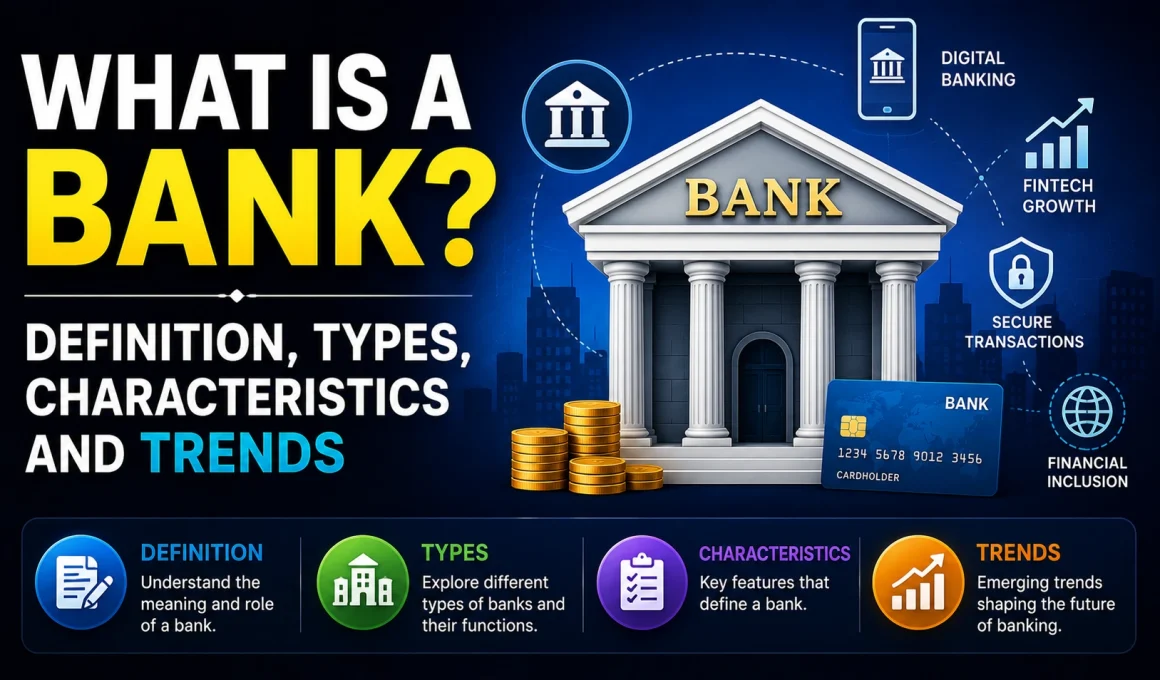
If you’ve ever wondered, “What is a bank, really?” you’re not alone. Most of us interact with banks almost daily—swiping a debit card, checking our balance on an app, or applying for a loan. Yet, the actual mechanics, history, and evolving role of these institutions often remain a mystery.
What is a Bank? Definition
In this guide, we’ll break down exactly what a bank is, explore its defining characteristics, walk through the different types of banks, and dive into the latest trends that are reshaping how we handle money. Whether you’re a student, a first-time saver, or a business owner, understanding banking fundamentals will help you make smarter financial decisions. Let’s get started.
What Is a Bank? The Simple Definition You Need
At its core, a bank is a licensed financial institution that acts as a trusted middleman between people who have extra money and those who need it. Banks accept deposits, keep them secure, and lend that same money to individuals or businesses in the form of loans. In return, they charge interest on loans while paying a smaller interest rate to depositors. The difference between these two rates is how banks stay profitable.
But a bank does much more than just store cash. It’s a financial engine that fuels everyday life and economic growth. When you pay your rent via NEFT, finance your education with a student loan, or invest in a mutual fund through your bank’s app, you’re participating in a system designed to move capital efficiently. In India, these institutions operate under strict guidelines set by the Reserve Bank of India (RBI), ensuring transparency, safety, and fair practices.
So, when we ask what is a bank?, the answer isn’t just a building with vaults. It’s a regulated ecosystem that connects savers, borrowers, investors, and the broader economy.
Key Characteristics of a Bank
Not every financial company qualifies as a bank. To operate legally and build public trust, banks must follow specific structural and operational rules. Here are the defining characteristics that set them apart:
- Deposit Acceptance: Banks legally accept public money in the form of savings, current, fixed, and recurring deposits. Your funds are typically insured up to a certain limit (like ₹5 lakh per depositor in India under DICGC).
- Lending & Credit Creation: Banks don’t just store money; they multiply it. By lending out a portion of deposits, they inject liquidity into the market, helping families buy homes and businesses expand operations.
- Profit-Driven Model: Banks operate as businesses. They earn primarily through the interest rate spread (loan interest minus deposit interest) and service fees like account maintenance, forex charges, or loan processing fees.
- Payment & Settlement Infrastructure: From UPI and debit cards to RTGS and cheque clearing, banks provide the backbone for seamless domestic and international transactions.
- Regulatory Compliance: Unlike informal lenders, banks must follow strict capital adequacy norms, KYC/AML rules, and periodic RBI audits to prevent fraud and maintain systemic stability.
- Wealth & Advisory Services: Modern banks offer mutual funds, insurance, retirement planning, and portfolio management, evolving into one-stop financial partners.
- Risk Management & Security: Banks use encryption, fraud monitoring, and secure vaults to protect both physical assets and digital data, ensuring customer trust remains intact.
These characteristics make banks indispensable to financial stability. Without them, managing money would be chaotic, risky, and highly inefficient.
Different Types of Banks Explained
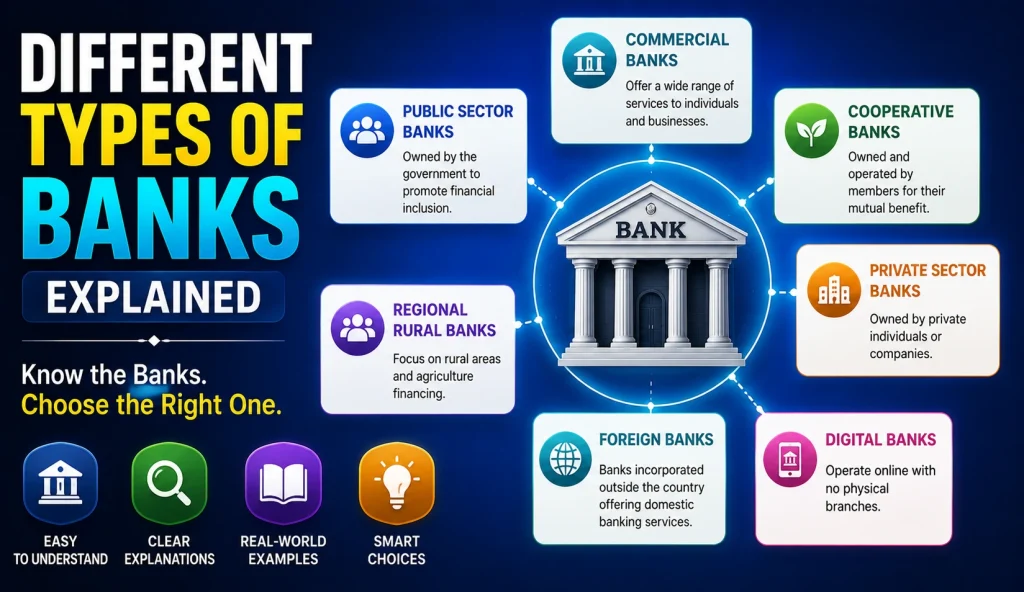
Banks aren’t one-size-fits-all. They’re categorized based on their target audience, services, and regulatory framework. Knowing the differences helps you pick the right institution for your financial goals.
Retail & Commercial Banks
Retail banks serve everyday consumers. If you’ve opened a savings account, applied for a personal loan, or used a credit card, you’ve interacted with a retail bank. They focus on accessibility, branch networks, and digital convenience. Commercial banks, on the other hand, cater to businesses. They offer working capital loans, trade finance, payroll services, and cash management solutions tailored for startups, SMEs, and large corporations.
Investment & Central Banks
Investment banks don’t handle regular savings accounts. Instead, they specialize in capital markets, mergers & acquisitions, IPOs, and institutional trading. Think of them as financial architects helping companies raise funds or restructure debt. Central banks, like the RBI, sit at the top of the hierarchy. They don’t serve the public directly. Instead, they control monetary policy, issue currency, regulate commercial banks, and manage inflation to keep the economy stable.
Private, Online & Specialized Banks
Private banks offer premium services to high-net-worth individuals (HNIs). You get dedicated relationship managers, tax planning, and customized investment strategies. Online banks (or digital-only banks) operate without physical branches, passing the cost savings to customers through higher deposit rates and lower fees.
Specialized categories include:
- Cooperative Banks: Member-owned institutions focused on community welfare, common in rural and semi-urban areas.
- Regional Rural Banks (RRBs): Government-backed banks designed to provide affordable credit and banking access to farmers and rural entrepreneurs.
- Payments Banks: Limited-scope banks that offer savings accounts, remittances, and UPI services but cannot issue traditional loans. They’re built for financial inclusion and digital-first users.
Choosing the right bank depends on your lifestyle. A freelancer might prefer an online bank for low fees, while a growing startup will lean toward a commercial bank for business credit lines.
Latest Trends Shaping the Banking Sector
The banking world is undergoing a quiet revolution. Technology, changing customer expectations, and regulatory shifts are rewriting the rules. Here’s what’s happening right now:
Customer-Centric Banking
Banks are moving away from product-pushing to problem-solving. Using data analytics, they now offer personalized dashboards, spending insights, and tailored loan offers. If you frequently travel abroad, your app might auto-suggest a zero-forex markup card. This shift boosts loyalty and reduces customer churn.
Hyperautomation & AI Integration
Manual paperwork is fading. Hyperautomation combines AI, robotic process automation (RPA), and machine learning to handle KYC verification, loan underwriting, and compliance checks in minutes. AI chatbots resolve 80% of routine queries, while predictive algorithms flag suspicious transactions before fraud occurs.
Open Banking Ecosystems
Open banking allows customers to securely share their financial data with third-party apps via APIs. Want a budgeting app that tracks all your accounts in one place? Open banking makes it possible. It also enables faster loan approvals, as lenders can instantly verify income and repayment capacity with your consent.
Cybersecurity & Risk Management
As banking goes fully digital, cyber threats grow smarter. Banks are investing heavily in biometric authentication, blockchain-based ledgers, zero-trust architectures, and real-time threat intelligence. Regulatory sandboxes now test new security protocols before public rollout, ensuring innovation doesn’t compromise safety.
Embedded Finance & Neo-Banking
Banking is disappearing into everyday platforms. E-commerce sites offer instant checkout loans, ride-hailing apps provide driver wallets, and telecom companies launch micro-savings features. Neo-banks (digital-only challengers) are partnering with traditional banks to offer sleek, app-first experiences without legacy system baggage.
These trends aren’t just buzzwords. They’re actively changing how quickly you get a loan, how safely your data is stored, and how seamlessly money moves across borders.
Why Understanding Banks Matters Today
Financial literacy starts with knowing where your money lives and how it works. When you understand what is a bank? Definition, types, characteristics and trends, you stop treating banking as a black box. You start comparing interest rates, spotting hidden fees, leveraging digital tools, and aligning your accounts with your life stage. In an era of instant payments, AI advisors, and open finance, being bank-savvy is no longer optional—it’s essential.
Become A Cloud, Blockchain Specialist With Kaashiv Infotech
Looking to dive into the world of Cloud, Blockchain technology and carve your path to success? Kaashiv Infotech is here for you! Our Comprehensive Cloud, Blockchain Course is specially designed by Microsoft MVPs and industry experts to equip you with practical skills and real-world experience that will help you set your foot in the competitive Cloud, Blockchain industry.
Let’s break down our course offerings to see what makes our training stand out:
- Live Industry Projects + Real-Time Implementation: You’ll work on a variety of technical scenarios to build a solid portfolio, enhanced by 2 Live Industry Projects that showcase your hands-on expertise in real-world Cloud, Blockchain environments.
- Practical Phase with Experts: Get hands-on training led directly by Microsoft MVPs and Google-recognized experts. Move beyond theory with a practical phase that mirrors actual industry workflows.
- Doubt Clearing Sessions: Our regular doubt sessions ensure that no question goes unanswered, giving you clarity on complex Cloud, Blockchain architectures and protocols.
- Kaashiv Lab for Coding: Access our exclusive, high-performance lab for coding practice. Whether it’s smart contracts or cloud scripting, polish your skills in a supportive, resource-rich environment.
- Industry-Oriented Curriculum: Learn industry-relevant skills and the latest tools (like AWS, Azure, Ethereum, or Hyperledger) that are directly applicable to real-world scenarios.
- Triple Certification Credentialing: Earn a robust set of credentials upon completion: an Internship Certificate, an Inplant Training (IPT) Certificate, and an Industrial Exposure Certificate—all recognized and valued by employers in the tech industry.
- Q&A Forum: Engage with fellow batchmates and instructors in our interactive Q&A forum to exchange ideas, seek advice, and collaborate on complex projects.
- Instructor-Led Sessions: Benefit from interactive sessions led by experienced professionals from top MNCs who guide you through every step of the [Cloud/Blockchain] development lifecycle.
- Interview Opportunities & Career Jump: Gain access to interview opportunities and career guidance. Utilize our ATS-friendly resume tools and extensive interview question banks to prepare for technical rounds.
- 100% Job Assistance Guarantee + Kaashiv Alumni Support: We’re offering 100% job assistance along with ongoing support from our wide alumni network in the cloud and blockchain sectors.
So what are you waiting for? Launch your career with confidence! Join the Kaashiv Infotech Cloud, Blockchain Course and unlock your potential today.
Conclusion
Banks have evolved from simple vaults guarding physical cash to dynamic digital hubs managing our entire financial lives. Whether you’re saving for a vacation, funding a business, or navigating complex investments, banks provide the infrastructure, security, and expertise to make it happen. By understanding their core characteristics, recognizing the right type for your needs, and staying updated on digital trends, you take control of your financial future. The banking sector will keep evolving, but one thing remains constant: a well-informed customer always wins.
Frequently Asked Questions (FAQs)
1. What exactly is a bank and how does it work?
A bank is a licensed financial institution that accepts deposits from customers, keeps them secure, and lends that money to individuals or businesses. It earns profit by charging higher interest on loans than it pays on deposits, while also offering payment, investment, and advisory services.
2. What are the main types of banks in India?
India’s banking sector includes retail banks, commercial banks, investment banks, central banks (RBI), private banks, online/digital banks, cooperative banks, Regional Rural Banks (RRBs), and payments banks. Each serves different customer segments and financial needs.
3. What are the key characteristics of a bank?
Core features include deposit acceptance, credit creation, profit generation through interest spreads, payment processing, regulatory compliance, wealth management services, and robust cybersecurity measures to protect customer assets and data.
4. How are banks different from NBFCs or credit unions?
Banks can accept demand deposits (like savings/current accounts) and participate in the payment system, while NBFCs cannot. Credit unions are member-owned cooperatives focused on community benefit, whereas banks are typically shareholder-driven institutions regulated by central banking authorities.
5. What are the latest trends in the banking industry for 2025?
Top trends include AI-driven personalization, hyper automation of back-office tasks, open banking APIs, embedded finance, zero-branch neo-banking, advanced biometric security, and real-time fraud detection using machine learning.