
When I first started learning Data types in data science, I honestly thought data was just… data. Numbers, tables, Excel sheets — all the same, right?
The moment I understood the Data types in Data Science, everything became easier. Machine learning concepts made more sense. SQL queries became clearer. Even data visualization suddenly stopped feeling confusing.
So if you’re someone learning data science, analytics, SQL, Python, or even AI, understanding these data types is one of those “foundation” topics you absolutely shouldn’t skip.
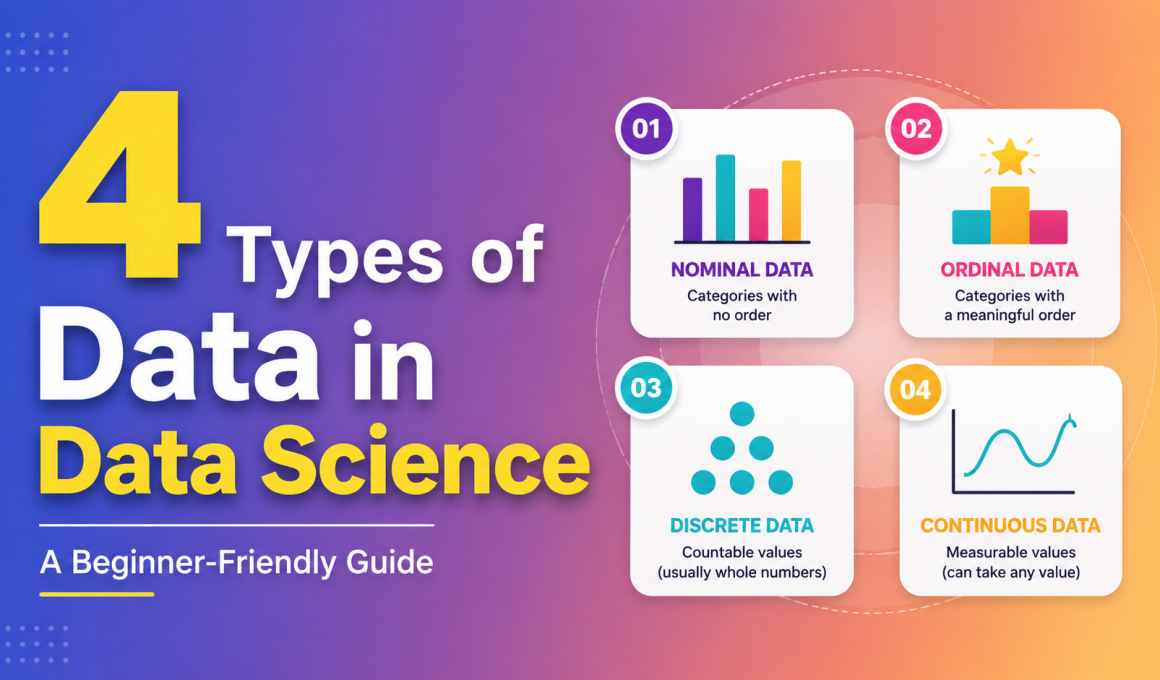
In this article, I’ll explain the 4 types of Data in Data Science in the simplest way possible — with examples, real-life situations, and zero boring textbook language.
✨ Key Highlights
- Learn the 4 different types of data in Data Science in simple words
- Understand the difference between qualitative and quantitative data
- Real-life examples for each data type
- Why these data types matter in data science and machine learning
- Beginner-friendly explanations with practical insights
- Helpful internal and external learning resources 📚
Why Understanding Data Types Actually Matters 🤔
Before jumping into the 4 types of Data in Data Science, let me tell you something I learned the hard way.
A few months ago, I tried creating a small data analysis project using student marks. I mixed up categorical data with numerical data, and my charts looked ridiculous. My analysis made no sense.
That’s when I realized:
If you don’t understand your data type, your analysis can go completely wrong.
Data scientists spend a huge amount of time understanding and cleaning data before doing any fancy AI or machine learning work.
So yes — this topic is more important than many beginners think.
The 4 Types of Data in Data Science 📂
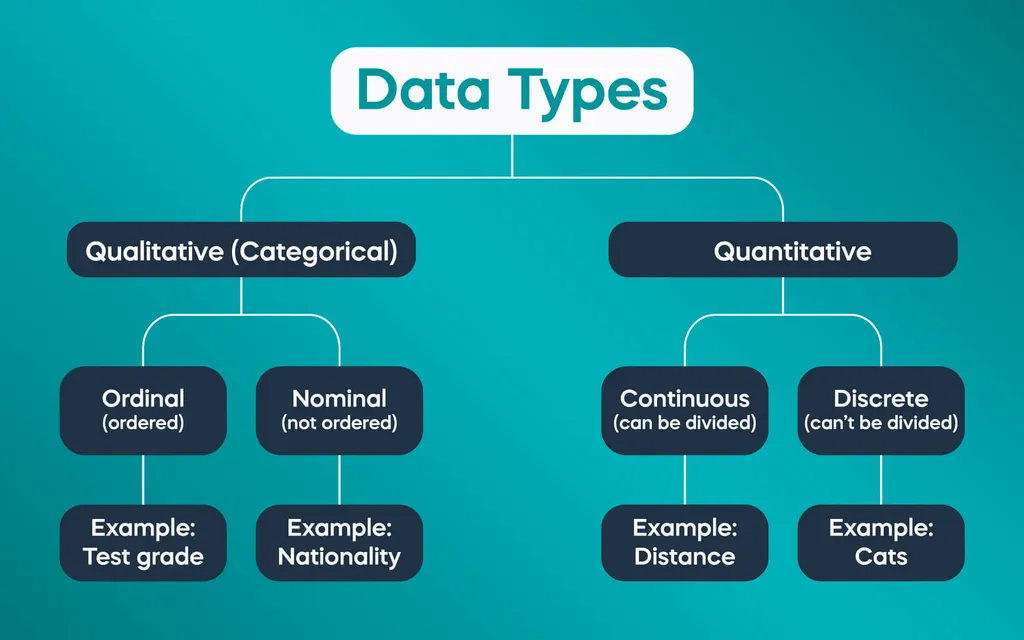
The Data types in Data Science are usually divided into two major categories:
- Qualitative Data
- Nominal Data
- Ordinal Data
- Quantitative Data
- Discrete Data
- Continuous Data
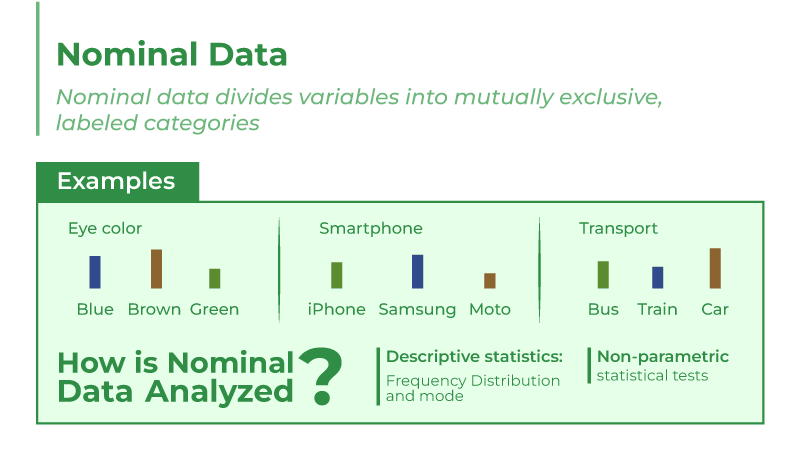
1. Nominal Data (Qualitative Data) 🏷️
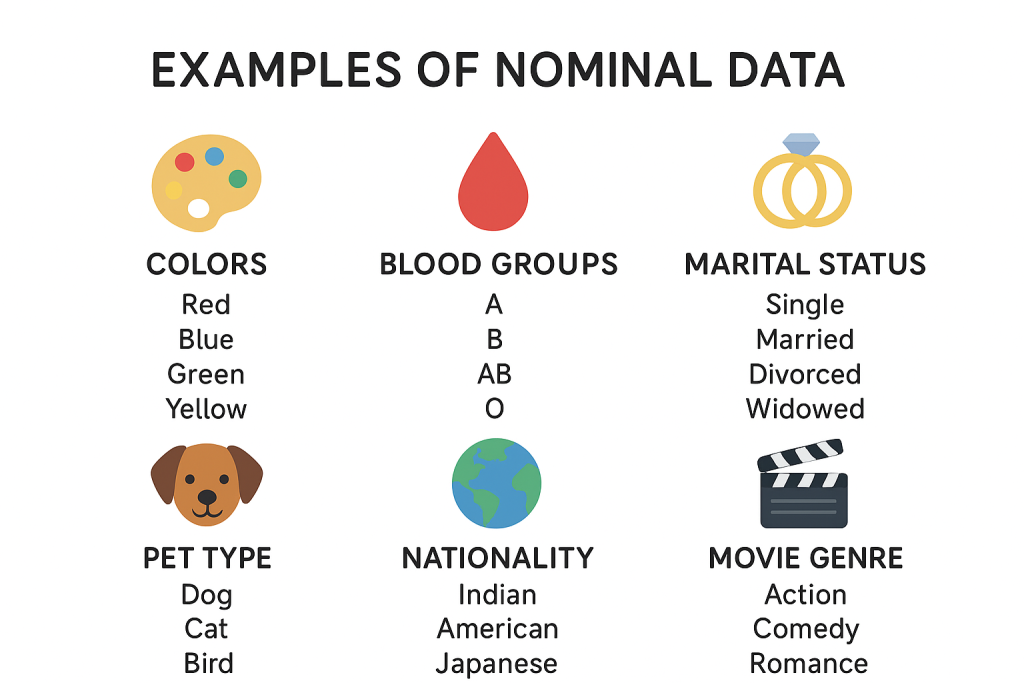
Nominal data is data used for naming or labeling things.
There’s no order or ranking here.
Examples of Nominal Data
- Gender
- Blood group
- Eye color
- Country names
- Favorite food
- Department names
For example:
| Student | Blood Group |
|---|---|
| Ravi | O+ |
| Priya | A+ |
| Arun | B+ |
See? We’re just labeling categories.
You cannot say:
- O+ is greater than A+
- B+ is smaller than O+
That would make no sense.
Real-Life Example
Think about Netflix genres 🎬
- Comedy
- Thriller
- Horror
- Romance
These are simply categories. No ranking exists.
That’s nominal data.
Why Nominal Data Matters in Data Science
In machine learning, algorithms cannot directly understand text labels like “Male” or “Female.”
So data scientists often convert nominal data into numbers using techniques like:
- One-hot encoding
- Label encoding
If you plan to learn machine learning later, you’ll see this everywhere.
2. Ordinal Data (Qualitative Data) 📈
This is where things become interesting.
Ordinal data has categories with a meaningful order.
But the gap between values may not be equal.
Examples of Ordinal Data
- Customer satisfaction
- Movie ratings
- Education level
- T-shirt sizes
Example:
| Rating |
|---|
| Poor |
| Average |
| Good |
| Excellent |
Here, the order matters.
“Excellent” is better than “Good.”
But can we measure the exact difference mathematically?
Not really.
My Personal Example ☕
I once ordered coffee from a cafe that asked me to rate the experience:
- Bad
- Okay
- Good
- Amazing
That’s ordinal data.
The ranking exists, but the distance between “Good” and “Amazing” isn’t fixed.
Ordinal Data in Real Projects
E-commerce websites use ordinal data all the time:
- Product ratings ⭐
- Customer feedback
- Priority levels
This helps businesses understand customer behavior better.
3. Discrete Data (Quantitative Data) 🔢
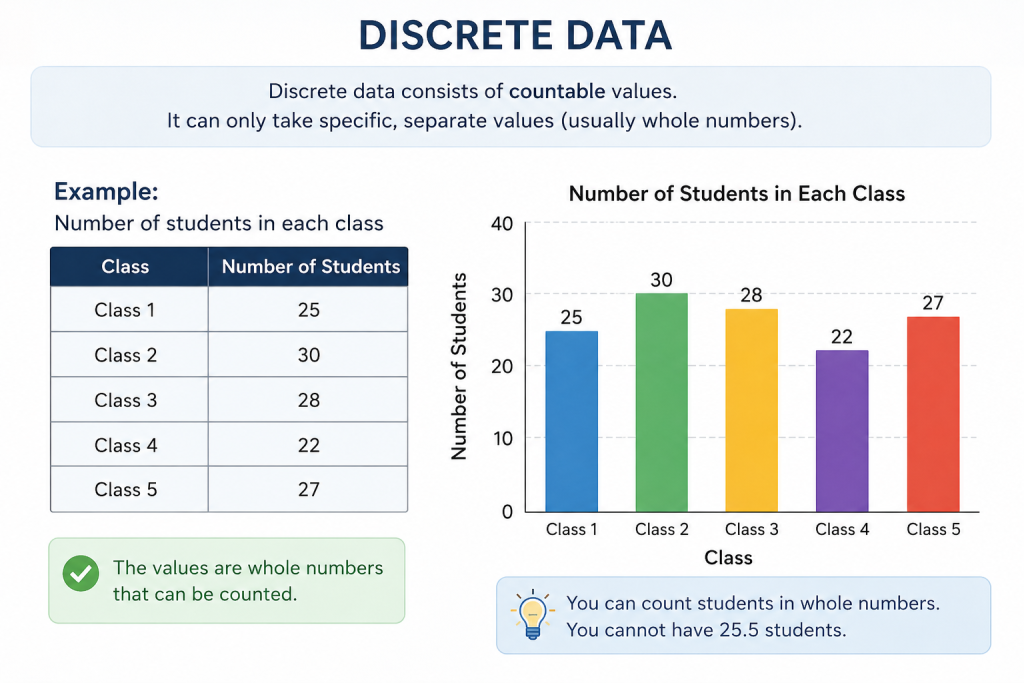
Now we move into numerical data.
Discrete data consists of countable numbers.
Usually whole numbers.
Examples of Discrete Data
- Number of students in a class
- Number of cars in parking
- Number of mobile phones sold
- Number of website visitors
Example:
| Day | Visitors |
|---|---|
| Monday | 120 |
| Tuesday | 98 |
You can count these values.
Important Point
Discrete data usually:
- Does NOT contain decimals
- Represents counting
You cannot have:
- 2.5 students
- 7.3 cars
Real-Life Example
Instagram followers.
You either gain:
- 1 follower
- 10 followers
- 100 followers
These are countable values.
4. Continuous Data (Quantitative Data) 📏
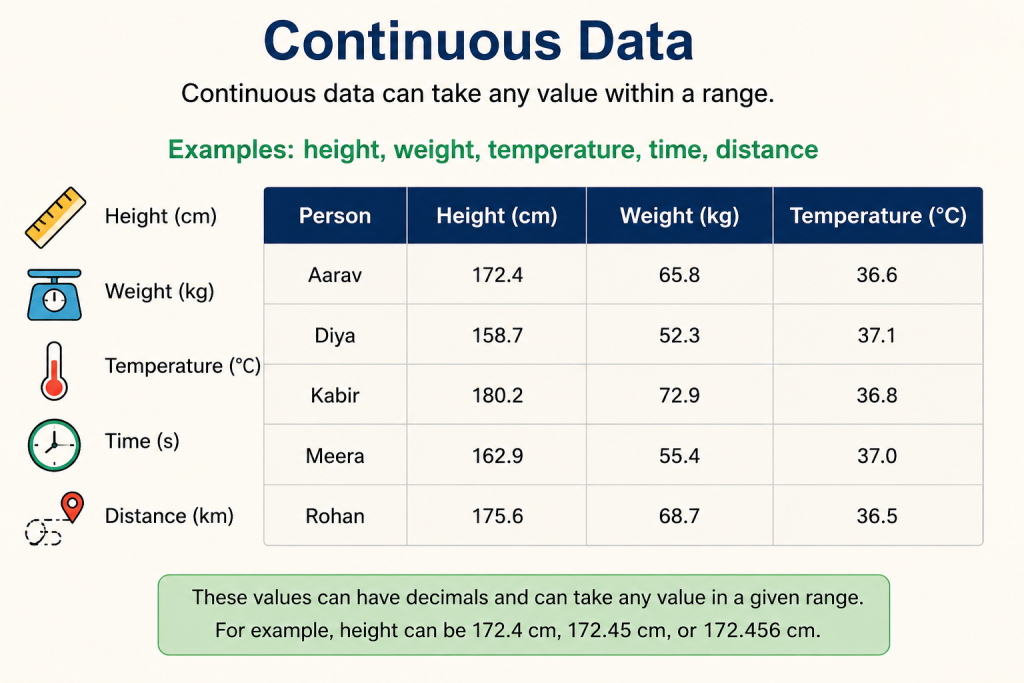
This is my favorite one because it appears almost everywhere in real life.
Continuous data can take any value within a range.
Including decimals.
Examples of Continuous Data
- Height
- Weight
- Temperature
- Speed
- Time
- Distance
Example:
| Person | Height |
|---|---|
| Ajay | 172.5 cm |
| Meena | 165.8 cm |
Notice the decimals?
That’s continuous data.
Real-Life Example 🌡️
Weather apps use continuous data constantly:
- Temperature
- Rainfall
- Humidity
- Wind speed
Even your smartwatch tracks continuous data like heartbeat and calories burned.
Quick Summary Table of the 4 Types of Data in Data Science 📋
| Data Type | Category | Ordered? | Numeric? | Example |
|---|---|---|---|---|
| Nominal | Qualitative | ❌ | ❌ | Gender |
| Ordinal | Qualitative | ✅ | ❌ | Ratings |
| Discrete | Quantitative | ✅ | ✅ | Number of students |
| Continuous | Quantitative | ✅ | ✅ | Height |
This table alone helped me remember everything quickly when I was learning.
Why the 4 Types of Data in Data Science Are Important 🚀
Understanding the 4 types of Data in Data Science helps in:
- Choosing correct graphs 📊
- Selecting proper machine learning models
- Cleaning data properly
- Writing better SQL queries
- Performing accurate statistical analysis
For example:
- Nominal data → Pie charts
- Continuous data → Histograms
- Discrete data → Bar charts
Using the wrong chart can completely confuse your audience.
How Data Types Connect to SQL and Python 💻
If you’re learning:
- SQL
- Python
- Power BI
- Machine Learning
- Data Analytics
…then the 4 types of Data in Data Science appear everywhere.
For example in SQL:
- VARCHAR → Qualitative data
- INT → Discrete data
- FLOAT → Continuous data
In Python pandas:
- Object datatype
- Integer datatype
- Float datatype
All connected.
Best Resources to Learn More 📚
Internal Learning Ideas
You can also continue learning:
- SQL aggregate functions
- GROUP BY in SQL
- Data visualization basics
- Python pandas
These topics connect directly with data types.
External Resources
- Kaggle Data Science Learning Platform
- W3Schools SQL Tutorial
- Python Pandas Documentation
- IBM Data Science Introduction
Final Thoughts on the 4 Types of Data in Data Science 💡
Honestly, the 4 types of Data in Data Science may sound like a small topic at first.
But once I truly understood them, many confusing concepts suddenly clicked together.
Data science is not only about coding or AI models. A huge part of it is simply understanding the data correctly.
And these four types:
- Nominal
- Ordinal
- Discrete
- Continuous
…form the backbone of that understanding.
So if you’re beginning your data science journey, spend time mastering this topic properly. Future-you will definitely thank you. 🚀
Want to learn more ??, Kaashiv Infotech Offers Data Analytics Course, Data Science Course, Cyber Security Course & More Visit Their Website www.kaashivinfotech.com.