

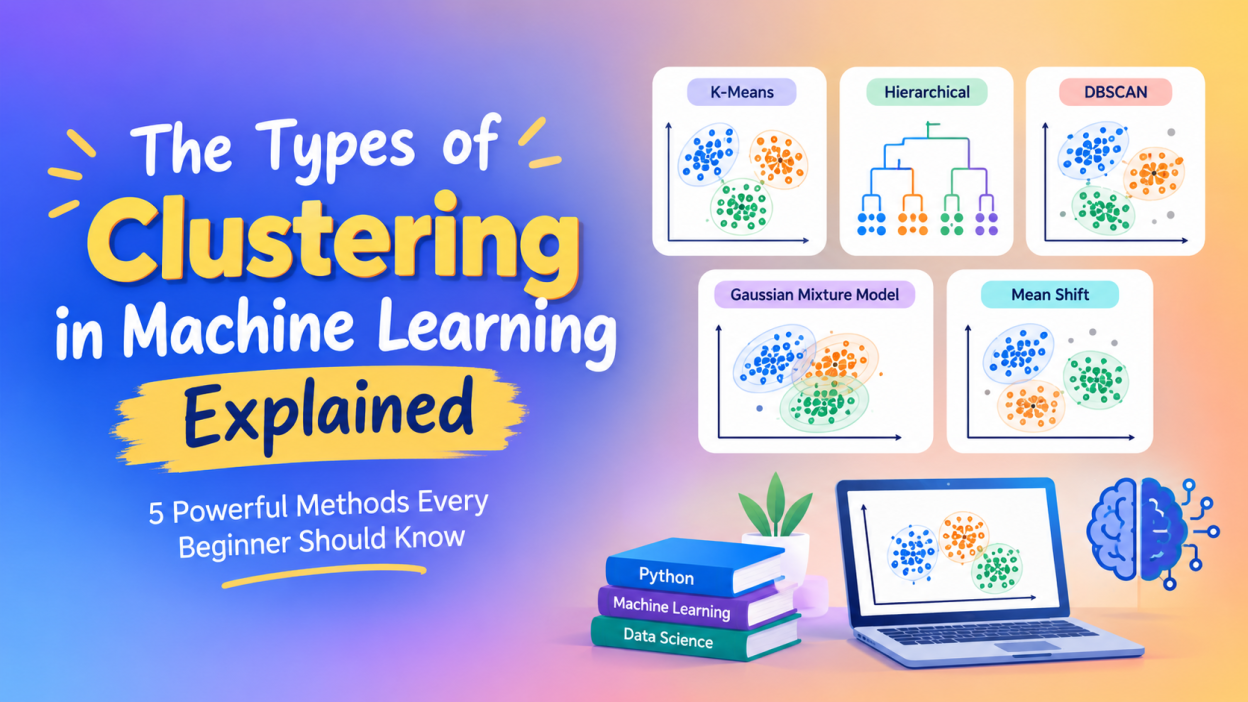
Machine Learning can do something that initially feels a little surprising: it can look at a large amount of data and discover groups without being told exactly what those groups should be.
That is where clustering in Machine Learning becomes useful.
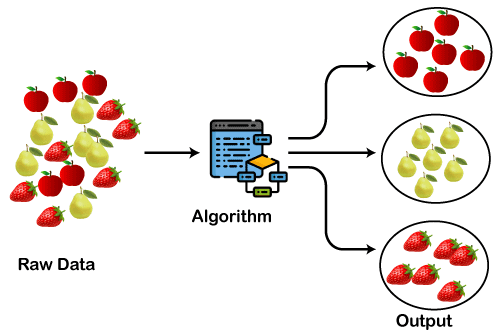
Machine Learning clustering is an unsupervised learning technique that groups similar data points together. Unlike supervised learning, we don’t give the model predefined labels such as “customer,” “student,” or “high-value buyer.” Instead, the algorithm studies the data and tries to find natural patterns.
For example, imagine an online shopping website with thousands of customers. Instead of manually labeling every customer, we could use Machine Learning clustering to discover groups such as:
- Customers who buy frequently
- Customers who spend a lot
- Customers who purchase only during discounts
- Customers who haven’t purchased recently
The interesting part? We don’t have to define these groups beforehand. The algorithm finds patterns based on the data.
In this article, I’ll explain the major types of clustering in Machine Learning, how they work, where we use them, and which clustering algorithm beginners should learn first.
Key Highlights
- Understand what clustering in Machine Learning actually means.
- Learn the difference between supervised and unsupervised learning.
- Explore 5 important types of clustering algorithms.
- Understand K-Means clustering with a simple example.
- Learn how Hierarchical clustering creates groups.
- Understand DBSCAN, Gaussian Mixture Models, and Mean Shift.
- See real-world Machine Learning clustering applications.
- Learn how to choose the right clustering algorithm.
- Understand the advantages and limitations of clustering.
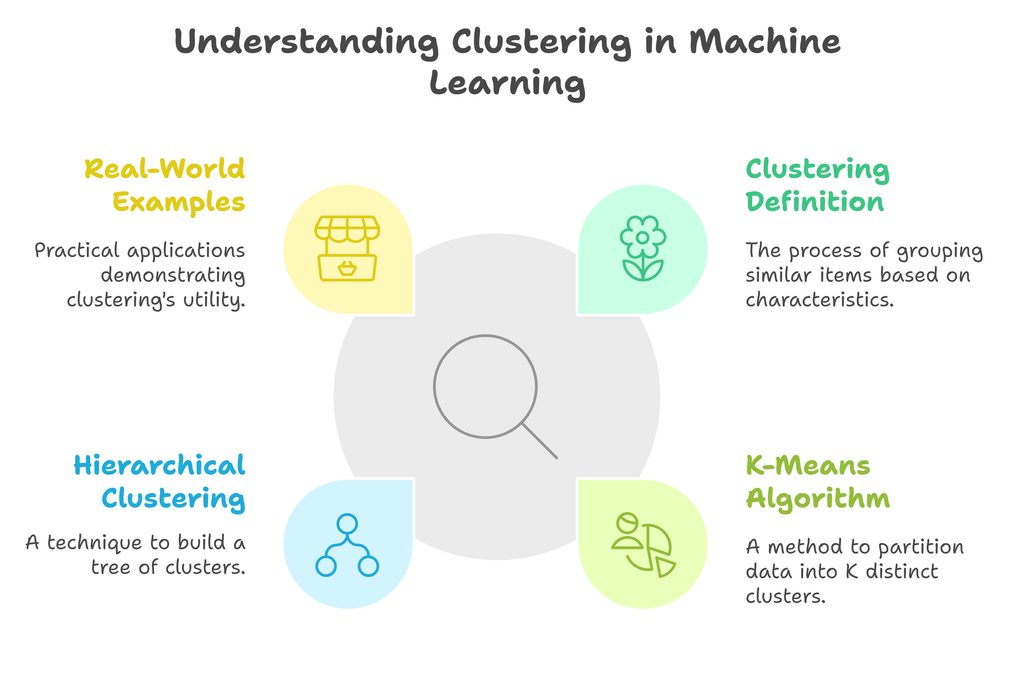
What Is Clustering in Machine Learning?
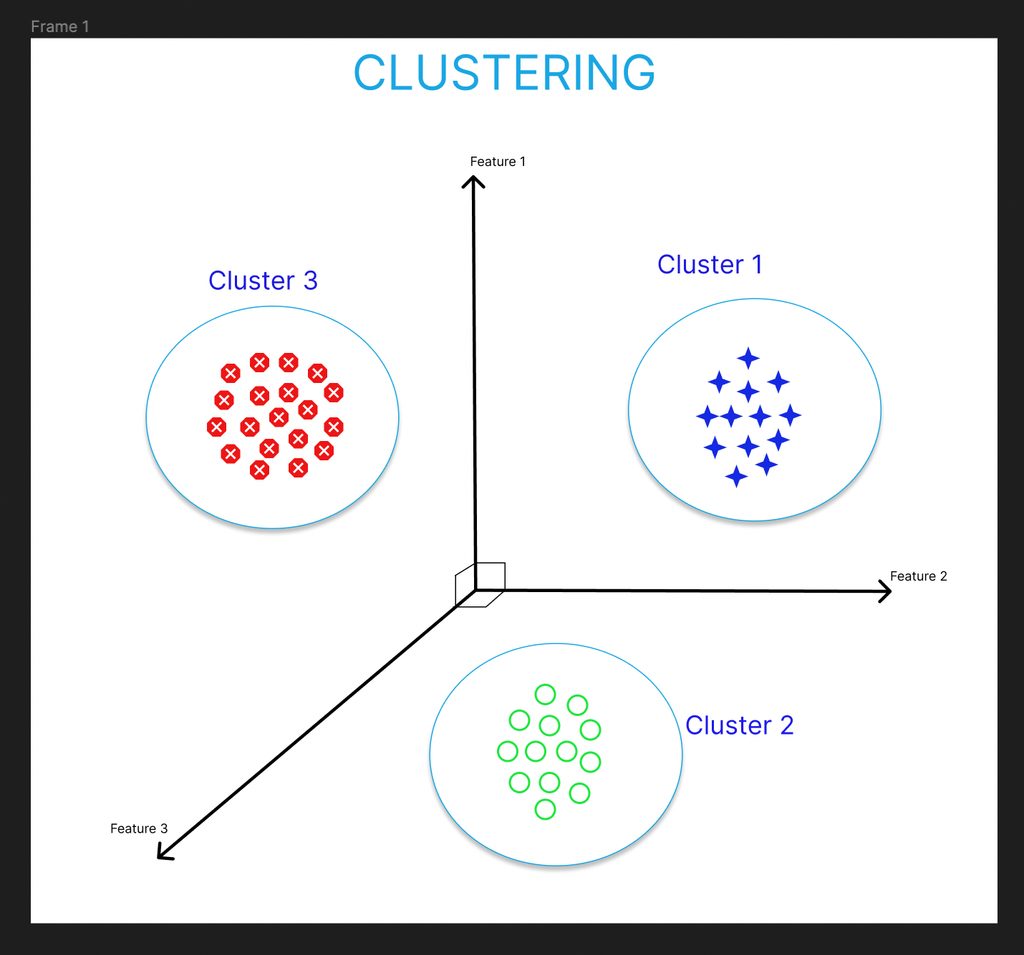
Clustering in Machine Learning means dividing data into groups based on similarity.
Think about a classroom.
Suppose I give you information about 30 students, including:
- Age
- Marks
- Attendance
- Study hours
I don’t tell you which students belong together.
You might naturally notice that some students have high marks and high attendance, while another group may have average marks but very high study hours.
A clustering algorithm tries to make similar groups automatically.
Simple idea:
Input data → Find similarities → Create groups
For example:
                 Customer Data
                       ↓
              Clustering Algorithm
                       ↓
        ┌──────────────┼──────────────┐
        ↓              ↓              ↓
     Group 1         Group 2        Group 3
     High spend      Low spend      Frequent buyers
This is why clustering is called unsupervised Machine Learning.
There are no predefined output labels.
Why Do We Use Clustering in Machine Learning?
You might wonder, “If we don’t have labels, why do we need clustering?”
That’s actually one of its biggest advantages.
Sometimes we have a huge amount of data, but we don’t know what patterns are hiding inside it.
Machine Learning clustering helps us discover those hidden patterns.
For example, a company may have millions of customer records.
Instead of looking at every customer individually, the company can use clustering to identify customer segments.
Some common applications include:
- Customer segmentation
- Market research
- Image segmentation
- Fraud detection
- Recommendation systems
- Document classification
- Social network analysis
- Medical research
- Anomaly detection
I find customer segmentation one of the easiest examples to understand.
Imagine a supermarket. The owner may discover that one group of customers buys baby products, another buys fitness products, and another frequently purchases electronics.
The business can then create different offers for each group.
That’s the practical value of Machine Learning clustering.
5 Types of Clustering in Machine Learning
There isn’t just one way to perform clustering.
Different datasets require different approaches.
The most important types of clustering in Machine Learning that beginners should know are:
- K-Means Clustering
- Hierarchical Clustering
- DBSCAN
- Gaussian Mixture Model (GMM)
- Mean Shift Clustering
Let’s look at each one.
1. K-Means Clustering in Machine Learning
If you’re completely new to clustering, I recommend starting with K-Means clustering.
It is one of the most commonly taught clustering algorithms and is relatively easy to understand.
The idea is simple.
We decide how many groups we want, represented by K.
For example:
K = 3
This means we want the algorithm to create three clusters.
Top 10 AI Tools for Content Creation in 2026 You Shouldn’t Miss.
How K-Means works
Suppose we have customer data.
The algorithm roughly follows these steps:
Step 1: Choose the number of clusters, K.
Step 2: Randomly select initial cluster centers.
Step 3: Assign each data point to its nearest center.
Step 4: Calculate new cluster centers.
Step 5: Repeat the process until the clusters stop changing significantly.
For example:
Customer Data
      ↓
Choose K = 3
      ↓
Create 3 initial centers
      ↓
Assign customers to nearest center
      ↓
Calculate new centers
      ↓
Repeat
      ↓
Final 3 clusters
Real-world example
Suppose an online store has customers based on:
- Annual spending
- Number of purchases
K-Means might identify:
Cluster 1: Low spending + few purchases
Cluster 2: Medium spending + regular purchases
Cluster 3: High spending + frequent purchases
The business can then create different marketing strategies for each group.
Advantages of K-Means
- Easy to understand
- Relatively fast
- Works well with large datasets
- Simple to implement
Limitation
You generally need to decide the number of clusters beforehand.
That can sometimes be difficult.
2. Hierarchical Clustering
The second important type of Machine Learning clustering is Hierarchical clustering.
This approach creates a hierarchy of clusters.
Instead of simply saying:
Cluster 1
Cluster 2
Cluster 3
it builds a tree-like structure showing how groups relate to one another.
This structure is called a dendrogram.
Imagine you have six students.
Initially, every student is separate:
A B C D E F
The algorithm finds the most similar students and joins them.
(A,B) (C,D) (E,F)
Then it may combine these groups again:
((A,B),(C,D)) (E,F)
Eventually, everything can become one large cluster.
Two approaches
Hierarchical clustering generally works in two ways:
Agglomerative clustering
Start with individual data points and keep merging them.
Divisive clustering
Start with one large group and keep splitting it.
Agglomerative clustering is commonly used in practice and teaching.
When is hierarchical clustering useful?
It can be useful when we want to understand the relationships between groups.
For example, researchers might use it to study similarities between:
- Different species
- Documents
- Products
- Customers
- Genes
One advantage is that you can inspect the dendrogram and decide where to cut the hierarchy to obtain the desired number of clusters.
3. DBSCAN Clustering
Now let’s talk about DBSCAN, which is especially interesting when your data doesn’t form neat circular groups.
DBSCAN stands for:
Density-Based Spatial Clustering of Applications with Noise
The name sounds complicated.
The basic idea isn’t.
DBSCAN looks for areas where data points are packed closely together.
It identifies:
- Dense regions
- Sparse regions
- Noise or outliers
Imagine looking at a map showing the locations of customers.
You might see several dense groups:
•••••             •••••

•••••             •••••

              •
                 •
                   •
The isolated points may be treated as noise.
Why is DBSCAN useful?
One major advantage is that it can identify irregularly shaped clusters.
For example:
    •••••
  •       •
 •         •
  •       •
    •••••
K-Means may struggle with certain shapes like this because of its assumptions about cluster centers.
DBSCAN can often handle such structures better.
Real-world applications
DBSCAN can be useful for:
- Geographic data
- GPS data
- Anomaly detection
- Image analysis
- Traffic analysis
- Location-based customer analysis
It is particularly useful when the dataset contains noise or outliers.
4. Gaussian Mixture Model in Machine Learning
A Gaussian Mixture Model (GMM) is another important clustering method.
Instead of assigning every data point strictly to one cluster, GMM works with probabilities.
This is an important difference.
Suppose a customer has characteristics that make them somewhat similar to two customer groups.
Instead of saying:
“This customer definitely belongs to Group A.”
GMM can estimate something like:
Group A → 70%
Group B → 30%
This makes GMM a soft clustering approach.
K-Means, in comparison, generally performs hard clustering, where each point is assigned to one cluster.
When can GMM be useful?
GMM can be useful when clusters overlap.
For example, imagine two groups of customers:
       Group A
      •••••••
    •••••••••
       •••••

          •••
        •••••••
       •••••••
         Group B
The boundaries aren’t always obvious.
GMM can model this uncertainty using probability distributions.
5. Mean Shift Clustering
Another interesting clustering technique is Mean Shift.
The basic idea is to find areas where data points are concentrated.
Instead of asking us to specify the exact number of clusters like K-Means, Mean Shift tries to discover dense regions in the data.
Imagine placing small balls over a landscape and allowing them to move toward areas containing more data points.
Eventually, they move toward density peaks.
Those peaks can represent clusters.
Why is Mean Shift useful?
It can be useful when:
- We don’t know the number of clusters.
- Data contains natural density peaks.
- We want a flexible clustering approach.
However, it can become computationally expensive for very large datasets.
K-Means vs Hierarchical vs DBSCAN vs GMM vs Mean Shift
At first, all these algorithms can feel confusing.
So I like to simplify the comparison.
| Algorithm | Main Idea | Need Number of Clusters? | Handles Noise? |
|---|---|---|---|
| K-Means | Groups around centers | Yes | Not particularly well |
| Hierarchical | Builds cluster hierarchy | Not necessarily | Limited |
| DBSCAN | Groups dense regions | No | Yes |
| GMM | Probability-based grouping | Usually yes | Limited |
| Mean Shift | Finds density peaks | No | Limited |
The important thing isn’t memorizing every detail.
Understand why each algorithm exists.
Real-World Applications of Machine Learning Clustering
This is where clustering becomes much more interesting.
We aren’t learning these algorithms just to pass an exam.
Companies and researchers use clustering to solve real problems.
1. Customer Segmentation
Businesses can group customers based on:
- Spending
- Purchase frequency
- Age
- Interests
- Location
This helps companies create targeted marketing campaigns.
2. Recommendation Systems
Clustering can help identify users with similar interests.
For example, if thousands of users watch similar movies, they may belong to similar behavioral groups.
The system can use this information to improve recommendations.
3. Image Processing
Clustering can divide an image into different regions based on properties such as color.
This can be useful in:
- Computer vision
- Medical imaging
- Object detection
- Image compression
4. Fraud Detection
Unusual transactions may appear far away from normal transaction patterns.
Clustering can help identify suspicious behavior that deserves further investigation.
5. Healthcare and Medical Research
Researchers can use clustering to discover groups of patients with similar characteristics.
This can help researchers explore patterns in medical datasets.
Of course, clustering itself does not automatically diagnose a disease. Human expertise and appropriate clinical validation remain essential.
How Do I Choose the Right Clustering Algorithm?
This is one of the most common beginner questions.
There isn’t one algorithm that works perfectly for every dataset.
I usually think about a few basic questions.
Do I know the number of clusters?
If yes, K-Means can be a good starting point.
Do I want to understand relationships between groups?
Try Hierarchical clustering.
Does my data contain noise or outliers?
Consider DBSCAN.
Do clusters overlap?
A Gaussian Mixture Model may be useful.
Do I want the algorithm to discover density peaks?
Consider Mean Shift.
The actual choice should also depend on the shape, size, scale, and structure of your dataset.
Advantages of Clustering in Machine Learning
Clustering has several benefits.
1. No labeled data required
One of the biggest advantages is that clustering works with unlabeled data.
2. Helps discover hidden patterns
It can reveal groups that we didn’t know existed.
3. Useful for large datasets
Clustering can help summarize complex datasets by grouping similar observations.
4. Supports business decisions
Companies can use customer clusters to design better strategies.
5. Useful across different industries
Machine Learning clustering appears in marketing, healthcare, finance, technology, research, and many other areas.
Artificial Intelligence vs Human Intelligence: A Deep Dive into Minds Made and Minds Born
Limitations of Machine Learning Clustering
Clustering isn’t magic.
There are some important limitations.
Choosing the right algorithm can be difficult
Different algorithms can produce different results.
Data quality matters
If the data contains poor-quality values, the resulting clusters may also be poor.
Scaling can affect results
Features with very different numerical ranges can influence distance-based algorithms such as K-Means.
For example:
Age → 20 to 60
Salary → 20,000 to 2,00,000
Salary has much larger numerical values.
Without appropriate preprocessing, it can dominate distance calculations.
Clusters may not have an obvious meaning
The algorithm can create a mathematically valid group, but we still need domain knowledge to understand what that group actually represents.
This is an important point that beginners sometimes miss.
Finding a cluster is not the same as understanding a cluster.
How Can Beginners Learn Machine Learning Clustering?
If you’re starting Machine Learning from scratch, don’t try to memorize five algorithms in one sitting.
I would follow this order:
Python Basics
      ↓
NumPy & Pandas
      ↓
Machine Learning Basics
      ↓
Supervised vs Unsupervised Learning
      ↓
K-Means
      ↓
Hierarchical Clustering
      ↓
DBSCAN
      ↓
GMM
      ↓
Clustering Projects
Start with K-Means.
Create a small dataset.
Plot it.
Run the algorithm.
Change the number of clusters.
Look at what happens.
That’s much more effective than simply reading definitions.
For Python-based Machine Learning projects, libraries such as scikit-learn provide implementations of many clustering algorithms. You can explore the official documentation here:
External resource: scikit-learn Clustering Documentation
You can also learn the broader concepts through the scikit-learn User Guide.
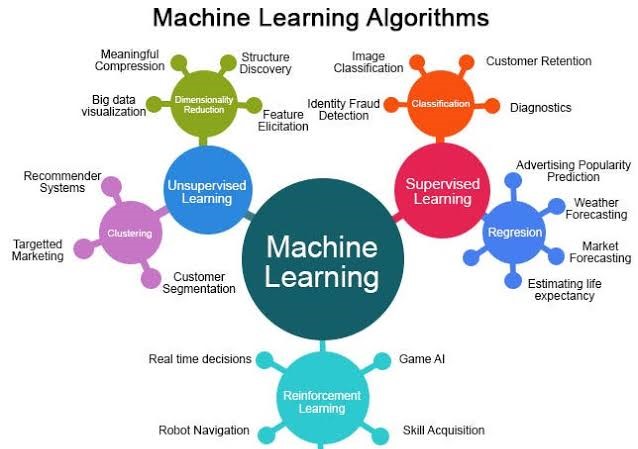
For beginners, I also recommend connecting clustering with other Machine Learning concepts such as classification, regression, dimensionality reduction, and model evaluation.
Final Thoughts on Clustering in Machine Learning
When I first came across clustering in Machine Learning, the idea seemed abstract: give a computer data and ask it to find groups.
But the concept becomes much easier once you connect it to everyday situations.
Think about customers shopping online.
Think about photos stored on your phone.
Think about locations on a map.
Think about documents containing similar topics.
In all these situations, we naturally look for similarities and groups. Machine Learning clustering simply gives a computer a systematic way to discover those patterns from data.
If you’re a beginner, don’t worry about understanding every algorithm immediately.
Start with K-Means.
Then learn Hierarchical clustering.
Move to DBSCAN.
After that, explore Gaussian Mixture Models and Mean Shift.
Most importantly, practice with real datasets.
Because once you actually see your data forming clusters on a graph, the whole topic starts to make much more sense. 🚀
And that’s when Machine Learning stops feeling like a collection of complicated algorithms and starts feeling like a practical tool for finding patterns hidden inside data.
Want to Learn More About Python & Artificial Intelligence ?, Kaashiv Infotech Offers Full Stack Python Course, Artificial Intelligence Course, Data Science Course & More Visit Their Website course.kaashivinfotech.com.

![Sorting in Data Structure Categories & Types [2026]](https://www.wikitechy.com/wp-content/uploads/2026/10/Sorting-in-Data-Structure-Categories-Types-2026-400x225.png)