
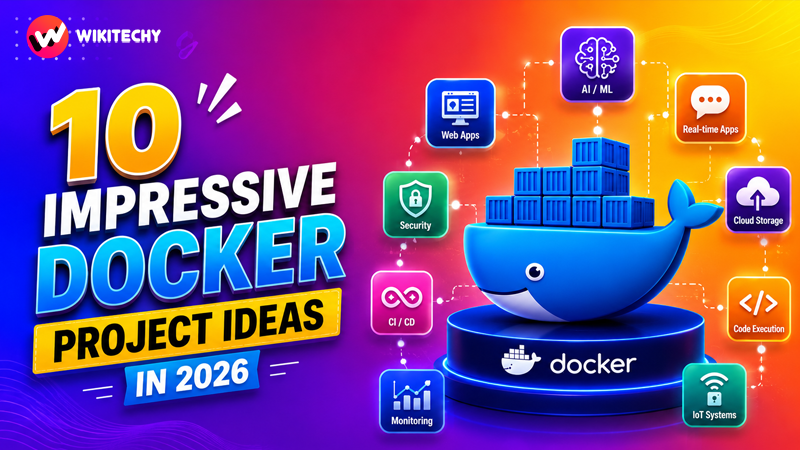
Docker has completely transformed how applications are built, shipped, and deployed. In 2026, companies expect developers and DevOps engineers to not just understand Docker—but to apply it in real-world scenarios.
If you want to stand out, building practical Docker projects is the fastest way to gain hands-on experience. In this detailed guide, you’ll explore 10 powerful Docker project ideas, each explained with concepts, tools, and real-world value.
10 powerful Docker project ideas
🧩 1. Multi-Container Blogging Platform
A multi-container blogging platform is one of the best ways to understand Docker deeply. Instead of running everything in a single container, you break your application into smaller services.
For example, your frontend (React) runs in one container, your backend API (Node.js or Django) in another, and your database (MongoDB or PostgreSQL) in a separate container. Using Docker Compose, you can define and manage all these services together.
This project teaches you service communication, networking, environment variables, and scaling. You’ll also learn how reverse proxies like Nginx handle routing between containers.
💬 2. Real-Time Chat Application with Docker
A real-time chat application is a great project to explore low-latency communication systems.
You can build a chat system using WebSockets with Node.js and Socket.IO, then containerize it. Add Redis as a message broker to handle scaling across multiple instances.
By dockerizing this setup, you’ll understand how to manage real-time data flow, session handling, and distributed communication between services.
This project is highly valuable because many modern apps rely on real-time updates—like messaging apps, gaming platforms, and live dashboards.
⚙️ 3. CI/CD Pipeline with Docker and Jenkins
Automation is at the heart of DevOps, and this project helps you master it.
Set up a CI/CD pipeline where every code push triggers automatic build, testing, and deployment using Docker containers. Jenkins can orchestrate the entire process.
For example, when you push code to GitHub, Jenkins pulls the repository, builds a Docker image, runs tests inside containers, and deploys the application.
This project demonstrates real-world DevOps workflows and is highly impressive for job interviews.
📊 4. Monitoring System with Prometheus and Grafana
Monitoring ensures your applications run smoothly in production.
In this project, you’ll use Prometheus to collect metrics from your Docker containers and Grafana to visualize them in dashboards.
You can track CPU usage, memory consumption, request rates, and system health. This helps you detect issues before they affect users.
Learning monitoring tools is crucial because every production system depends on observability and performance tracking.
🔐 5. Dockerized Microservices E-Commerce App
Take your skills to the next level by building a microservices-based e-commerce platform.
Instead of a monolithic app, break the system into services like:
- User service
- Product service
- Order service
- Payment service
Each service runs in its own Docker container and communicates via APIs.
This project helps you understand scalability, fault isolation, and service orchestration—key skills in modern backend development.
🌐 6. Personal Portfolio Website with Docker Deployment
A simple but powerful project is to containerize your personal portfolio website.
You can host a static website using Nginx inside a Docker container and deploy it to a cloud platform. Add HTTPS using Let’s Encrypt and automate deployment.
This project is great for beginners and shows that you understand deployment pipelines and hosting strategies.
🧪 7. Dockerized Machine Learning Model API
Machine learning models need to be deployed properly to be useful.
In this project, you containerize a trained ML model using Flask or FastAPI and expose it as an API. This allows other applications to consume predictions.
Docker ensures your model runs consistently across environments without dependency issues.
This is especially useful if you’re combining AI with DevOps (MLOps).
📂 8. File Upload and Processing System
This project focuses on handling background tasks efficiently.
Users upload files, which are then processed asynchronously using worker containers. Tools like Redis and Celery can manage queues.
For example, uploaded images can be resized, compressed, or analyzed in the background.
This teaches you task queues, asynchronous processing, and scalability.
🧱 9. Infrastructure Simulation with Docker (Mini Cloud)
Create a mini cloud environment on your local machine using Docker.
Simulate multiple services like web servers, databases, load balancers, and monitoring tools. Connect them using Docker networks.
This project gives you a deep understanding of system architecture and infrastructure design without needing real cloud resources.
🔄 10. Log Aggregation System with ELK Stack
Logging is essential for debugging and monitoring applications.
In this project, you build a centralized logging system using the ELK Stack:
- Elasticsearch (storage)
- Logstash (processing)
- Kibana (visualization)
Docker helps you run all these services easily and connect them together.
This project is highly valuable for production-level systems where tracking logs is critical.
🎯 Final Thoughts
Docker is more than just a tool—it’s a core skill in modern software engineering. By building these projects, you’ll move beyond theory and gain practical experience that employers value.
Start with simple projects like a portfolio website, then gradually move to advanced ones like microservices and CI/CD pipelines.
The key is consistency. Build, break, fix, and improvAnd if you want to level up? Enroll in a hands-on DevOps course in Chennai that includes software development projects. It’s the best of both worlds.