
Imagine you’re building the “Undo” feature for a photo editor. Now, imagine you’re designing a system to handle customer support tickets.
In both cases, you need to manage a list of items. But if you choose the wrong management principle for the job, one application will be brilliant, and the other will be completely broken.
This choice comes down to one of the most fundamental decisions in computer science: LIFO and FIFO.
Understanding the difference between LIFO and FIFO isn’t just academic—it’s a practical skill that separates junior developers from seasoned pros. This guide will make you the expert, ready to tackle any problem or interview question.
LIFO and FIFO: The Core Difference at a Glance
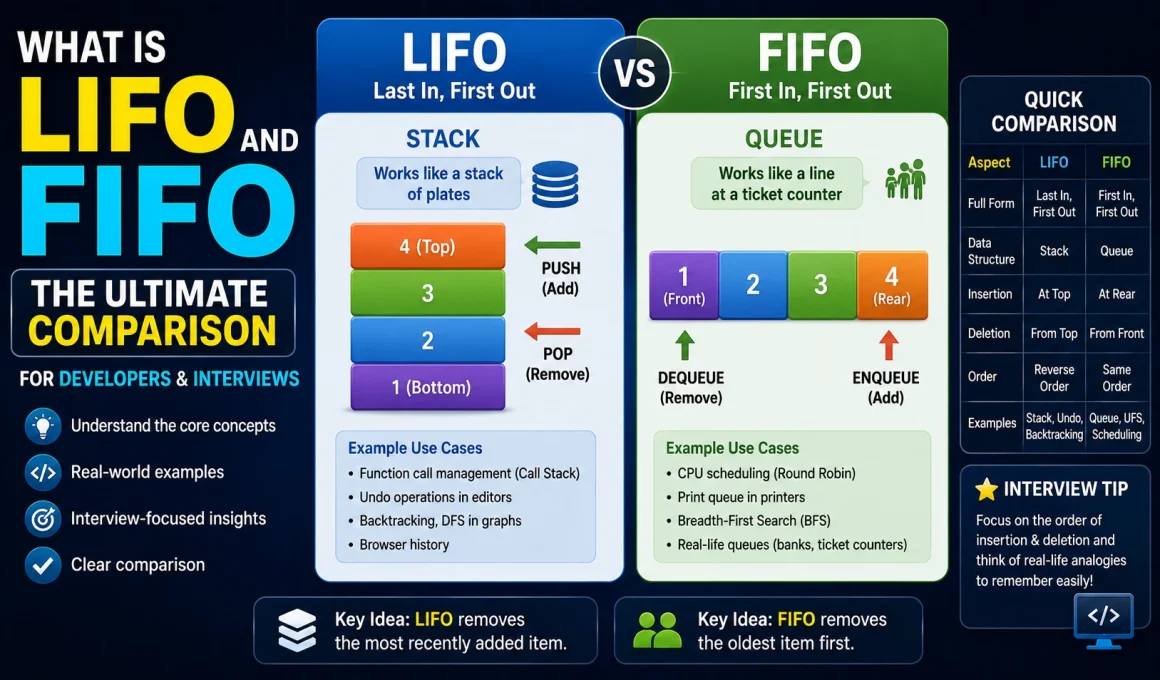
| Feature | LIFO (Last-In, First-Out) | FIFO (First-In, First-Out) |
|---|---|---|
| Principle | The newest item gets processed first. | The oldest item gets processed first. |
| Data Structure | Stack | Queue |
| Analogy | A stack of plates. | A line at a store. |
Now, let’s dive deep into the details.
A Deep Dive into LIFO (Last-In, First-Out)
The LIFO principle dictates that the last element added to a collection is the first one to be removed. It’s all about processing the most recent item first.
The data structure that perfectly embodies this is the Stack.
New to the term? For a complete beginner’s explanation, check out our guide: What is LIFO?
Advanced Use Cases for LIFO (Stacks):
While browser history and “Undo” are simple examples, LIFO’s power lies in more complex scenarios:
- Function Call Stack & Recursion: This is LIFO’s most important job. When
function_A()callsfunction_B(),function_Bis pushed on top of the call stack.function_Bmust finish (be popped off) beforefunction_Acan resume. This is why infinite recursion leads to a “Stack Overflow” error—the stack runs out of space! - Expression Evaluation: Compilers use stacks to correctly evaluate mathematical expressions. They convert expressions from infix notation (e.g.,
5 * (3 + 4)) to postfix notation (e.g.,5 3 4 + *) using a stack, which is then trivial to solve. - Backtracking Algorithms: In problems like solving a maze or a Sudoku puzzle, a stack is used to keep track of every decision made. When you hit a dead end, you “backtrack” by popping the last decision off the stack and trying a different path.
A Deep Dive into FIFO (First-In, First-Out)
The FIFO principle is the epitome of fairness: the first element that arrives is the first one to be served. It’s all about maintaining order.
The data structure for this job is the Queue.
Need a refresher? We cover all the basics in our beginner’s guide: What is FIFO?
Advanced Use Cases for FIFO (Queues):
Beyond simple print queues, FIFO is critical for managing resources and data flow:
- Resource Management in Operating Systems: When multiple processes need access to a shared resource (like a CPU or a disk drive), they are often placed in a queue. The OS scheduler then grants access in a FIFO manner to ensure no process is unfairly starved.
- Network Buffers & Data Streaming: When you stream a video, data packets arrive from the network. They are placed in a buffer (a queue) on your device. Your video player then dequeues these packets in the order they arrived to play the video smoothly and without jumbling the frames.
- Breadth-First Search (BFS): This essential graph traversal algorithm uses a queue to explore a graph level by level. It’s the key to finding the shortest path between two nodes in an unweighted graph, used in everything from Google Maps to social network analysis.
LIFO and FIFO: The Head-to-Head Technical Comparison
This is where the real differences become clear for a developer.
| Feature | LIFO (Implemented with a Stack) | FIFO (Implemented with a Queue) |
|---|---|---|
| Principle | Last-In, First-Out | First-In, First-Out |
| Data Structure | Stack | Queue |
| Access Points | One end (the “top”) for both insertion and deletion. | Two ends: rear for insertion, front for deletion. |
| Key Operations | push() (add to top), pop() (remove from top) | enqueue() (add to rear), dequeue() (remove from front) |
| Performance | push(), pop(), and peek() are all extremely fast O(1) operations. | enqueue() and dequeue() are also typically fast O(1) operations. |
| Primary Use | Reversing order, tracking nested states, “undoing” actions. | Maintaining order, fair resource sharing, processing items sequentially. |
The Interview Winner: How to Ace the “Stack vs. Queue” Question
You can almost guarantee this question will come up in a junior developer interview. Here’s how to nail it.
Interviewer: “What’s the difference between a Stack and a Queue? When would you use one over the other?”
Your Perfect Answer:
“A Stack and a Queue are both linear data structures, but they differ in how you access elements.
A Stack operates on a LIFO (Last-In, First-Out) principle. Think of it like a stack of plates—you can only add or remove from the top. This makes it perfect for scenarios where you need to process the most recent data first, like implementing an ‘Undo’ feature, managing function calls in the call stack, or for backtracking algorithms.
A Queue, on the other hand, operates on a FIFO (First-In, First-Out) principle, like a line at a store. Elements are added to the back and removed from the front. This is ideal for situations that require fairness and maintaining order, such as a print queue, managing CPU tasks, or in algorithms like Breadth-First Search.
So, the choice depends entirely on the problem: if I need to reverse order or handle recursion, I’d use a Stack. If I need to process items in the order they were received, I’d use a Queue.”
Tricky Follow-Up Questions (Be Ready!):
- “How would you implement a Queue using only two Stacks?”
This classic tests your problem-solving skills. The trick is to use one stack (in_stack) forenqueueoperations and another (out_stack) fordequeue. When you need to dequeue, you pop everything fromin_stackand push it toout_stack. This reverses the order, effectively simulating a queue. You only do this transfer whenout_stackis empty.Pythonclass QueueWithStacks: def __init__(self): self.in_stack = [] self.out_stack = [] def enqueue(self, item): self.in_stack.append(item) def dequeue(self): if not self.out_stack: while self.in_stack: self.out_stack.append(self.in_stack.pop()) if not self.out_stack: raise IndexError("Cannot dequeue from an empty queue") return self.out_stack.pop() - “Is the browser’s ‘Forward’ button a Stack or a Queue?”
It’s a Stack! When you press “Back,” the page you were on is popped from the “back stack” and pushed onto a “forward stack.” Hitting “Forward” simply pops from the forward stack.
Conclusion: The Right Tool for the Right Job
In the LIFO vs. FIFO debate, there is no “better” option. There is only the right option for the task at hand.
- Choose LIFO (Stack) when you care about the most recent item.
- Choose FIFO (Queue) when you care about fairness and order.
This decision is a cornerstone of efficient algorithm design. It’s not about which is superior—it’s about a developer’s ability to analyze a problem and select the perfect tool.
Mastering these fundamentals is non-negotiable for a career in software development. To go beyond theory and build complex, efficient applications, you need structured practice.
At Kaashiv Infotech, our Data Structures & Algorithms course is designed to do just that. We’ll guide you through Stacks, Queues, and advanced algorithms with hands-on projects that prepare you for real-world challenges and technical interviews.
👉 Supercharge your career—explore our DSA Course and Internship opportunities today!