
Benefits of Data Science – In 2026, data science is no longer a niche technical discipline—it has evolved into a core driver of innovation, efficiency, and competitive advantage across nearly every industry. With the explosion of digital platforms, IoT devices, cloud computing, and artificial intelligence, organizations are generating unprecedented volumes of data every second. The ability to extract meaningful insights from this data has become essential for survival and growth.
Data science combines statistics, machine learning, data engineering, and domain expertise to turn raw data into valuable knowledge. Businesses today are not just collecting data—they are actively using it to predict outcomes, optimize processes, and personalize experiences at scale. From healthcare and finance to retail, education, and manufacturing, data science is fundamentally reshaping how industries operate.
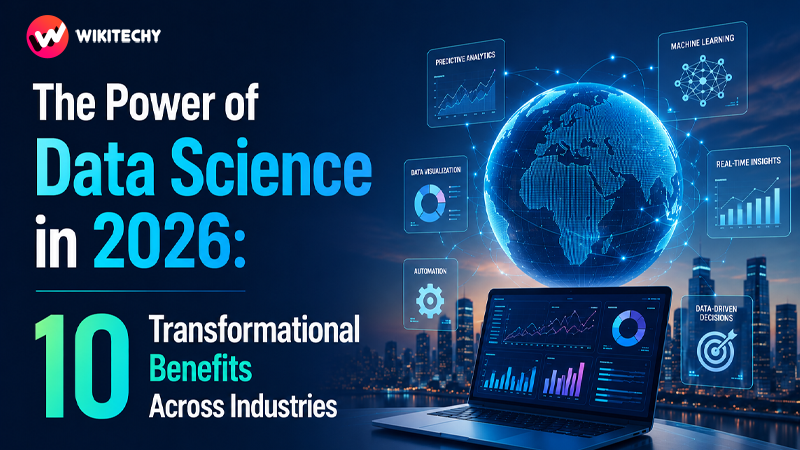
Let’s take a deep dive into the 10 transformational benefits of data science across sectors in 2026.
1. Smarter and Faster Decision-Making

One of the most impactful benefits of data science is its ability to empower organizations with data-driven decision-making. In the past, decisions were often based on intuition, limited data, or delayed reports. Today, data science enables real-time insights that support faster and more accurate decisions.
Organizations can analyze historical and real-time data to identify patterns, trends, and correlations. This allows leaders to evaluate multiple scenarios, reduce uncertainty, and choose the most effective strategies. Whether it’s pricing a product, entering a new market, or managing risks, data-backed decisions significantly improve outcomes.
2. Advanced Predictive Analytics
Predictive analytics has become a game-changer in 2026. Using machine learning models and statistical techniques, businesses can forecast future outcomes with impressive accuracy.
For example, companies can predict:
- Customer churn and retention rates
- Future sales and demand patterns
- Equipment failures in manufacturing
- Stock market trends in finance
This forward-looking approach allows organizations to move from reactive to proactive strategies, helping them stay ahead of competitors and market changes.
3. Hyper-Personalized Customer Experiences

Modern consumers expect personalized experiences, and data science makes this possible at scale. By analyzing user behavior, preferences, and interactions, businesses can deliver highly customized content, products, and services.
Streaming platforms recommend content based on viewing history, e-commerce sites suggest products tailored to user preferences, and banks offer personalized financial advice. This level of personalization increases customer satisfaction, engagement, and loyalty, ultimately driving higher revenue.
4. Operational Efficiency and Process Optimization

Data science plays a crucial role in identifying inefficiencies and optimizing operations. Organizations can analyze workflows, resource usage, and performance metrics to streamline processes.
In manufacturing, predictive maintenance reduces downtime by identifying potential equipment failures before they occur. In logistics, route optimization minimizes delivery times and fuel consumption. Automation powered by data science also reduces manual effort, allowing employees to focus on higher-value tasks.
5. Fraud Detection and Risk Management

With the rise of digital transactions, fraud detection has become more critical than ever. Data science uses anomaly detection and machine learning algorithms to identify suspicious patterns and prevent fraudulent activities in real time.
Financial institutions can monitor transactions continuously, flag unusual behavior, and take immediate action. Similarly, insurance companies use data science to detect fraudulent claims, while cybersecurity systems identify potential threats before they escalate.
This proactive approach significantly reduces financial losses and enhances security.
6. Transforming Healthcare Outcomes

The healthcare industry has experienced a massive transformation due to data science. By analyzing patient data, medical histories, and clinical trials, healthcare providers can deliver more accurate diagnoses and personalized treatments.
Data science enables:
- Early detection of diseases such as cancer and diabetes
- Predictive modeling for patient outcomes
- Optimization of hospital resources
- Drug discovery and research acceleration
These advancements not only improve patient care but also reduce costs and increase efficiency in healthcare systems.
7. Driving Innovation and Product Development

Innovation is at the heart of business growth, and data science fuels this innovation by providing insights into customer needs and market trends.
Companies can analyze customer feedback, usage patterns, and competitor data to design better products and services. This reduces the risk of product failure and ensures that new offerings align with market demand.
In 2026, many organizations are adopting data-driven product development strategies, where every feature and update is backed by data insights rather than assumptions.
8. Cost Reduction and Financial Optimization

Data science helps organizations manage their finances more effectively by identifying areas of unnecessary spending and optimizing resource allocation.
Businesses can analyze operational costs, forecast budgets, and improve financial planning. For example, supply chain analytics can reduce inventory costs, while energy analytics can optimize power consumption in large facilities.
By minimizing waste and improving efficiency, organizations can achieve higher profitability and sustainable growth.
9. Real-Time Insights and Intelligent Automation

Real-time data processing has become a standard requirement in 2026. With advancements in cloud computing and big data technologies, organizations can analyze data instantly and respond to events as they happen.
This capability enables:
- Real-time monitoring of systems and operations
- Instant alerts for anomalies or issues
- Automated decision-making using AI models
Intelligent automation powered by data science reduces human intervention, speeds up processes, and ensures consistent performance across systems.
10. Cross-Industry Impact and Scalability

One of the most powerful aspects of data science is its versatility. It is not limited to a single domain but can be applied across industries to solve complex problems.
For instance:
- Retail uses data science for demand forecasting and personalization
- Finance relies on it for risk assessment and fraud detection
- Transportation uses it for route optimization and traffic prediction
- Energy sectors use it for resource management and sustainability
This scalability makes data science a universal tool for innovation and efficiency, regardless of the industry.
Final Thoughts
In 2026, data science has become a critical pillar of digital transformation. Organizations that effectively leverage data science are better equipped to innovate, compete, and adapt in an ever-changing environment. From improving decision-making and enhancing customer experiences to driving efficiency and reducing risks, the benefits of data science are both profound and far-reaching.
As technology continues to evolve, the role of data science will only grow stronger. Businesses that invest in data-driven strategies today are not just improving their current operations—they are building a future-ready foundation for long-term success.
Want to learn more ??, Kaashiv Infotech Offers Data Analytics Course, Data Science Course, Cyber Security Course & More Visit Their Website www.kaashivinfotech.com.