
Java continues to be one of the most widely used programming languages for building enterprise applications, backend systems, web applications, Android applications, and large-scale software solutions. Its mature ecosystem and strong presence in enterprise development make Java a valuable skill for aspiring software developers.
If you’re starting from scratch and wondering how to become a Java Developer, following a structured roadmap can make the learning process much easier.
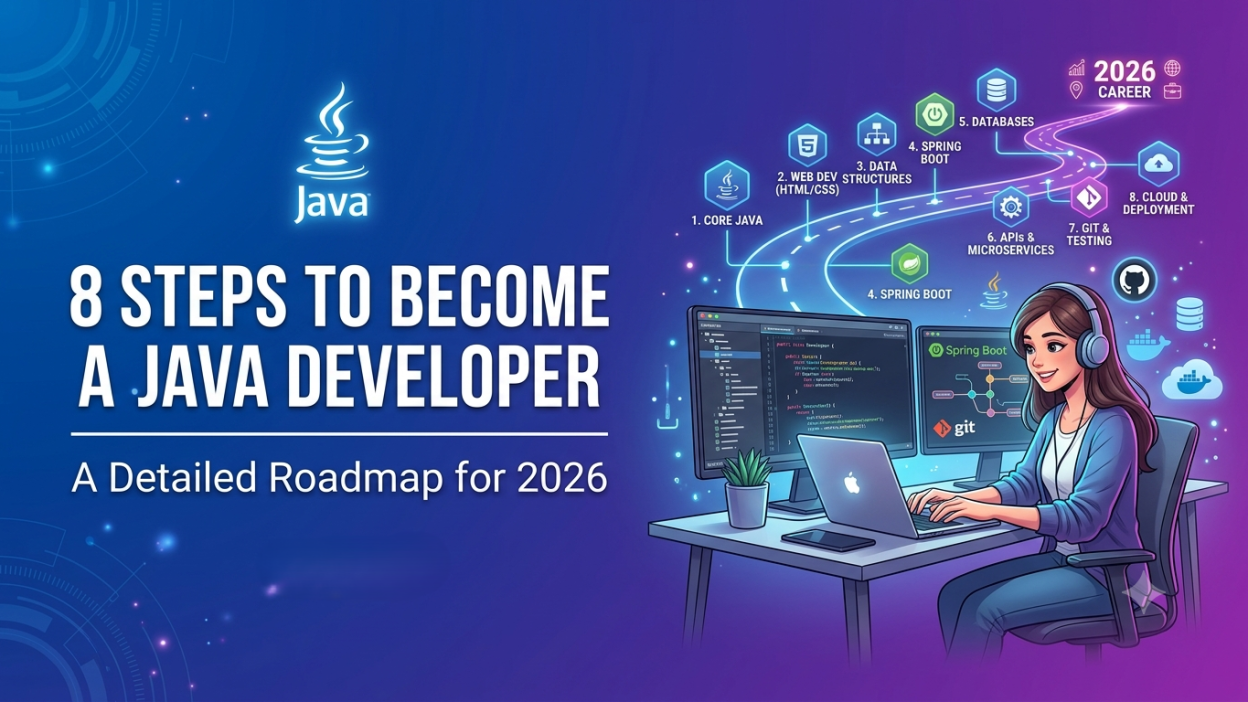
In this guide, we’ll explore 8 practical steps to become a Java Developer, from learning programming fundamentals to building projects and preparing for interviews.
Why Become a Java Developer?
Java has been around for decades, but it remains highly relevant in modern software development. Oracle currently lists Java 26 as the latest Java SE release and Java 25 as the latest Long-Term Support (LTS) release, with Java 21 as the previous LTS release.
Java is commonly used for:
- Enterprise applications
- Backend development
- Web applications
- Banking and financial software
- E-commerce platforms
- Cloud applications
- Microservices
- Android development
- Distributed systems
- Large-scale business applications
For beginners, Java also provides a strong foundation for learning Object-Oriented Programming, Data Structures, Algorithms, databases, APIs, and software architecture.
Step 1: Learn the Fundamentals of Programming
Before jumping directly into frameworks such as Spring Boot, start with programming fundamentals.
You should understand how programs work and how to solve problems using code.
Start by learning:
- Variables and data types
- Operators
- Conditional statements
- Loops
- Arrays
- Methods
- Input and output
- Type casting
- Basic error handling
- Debugging
- Basic problem-solving
For example:
public class Main {
public static void main(String[] args) {
    int age = 22;

    if (age >= 18) {
        System.out.println("Eligible to vote");
    } else {
        System.out.println("Not eligible to vote");
    }
}
}
Don’t focus only on memorizing syntax. Try to understand why the code works.
A good beginner should be able to take a simple problem such as calculating a student’s grade, checking whether a number is prime, or finding the largest number in an array and implement the solution independently.
What to Practice
Start with small programming problems:
- Reverse a string
- Check palindrome
- Find factorial
- Generate Fibonacci numbers
- Check prime numbers
- Find the largest element
- Count vowels
- Sort an array
- Calculate student grades
Once these become comfortable, move to Java-specific concepts.
Step 2: Master Core Java
This is one of the most important stages of your Java Developer roadmap.
After learning programming basics, spend considerable time understanding Core Java.
Important topics include:
Object-Oriented Programming
Java is heavily based on object-oriented programming.
Learn:
- Classes and objects
- Constructors
- Encapsulation
- Inheritance
- Polymorphism
- Abstraction
- Interfaces
For example:
class Employee {
String name;
double salary;

Employee(String name, double salary) {
    this.name = name;
    this.salary = salary;
}

void displayDetails() {
    System.out.println(name + " - " + salary);
}
}
You should understand how objects communicate with each other rather than simply knowing the definitions.
Other Core Java Topics
You should also learn:
- String and StringBuilder
- Exception handling
- Packages
- Access modifiers
- Static and final keywords
- Wrapper classes
- Enums
- Generics
- Collections
- Lambda expressions
- Functional interfaces
- Stream API
- Date and Time API
- Multithreading
- Concurrency basics
Modern Java learning should not stop at older Java 8 concepts. Understanding newer Java releases is useful as well, particularly when working with modern applications. Oracle currently provides documentation for Java 26, 25, 21, 17, 11, and 8.
Step 3: Learn Data Structures and Algorithms
Knowing Java syntax isn’t enough to become a professional Java Developer.
You also need to learn Data Structures and Algorithms (DSA).
DSA improves your problem-solving ability and is particularly important for technical interviews.
Start with:
- Arrays
- Strings
- Linked Lists
- Stacks
- Queues
- Hash Tables
- Sets
- Trees
- Binary Search Trees
- Heaps
- Graphs
Then learn important algorithms such as:
- Linear Search
- Binary Search
- Bubble Sort
- Selection Sort
- Insertion Sort
- Merge Sort
- Quick Sort
- Recursion
- Tree Traversal
- Graph Traversal
You should also understand time and space complexity.
For example:
O(1) ConstantO(log n) LogarithmicO(n) LinearO(n log n) LinearithmicO(n²) Quadratic
Don’t try to solve hundreds of problems without understanding the concepts. Instead, solve problems consistently and learn different approaches to the same problem.
Step 4: Learn SQL and Database Management
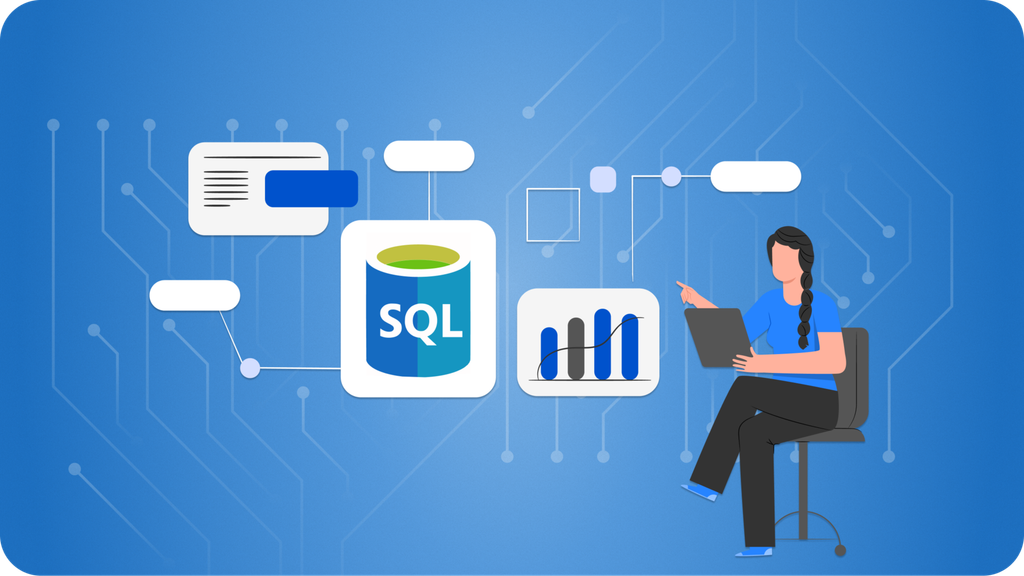
Most real-world Java applications need a database.
For example, an e-commerce application may need to store:
- Customer information
- Products
- Orders
- Payments
- Addresses
- Reviews
So, SQL is an essential skill for Java Developers.
Start with relational databases such as:
- MySQL
- PostgreSQL
- Oracle Database
Learn SQL concepts including:
- SELECT
- INSERT
- UPDATE
- DELETE
- WHERE
- ORDER BY
- GROUP BY
- JOIN
- Subqueries
- Aggregate functions
- Primary keys
- Foreign keys
- Indexes
- Transactions
For example:
SELECT name, salaryFROM employeesWHERE salary >50000;
Then learn how Java applications communicate with databases.
Important concepts include:
- JDBC
- Connection management
- PreparedStatement
- ResultSet
- ORM
- JPA
- Hibernate
Understanding databases will help you build applications that work with real-world data rather than simple in-memory programs.
Step 5: Learn Web Development and Spring Boot
Once you are comfortable with Core Java, DSA, and SQL, move into backend development.
This is where the Java ecosystem becomes especially powerful.
Start by understanding basic web concepts:
- HTTP
- HTTPS
- Request and response
- GET
- POST
- PUT
- DELETE
- Status codes
- JSON
- REST APIs
- Authentication
- Authorization
Then learn the Spring Framework and Spring Boot.
Spring Boot is widely used for developing Java backend applications.
Focus on:
- Spring Boot fundamentals
- Dependency Injection
- Inversion of Control
- Spring MVC
- REST Controllers
- Services
- Repositories
- Configuration
- Exception handling
- Validation
- Spring Data JPA
- Hibernate
- Spring Security
A simple REST controller might look like:
@RestController
@RequestMapping(“/api/users”)
public class UserController {
@GetMapping
public String getUsers() {
    return "List of users";
}
}
After learning this, build APIs that communicate with a database.
For example:
Client ↓REST API ↓Controller ↓Service ↓Repository ↓Database
Understanding this flow is extremely important for aspiring Java backend developers.
Step 6: Learn Development Tools and Git
Professional development isn’t just about writing Java code.
You also need to understand the tools developers use every day.
Start with Git and GitHub.
Learn commands such as:
git initgit add .git commit -m"Initial commit"git pushgit pullgit branchgit merge
You should understand:
- Repositories
- Branches
- Commits
- Pull requests
- Merge conflicts
.gitignore- Remote repositories
Then learn build tools such as:
- Maven
- Gradle
Maven is particularly important for Java developers because it helps manage:
- Dependencies
- Project builds
- Plugins
- Testing
- Packaging
You should also become comfortable with an IDE such as:
- IntelliJ IDEA
- Eclipse
- Visual Studio Code
The goal isn’t to learn every tool. Instead, learn enough to work comfortably in a professional development environment.
Step 7: Build Real-World Java Projects
This is where your learning becomes practical.
Reading tutorials can teach you concepts, but projects demonstrate that you can actually use those concepts.
Start with small projects and gradually increase the complexity.
Beginner Java Projects
You can start with:
- Calculator
- Student Management System
- Library Management System
- Bank Account System
- Employee Management System
- Quiz Application
These projects help you practice Core Java and OOP.
Intermediate Projects
Once you understand databases and JDBC/JPA, build:
- Expense Tracker
- Online Book Store
- Inventory Management System
- Employee Leave Management System
- Online Examination System
- Hospital Management System
Advanced Java Projects
After learning Spring Boot, build projects such as:
E-Commerce Backend
Features could include:
- User registration
- Login
- Product management
- Shopping cart
- Orders
- Payments
- Admin dashboard APIs
Job Portal
You could implement:
- User authentication
- Job posting
- Job searching
- Resume upload
- Applications
- Employer dashboard
Task Management API
Features could include:
- User registration
- Create tasks
- Update tasks
- Delete tasks
- Task status
- Role-based access
- Database integration
Try to publish your projects on GitHub with a proper README file.
A good project should explain:
- What the application does
- Technologies used
- How to install it
- How to run it
- API endpoints
- Database structure
- Screenshots, where applicable
This can make your portfolio much stronger.
Step 8: Prepare for Java Developer Jobs
The final step is preparing yourself for the actual job market.
Having completed tutorials isn’t enough. You need to demonstrate your knowledge during interviews.
Revise Core Java
Be prepared for questions about:
- OOP
- Collections
- Exception handling
- Strings
- Interfaces
- Abstract classes
- Multithreading
- JVM
- Memory management
- Garbage collection
- Java Streams
- Lambda expressions
Practice DSA
Regularly solve coding problems involving:
- Arrays
- Strings
- HashMaps
- Linked Lists
- Stacks
- Queues
- Trees
- Sorting
- Searching
- Recursion
Prepare SQL
Interviewers may ask you to write queries involving:
- JOIN
- GROUP BY
- Subqueries
- Aggregations
- Indexes
- Transactions
Learn Spring Boot Interview Topics
You should understand:
- Dependency Injection
- REST APIs
- Spring MVC
- Spring Data JPA
- Hibernate
- Spring Security
- Authentication
- Authorization
- Exception handling
- Microservices basics
Build Your Resume
Your resume should highlight:
Technical Skills
JavaSpring BootSpring Data JPAHibernateSQLMySQL/PostgreSQLREST APIsGitMaven
Projects
Mention what you built, the technologies used, and what functionality you implemented.
Avoid simply writing:
“Created an e-commerce project.”
Instead:
“Developed a Spring Boot-based e-commerce REST API with user authentication, product management, order processing, and MySQL database integration.”
That gives recruiters a much clearer picture of your skills.
Java Developer Roadmap at a Glance
You can think of the complete roadmap like this:
Programming Fundamentals
↓
Core Java
↓
OOP + Collections
↓
DSA + SQL
↓
JDBC + Hibernate/JPA
↓
Spring + Spring Boot
↓
REST APIs + Security
↓
Git + Maven + Testing
↓
Real-World Projects
↓
Resume + Interviews
↓
Java Developer
How Long Does It Take to Become a Java Developer?
The time depends on how much time you can dedicate each day.
A beginner studying consistently might follow a progression such as:
| Stage | Approximate Time |
|---|---|
| Programming Fundamentals | 2–3 weeks |
| Core Java | 4–6 weeks |
| DSA | 4–8 weeks |
| SQL & Databases | 2–4 weeks |
| Spring Boot | 4–6 weeks |
| Projects | 4–8 weeks |
| Interview Preparation | 3–6 weeks |
These stages can overlap. You don’t necessarily have to finish one completely before starting the next.
The most important factor is consistent practice.
Skills You Should Have Before Applying for Java Jobs
Before applying for junior Java Developer positions, make sure you can confidently:
- Write Java programs without copying tutorials
- Explain OOP concepts
- Use Java Collections
- Handle exceptions
- Work with Java Streams and Lambdas
- Solve basic and intermediate DSA problems
- Write SQL queries
- Connect applications to databases
- Build REST APIs
- Develop applications using Spring Boot
- Use JPA/Hibernate
- Use Git and GitHub
- Understand Maven or Gradle
- Build at least 2–3 meaningful projects
- Explain your projects during interviews
You don’t need to know everything before applying. Software development is a continuous learning process.
Final Thoughts
Becoming a Java Developer isn’t about learning one programming language and immediately getting a job. It is a gradual process that combines programming fundamentals, Core Java, DSA, databases, backend development, frameworks, development tools, projects, and interview preparation.
The best approach is to learn one concept, practice it, and then use it in a project.
If you’re starting from zero, don’t worry about learning everything at once. Follow the roadmap step by step:
Learn Java → Practice DSA → Learn SQL → Master Spring Boot → Build Projects → Learn Development Tools → Prepare for Interviews → Apply for Jobs.
Java’s ecosystem continues to evolve, with Java 25 currently serving as the latest LTS release and Java 26 as the latest feature release as of 2026.
Want to Learn More About Java ?, Kaashiv Infotech Offers, Full Stack Java Course, Java Course, Data Science Course, Internships & More, Visit Their Website www.kaashivinfotech.com.