

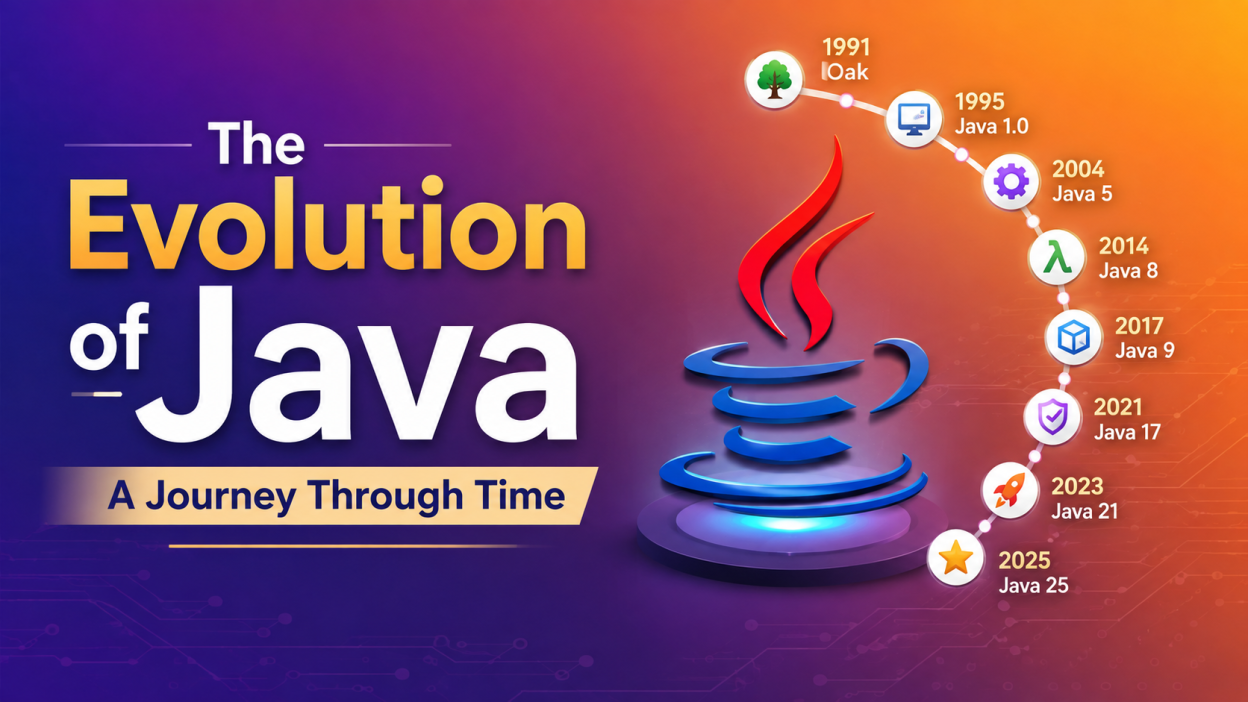
I still find Java’s journey fascinating because Java didn’t become successful overnight. It changed slowly, release after release, while keeping one important idea alive: write code once and run it across different environments.
From the early days of Oak to modern Java releases such as Java 21, Java 25, and Java 26, the Evolution of Java shows how a programming language can survive for decades by adapting without completely losing its identity.
So, how did Java get here? Let’s go back to the beginning. ☕
Key Highlights of the Evolution of Java
Before we dive into the story, here are the major points I want you to remember:
- 🌱 Java started as a project at Sun Microsystems in 1991.
- 🌳 The original name of Java was Oak.
- 🌐 Java was publicly introduced in 1995.
- 💻 Java became popular because of its platform-independent approach.
- 🏢 Java grew rapidly in enterprise and server-side development.
- ⚡ Java 5 introduced major language improvements such as generics, annotations, enhanced for-loops, and autoboxing.
- 🚀 Java 8 brought lambda expressions and the Stream API, changing how many developers wrote Java.
- 🧩 Java 9 introduced the Java Platform Module System.
- 📦 Java 17 and Java 21 became important Long-Term Support (LTS) releases.
- 🔥 Java 25 became the latest LTS release in September 2025.
- 🆕 Java 26 is currently the latest Java SE release as of 2026.
1. The Beginning of Java: From Oak to Java 🌱
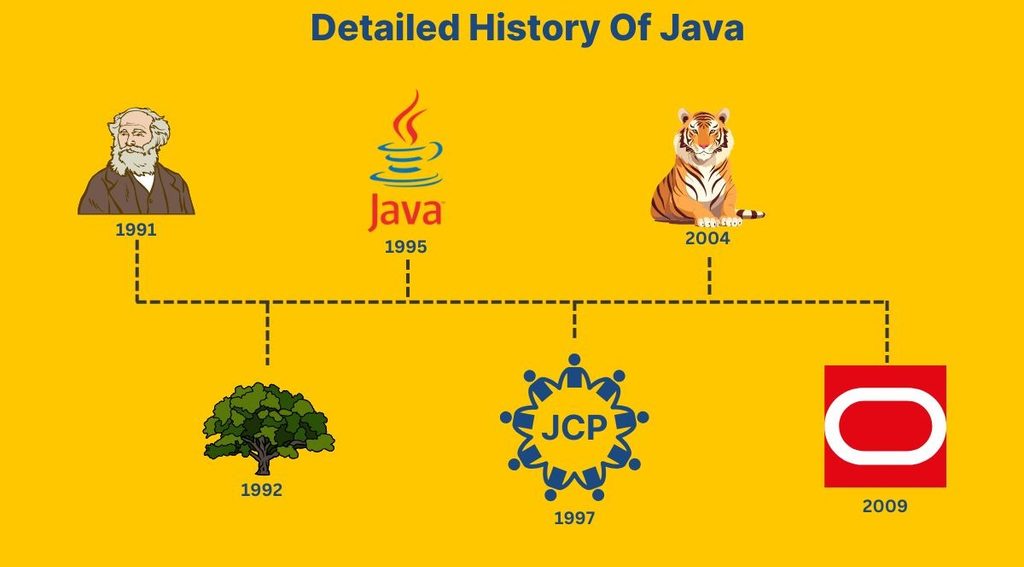
The Evolution of Java actually began before the name “Java” existed.
In 1991, a team at Sun Microsystems started what became known as the Green Project. James Gosling and his team were exploring software for consumer electronic devices.
The language they created was initially called Oak.
That part of Java history is easy to miss. Most beginners learn Java as if it appeared directly as “Java,” but it didn’t.
Oak was designed with devices and embedded systems in mind. Later, the team realized that the growing Internet offered a much bigger opportunity.
The language was redesigned and renamed Java.
Oracle’s historical material confirms that the original Oak project began in 1991 and that Java was publicly introduced in 1995.
And that’s where the real Evolution of Java began.
2. Java Arrives in 1995 🌐
Java officially entered the public spotlight in 1995.
The timing couldn’t have been better.
The Internet was growing quickly, and developers needed ways to create software that could work across different types of computers.
Java had an interesting answer.
Instead of compiling code directly for one particular operating system, Java programs could run through the Java Virtual Machine (JVM).
This led to Java’s famous idea:
“Write once, run anywhere.”
Of course, modern software development is more complicated than that slogan suggests. But the basic concept was powerful.
A developer could write Java code, compile it into bytecode, and then run that bytecode on a compatible JVM.
That portability became one of Java’s biggest strengths.
3. Java 1.0 and the Rise of Platform Independence
The first major public version was Java 1.0.
At this stage, Java was still young. It didn’t have the enormous ecosystem we associate with it today.
But it already had several characteristics that helped it stand out:
- Object-oriented programming
- Automatic memory management
- Garbage collection
- Strong type checking
- Multithreading
- Platform independence
- Built-in networking support
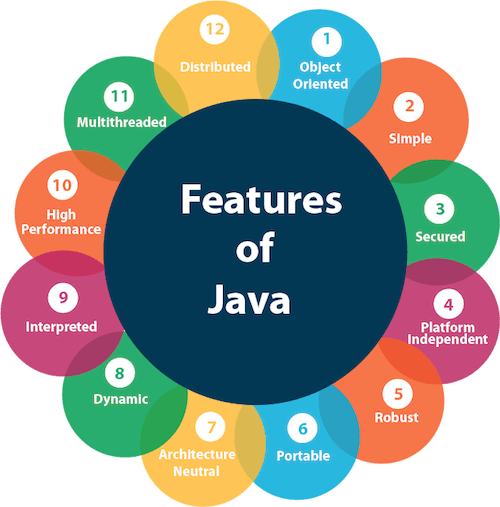
Java’s original design goals included being simple, object-oriented, robust, secure, architecture-neutral, portable, and suitable for networked computing.
When I look at these goals today, what surprises me is how many of them are still relevant.
That’s one reason the Evolution of Java feels different from the history of many older languages.
4. Java Becomes More Than an Internet Language
Java didn’t remain limited to small Internet programs.
It gradually moved into:
- Web applications
- Enterprise software
- Banking systems
- Server applications
- Desktop applications
- Scientific applications
- Mobile development
- Embedded systems
Java’s versatility helped it survive different technology trends.
One year developers were talking about web applications. Later, enterprise applications became huge. Then mobile development exploded.
Java kept finding a place.
Oracle notes that Java is used across web, mobile, desktop, embedded, enterprise, scientific, and server-side applications.
5. Java 2 and the Growth of the Platform 🏢
As Java matured, Sun introduced Java 2, which was a major stage in the Evolution of Java.
Java started being discussed not just as a language but as a broader platform.
The Java platform became commonly associated with different editions, including:
- Java SE – Standard Edition
- Java EE – Enterprise Edition
- Java ME – Micro Edition
Java SE became the foundation for general-purpose Java development.
Java EE focused heavily on enterprise applications.
Java ME targeted devices with limited resources.
This separation helped Java reach different categories of developers and applications.
6. Java 5: A Major Turning Point 🚀
For me, one of the most important stages in the Evolution of Java was Java 5, released in 2004.
Java 5 introduced several features that made everyday Java programming much better.
Some important additions included:
Generics
Generics allowed developers to write more type-safe collections and APIs.
For example:
List<String> names = new ArrayList<>();
Instead of treating everything as a generic Object, we can tell Java exactly what type the collection should contain.
Enhanced for Loop
Java also introduced the enhanced for loop:
for (String name : names) {
    System.out.println(name);
}
For beginners, this looks simple.
But small improvements like this made Java code cleaner and easier to read.
Annotations
Annotations became another important part of modern Java.
You have probably seen:
@Override
That familiar annotation came from this era.
Java 5 also introduced features such as autoboxing, enums, variable arguments, and static imports.
This was a major step in the Evolution of Java because Java was becoming more expressive without abandoning its core design.
7. Java 8: The Revolution Developers Still Talk About ☕
If I had to choose one Java release that changed the way many developers write Java, I’d pick Java 8.
Java 8 was released in 2014.
Its biggest headline features included:
- Lambda expressions
- Stream API
- Functional interfaces
- Method references
- Default methods in interfaces
- Improved date and time API
Before Java 8, Java developers often needed more lines of code to express certain operations.
Then lambda expressions arrived.
For example:
List<String> names = Arrays.asList("Asha", "Rahul", "John");

names.forEach(name -> System.out.println(name));
Suddenly, Java felt more modern.
The Stream API also changed how developers handled collections.
For example:
names.stream()
     .filter(name -> name.startsWith("A"))
     .forEach(System.out::println);
This is a great example of the Evolution of Java in action.
Java wasn’t throwing away object-oriented programming. It was adding useful ideas from functional programming.
That balance helped Java remain relevant.
8. Java 9 and the Module System 🧩
Java 9 arrived in September 2017 and introduced the Java Platform Module System.
This was a significant architectural change.
Large Java applications can contain thousands of classes and dependencies. Managing such applications can become difficult.
Modules provided a stronger way to organize Java applications and control dependencies.
Java 9 also marked another important change in the Java release cycle.
Instead of waiting several years for a giant release, Java moved toward a much faster release model.
That meant developers could receive improvements more frequently.
This was an important shift in the Evolution of Java.
9. From Java 10 to Java 16: Faster and Cleaner Java
After Java 9, Java started moving through releases at a much faster pace.
Several useful language features arrived during these versions.
For example:
Java 10 introduced local variable type inference using var.
var name = "Aishwariya";
Java 14 introduced switch expressions.
Java 15 introduced text blocks.
String message = """
        Hello Java!
        Welcome to programming.
        """;
Java 16 made records a permanent language feature.
These changes may look small individually.
Together, however, they show something important about the Evolution of Java.
Java was becoming less verbose while keeping its familiar structure.
10. Java 17: A New LTS Era 🔒
Java 17 was released in September 2021 and became an important Long-Term Support (LTS) release.
LTS versions matter because companies often prefer versions that receive support for a longer period.
Java 17 introduced or finalized several important features, including sealed classes.
For example:
public sealed class Vehicle
    permits Car, Bike {
}
Sealed classes give developers more control over which classes can extend or implement a particular type.
For enterprise developers, LTS releases became especially important.
Instead of immediately moving to every six-month release, organizations could choose an LTS version and build long-term projects around it.
11. Java 21: Modern Java Gets Even Better 🚀
Java 21 arrived in September 2023 and became another LTS release.
This release brought several modern language features, including:
- Record patterns
- Pattern matching for
switch - Virtual threads
- Sequenced collections
- Other JVM and performance improvements
One feature that attracted a lot of attention was virtual threads.
Traditional threads can become expensive when applications need to handle huge numbers of concurrent tasks.
Virtual threads provide a lightweight approach to concurrency and are especially interesting for server-side applications.
Java 21 became a major milestone in the modern Evolution of Java.
12. Java 25: The Latest LTS Chapter 📚
The Evolution of Java didn’t stop at Java 21.
Java 25 was released in September 2025 and became an LTS release.
Oracle’s current roadmap identifies Java 25 as an LTS release, with Premier Support planned through September 2030.
Java 25 also introduced language improvements such as:
- Module import declarations
- Compact source files and instance
mainmethods - Flexible constructor bodies
These features are interesting because they make Java easier to write without changing the fundamentals that developers already know.
13. Java 26: Where Java Stands Today
As of 2026, Java 26 is the latest Java SE release.
Oracle currently lists:
- Java 26 – latest release
- Java 25 – latest LTS release
- Java 21 – previous LTS release
- Java 17
- Java 11
- Java 8
Java 26 is a regular release, while Java 25 remains the latest LTS version.
This distinction is important if you’re learning Java today.
If you’re a beginner, you don’t necessarily need to chase every new version.
I’d recommend understanding the fundamentals first and then learning the features relevant to the Java version used by your workplace or project.
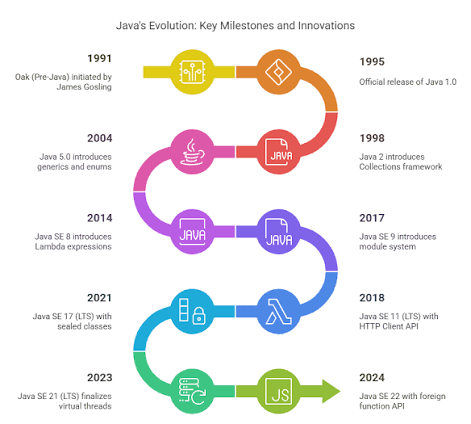
Java Versions: A Simple Timeline
Here is the Java history in a quick format:
| Year | Java Version | Major Milestone |
|---|---|---|
| 1991 | Oak | Java project begins |
| 1995 | Java 1.0 | Java becomes public |
| 1998 | Java 1.2 | Java 2 era begins |
| 2004 | Java 5 | Generics, annotations, enhanced for-loop |
| 2014 | Java 8 | Lambdas and Stream API |
| 2017 | Java 9 | Module system |
| 2018 | Java 11 | LTS release |
| 2021 | Java 17 | LTS + modern language improvements |
| 2023 | Java 21 | LTS + virtual threads and pattern matching |
| 2025 | Java 25 | LTS release |
| 2026 | Java 26 | Latest Java SE release |
Oracle maintains the official Java release notes for current and historical JDK versions.
Why Has Java Survived for So Long? ❤️
This is probably the biggest question.
Why is Java still relevant after more than 30 years?
I think the answer is adaptability.
Java didn’t try to become a completely different language every few years.
Instead, it kept its foundation and added new capabilities.
The Evolution of Java can be seen in this pattern:
Oak → Java → Java 5 → Java 8 → Java 9 → Java 17 → Java 21 → Java 25 → Java 26
Each stage added something useful.
Java also benefits from a massive ecosystem, mature development tools, frameworks, libraries, learning resources, and a large developer community.
And there’s another practical reason.
Companies don’t casually rewrite huge enterprise applications just because a new programming language becomes popular.
If a Java application is stable, secure, scalable, and generating business value, organizations have a strong reason to continue investing in it.
Java Evolution and Modern Software Development
Today, Java is no longer limited to traditional desktop or enterprise applications.
Java is used in:
- ☁️ Cloud applications
- 🏦 Banking systems
- 🛒 E-commerce platforms
- 📱 Android-related development
- 🔐 Security applications
- 🌐 Backend systems
- 📊 Data-processing systems
- 🏢 Enterprise software
- 🤖 Modern AI-related infrastructure and applications
The language has also continued improving its performance, garbage collection, concurrency capabilities, developer experience, and tooling.
Oracle describes Java as an enterprise-grade platform used across modern application development, cloud environments, connected devices, and AI-related applications.
What the Evolution of Java Means for Beginners 🎯
If you’re learning Java today, you might look at the history and think:
“Do I really need to learn all these versions?”
No.
Please don’t make learning harder than it needs to be.
I’d start with:
- Java syntax
- Variables and data types
- Operators
- Conditional statements
- Loops
- Arrays
- Strings
- Methods
- Object-oriented programming
- Exception handling
- Collections
- Generics
- File handling
- Multithreading
- Lambda expressions
- Stream API
- JDBC
- Spring/Spring Boot
Once your fundamentals are strong, understanding the Evolution of Java becomes much easier.
You’ll start recognizing why features were introduced instead of simply memorizing them.
Final Thoughts on the Evolution of Java ☕
When I look at the Evolution of Java, I don’t see a programming language that stayed successful because it never changed.
I see the opposite.
Java survived because it changed when it needed to change.
It started as Oak.
It moved toward the Internet.
It became an enterprise powerhouse.
Java 5 made the language more expressive.
Java 8 changed everyday coding with lambdas and streams.
Java 9 introduced modules.
Java 17 and Java 21 brought modern language and JVM improvements through LTS releases.
Java 25 continued that journey as the latest LTS release, while Java 26 represents the current Java SE release in 2026.
That’s what makes the Evolution of Java so interesting.
Technology changes quickly. Some languages disappear. Others become niche tools.
Java kept moving.
And if you’re learning Java today, you’re not learning a dead or frozen language. You’re learning a platform that has been evolving for more than three decades — and is still evolving.
Want to Learn More About Java ?, Kaashiv Infotech Offers, Full Stack Java Course, Java Course, Data Science Course, Internships & More, Visit Their Website www.kaashivinfotech.com.
