
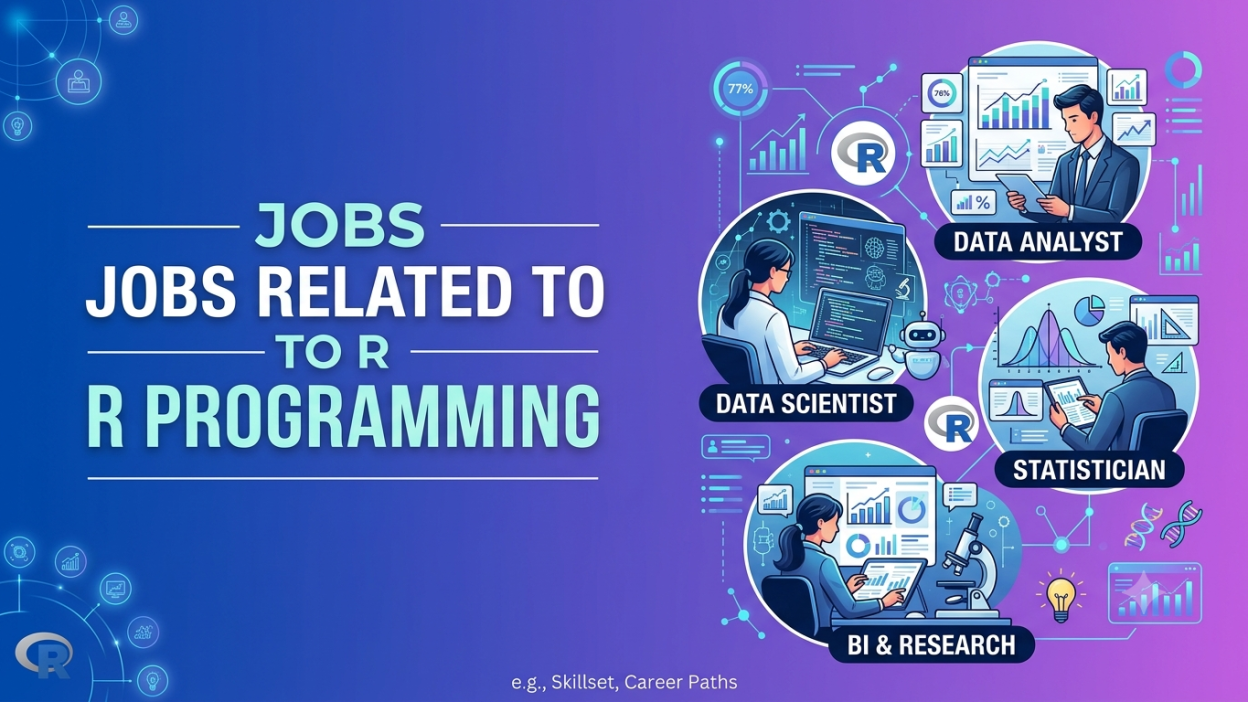
R Programming is one of those skills that I often see people associate only with statistics. But that’s no longer the full picture. R Programming has grown into a useful tool for data analysis, visualization, research, machine learning, finance, healthcare, and many other fields.
If you’re learning R and wondering, “Okay, but what job can I actually get with this?” — you’re asking the right question.
The good news is that you don’t have to become a statistician just because you know R.
You can explore roles such as R Programmer, Data Analyst, Data Scientist, Statistical Programmer, Business Analyst, Machine Learning Engineer, Research Analyst, and more.
In this article, I’ll walk through the major jobs related to R Programming, the skills you’ll need, what each role actually involves, and how you can start preparing for them.
Key Highlights
Before we get into the details, here are the main things I’ll cover:
- 💻 7+ career options related to R Programming
- 📊 What an R Programmer actually does
- 🔬 R Programming careers in data science and statistics
- 🤖 How R is used in machine learning
- 🏥 R Programming opportunities in healthcare and research
- 🛠️ Important skills to learn along with R
- 📚 Beginner-friendly career roadmap
- 💰 Salary expectations and factors affecting pay
- 🎯 Tips for getting your first R-related job
What Is R Programming?
Let’s start with the basics.
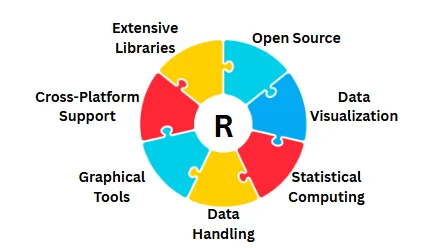
R Programming is a programming language and environment mainly used for statistics, data analysis, data visualization, and research.
What I like about R is that it makes working with data much easier.
For example, imagine you have sales data for 10,000 customers. You want to know:
- Which product sells the most?
- Which month generates the highest revenue?
- Which customers are likely to stop buying?
- Is there a relationship between age and spending?
- Can we predict next month’s sales?
Instead of manually going through thousands of rows, we can use R Programming to clean the data, analyze it, create charts, and build statistical or machine-learning models.
R also has a huge collection of packages such as ggplot2, dplyr, tidyr, caret, and Shiny, which extend what you can do with the language.
If you’re completely new to R, you can start with the official R Project website.
Why Are R Programming Jobs in Demand?
Data is everywhere.
Companies collect customer information, sales records, website traffic, financial information, healthcare data, employee information, and much more.
But raw data isn’t particularly useful by itself.
Someone needs to turn that data into something understandable.
That’s where people with R Programming skills can become valuable.
For example, a company might have millions of customer records. A data professional could use R to identify patterns and answer questions that help the business make better decisions.
R is particularly popular in areas where statistics and data analysis are important.
That’s why you’ll find R Programming used in:
- Finance 💰
- Healthcare 🏥
- Marketing 📢
- Education 🎓
- Pharmaceuticals 💊
- Research 🔬
- Government
- Banking
- Data science
- Machine learning
1. R Programmer
Let’s start with the most obvious career option: R Programmer.
An R Programmer works primarily with R to perform tasks such as:
- Data cleaning
- Data analysis
- Statistical calculations
- Data visualization
- Report generation
- Automation
- Building analytical applications
For example, suppose a company collects customer feedback every month.
An R Programmer might create a script that automatically processes the feedback, calculates important statistics, generates charts, and produces a report.
That’s much better than someone repeating the same manual process every month.
Skills you should learn
If you want to become an R Programmer, focus on:
- R fundamentals
- Variables and data types
- Functions
- Loops
- Data frames
- Lists and vectors
- Data manipulation
- Error handling
- Packages
- Visualization
- SQL
Learning SQL along with R Programming is especially useful because many real-world data jobs involve working with databases.
2. Data Analyst
This is one of the most practical career paths for someone learning R Programming.
A Data Analyst collects, cleans, analyzes, and interprets data to help organizations make decisions.
Imagine an online shopping company.
The company wants to know why sales dropped last month.
A Data Analyst could examine:
- Website traffic
- Customer purchases
- Product categories
- Marketing campaigns
- Customer demographics
- Previous sales
Using R Programming, the analyst could identify patterns and present the results using charts and reports.
Useful skills for a Data Analyst
I would recommend learning:
- R Programming
- SQL
- Excel
- Statistics
- Data visualization
- Power BI or Tableau
- Basic Python
- Business communication
You don’t need to master everything on day one.
Start with R + SQL + statistics + visualization and build from there.
3. Data Scientist
If you’re interested in a more advanced career, Data Scientist is another major option.
A Data Scientist uses data to solve complex problems and build predictive models.
For example: “Which customers are likely to leave our service next month?”
That’s not just a simple reporting question.
A Data Scientist might collect the data, clean it, explore patterns, create features, train a machine-learning model, evaluate its performance, and communicate the results.
R Programming can support many of these tasks, particularly statistical analysis and visualization.
Skills needed
For this career, you’ll need more than R.
Learn:
- R Programming
- Statistics
- Probability
- Machine learning
- Data visualization
- SQL
- Data cleaning
- Feature engineering
- Model evaluation
- Basic mathematics
You can also explore the official RStudio Posit resources to learn more about R and its modern data-science ecosystem.
4. Statistical Programmer
Here’s a career option that many beginners don’t hear about: Statistical Programmer.
Statistical programmers work heavily with statistical data and programming techniques.
This role is particularly important in areas such as:
- Clinical research
- Pharmaceuticals
- Healthcare
- Biostatistics
- Research organizations
For example, during a clinical study, researchers may collect huge amounts of patient and trial data.
A Statistical Programmer may help process the data, perform statistical analysis, and prepare outputs for researchers.
This career can be particularly interesting if you enjoy statistics more than traditional software development.
5. Data Scientist in Healthcare
Healthcare is another interesting area where R Programming can be useful.
Hospitals, pharmaceutical companies, universities, and research organizations generate enormous amounts of data.
R can be used for:
- Clinical data analysis
- Research
- Patient-data analysis
- Statistical modelling
- Medical research
- Visualization
- Predictive analytics
For example, researchers may want to investigate whether certain factors are associated with a particular health outcome.
R can help them analyze the data and visualize the results.
If you have an interest in both healthcare and data, this can be a fascinating career direction.
6. Research Analyst
Do you enjoy asking questions and finding patterns?
Then you might enjoy being a Research Analyst.
Research Analysts work with data to answer specific research questions.
They can work in:
- Universities
- Research institutions
- Market research companies
- Government organizations
- Consulting firms
- Healthcare organizations
For example, a market research company might want to understand customer preferences for a new product.
A Research Analyst can collect survey data, analyze it using R Programming, create visualizations, and prepare a report.
Here, your ability to explain the data clearly matters just as much as your technical skills.
7. Business Analyst
You might be surprised to see Business Analyst on a list of R Programming jobs.
But R can be a useful additional skill for business analysts who work heavily with data.
A Business Analyst generally focuses on understanding business problems and helping organizations make better decisions.
For example: “Why are customers buying less from us?”
A Business Analyst could use data to investigate the problem.
Knowing R Programming can help when the analysis becomes more advanced than what can comfortably be handled with spreadsheets.
However, if you’re targeting Business Analyst roles, don’t spend all your time learning R.
Also focus on:
- Excel
- SQL
- Power BI
- Business requirements
- Communication
- Problem solving
- Data interpretation
8. Machine Learning Engineer
Now we’re moving into a more technical direction.
A Machine Learning Engineer builds and works with systems that use machine-learning models.
R can be used for machine learning, although Python is extremely common in many modern machine-learning development environments.
So I wouldn’t recommend learning R alone if your primary goal is to become a Machine Learning Engineer.
Instead, consider learning:
R + Python + SQL + Statistics + Machine Learning
R can be especially useful when your work involves statistical modelling and analysis.
R Programming Jobs: Which Career Should You Choose?
This is probably the question you’re really waiting for.
There isn’t one perfect answer.
It depends on what you enjoy.
| Career | R Usage | Other Important Skills |
|---|---|---|
| R Programmer | ⭐⭐⭐⭐⭐ | SQL, Statistics |
| Data Analyst | ⭐⭐⭐⭐ | SQL, Excel, BI tools |
| Data Scientist | ⭐⭐⭐⭐ | ML, Statistics, SQL |
| Statistical Programmer | ⭐⭐⭐⭐⭐ | Statistics, Research |
| Research Analyst | ⭐⭐⭐⭐ | Statistics, Communication |
| Business Analyst | ⭐⭐ | Excel, SQL, Power BI |
| ML Engineer | ⭐⭐ | Python, ML, SQL |
| Healthcare Data Analyst | ⭐⭐⭐⭐ | Statistics, Healthcare Data |
The stars aren’t official rankings. They’re simply my way of showing how heavily R may feature in the role.
Skills You Should Learn Along With R Programming
Here’s something I strongly recommend.
Don’t learn R in isolation.
Learning R syntax is useful, but employers generally look for people who can actually solve problems with data.
Build your skills in layers.
1. R Fundamentals
Start with:
- Variables
- Operators
- Conditions
- Loops
- Functions
- Vectors
- Lists
- Data frames
2. Data Manipulation
Learn packages such as:
- dplyr
- tidyr
You’ll frequently need to filter, transform, join, group, and summarize data.
3. Data Visualization
Learn ggplot2.
This is one of the most popular R packages for creating data visualizations.
Learn how to create:
- Bar charts
- Line charts
- Scatter plots
- Histograms
- Box plots
4. SQL
This is a big one.
If you’re working with company data, there’s a good chance you’ll encounter databases.
Learn:
- SELECT
- WHERE
- GROUP BY
- ORDER BY
- JOIN
- Subqueries
- Aggregate functions
- Window functions
5. Statistics
Don’t skip statistics just because programming seems more exciting.
For many R-related careers, statistics is incredibly important.
Learn:
- Mean
- Median
- Standard deviation
- Probability
- Correlation
- Regression
- Hypothesis testing
6. Build Projects
This is where things become interesting.
Instead of watching 50 tutorials, create projects.
For example:
📊 Sales Analysis Dashboard
Analyze sales data and identify the best-performing products.
📈 Customer Analysis
Find patterns in customer purchasing behavior.
🏠 House Price Analysis
Explore factors affecting house prices.
📉 Stock Data Analysis
Analyze historical market data.
The project doesn’t have to be revolutionary.
It just needs to show that you can take raw data → analysis → useful conclusion.
How to Get an R Programming Job as a Beginner
I know this part can feel overwhelming.
You see job descriptions asking for R, SQL, Python, statistics, machine learning, cloud, dashboards…
And you start thinking:
“Do I need to learn everything before applying?”
No.
Don’t fall into that trap.
Instead, create a focused learning path.
My suggested roadmap:
Step 1: Learn R fundamentals
↓
Step 2: Learn data manipulation
↓
Step 3: Learn ggplot2
↓
Step 4: Learn SQL
↓
Step 5: Learn statistics
↓
Step 6: Build 3–5 projects
↓
Step 7: Create a GitHub portfolio
↓
Step 8: Prepare for interviews
↓
Step 9: Start applying
And keep improving while you apply.
You don’t have to wait until you feel “100% ready.”
Honestly, nobody feels completely ready.
R Programming Salary: What Can You Expect?
Salary varies significantly depending on the country, company, experience, job title, and technical skills.
An entry-level Data Analyst will generally have a different salary range from an experienced Data Scientist or Statistical Programmer.
Your R Programming knowledge alone doesn’t determine your salary.
Employers also consider:
- Experience
- SQL skills
- Statistics
- Machine learning
- Industry knowledge
- Communication
- Problem-solving ability
- Portfolio projects
So instead of thinking: “I know R, therefore I should get a high salary.”
Think: “I can use R and other tools to solve real business problems.”
That mindset will take you much further.
Final Thoughts
When I look at the career opportunities around R Programming, I don’t see R as just another programming language.
I see it as a data-focused career skill.
You can use it to explore datasets, create visualizations, perform statistical analysis, build models, automate repetitive tasks, and communicate insights.
And the best part?
You don’t have to decide your entire career on day one.
Start with R.
Then see what you enjoy.
If you love dashboards and business questions → explore Data Analytics.
If statistics excites you → consider Statistical Programming.
If predictive models interest you → move toward Data Science.
If research fascinates you → explore Research Analyst roles.
If you enjoy programming and machine learning → add Python and explore Machine Learning.
The important thing is to keep building.
Learn R Programming. Practice R Programming. Build projects with R Programming. Then use those projects to show employers what you can actually do. 🚀
Want Learn Cloud Computing Course, Cyber Security Course, Networking Course ?, Visit Our Website www.kaashivinfotech.com.