
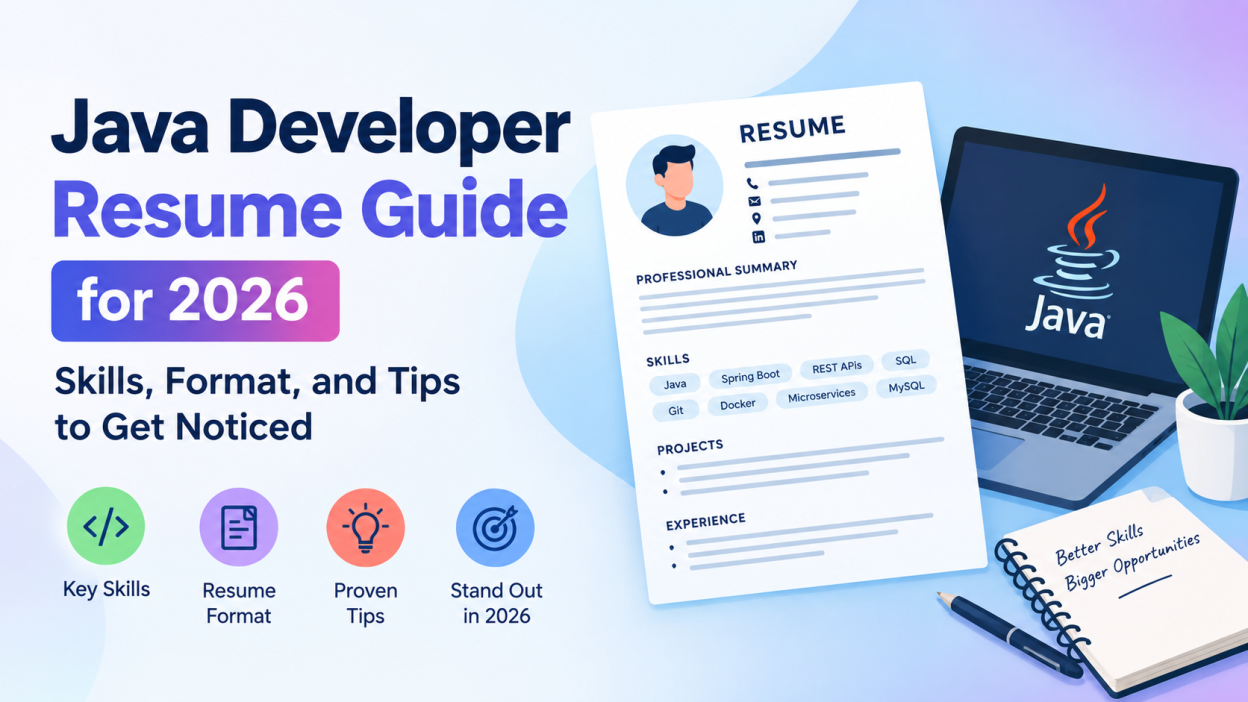
A well-written resume is one of the most important tools for a Java developer looking for a new job in 2026. Whether you are a fresher, junior developer, or experienced professional, your resume should clearly show your technical skills, projects, work experience, and ability to build real-world applications.
Recruiters often review many resumes for a single Java developer position, so a clear and relevant resume can help you communicate your strengths quickly. Instead of listing every technology you have ever used, focus on the skills and experience that match the job description.
Here are practical tips to create a strong Java developer resume in 2026.
Start With a Clear Resume Header

Your resume should begin with your basic professional information. Include your full name, phone number, professional email address, location, and relevant links such as LinkedIn or GitHub.
You can also add a portfolio website if you have one.
Avoid unnecessary personal information such as your age, photograph, marital status, or complete home address unless specifically requested by the employer.
Your header should make it easy for recruiters to identify and contact you.
Write a Strong Java Developer Summary
The professional summary should provide a short introduction to your background and technical strengths.
For example:
Java Developer with experience in developing backend applications using Java, Spring Boot, REST APIs, SQL, and Git. Skilled in building scalable applications, integrating databases, and debugging application issues.
Freshers can focus on education, projects, programming skills, and career interests.
A good summary should be concise and relevant to the position you are applying for. Avoid generic statements such as “hardworking person” or “quick learner” unless they are supported by specific examples.
Highlight Relevant Java Skills
The skills section is particularly important for a Java developer resume. Recruiters should be able to quickly identify your technical capabilities.
Depending on your experience, you can include:
- Core Java
- Object-Oriented Programming
- Collections Framework
- Exception Handling
- Multithreading
- Java Streams
- JDBC
- Spring
- Spring Boot
- Spring MVC
- Spring Security
- Hibernate
- JPA
- REST APIs
- Microservices
- SQL
- MySQL
- PostgreSQL
- Git and GitHub
- Maven or Gradle
- Docker
- AWS or other cloud platforms
- JUnit
- Mockito
Do not add technologies simply because they are popular. Include tools and frameworks that you actually understand and can discuss during an interview.
Showcase Java Projects

Projects can make a significant difference, especially for freshers and developers with limited professional experience.
Instead of simply writing:
Java Project – Banking Application
Explain what you built and the technologies you used.
For example:
Online Banking Application
- Developed a backend application using Java and Spring Boot.
- Created REST APIs for account management and transactions.
- Connected the application with MySQL using Spring Data JPA.
- Implemented validation and exception handling.
- Tested APIs using Postman.
This format tells the recruiter what you built, which technologies you used, and what you contributed.
If possible, add GitHub links to your projects so recruiters can review your code.
Focus on Achievements in Work Experience
Experienced Java developers should avoid writing a simple list of responsibilities.
Instead of:
Worked on Java applications and fixed bugs.
Write something more specific:
Developed and maintained REST APIs using Java and Spring Boot and resolved production issues to improve application reliability.
Whenever possible, include measurable information.
For example:
- Reduced API response time by 25% through query optimization.
- Developed 15+ REST APIs for customer management.
- Automated repetitive testing tasks using Java and Selenium.
- Improved database queries for high-volume application modules.
Numbers help recruiters understand the scale and impact of your work.
Mention Spring Boot and Modern Backend Technologies

Java development has expanded beyond traditional Core Java programming. Many modern backend applications use Spring Boot, REST APIs, databases, cloud services, containers, and microservices.
If you are applying for backend roles, your resume can highlight relevant experience with technologies such as Spring Boot, Spring Security, Hibernate, JPA, REST APIs, Microservices, Docker, Kubernetes, CI/CD, and cloud platforms.
However, avoid filling your resume with technologies you have only studied briefly. Interviewers may ask detailed questions about anything you list.
Keep the Resume ATS-Friendly
Many companies use Applicant Tracking Systems (ATS) to scan resumes before recruiters review them.
An ATS-friendly resume should have:
- Simple formatting
- Clear section headings
- Standard fonts
- Relevant keywords
- Consistent job titles
- No unnecessary graphics
- No complicated tables or text boxes
Use keywords naturally from the job description.
For example, if a job description asks for Java, Spring Boot, REST API, SQL, Git, and Docker, make sure the technologies you genuinely know are clearly visible in your resume.
Customize Your Resume for Each Job
One resume does not necessarily need to be submitted for every Java developer position.
Read the job description and identify the most important requirements. Then adjust your professional summary, skills, and project descriptions to emphasize your relevant experience.
For example, a Java backend position may prioritize Spring Boot, REST APIs, SQL, and Microservices, while a Java testing position may focus more on Selenium, JUnit, TestNG, and automation frameworks.
Customization helps recruiters quickly understand your relevance to the position.
Include Education and Certifications

Freshers should give more space to their educational background and academic projects.
Include:
- Degree
- College or university
- Graduation year
- Relevant coursework, when useful
- Academic projects
You can also include relevant certifications in areas such as Java, Spring Boot, cloud computing, databases, or software development.
Only include certifications that are relevant to the job and that you can confidently discuss.
Avoid Common Resume Mistakes
Several mistakes can make an otherwise good Java resume less effective.
Avoid:
- Spelling and grammar mistakes
- Very long paragraphs
- Unnecessary personal information
- Fake technical skills
- Too many unrelated technologies
- Generic career objectives
- Repeating the same information
- Using an overly designed template
- Listing responsibilities without achievements
- Submitting the same resume for every job
A concise resume with relevant information is generally easier to read than one packed with unnecessary details.
Final Thoughts
Creating a Java developer resume in 2026 is about more than listing programming languages. Your resume should demonstrate how you use Java and related technologies to solve practical development problems.
Highlight your Core Java knowledge, Spring Boot experience, APIs, databases, projects, development tools, and measurable achievements. Freshers should focus on strong projects and practical skills, while experienced developers should emphasize their professional contributions and results.
Most importantly, keep your resume clear, honest, relevant, and easy to scan. A well-structured Java developer resume can make it easier for recruiters to understand your technical profile and decide whether to move forward with your application.
Want to Learn More About Java ?, Kaashiv Infotech Offers, Full Stack Java Course, Java Course, Data Science Course, Internships & More, Visit Their Website www.kaashivinfotech.com.