
Machine learning (ML) has become one of the most important technologies behind modern digital services. From personalized recommendations on streaming platforms to fraud detection in banking, machine learning helps organizations analyze large amounts of data and make faster, more informed decisions.
Unlike traditional software, which follows explicitly programmed rules, machine learning systems can identify patterns from data and use those patterns to make predictions or decisions. As data continues to grow across industries, the demand for practical machine learning applications is also increasing.
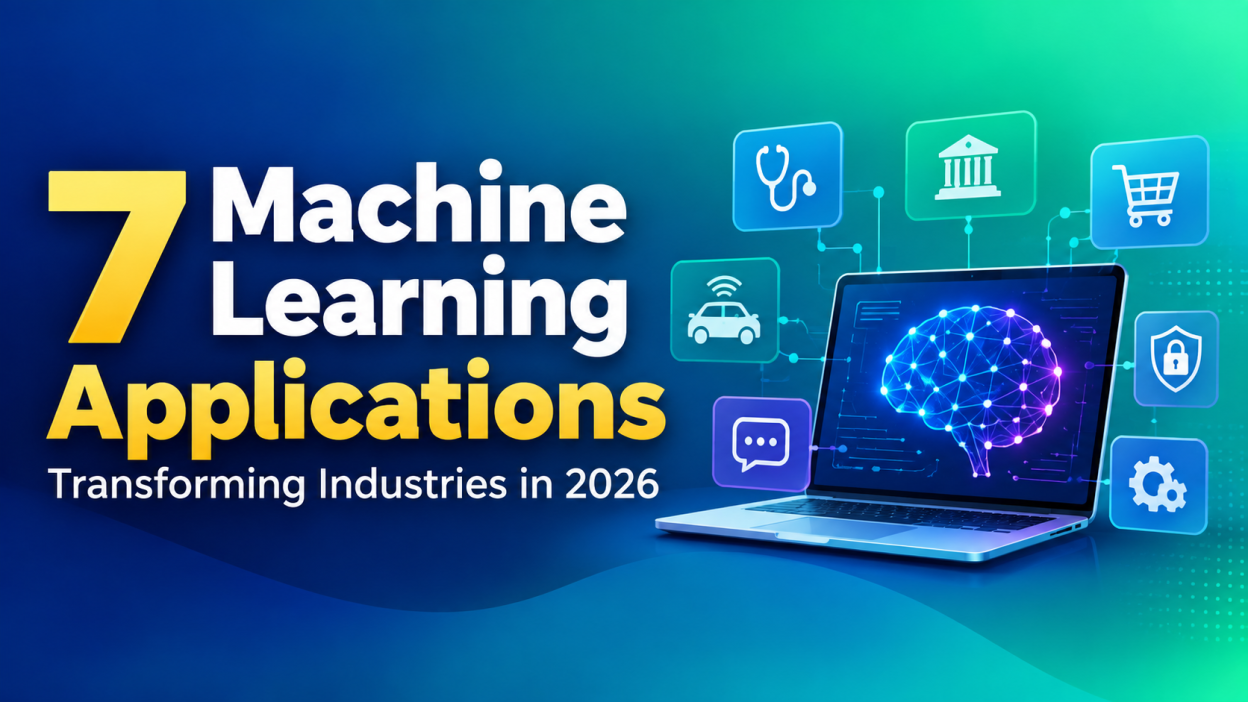
In this article, let us explore 7 important machine learning applications and understand how they are being used in real-world scenarios.
1. Healthcare and Medical Diagnosis

Healthcare is one of the major areas where machine learning can support professionals. ML models can analyze medical images, patient records, laboratory results, and other healthcare data to identify patterns that may be difficult to detect manually.
For example, machine learning can be used in medical imaging to assist with identifying abnormalities in X-rays, CT scans, and MRI images. It can also support risk prediction by analyzing patient information and identifying people who may require additional attention.
Machine learning is also used in drug discovery and research. Researchers can analyze large datasets to identify potential relationships between compounds, diseases, and treatment outcomes.
However, ML systems in healthcare are generally designed to support medical professionals rather than replace them. Human expertise, clinical validation, privacy, and regulatory requirements remain important.
2. Fraud Detection in Banking
Financial institutions process millions of transactions every day. Detecting suspicious activity manually across such a large volume of transactions is extremely difficult.
Machine learning can analyze transaction patterns and identify unusual behavior. For example, an ML model may consider factors such as transaction amount, location, timing, device information, and previous account activity when assessing whether a transaction appears unusual.
Banks and payment companies can use these systems to flag potentially fraudulent transactions for further investigation.
Machine learning models can also improve over time as new transaction data becomes available. This makes ML useful for detecting changing patterns that traditional rule-based fraud detection systems may not easily recognize.
3. Recommendation Systems

Recommendation systems are one of the most visible applications of machine learning. Many websites and applications use ML to recommend products, videos, music, articles, or other content.
For example, an e-commerce platform can analyze a customer’s browsing history, previous purchases, and interactions with products. It can then use this information to suggest products that may be relevant to that customer.
Streaming platforms similarly analyze viewing or listening behavior to recommend content.
Recommendation systems can use different types of information, including user behavior, item characteristics, and similarities between users or products. These systems help businesses personalize digital experiences while helping users discover relevant content.
4. Autonomous Vehicles and Driver Assistance
Machine learning plays an important role in modern vehicle technology. Advanced driver-assistance systems can use ML models to process information collected from cameras, radar, and other sensors.
These systems can help identify objects such as vehicles, pedestrians, road signs, and lane markings. Machine learning can also support features such as lane assistance, collision warnings, and adaptive driving functions.
Fully autonomous driving is considerably more complex because vehicles must operate safely in unpredictable environments. Weather conditions, road construction, traffic behavior, and unusual situations can create challenges for automated systems.
For this reason, autonomous vehicle development involves machine learning along with computer vision, sensors, robotics, mapping, and safety engineering.
5. Natural Language Processing
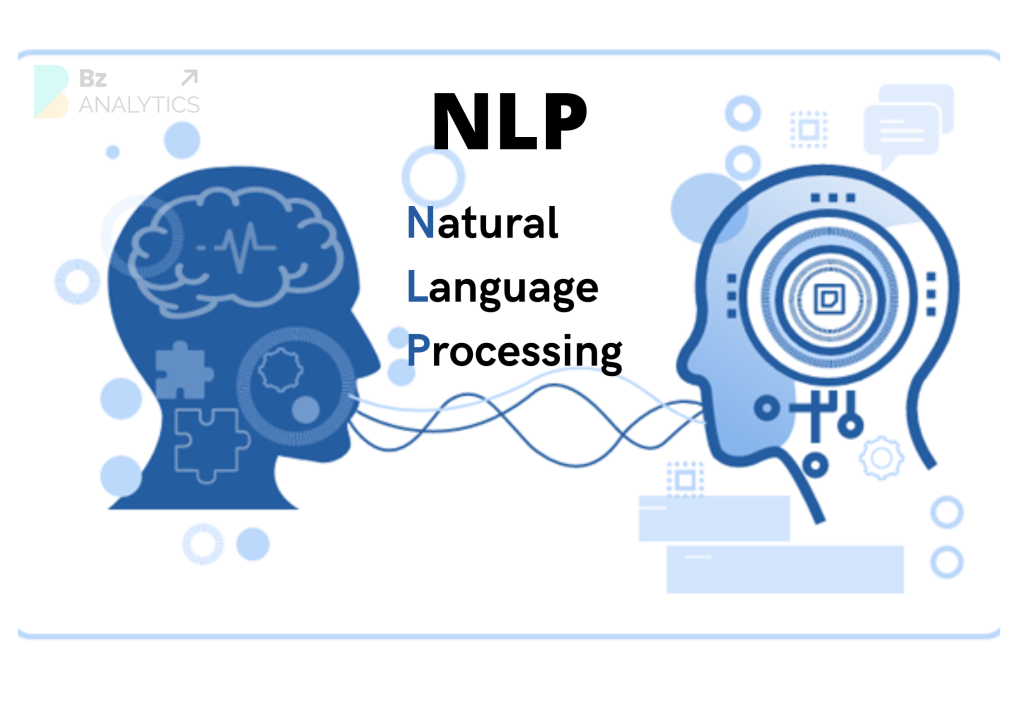
Natural Language Processing (NLP) is a field of artificial intelligence that enables computers to work with human language. Machine learning is a major component of many NLP applications.
Examples include chatbots, virtual assistants, language translation, sentiment analysis, text classification, and speech-related applications.
For instance, businesses can use NLP-powered chatbots to answer frequently asked customer questions. Organizations can also analyze large collections of customer reviews to understand common opinions and issues.
Modern language models have expanded the capabilities of NLP by allowing computers to process and generate human-like text. Machine learning enables these systems to learn patterns from large amounts of language data.
6. Cybersecurity and Threat Detection
Cybersecurity is another important area where machine learning is increasingly used. Traditional security systems often rely on predefined rules and known signatures. While these methods remain useful, machine learning can help identify unusual patterns that may indicate suspicious activity.
ML-based security systems can analyze network traffic, login behavior, files, system activity, and other data sources. For example, a system may detect unusual login activity or unexpected communication patterns and generate an alert for security teams.
Machine learning can also assist with malware classification, spam detection, phishing detection, and network anomaly detection.
However, machine learning is not a complete replacement for traditional security controls. Effective cybersecurity typically combines ML with firewalls, endpoint protection, access controls, monitoring, threat intelligence, and human analysis.
7. Predictive Maintenance in Manufacturing
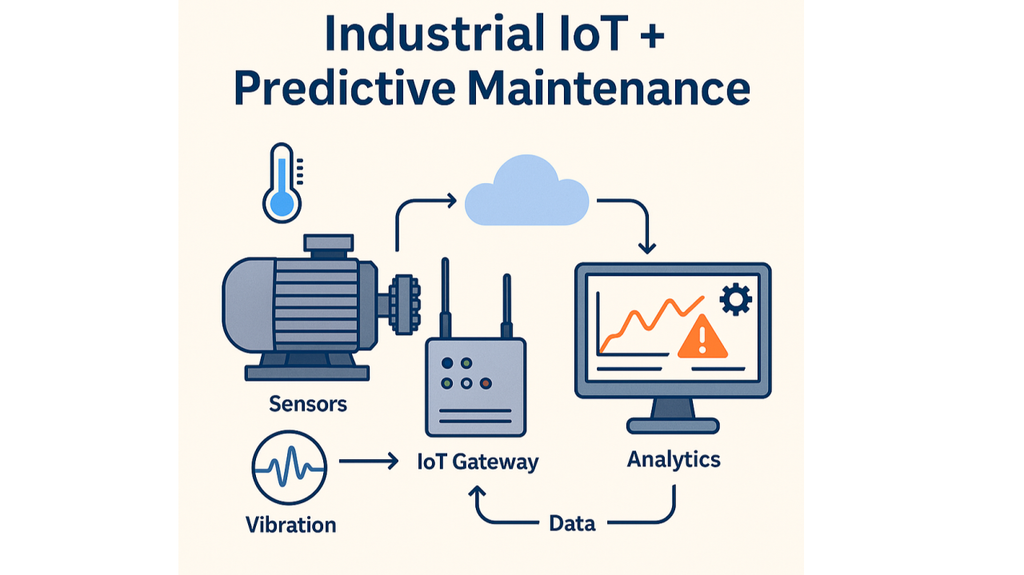
Manufacturing companies use machine learning to monitor equipment and predict potential failures. This approach is commonly known as predictive maintenance.
Machines can generate large amounts of data through sensors that measure factors such as temperature, vibration, pressure, and operating speed. Machine learning models can analyze this information and identify patterns associated with equipment problems.
Instead of waiting for a machine to fail, organizations can use these predictions to schedule maintenance at an appropriate time. This can help reduce unexpected downtime and improve equipment utilization.
Predictive maintenance is especially useful in industries where equipment failure can result in significant production losses.
Why Machine Learning Applications Are Important
The value of machine learning comes from its ability to identify patterns and generate useful predictions from data. Organizations can apply these capabilities to different business and technical problems.
Some major benefits include:
- Automating repetitive data-driven tasks
- Identifying patterns in large datasets
- Supporting faster decision-making
- Improving personalization
- Detecting unusual activities
- Predicting potential outcomes
- Supporting business and operational efficiency
At the same time, machine learning systems depend heavily on the quality of their data. Poor-quality, incomplete, or biased data can affect the results produced by an ML model. Organizations also need to consider privacy, security, transparency, and responsible AI practices.
Skills Needed to Build Machine Learning Applications
If you want to build real-world machine learning applications, start with programming fundamentals and gradually develop your knowledge of data and AI.
Important skills include:
- Python programming
- Statistics and probability
- Data preprocessing
- Machine learning algorithms
- SQL and databases
- Data visualization
- Model evaluation
- Deep learning fundamentals
- Natural Language Processing
- Computer vision
- Cloud and deployment technologies
Popular Python libraries such as NumPy, Pandas, Scikit-learn, TensorFlow, and PyTorch can help learners develop practical ML projects.
Conclusion
Machine learning is no longer limited to research laboratories. It is being applied across healthcare, banking, entertainment, transportation, cybersecurity, manufacturing, and many other industries.
The 7 machine learning applications discussed in this article—healthcare, fraud detection, recommendation systems, autonomous vehicles, NLP, cybersecurity, and predictive maintenance—show how ML can solve different types of real-world problems.
For students and aspiring technology professionals, learning machine learning through practical projects can be a useful way to understand how algorithms work with real data. As organizations continue adopting AI-driven technologies, understanding these applications can provide a strong foundation for exploring careers in machine learning and artificial intelligence.
Want to Learn More About Python & Artificial Intelligence ?, Kaashiv Infotech Offers Full Stack Python Course, Artificial Intelligence Course, Data Science Course & More Visit Their Website course.kaashivinfotech.com.
Related Reads:
Artificial Intelligence vs Human Intelligence: A Deep Dive into Minds Made and Minds Born
Top 10 AI Tools for Content Creation in 2026 You Shouldn’t Miss.