

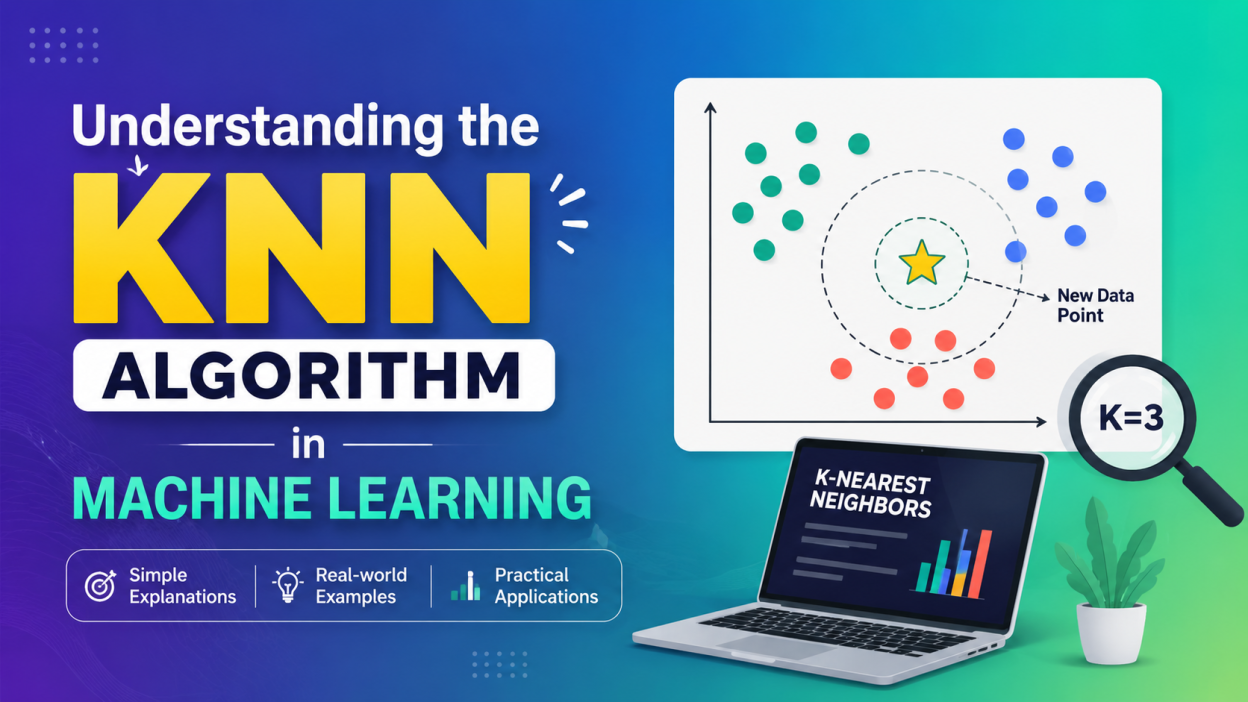
KNN Algorithm in Machine Learning is one of the easiest machine learning algorithms I learned when I first started exploring AI. In fact, the KNN Algorithm in Machine Learning was the first algorithm that truly made me understand how a computer can “learn” without writing hundreds of complicated rules.
If you’ve ever wondered how Netflix recommends movies, how an email is identified as spam, or how an online shopping website suggests products similar to what you viewed, then you’re already thinking in the same direction as the KNN Algorithm in Machine Learning.
The best part? You don’t need to be a math genius to understand it.
In this guide, I’ll explain everything in simple English, just like I would explain it to a friend who’s learning machine learning for the first time. I’ll also share practical examples, real-life scenarios, and a few lessons I wish someone had told me when I was learning KNN.
🌟 Key Highlights
- ✅ What is the KNN Algorithm in Machine Learning?
- ✅ Why KNN is called a lazy learning algorithm
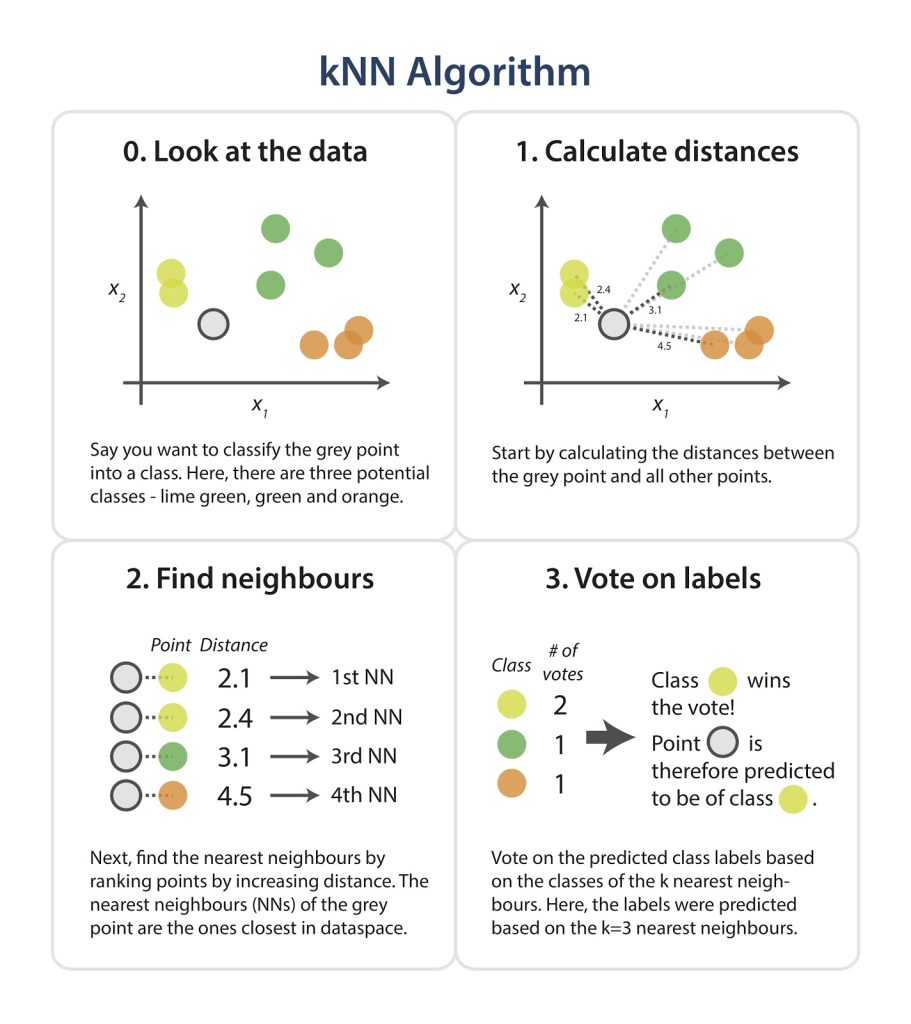
- ✅ How the KNN algorithm works step by step
- ✅ Understanding the value of K
- ✅ Distance calculation methods
- ✅ Real-world examples
- ✅ Advantages and disadvantages
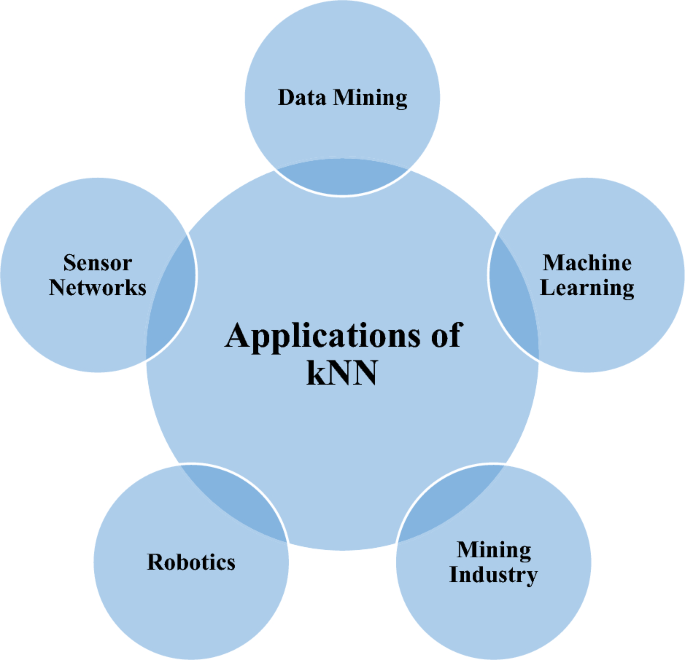
- ✅ Applications of KNN
- ✅ Tips to improve KNN performance
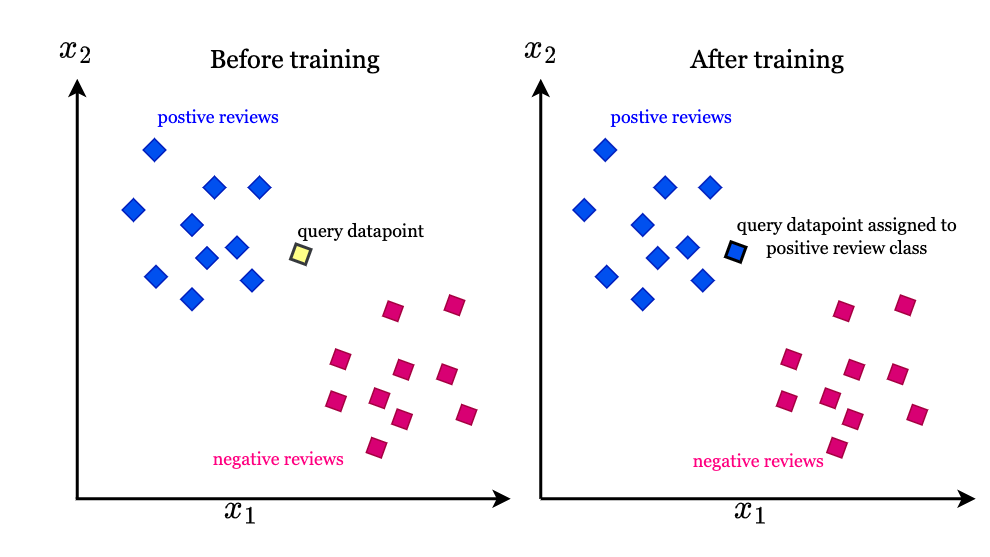
🤔 What is the KNN Algorithm in Machine Learning?
The KNN Algorithm in Machine Learning (K-Nearest Neighbors) is a supervised machine learning algorithm used for both classification and regression problems.
Instead of building a mathematical model during training, KNN simply remembers the training data. When new data arrives, it looks for the K nearest data points and predicts the result based on their values.
That’s why many people call it a lazy learner.
When I first heard the term “lazy algorithm,” I laughed. 😄 But it actually makes sense. KNN doesn’t do much work while learning. It waits until someone asks it to make a prediction. Only then does it start working.
Think of it as that student in class who never studies until the night before the exam—but somehow still manages to score decent marks!
📚 What Does “K” Mean?
This is one of the first questions I had.
The letter K simply represents the number of nearest neighbors the algorithm will consider before making a prediction.
For example:
- K = 1 → Look at only one nearest neighbor.
- K = 3 → Look at three nearest neighbors.
- K = 5 → Look at five nearest neighbors.
The majority decides the answer.
Simple!
🎯 A Real-Life Example I Always Remember
Imagine you’ve moved into a new neighborhood.
You don’t know whether it’s a quiet place or a noisy one.
Instead of surveying the entire city, you ask your five nearest neighbors.
- Four people say,”It’s peaceful.”
- One person says,”It’s noisy.”
What would you believe?
Probably the majority.
That’s exactly how the KNN Algorithm in Machine Learning works.
It doesn’t ask everyone.
It only asks the closest neighbors.
🛒 Another Everyday Example
Suppose you’re shopping online.
You view:
- Running Shoes
- Sports Socks
- Water Bottle
The website notices that thousands of other customers who bought these items also purchased a fitness smartwatch.
So it recommends the smartwatch to you.
This recommendation is based on finding users with similar behavior.
Although modern recommendation systems often use more advanced techniques, this idea of finding “similar neighbors” is very close to the intuition behind the KNN Algorithm in Machine Learning.
⚙️ How Does the KNN Algorithm Work?
I like breaking it into five easy steps.
Step 1️⃣ Store the Training Data
Unlike many algorithms, KNN doesn’t build a model.
It simply stores all the training data.
That’s it.
Step 2️⃣ Receive New Data
Suppose a new customer arrives.
The algorithm now wants to predict:
- Spam or Not Spam?
- Healthy or Sick?
- Cat or Dog?
Step 3️⃣ Calculate the Distance
Now KNN measures how close the new data is to every existing data point.
The smaller the distance…
…the more similar the data.
Step 4️⃣ Find the K Nearest Neighbors
Suppose K = 5.
The algorithm selects the five closest neighbors.
These become the “friends” who influence the prediction.
Step 5️⃣ Make the Prediction
For classification:
The majority wins.
Example:
Dog
Dog
Dog
Cat
Dog
Prediction = Dog
Simple majority voting.
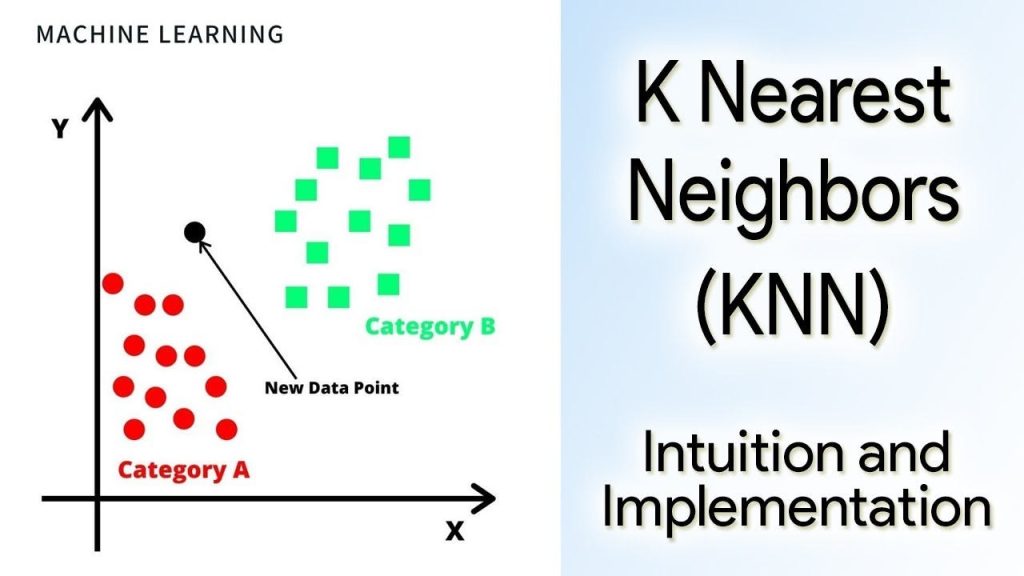
🖼️ Visualizing the Process
Imagine this:
      Cat

           ●

Dog   ●

          New Point ❓

Dog   ●

Cat          ●

Dog      ●
The nearest neighbors around the new point vote.
Whichever category receives the most votes becomes the prediction.
📏 How Does KNN Measure Distance?
This is where a little math enters—but don’t worry.
You don’t have to memorize formulas to understand the concept.
The algorithm simply asks:
Several methods help answer this question.
1️⃣ Euclidean Distance ⭐ (Most Common)
Think of measuring distance with a ruler.
It’s simply the straight-line distance between two points.
I imagine it like walking diagonally across a park instead of following the footpath around it.
Euclidean distance works well when features are continuous and measured on similar scales.
2️⃣ Manhattan Distance 🏙️
Imagine you’re driving through a city with grid-like roads.
You can’t drive through buildings.
Instead, you move:
- Left
- Right
- Up
- Down
The total road distance is called Manhattan Distance.
This metric is useful when movement follows grid patterns or when you want to reduce the influence of outliers.
3️⃣ Minkowski Distance
This is actually a general formula that includes both Euclidean and Manhattan distance depending on a parameter.
When I first encountered it, I didn’t spend much time worrying about the formula. I focused on understanding that it’s a flexible way of measuring distance.
Once I understood Euclidean and Manhattan distance, Minkowski became much easier to grasp.
4️⃣ Hamming Distance
Not all data is numerical.
Sometimes the values are simply different or the same.
For example:
101011
111001
Hamming Distance counts how many positions differ.
It’s commonly used for binary strings and categorical data.
💡 Why Distance Matters
Here’s something I learned after experimenting with small datasets.
Imagine measuring:
- Age (20–60)
- Salary (₹20,000–₹20,00,000)
Because salary values are much larger, salary will dominate the distance calculation.
That means age barely influences the prediction.
This is why feature scaling (such as normalization or standardization) is often important before applying the KNN Algorithm in Machine Learning. Scaling helps ensure that one feature doesn’t unfairly outweigh the others.
🎯 Why I Like the KNN Algorithm
What I appreciate most about the KNN Algorithm in Machine Learning is how intuitive it feels.
There’s no mysterious “black box.”
It simply says:
That idea is surprisingly similar to how many of us make decisions in everyday life—we often look at similar situations from the past before deciding what to do next.
Whether you’re preparing for interviews, working on college projects, or taking your first steps into AI, understanding the KNN Algorithm in Machine Learning gives you a strong foundation for learning more advanced algorithms later on.
🚀 Choosing the Best Value of K in the KNN Algorithm in Machine Learning
One question confused me a lot when I started learning the KNN Algorithm in Machine Learning:
At first, I thought there would be a fixed answer like K = 5 or K = 10.
But that’s not how it works.
The “best” value of K depends on your dataset. There’s no universal number that works for every problem.
Here’s a simple way to think about it.
🔹 If K is Too Small
Suppose K = 1.
The algorithm only looks at the nearest neighbor.
That’s fast, but it can also be risky.
Imagine your closest neighbor accidentally gives you incorrect advice. You’ll make the wrong decision because you relied on just one opinion.
In machine learning, this can lead to overfitting, where the model becomes too sensitive to small variations or noise in the data.
🔹 If K is Too Large
Now imagine K = 50.
The algorithm asks fifty neighbors before making a decision.
While this reduces the impact of noise, it can also ignore important local patterns. The prediction becomes too generalized, which may result in underfitting.
🎯 My Tip
A common starting point is to use an odd value of K (such as 3, 5, or 7) for binary classification. This helps reduce the chance of a tie when neighbors vote.
In practice, data scientists usually try several values using cross-validation and choose the one that performs best on validation data.
⚡ Advantages of the KNN Algorithm in Machine Learning
Even after learning advanced machine learning algorithms, I still appreciate KNN because of its simplicity.
Here are some of its biggest advantages.
✅ 1. Easy to Understand
One reason beginners enjoy the KNN Algorithm in Machine Learning is that it doesn’t involve complicated equations.
The logic is straightforward:
✅ 2. No Training Phase
Unlike algorithms such as Decision Trees or Logistic Regression, KNN doesn’t build a model during training.
It simply stores the data and performs calculations only when a prediction is needed.
✅ 3. Works for Classification and Regression
The KNN Algorithm in Machine Learning isn’t limited to predicting categories.
It can also predict numerical values.
Examples include:
- Predicting house prices
- Estimating rainfall
- Forecasting sales
✅ 4. Handles Multiple Classes
KNN can classify more than two categories.
For example:
- Apple 🍎
- Mango 🥭
- Banana 🍌
- Orange 🍊
The algorithm simply predicts the class with the most nearby neighbors.
✅ 5. Great for Small Datasets
If your dataset is relatively small and well-structured, the KNN Algorithm in Machine Learning often performs surprisingly well.
❌ Disadvantages of the KNN Algorithm in Machine Learning
Like every algorithm, KNN has limitations.
Knowing these helps you decide when it is—and isn’t—the right choice.
❌ 1. Slow with Large Datasets
Since KNN compares a new data point with many or all stored examples, prediction becomes slower as the dataset grows.
❌ 2. Uses More Memory
The algorithm stores the entire training dataset.
Large datasets therefore require more memory.
❌ 3. Sensitive to Feature Scaling
Imagine comparing:
- Age (20–60)
- Annual Income (₹3,00,000–₹30,00,000)
Income has much larger values, so it can dominate the distance calculation.
That’s why techniques like Normalization or Standardization are commonly applied before using KNN.
❌ 4. Sensitive to Noise
If your data contains many incorrect or unusual values (outliers), the predictions may become less accurate.
Cleaning the dataset before training is important.
🌍 Real-World Applications of the KNN Algorithm in Machine Learning
When I first learned KNN, I wondered if companies actually used it.
The answer is yes.
Although many production systems now use more advanced models, KNN remains valuable in several domains and is widely used for learning, prototyping, and certain real-world tasks.
📧 1. Spam Email Detection
KNN can classify emails as:
- Spam
- Not Spam
based on similarity to previously labeled emails.
🩺 2. Medical Diagnosis
Healthcare researchers have used KNN to help classify diseases by comparing a patient’s symptoms with historical patient data.
It supports decision-making but does not replace a doctor’s expertise.
🛍️ 3. Product Recommendation
Shopping platforms often recommend products based on users with similar preferences.
Modern recommendation engines usually combine multiple algorithms, but the idea of “nearest neighbors” is an important foundation.
🏦 4. Credit Risk Analysis
Banks and financial institutions may use similarity-based methods alongside other machine learning models to help assess loan applications.
🎥 5. Image Classification
KNN can classify images by comparing extracted features with those of labeled images.
🎵 6. Music Recommendation
Streaming services recommend songs based on listening patterns and similarities between users or tracks.
📱 7. Handwriting Recognition
Early handwriting recognition systems often relied on KNN to identify handwritten characters based on similar examples.
🐍 Simple Python Example of KNN
If you’re using Python with scikit-learn, creating a basic KNN classifier is surprisingly easy.
from sklearn.neighbors import KNeighborsClassifier

model = KNeighborsClassifier(n_neighbors=3)

model.fit(X_train, y_train)

prediction = model.predict(X_test)
Even though the code is short, it’s built on the same idea we’ve discussed throughout this article: compare the new data with nearby examples and predict based on the closest neighbors.
💡 Best Practices for Using the KNN Algorithm in Machine Learning
Here are a few practical lessons I’ve picked up:
- ✅ Normalize or standardize your features before training.
- ✅ Experiment with different values of K instead of guessing.
- ✅ Remove unnecessary features whenever possible.
- ✅ Clean noisy data and handle missing values.
- ✅ Use cross-validation to find the most suitable K.
- ✅ Avoid KNN for extremely large datasets unless performance is acceptable.
🎯 Common Interview Questions
If you’re preparing for interviews, these questions are worth practicing:
- What is the KNN Algorithm in Machine Learning?
- Why is KNN called a lazy learner?
- What does the value of K represent?
- Why is feature scaling important in KNN?
- What is the difference between KNN classification and regression?
- What are the advantages and disadvantages of KNN?
- Which distance metrics are commonly used in KNN?
- How do you choose the best value of K?
❓ Frequently Asked Questions (FAQs)
1. Is KNN supervised or unsupervised?
The KNN Algorithm in Machine Learning is a supervised learning algorithm because it learns from labeled training data.
2. Can KNN perform regression?
Yes. Besides classification, KNN can also predict continuous numerical values.
3. Why is KNN called a lazy learning algorithm?
Because it doesn’t build a predictive model during training. Instead, it stores the data and performs calculations only when making a prediction.
4. Which distance metric is most commonly used?
Euclidean Distance is the most widely used, though Manhattan, Minkowski, and Hamming distances are also useful depending on the dataset.
5. Is KNN suitable for big data?
Generally, KNN becomes slower as the dataset grows because it must compare the new data point with many stored examples. For very large datasets, other algorithms may be more efficient.
🎉 Final Thoughts
When I first encountered the KNN Algorithm in Machine Learning, I expected it to be filled with difficult mathematics. Instead, I found one of the most intuitive algorithms in machine learning.
Its core idea is beautifully simple: look at the closest neighbors and learn from them.
That simplicity makes KNN an excellent starting point for anyone beginning their machine learning journey. It also teaches an important lesson that carries into more advanced models—similar data often leads to similar outcomes.
If you’re just starting with AI or preparing for technical interviews, I strongly recommend taking time to understand the KNN Algorithm in Machine Learning. Once you grasp how KNN works, concepts like classification, distance metrics, feature scaling, and model evaluation become much easier to understand.
Happy learning! 🚀
Want to Learn More About Python & Artificial Intelligence ?, Kaashiv Infotech Offers Full Stack Python Course, Artificial Intelligence Course, Data Science Course & More Visit Their Website course.kaashivinfotech.com.
Related Reads:
Artificial Intelligence vs Human Intelligence: A Deep Dive into Minds Made and Minds Born
Top 10 AI Tools for Content Creation in 2026 You Shouldn’t Miss.
Top 6 Essential Prerequisites for Machine Learning: A Complete Beginner’s Guide
Learn LangGraph and Build Conversational AI with Python – My Journey Into the Future of Chatbots