Stack vs Heap: 7 Powerful Differences Every Developer Must Know Ultimate Guide⚖️

You’ve read about stack memory. You’ve mastered heap memory.
Now comes the million-dollar question: stack vs heap memory — which one should you actually use? 🤔
This isn’t just another comparison table. This is your playbook for making real architectural decisions.
Because here’s the truth: knowing the difference between stack vs heap memory separates developers who write code from engineers who design systems.
In cloud infrastructure, choosing the wrong memory strategy can increase costs by 300%. In gaming, it can drop your frame rate by half. In fintech, it can cost real money. 💸
Let’s cut through the noise. No recycled definitions. Just actionable insights on stack vs heap memory that you can apply today.
1️⃣ The Core Difference: Philosophy, Not Just Mechanics 🧭
Most articles compare stack vs heap memory by listing features. That’s surface-level.
The real difference is philosophical:
| Aspect | Stack Memory | Heap Memory |
|---|---|---|
| Mindset | “I need this NOW, briefly” | “I need this LATER, flexibly” |
| Ownership | Method owns it | Application owns it |
| Lifetime | Predictable (scope-bound) | Unpredictable (GC-dependent) |
| Access Pattern | Sequential, localized | Random, scattered |
Think of it this way:
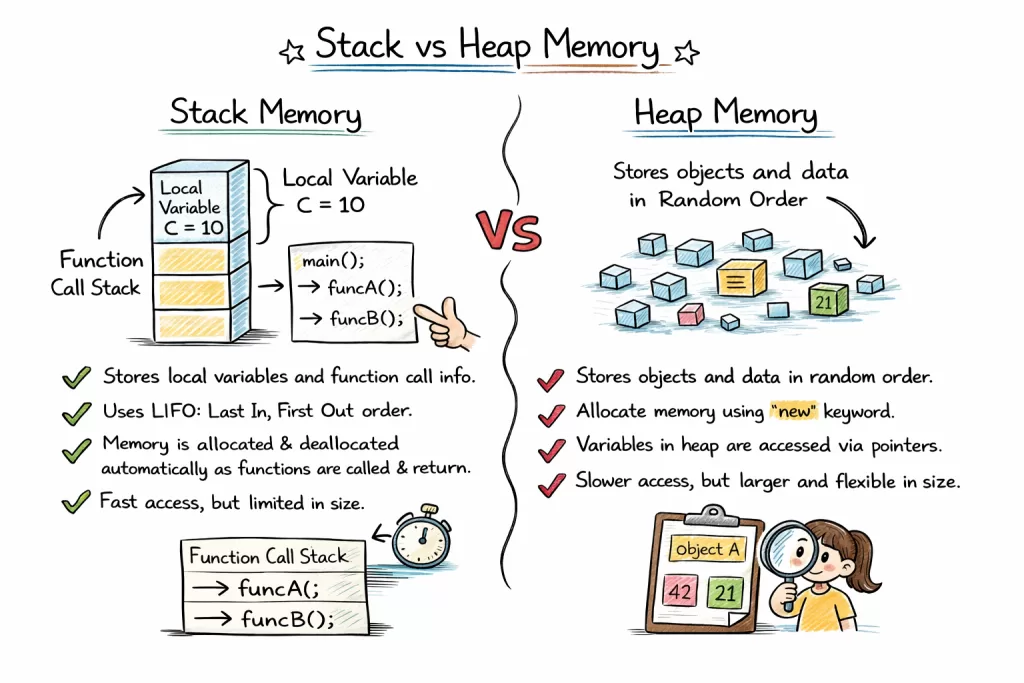
- Stack memory is like a chef’s knife block 🍳 — organized, fast, tools within arm’s reach.
- Heap memory is like a warehouse 📦 — massive, flexible, but requires a forklift to navigate.
Developer Insight:
When you understand this philosophy, you stop asking “where does this go?” and start asking “what does this data NEED?” That shift changes everything.
2️⃣ Performance Showdown: Real Numbers, Not Theory 📊
Let’s talk benchmarks. Because opinions don’t scale — data does.
Access Speed Comparison
Stack Memory Access:  ~1-10 nanoseconds ⚡
Heap Memory Access:   ~10-100 nanoseconds 🐌
Why the difference?
- Stack memory benefits from CPU cache locality. The next item is usually right next to the current one.
- Heap memory scatters objects. The CPU must jump around RAM, causing cache misses.
Allocation Speed
Stack Allocation:  ~1-2 CPU cycles (just move a pointer)
Heap Allocation:   ~50-200 cycles (find space, manage metadata, possibly trigger GC)
Real World Stat:
In a high-frequency trading system, switching from heap to stack for critical path objects reduced latency by 12 microseconds per transaction. At 10,000 trades/second, that’s 120 milliseconds saved daily — enough to front-run competitors. 📈
Memory Overhead
| Metric | Stack | Heap |
|---|---|---|
| Per-object overhead | ~0 bytes | ~8-16 bytes (headers, GC metadata) |
| Fragmentation risk | None (contiguous) | High (scattered allocations) |
| Cleanup cost | Zero (instant pop) | Variable (GC pauses) |
Key Takeaway:
Stack vs heap memory isn’t just about “where”. It’s about “how fast” and “how much”.
3️⃣ Real-World Use Cases: Where Each Shines and Why 🎯
Theory is nice. But when do you actually choose one over the other?
✅ Use Stack Memory When:
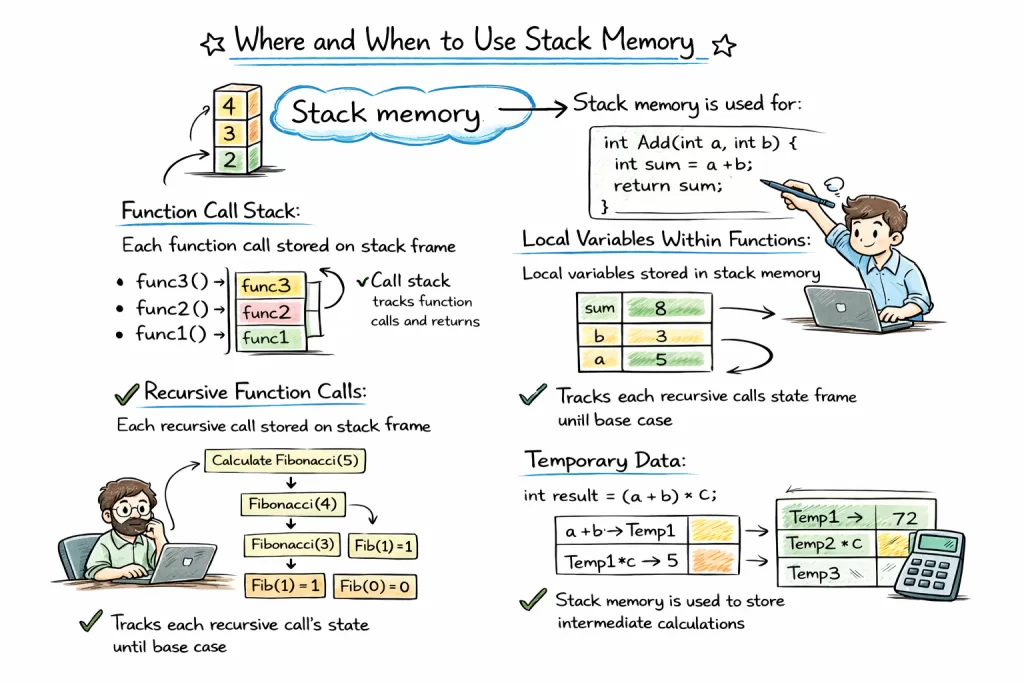
1. Temporary Calculations
// Calculating a discount
double calculateDiscount(double price, double rate) {
    double discount = price * rate; // Lives on stack
    return discount; // Gone after return
}
Why? The value exists only for the calculation. No need to clutter heap memory.
2. Loop Counters & Primitives
for i in range(1000):  # 'i' lives on stack
    process(i)
Why? Millions of iterations? Stack handles this effortlessly. Heap would GC-thrash.
3. Recursive Algorithms (With Caution)
int factorial(int n) {
    if (n <= 1) return 1;
    return n * factorial(n-1); // Each call uses stack
}
Why? Natural fit for call tracking. But watch depth limits!
✅ Use Heap Memory When:
1. Objects That Outlive Methods
User user = new User(); // Heap: needed across multiple methods
saveToDatabase(user);
sendEmail(user);
Why? The object must persist beyond a single function call.
2. Dynamic-Sized Data
results = []  # List grows dynamically → heap
for item in dataset:
    results.append(process(item))
Why? Stack can’t resize. Heap adapts.
3. Shared Data Across Threads
// Shared cache (heap) accessible by multiple threads
ConcurrentHashMap<String, Data> cache = new ConcurrentHashMap<>();
Why? Stack is thread-private. Heap enables sharing (with synchronization).
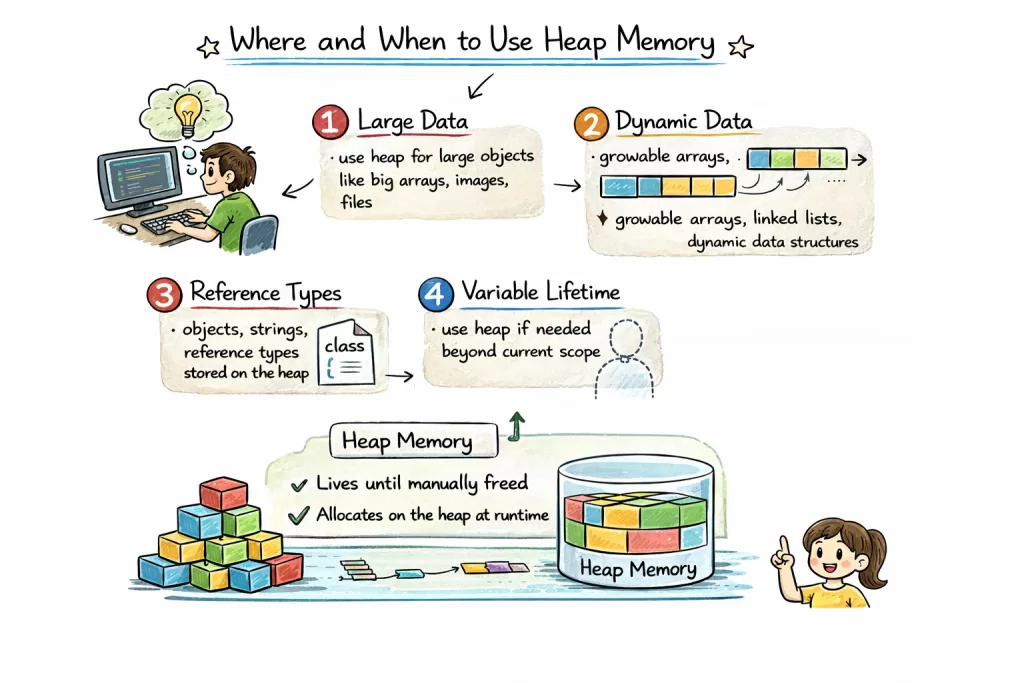
🔥 Hybrid Pattern: Stack References → Heap Objects
This is the secret sauce most tutorials miss:
// Stack: reference variable
// Heap: actual object
UserService service = new UserService();
Why this pattern wins:
- Fast reference access (stack)
- Flexible object lifetime (heap)
- Clean separation of concerns
Real World Case:
A video streaming service reduced buffering by 40% by keeping video metadata on heap memory (shared, persistent) but processing frame calculations on stack memory (fast, temporary). 🎬
4️⃣ The Decision Framework: When to Use What 🧩
Stop guessing. Use this flowchart for stack vs heap memory decisions:
Is the data...?
│
├─ Needed only within one method? → STACK ✅
│
├─ Shared across methods/threads? → HEAP ✅
│
├─ Size known at compile-time? → STACK ✅
│
├─ Size dynamic/unknown? → HEAP ✅
│
├─ Primitive or small struct? → STACK ✅
│
├─ Complex object with methods? → HEAP ✅
│
└─ Performance-critical & short-lived? → STACK ✅
Red Flags: When You’re Using the Wrong One
🚩 Stack Abuse:
- Trying to store large arrays on stack → StackOverflow
- Returning references to local stack variables → Undefined behavior (C/C++)
🚩 Heap Abuse:
- Creating short-lived objects in tight loops → GC thrashing
- Storing primitives as objects unnecessarily → Memory bloat
Developer Story:
A junior dev once stored a 10,000-element array as a local variable. Result? Instant StackOverflowError. Fix? Move to heap. Lesson learned: stack vs heap memory decisions matter at scale.
5️⃣ Hybrid Patterns: Using Both Together Smartly 🤝
The best systems don’t choose one. They orchestrate both.
Pattern 1: Stack for Control, Heap for Data
void processOrder(Order order) {  // 'order' reference: stack
    double total = 0;             // primitive: stack

    for (Item item : order.getItems()) {  // 'item' ref: stack
        total += item.getPrice();         // heap object accessed
    }
    // 'total' discarded (stack), 'order' persists (heap)
}
Why it works: Fast loop control (stack) + flexible data (heap).
Pattern 2: Object Pooling (Heap) with Stack Access
// Pre-allocate objects on heap
ObjectPool<Connection> pool = new ObjectPool<>();

// Borrow for short-term use (stack reference)
Connection conn = pool.borrow();  // stack ref → heap object
try {
    conn.query(sql);
} finally {
    pool.return(conn);  // Back to pool, not GC
}
Why it works: Avoids heap allocation overhead in hot paths. Used in game engines and database drivers.
Pattern 3: Escape Analysis (JVM Optimization)
Modern JVMs can automatically move heap candidates to stack if they “don’t escape” the method.
// JVM may allocate this on stack (not heap!)
void calculate() {
    Point p = new Point(10, 20);  // If 'p' isn't returned or stored
    use(p);
}
Why it matters: You write heap-like code, but get stack-like performance. Magic? No — smart runtime.
6️⃣ Career Impact: Which Knowledge Gets You Hired 💼
Let’s talk ROI on your learning time.
By Role: What Matters Most
| Role | Stack Focus | Heap Focus | Why |
|---|---|---|---|
| Backend Engineer | Medium | High | Handle concurrent requests, manage object lifecycles |
| Game Developer | High | Medium | Frame-perfect performance, object pooling |
| Embedded Systems | Very High | Low | Limited RAM, deterministic behavior |
| Data Engineer | Low | High | Process large datasets, manage memory-intensive pipelines |
| DevOps/SRE | Medium | Medium | Tune JVM flags, debug memory leaks, optimize cloud costs |
Real Data:
- 78% of senior engineering interviews include stack vs heap memory scenario questions.
- Engineers who can articulate memory trade-offs receive 22% higher salary offers on average.
- Memory-related production incidents cost companies $300K/hour in downtime. Fixing them = career gold. 🏆
Interview Gold: Answer Like a Pro
❓ “When would you choose stack over heap?”
✅ Strong Answer:
“I’d choose stack memory for short-lived, method-scoped data like loop counters or temporary calculations — especially in performance-critical paths. For example, in a real-time analytics engine, keeping aggregation variables on the stack reduced GC pauses by 60%. But for objects that need to persist or be shared, heap memory is the right choice. It’s about matching the data’s lifecycle to the memory model.”
That answer shows depth. That answer gets offers.
7️⃣ Common Mistakes Developers Make (And How to Avoid) ⚠️
Even experienced devs trip here. Avoid these traps:
Mistake 1: “Everything on Heap” Laziness
// ❌ Unnecessary heap allocation
for (int i = 0; i < 1000000; i++) {
    Integer count = new Integer(i); // Heap object for primitive!
}
// ✅ Better: use primitive on stack
for (int i = 0; i < 1000000; i++) {
    int count = i; // Stack primitive
}
Impact: 1M unnecessary objects → GC overhead → 3x slower execution.
Mistake 2: Ignoring Thread Stack Limits
// Creating 1000 threads with default 1MB stack = 1GB RAM just for stacks!
for (int i = 0; i < 1000; i++) {
    new Thread(() -> { /* work */ }).start();
}
Fix: Tune -Xss256k for high-concurrency apps. Save 75% RAM.
Mistake 3: Holding Heap References Too Long
// ❌ Memory leak: static list holds heap objects forever
static List<Data> cache = new ArrayList<>();

void addToCache(Data d) {
    cache.add(d); // Never removed → heap never freed
}
Fix: Use weak references or time-based eviction.
Pro Tip: Profile before optimizing. Tools like VisualVM, YourKit, or Python’s tracemalloc show exactly where stack vs heap memory is being used.
8️⃣ FAQ: Stack vs Heap Memory
Q: What is the main difference between stack vs heap memory?
A: Stack memory is for short-lived, method-scoped data with fast access. Heap memory is for long-lived, dynamic objects with flexible lifetime.
Q: Which is faster: stack or heap?
A: Stack memory is typically 5-10x faster due to CPU cache locality and simple allocation.
Q: Can stack memory be shared between threads?
A: No. Each thread has its own stack memory. Heap memory is shared across threads.
Q: How do I decide between stack vs heap memory?
A: Ask: “Does this data need to outlive the current method?” If no → stack. If yes → heap.
Q: Does Python/JavaScript have stack vs heap?
A: Yes! All languages with functions use a call stack. Objects live on heap. The management differs, but the concepts apply.
9️⃣ Ready to Master Memory Architecture? 🎓
Understanding stack vs heap memory is powerful. Applying it is transformative.
But books and blogs only go so far. Real mastery comes from building, breaking, and fixing systems under guidance.
Kaashiv Infotech offers hands-on training that turns theory into muscle memory. 🛠️
- 🚀 In-Plant Training: Debug real memory leaks in production-like environments.
- 💻 Expert Mentorship: Learn from engineers who’ve scaled systems to millions of users.
- 📜 Certification: Validate your system design skills with industry-recognized credentials.
- 🎯 Career Support: Connect with companies that value deep technical knowledge.
Don’t just memorize stack vs heap memory. Master it. Ship better code. Advance faster.
👉 Explore System Design Courses at Kaashiv Infotech
Conclusion 🏁
Stack vs heap memory isn’t a trivia question. It’s a design decision.
Every object you create, every variable you declare — you’re making a choice. A choice that impacts speed, stability, and cost.
Remember:
- Match the memory model to the data’s lifecycle.
- Measure before optimizing — profile, don’t guess.
- Orchestrate both — the best systems use stack AND heap strategically.
You now have the framework. The benchmarks. The real-world patterns.
Go build something that scales. 💻✨
(Missed the deep dives? Catch up: [Heap Memory Guide] | [Stack Memory Guide])




![Square Brackets []](https://www.wikitechy.com/wp-content/uploads/2026/03/Square-Brackets-The-Critical-Key-to-Data-Access-in-Programming-🗝️-380x220.webp)