
In software Test Automation Frameworks help testers organize test scripts, tools, data, reports, and execution methods in a structured way. During interviews, simply saying that a framework is a collection of libraries and tools may not be enough. Interviewers often want to know whether you understand how an automation framework works, why it is used, and how you would explain or design one in a real project.
If you are preparing for a software testing or automation testing interview, understanding the major framework types and their practical use can help you answer confidently.
What Is a Test Automation Framework?
A test automation framework is a structured approach used to create, execute, maintain, and manage automated test cases.
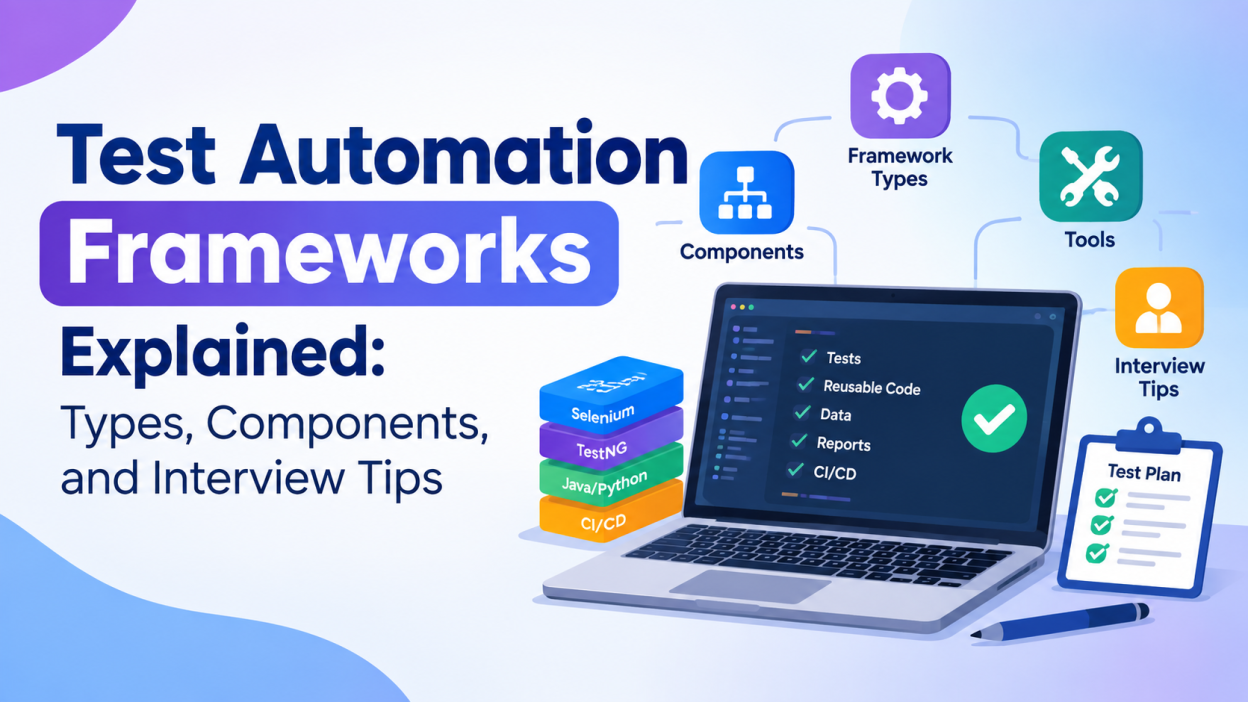
Instead of writing every test script from scratch, a framework provides reusable components such as:
- Test scripts
- Reusable functions
- Test data
- Configuration files
- Object repositories
- Reporting mechanisms
- Logging
- Assertions
- Test execution tools
For example, Selenium can be used for browser automation, while Java, Python, or C# can be used to develop the automation scripts. Frameworks such as TestNG, JUnit, PyTest, or NUnit can help organize and execute tests.
In an interview, you can explain it simply:
“A test automation framework provides a structured and reusable approach for developing, executing, and maintaining automated test cases.”
Why Are Automation Frameworks Important?
Without a proper framework, an automation project can quickly become difficult to maintain. When the application changes, testers may need to update the same code in multiple places.
A well-designed framework improves:
Reusability: Common functions can be reused across multiple test cases.
Maintainability: Changes can be made in centralized locations.
Scalability: New test cases can be added without redesigning the entire project.
Readability: Test scripts become easier for team members to understand.
Reporting: Test results can be generated automatically.
Consistency: Tests follow a common structure and execution process.
These advantages are useful points to mention when an interviewer asks, “Why do we need an automation framework?”
Major Types of Test Automation Frameworks
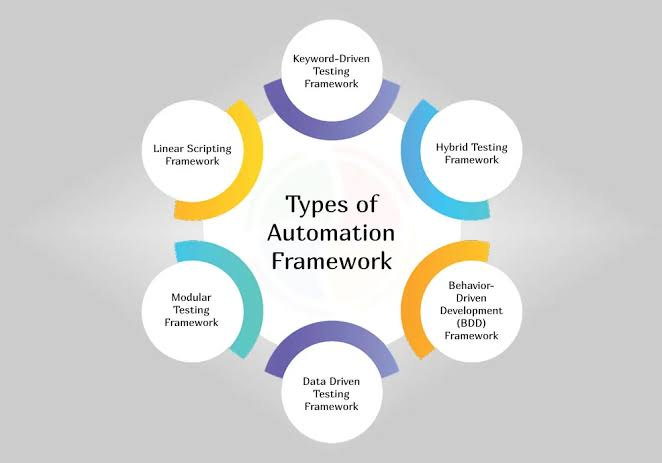
There are several commonly discussed automation framework approaches. Understanding their differences is important for interviews.
1. Linear Framework
In a linear framework, testers create test scripts independently, generally following the application’s workflow from beginning to end.
For example, an e-commerce test may:
Open the website → Login → Search for a product → Add it to the cart → Checkout.
This approach is easy for beginners but has limited code reusability. If the same login functionality is required in many tests, the login steps may be duplicated.
2. Modular-Based Framework
A modular framework divides the application into different modules.
For example:
- Login module
- Product module
- Cart module
- Payment module
- Logout module
Each module can have reusable functions. Test cases can then combine these modules according to the scenario.
This makes the framework easier to maintain because changes to one functionality can usually be handled within its corresponding module.
3. Data-Driven Framework
In a data-driven framework, test data is separated from the test script.
Data can be stored in sources such as:
- Excel
- CSV
- JSON
- XML
- Database
For example, instead of creating separate login tests for ten users, one login test can read ten sets of usernames and passwords from a data source.
This approach is particularly useful when the same functionality needs to be tested with many different input values.
4. Keyword-Driven Framework
A keyword-driven framework uses predefined keywords to represent testing actions.
For example:
| Keyword | Action |
|---|---|
| OpenBrowser | Launch browser |
| EnterText | Enter input |
| Click | Click an element |
| VerifyText | Verify displayed text |
| CloseBrowser | Close browser |
The framework maps these keywords to programming functions. This can make test cases easier to understand, especially for teams where not every tester has strong programming knowledge.
5. Hybrid Framework
A hybrid framework combines two or more framework approaches.
For example, a project may combine:
Page Object Model + Data-Driven Testing + Keyword-Based Components + TestNG
Hybrid frameworks are common in larger automation projects because they allow teams to combine the strengths of different approaches.
Page Object Model in Automation Testing
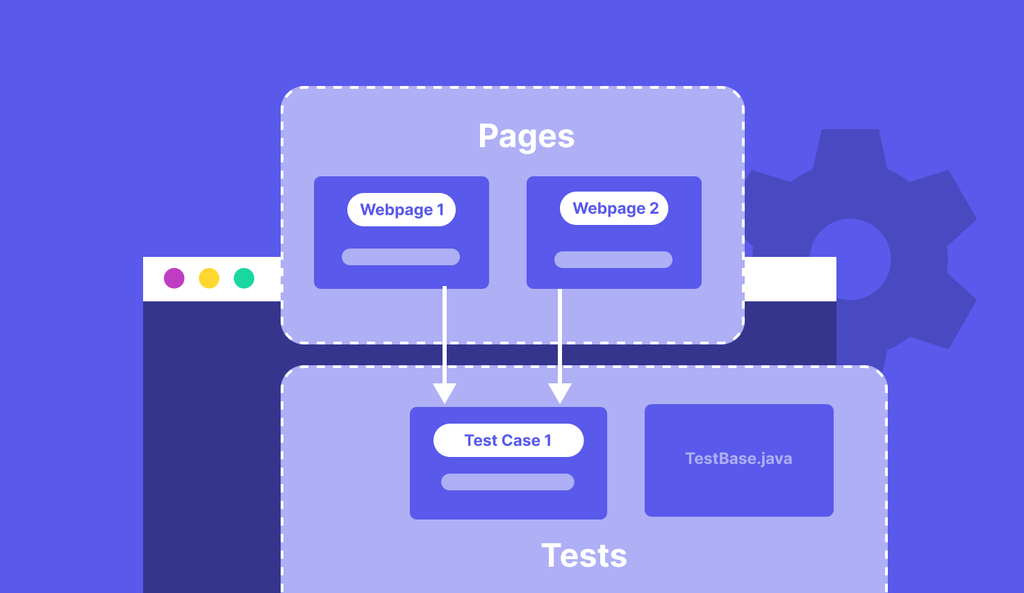
The Page Object Model (POM) is another important concept that frequently appears in automation interviews.
In POM, each important application page is represented by a separate class or object.
For example:
- LoginPage
- HomePage
- ProductPage
- CartPage
- CheckoutPage
The page class contains the elements and methods related to that page.
Instead of writing browser interaction code directly inside every test, the test can call reusable methods such as:
login()
searchProduct()
addToCart()
This reduces duplication and makes maintenance easier when the application’s UI changes.
Important Components of an Automation Framework
When explaining your framework during an interview, discuss its major components.
A typical framework may contain:
Test Cases: Actual automated scenarios.
Page Objects: Application pages and their reusable methods.
Test Data: Input values required for testing.
Configuration: Browser, environment, URL, timeout, and other settings.
Utilities: Reusable helper functions such as screenshots, waits, file handling, or database operations.
Assertions: Validation of expected versus actual results.
Logging: Information about test execution and failures.
Reports: Summary of passed, failed, and skipped test cases.
Build Tools: Tools such as Maven or Gradle for managing dependencies and builds.
CI/CD Integration: Platforms such as Jenkins or GitHub Actions can execute automated tests as part of development pipelines.
How to Explain Your Framework in an Interview
A good answer should be based on your actual project experience rather than simply listing framework names.
You can structure your answer like this:
“In my project, we used a hybrid automation framework. Selenium was used for browser automation, Java was used for scripting, and TestNG was used for test execution. We followed the Page Object Model to separate page elements and business actions from test cases. Test data was maintained separately, and reusable utility methods were created for common operations such as screenshots and waits. Test results were generated through reports, and the test suite could be executed through the CI/CD pipeline.”
This type of answer gives the interviewer a clear picture of how the different components work together.
Common Interview Questions

Interviewers may ask questions such as:
What is an automation framework?
Explain its purpose, structure, and benefits.
Which framework have you worked with?
Mention the actual framework and technologies you have used.
What is the difference between data-driven and keyword-driven frameworks?
Explain that data-driven frameworks separate test inputs, while keyword-driven frameworks represent actions using predefined keywords.
What is POM?
Explain how page-specific elements and methods are organized separately from test cases.
How do you handle test data?
Explain whether you use Excel, CSV, JSON, databases, or another method.
How do you generate reports?
Mention the reporting solution used in your project.
How do you handle failures?
Discuss screenshots, logs, retries where appropriate, assertions, and reporting.
Final Thoughts
Test automation frameworks are not just collections of tools. They provide a structured way to build reusable, maintainable, scalable, and reliable automated tests.
For interviews, focus on understanding how different components work together rather than memorizing definitions. Be ready to explain the framework you have worked with, why particular tools were selected, how test data is managed, how failures are reported, and how the framework supports continuous testing.
If you can explain the complete flow—from writing a test case to executing it and generating a report—you can demonstrate practical understanding rather than only theoretical knowledge.
If You Want to study Software Testing Course, or any other course & Internship visit www.kaashivinfotech.com