What Is the Nature of Accounting? A Simple Guide for Everyone
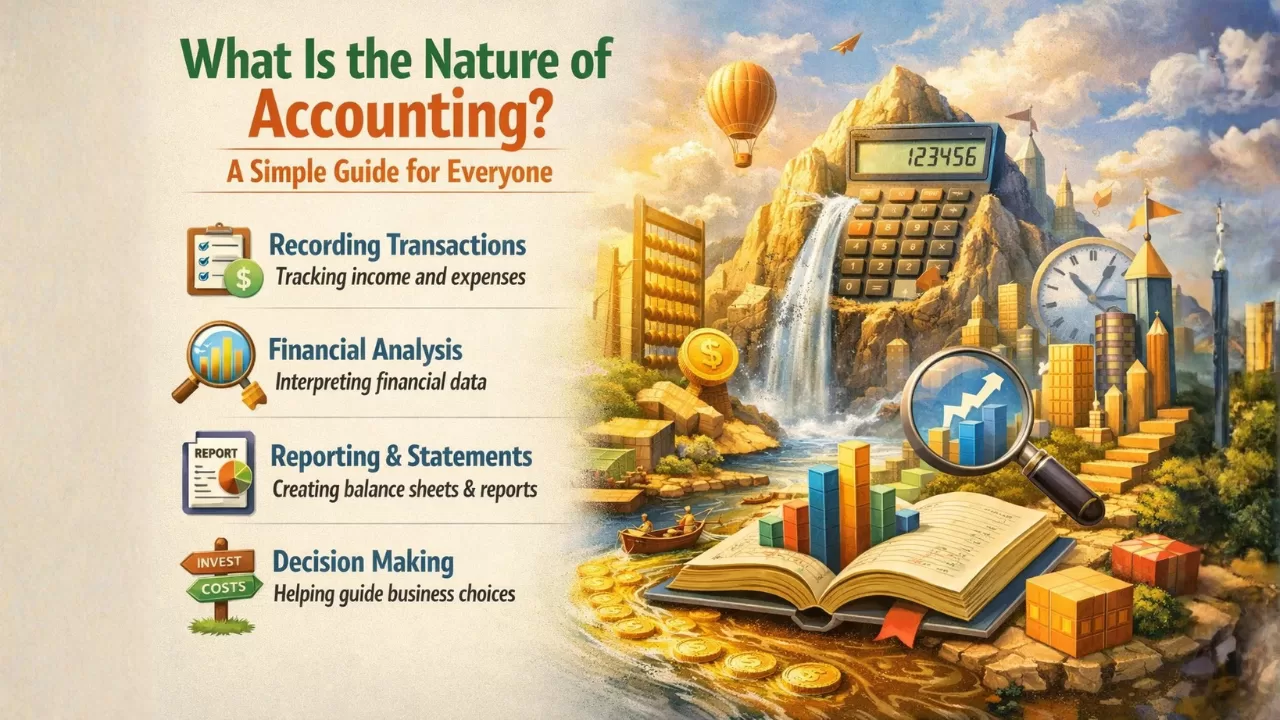
Hey there! Have you ever sat down and wondered how businesses keep track of every rupee coming in and going out? Or how someone decides whether a company is doing well just by looking at some numbers?
I remember when I first started learning about money and business, I thought accounting was just about boring spreadsheets and endless calculations. But honestly? It’s so much more than that. At its heart, it’s about telling a story—the financial story of a business.
Today, we’re diving into something super important: the nature of accounting. Don’t worry—I’ll keep it simple, real, and easy to understand. No jargon overload. Just honest talk about what accounting really is, why it matters, and how it helps people like you and me every day.
What Is the Nature of Accounting?
So, what is the nature of accounting?
Think of it this way: when you start a small business—maybe selling handmade crafts or running a food stall—you need to know how much you’re spending on supplies, how much you’re earning from sales, and whether you’re actually making a profit.
That’s where accounting comes in.
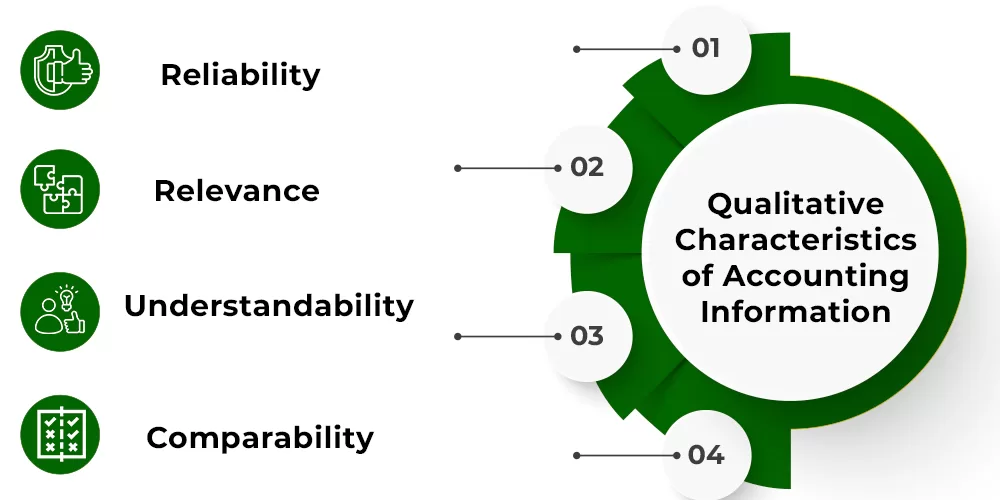
The nature of accounting isn’t just one thing—it’s actually a mix of four key ideas:
- A process
- An art
- A means to an end
- An information system
Let me break each one down like we’re chatting over coffee.
Understanding the Nature of Accounting
1. Accounting as a Process
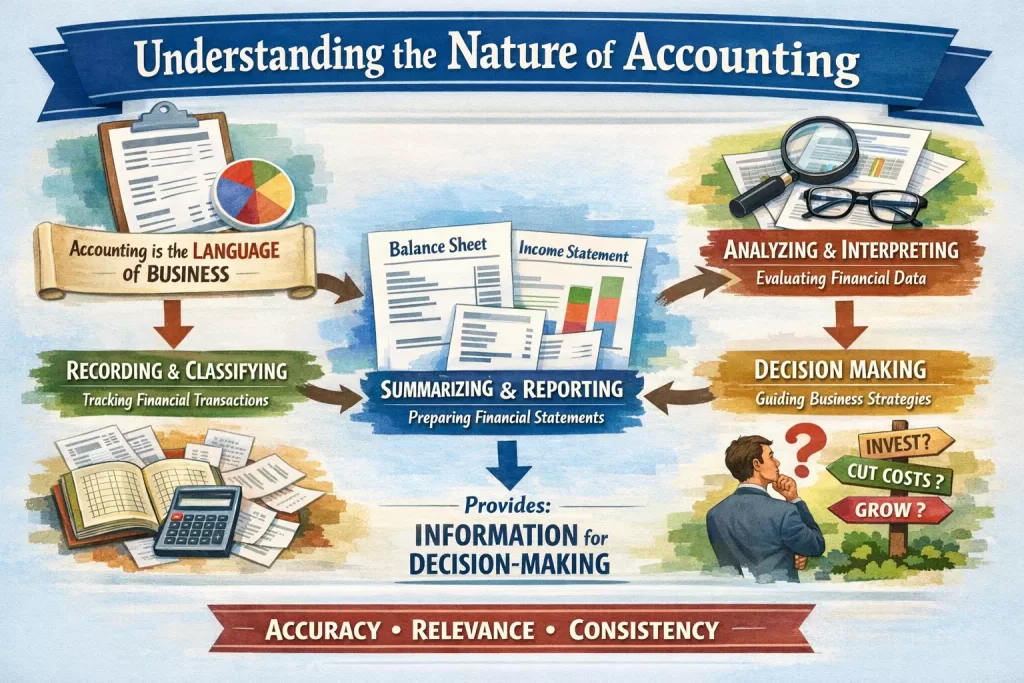
Accounting feels like following a recipe. There are clear steps you take every time to make sure nothing gets missed.
Here’s how it usually works:
- Identifying transactions: First, you spot something that involves money—like buying new equipment or receiving payment from a customer.
- Measuring and recording: You put a number on it (like ₹10,000 from a sale) and write it down in your books.
- Classifying data: You group similar things together—like putting all rent payments under “Expenses.”
- Summarizing: You turn all that detail into simple reports, like a monthly profit statement.
- Analyzing and communicating: Finally, you look at the numbers and share them with people who need to know—like your business partner or bank.
It’s kind of like cleaning your room. You sort, organize, and then show your parents it’s tidy. Accounting does the same for money!
2. Accounting as an Art
Wait—accounting as an art? I know, it sounds strange at first. But hear me out.
Yes, there are rules (like math and laws), but accountants also use judgment and creativity. For example:
- How do you decide if a big purchase counts as an expense or an investment?
- How do you present financial reports so someone who’s not a numbers person can understand them?
It’s not just about getting the right answer—it’s about telling the story in a way that makes sense. That takes skill, experience, and a bit of flair. Just like a painter chooses colors, an accountant chooses how to show financial truth.
3. Accounting as a Means, Not an End
Here’s a truth I wish I knew earlier: accounting isn’t the goal. It’s a tool.
Think of it like a GPS. You don’t use GPS just to see dots on a map—you use it to get somewhere. In the same way, accounting gives people the info they need to make smart choices.
Who uses this info?
- Managers (internal): To plan budgets or decide whether to hire new staff.
- Investors (external): To see if a company is worth putting money into.
- Banks: To decide whether to give a loan.
Accounting helps all of them—but it’s not the final destination. It’s just the map.
4. Accounting as an Information System
In today’s world, accounting is also a system—like a digital brain for a business.
It collects financial data, stores it safely, and shares it when needed. Whether it’s through software like Zoho Books or simple Excel sheets, accounting systems help:
- Keep records organized
- Spot trends over time
- Send reports to the right people
For example, if a company wants to know which product sold the most last quarter, the accounting system can pull that info in minutes. That’s powerful!
So, when we talk about the nature of accounting, we’re really talking about something dynamic—part science, part art, all useful.
Scope of Accounting: Who Uses This Info?
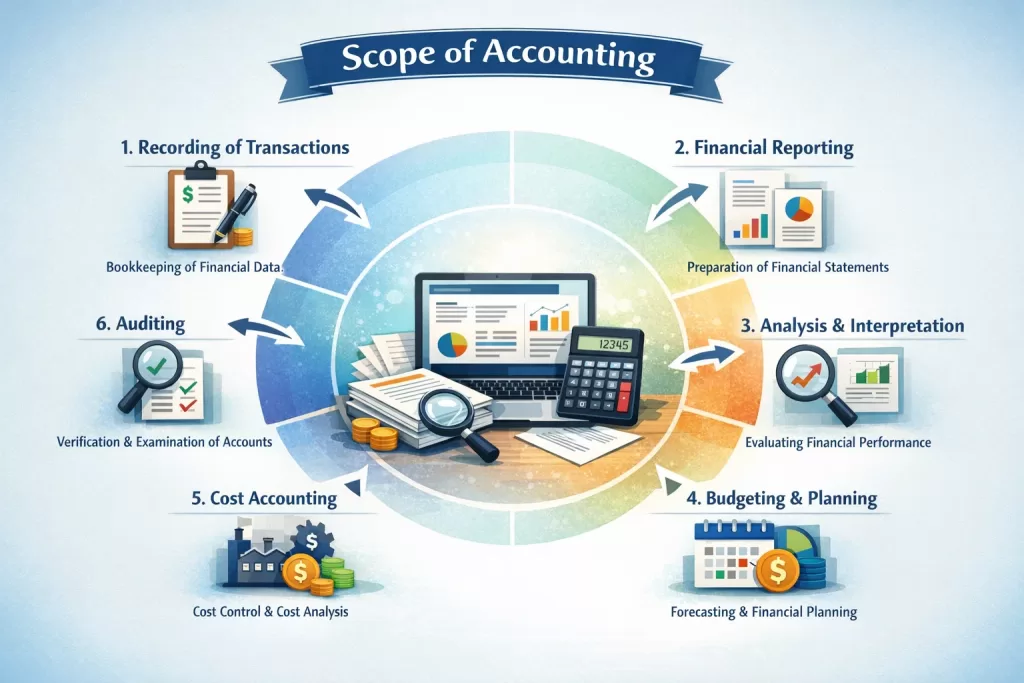
Accounting doesn’t happen in a vacuum. The scope of accounting is wide because so many people depend on it.
Let’s look at who benefits:
Reporting to Shareholders
If someone invests money in a company, they want to know how it’s doing. Accounting gives them reports like:
- Balance sheets
- Income statements
- Cash flow statements
These help shareholders decide: Should I keep my money here, or move it?
Reporting to the Public
Big companies share their finances with everyone. Why? Transparency.
When you’re thinking about buying shares in a company, you can actually read their financial reports online. It helps you judge:
- Is this company stable?
- Is it growing?
- Is it risky?
Accounting makes that possible.
Reporting to Government
Taxes! No one loves them, but we all need them. Accounting helps businesses:
- Calculate the right tax amount
- Follow legal rules
- Avoid penalties
Without proper accounting, companies could get into serious trouble.
Reporting to Employees
Even employees care about finances. If a company is profitable, there might be bonuses or job security. If it’s struggling, people might worry.
Accounting helps employees understand:
- Is the company healthy?
- Are my job and growth safe?
It’s about trust and clarity.
Types of Accounting: More Than Just One Kind
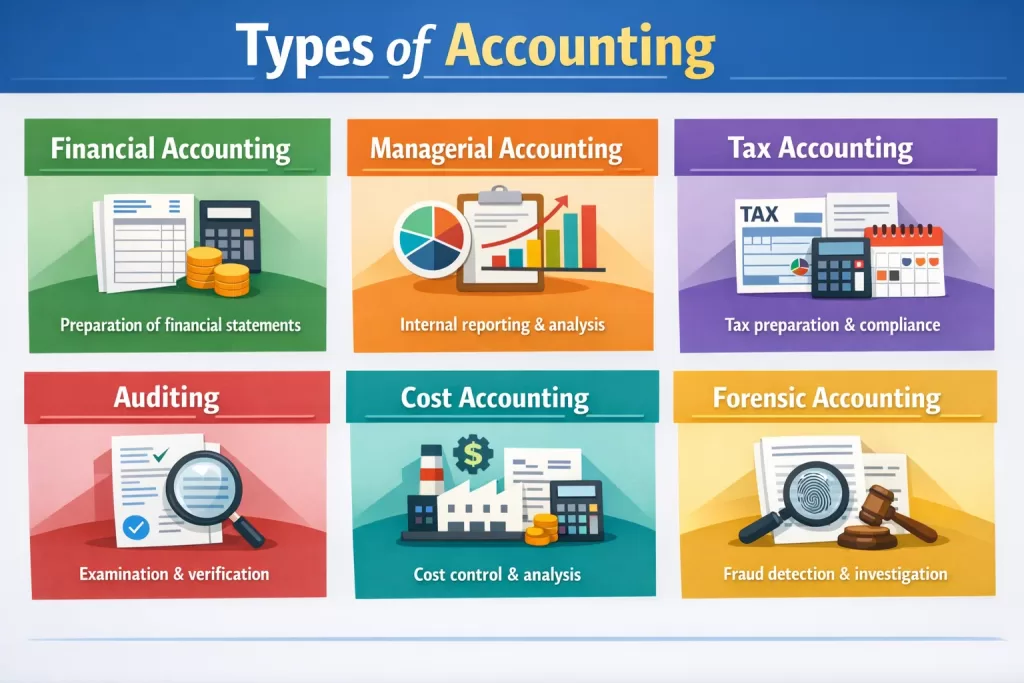
You might think accounting is just one thing—but there are actually different types, each with its own job.
Here are the main ones:
1. Financial Accounting
This is the most common type. It’s all about recording past transactions and making reports for outside people—like investors or the government.
Example: Preparing annual financial statements.
2. Cost Accounting
This one’s for inside the business. It helps companies understand how much it costs to make their products or offer services.
Example: Finding out if raw materials are too expensive—and how to save money.
3. Managerial Accounting
Also internal, this helps bosses make decisions. It’s more flexible and future-focused.
Example: Figuring out which product line is most profitable.
4. Forensic Accounting
This sounds like something from a crime show—and kind of is! Forensic accountants investigate fraud or financial mistakes.
Example: Tracing missing money in a company’s books.
Each type plays a role in keeping businesses honest, efficient, and successful.
Why Understanding the Nature of Accounting Matters
Look, I get it—accounting might not sound exciting at first. But understanding the nature of accounting helps everyone:
- Business owners make better choices
- Students pick the right career path
- Regular people manage their own money better
When you see accounting as a process, an art, a tool, and a system—it starts to make sense. It’s not just about numbers. It’s about people, decisions, and trust.
And if you’re thinking about a career in finance, tax, or accounting, knowing this foundation is key.
That’s why programs like the (in partnership with PwC India) focus so much on the real nature of accounting—not just theory, but practical, human-centered learning.
With mentorship, real case studies, and tools like Excel and Zoho Books, it’s designed to help people like you grow with confidence.
Become A Cloud,Black chain and Data analytics With Kaashiv Infotech
Looking to dive into the world of Cloud ,Black chain, Data analytics and carve your path to success? Kaashiv Infotech is here for you! Our Comprehensive Cloud,Black chain, Data analytics Course is specially designed by experts to equip you with practical skills and real-world experience that will help you to set your foot in the competitive [Cloud/Black chain/ Data analytics] industry.
Let’s break down our course offerings to see what makes our course stand out:
- Live Industry Projects + Real-Time Implementation: You’ll work on a variety of projects to build a solid portfolio, enhanced by 2 real-time industry projects provided per internship that showcase your practical skills.
- Practice Exercises: Get hands-on practice with daily exercises that enhance your learning and help you master key concepts in a practical environment.
- Doubt Clearing Sessions: Our regular doubt sessions ensure that no question goes unanswered, giving you clarity on all concepts directly from our trainers.
- Kaashiv Lab for Coding: Access our exclusive infrastructure and lab facilities for coding practice, polishing your technical skills in a supportive, hands-on environment.
- Training by Microsoft MVPs & Google-Recognized Experts: Learn from industry leaders. Our curriculum is led by Microsoft MVPs and Google-recognized experts, ensuring industry-relevant skills and techniques.
- Triple Certification Credentialing: Earn a robust set of credentials upon completion—comprising an Internship Certificate, an Inplant Training (IPT) Certificate, and an Industrial Exposure Certificate—valued by employers in the industry.
- Q&A Forum: Engage with fellow batchmates and instructors in our interactive sessions to exchange ideas, seek advice, and collaborate on projects.
- Instructor-Led Sessions: Benefit from interactive sessions led by experienced instructors who guide you every step of the way through complex algorithms and architectures.
- Interview Opportunities & ATS Tools: Gain access to interview opportunities, ATS-friendly resume tools, and a comprehensive cloud interview question bank to help you land your dream job.
- 100% Job Assistance Guarantee + Alumni Support: We’re offering 100% job assistance along with ongoing support from our wide alumni network spanning top tech companies.
Conclusion
So, what’s the takeaway?
The nature of accounting is rich and layered. It’s a step-by-step process, a creative art, a helpful tool, and a smart information system—all rolled into one.
It helps businesses survive, grow, and stay honest. It gives people the power to make informed decisions—whether they’re running a company or just planning their next big purchase.
we believe financial knowledge should be simple and human. No fear. No confusion. Just clear, honest answers.
So next time you hear the word “accounting,” don’t think of boring numbers. Think of stories, choices, and the quiet force that keeps our economy moving.
And hey—if you’ve got questions, drop them below. Let’s keep the conversation going.
Frequently Asked Questions (Based on People Also Ask)
1. What is the nature of accounting?
The nature of accounting means it’s more than just number-crunching. It’s a process to record transactions, an art that needs judgment, a tool to help decisions, and an information system that shares financial data with stakeholders.
2. What does the nature of financial accounting involve?
Financial accounting focuses on recording, summarizing, and reporting past financial activities. Its nature is to provide clear, accurate reports—like income statements—for external users such as investors and the government.
3. What is the primary objective of accounting?
The main goal is to provide useful financial information so people can make smart decisions. Whether it’s a manager planning a budget or an investor choosing stocks, accounting helps by telling the financial story clearly.
4. Why is understanding the scope of accounting important?
Knowing the scope helps you see who uses accounting info—shareholders, employees, government, and the public. It shows how accounting supports transparency, compliance, and trust in business.
5. How does accounting contribute to business growth?
Accounting helps track performance, control costs, plan for the future, and attract investors. By understanding financial health, businesses can make better choices that lead to long-term growth and stability.