
If you’re learning or building with Python today, one decision can quietly shape your entire journey—the Python IDEs you choose. Many beginners underestimate this. They think any editor will work. But in reality, the difference between a good Python IDE and a poor one is the difference between confident coding and constant frustration.
Students often struggle not because Python is hard, but because their Python IDE makes learning harder. Developers waste hours debugging issues that a smarter Python IDE could have caught instantly. Freshers lose motivation when their environment feels confusing. Even experienced professionals sometimes slow down simply because their Python IDE isn’t optimized for their workflow.
So the question becomes very real—which Python IDE is actually the best in 2026?
With so many tools available today, choosing the right Python IDE is no longer just about preference. It directly affects how fast you learn, how efficiently you code, and how well you perform in real-world projects. A well-chosen Python IDE becomes your coding partner. A poor one becomes your biggest obstacle.
According to the JetBrains Developer Ecosystem Report 2025, more than 65% of developers agreed that using the right Python IDE improved their coding speed by over 40% and reduced debugging time significantly. That’s not a small improvement—it’s a career-changing advantage.
⭐ Understanding Python IDE in a Practical Way
A Python IDE, or Integrated Development Environment, is not just a place where you type code. It is your complete development workspace where writing, testing, debugging, and managing code all happen together.
Imagine trying to learn in a messy classroom with no tools—that’s what coding without a proper Python IDE feels like. Now imagine a well-equipped digital lab where everything is organized, automated, and intelligent. That is what a good Python IDE provides.
A modern Python IDE helps you write cleaner code with intelligent suggestions, identifies mistakes before they become problems, allows you to debug step by step without confusion, and manages even large projects smoothly. Over time, this doesn’t just improve your coding—it transforms the way you think as a developer.
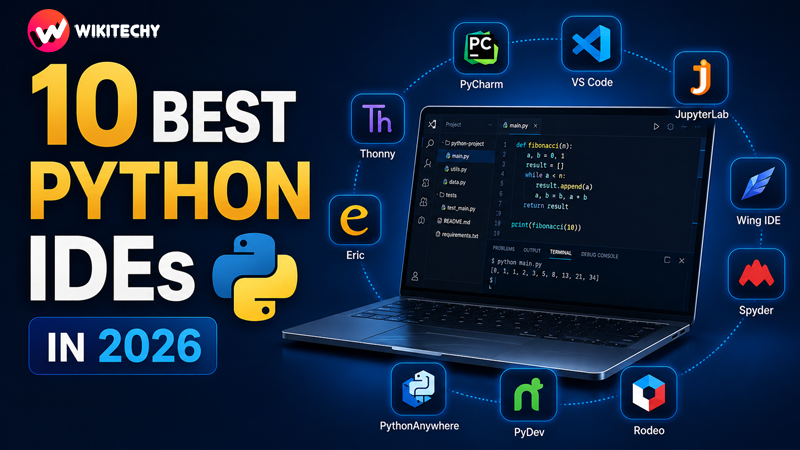
✅ Top 10 Best Python IDEs in 2026 (Detailed Guide)
When we talk about the best Python IDE options in 2026, we are not just comparing tools—we are comparing experiences. Each Python IDE serves a different purpose, and choosing the right one depends on your goals.
1️⃣ PyCharm – The Professional Standard
PyCharm continues to dominate as a powerful Python IDE for serious developers. Built by JetBrains, this Python IDE is designed for people who want structure, reliability, and deep functionality.
What makes PyCharm stand out is how intelligently it understands your code. It doesn’t just autocomplete—it predicts. It doesn’t just debug—it guides you through issues step by step. Whether you are working on web development using Django or Flask, or diving into AI and machine learning, PyCharm adapts to your needs.
This Python IDE is especially valuable in professional environments where clean code, scalability, and maintainability matter. That’s why many companies and recruiters prefer developers who are comfortable using PyCharm.
2️⃣ Visual Studio Code – The Most Flexible Python IDE
Visual Studio Code has evolved from a simple editor into one of the most widely used Python IDE tools in the world. Its popularity comes from its flexibility.
This Python IDE is lightweight, fast, and extremely customizable. With the right extensions, VS Code can transform into a powerful Python IDE capable of handling everything from small scripts to large applications.
One of the biggest advantages of this Python IDE is that it runs smoothly even on low-end systems, making it accessible to students and beginners. At the same time, professionals use it for complex development tasks because of its adaptability.
VS Code proves that a Python IDE doesn’t need to be heavy to be powerful.
3️⃣ Jupyter Notebook / JupyterLab – The Data Science Favorite
For anyone interested in data science, machine learning, or AI, Jupyter is not just a Python IDE—it’s an essential tool.
Unlike traditional Python IDE environments, Jupyter allows you to write and run code in blocks. This makes experimentation easier and learning more interactive. You can visualize data instantly, test ideas quickly, and build models step by step.
This Python IDE is widely used in universities, research labs, and even top tech companies. It creates an environment where learning and experimentation feel natural rather than overwhelming.
4️⃣ Spyder – Built for Analysis and Research
Spyder is a Python IDE designed specifically for scientific computing and data analysis. It provides a structured environment that feels familiar to users coming from tools like MATLAB.
This Python IDE includes features like a variable explorer, which allows you to inspect data in real time, and advanced debugging tools that make complex analysis easier to handle. It is especially popular among engineers, analysts, and researchers who deal with large datasets.
5️⃣ Thonny – A Beginner’s Best Friend
For someone just starting out, choosing the right Python IDE can make a huge difference. Thonny is built with beginners in mind.
This Python IDE removes unnecessary complexity and focuses on clarity. Its interface is simple, its debugging is easy to understand, and it helps new learners build confidence step by step.
Instead of overwhelming users, Thonny supports them. That’s why it’s often recommended as a first Python IDE for students.
6️⃣ IDLE – The Built-in Starting Point
IDLE is the default Python IDE that comes installed with Python itself. While it may not be the most advanced option, it serves as a simple and reliable starting point.
This Python IDE is useful for quick testing, small programs, and basic learning. It proves that even a minimal environment can still be effective for understanding core concepts.
7️⃣ Eclipse with PyDev – Structured and Powerful
Eclipse with the PyDev plugin is a Python IDE that appeals to developers who prefer structured environments. It is especially useful for those with a background in Java or enterprise development.
This Python IDE offers strong project management tools, debugging capabilities, and scalability. It may feel slightly traditional, but it remains a powerful choice for team-based development.
8️⃣ JetBrains Fleet – The Future of Python IDEs
Fleet represents a new generation of Python IDE tools. It is lightweight, fast, and designed for modern workflows, including cloud-based development.
This Python IDE focuses on speed and simplicity while still offering smart features. As more developers move toward faster and more flexible tools, Fleet is gaining attention as a future-ready option.
9️⃣ Replit – Coding Without Limits
Replit changes the idea of what a Python IDE can be. Instead of installing software, you can code directly from your browser.
This Python IDE is perfect for students, beginners, and collaborative environments. It allows real-time coding with others, making it ideal for classrooms and hackathons.
🔟 Google Colab – Cloud Power for AI

Google Colab is a Python IDE designed for performance and accessibility. It provides cloud-based coding with free GPU support, making it extremely useful for machine learning and deep learning projects.
This Python IDE removes hardware limitations and allows you to work on powerful tasks without needing a high-end system.
🏆 Choosing the Right Python IDE
The best Python IDE is not the same for everyone. It depends on your goals, your experience level, and the kind of projects you want to build.
A beginner may feel comfortable with a simple Python IDE like Thonny, while a professional developer may need the advanced capabilities of PyCharm. A data science learner may prefer Jupyter, while someone working on AI projects might choose Google Colab.
The key is not to follow trends blindly, but to choose a Python IDE that supports your learning style and career direction.
💼 Why the Right Python IDE Matters More Than You Think
Many people ignore the impact of their Python IDE, but it plays a major role in shaping their coding journey.
A poor Python IDE can slow you down, confuse you, and reduce your confidence. A good Python IDE, on the other hand, can make coding faster, smoother, and more enjoyable.
Over time, this difference becomes huge. It affects how quickly you learn, how well you build projects, and how prepared you are for real-world opportunities.
✨ Final Thoughts
Python is no longer just a programming language. It has become a gateway to careers in software development, data science, artificial intelligence, and more.
And behind every successful Python developer is a Python IDE that supported their growth.
Choose the right Python IDE.
Learn with consistency.
Build with confidence.
Want to Learn More About Python & Artificial Intelligence ???, Kaashiv Infotech Offers Full Stack Python Course, Artificial Intelligence Course, Data Science Course & More Visit Their Website course.kaashivinfotech.com.