
Let me start with a question that everyone has. What does PPC stand for?
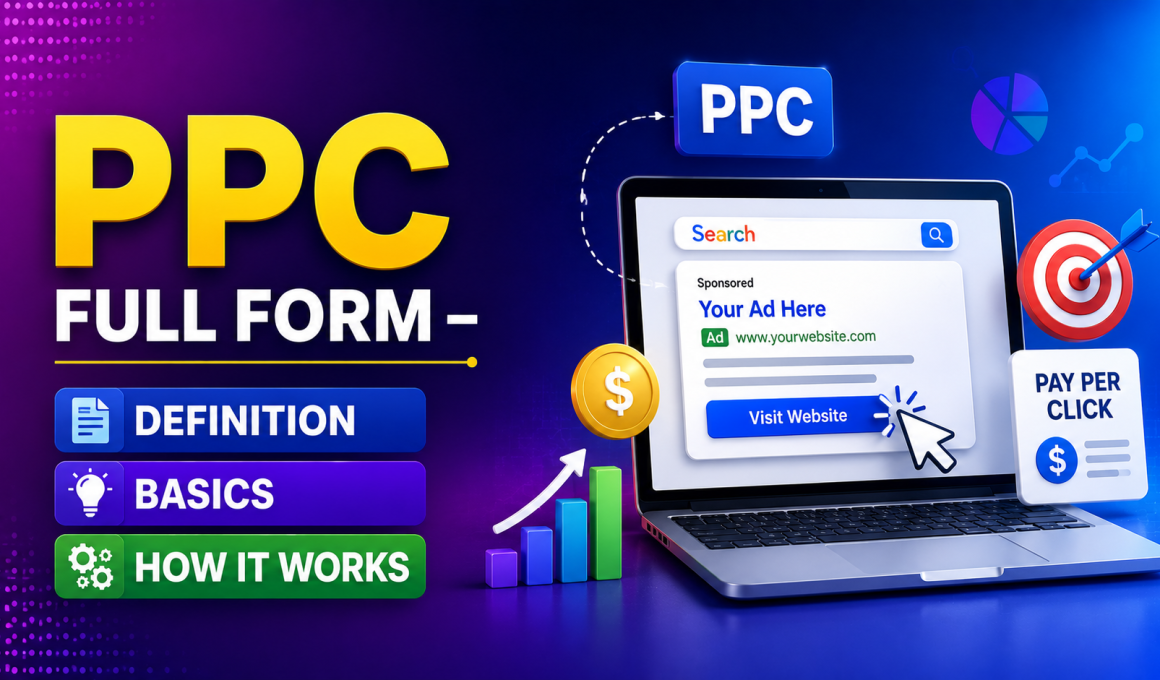
The PPC Full Form is Pay Per Click.
PPC Full Form – Definition, Basics,
If you have spent than a few seconds on the internet today you have already seen a lot of PPC ads. These are the results with the Ad tag at the top of Google. These are the sponsored posts on your Instagram feed. These are the ads that play before that YouTube video you watched this morning.
Pay Per Click is the popular form of online advertising right now. Almost every guide online will explain Pay Per Click to you with a lot of complicated terms. I will not do that. This is the explanation of Pay Per Click that I wish someone had given me when I first started.
What Actually Is Pay Per Click?
At its core Pay Per Click is a fair advertising model.
Before Pay Per Click advertising worked like this: You paid a lot of money to show your ad to a lot of people. It did not matter if most of them did not care did not see it or hated it. You still paid the amount.
Pay Per Click completely changed that
PPC Full Form – Definition, Basics.
With Pay Per Click you pay nothing to show your ad. You only pay when someone actually clicks on it.
This one simple rule changed the internet. For the time advertisers only paid for actual interest not just the opportunity to be ignored.
This is why Pay Per Click grew from nothing to an industry in less than twenty years. Pay Per Click works. It works for advertisers. It works for platforms. It even works for users.
How Does Pay Per Click Work?
Most guides will tell you “you bid on keywords and pay when someone clicks”. That is true. It is only part of the story. There is a system that runs every Pay Per Click ad you ever see and almost no one explains it properly.
This is the step by step process that happens in a fraction of a second after you press search on Google:
Step 1: The Auction
When you type something into Google the platform instantly runs an auction between every advertiser who is bidding on that keyword.
This is a myth about Pay Per Click: the highest bidder does not always win.
Google and every other Pay Per Click platform do not want to show ads. If they show people ads people will stop clicking ads altogether and they will go out of business.
So instead they calculate something called Ad Rank.
Step 2: Ad Rank
Ad Rank is the number that decides what position your ad gets. It is calculated using two things:
- How much you bid per click
- Your Quality Score
Quality Score is a score that Google gives every ad, based on how relevant it is, how good your landing page is and how often people actually click your ad when it is shown.
Here is a tip: an advertiser with a bid and a perfect Quality Score will beat an advertiser with a high bid and a bad Quality Score every single time. This is the important secret of Pay Per Click. All new advertisers waste a lot of money because no one tells them this.
Step 3: You Get Charged
If your ad wins and someone clicks it you get charged. You almost never pay your full bid amount. You only pay a little more than the highest bidder below you.
That is it. That is the system. It runs billions of times every day completely automatically.
The Different Pay Per Click Models
Pay Per Click is the name but there are actually different variations of this model each used for different goals.
Here are the different models:
- CPC: You pay when someone clicks your ad. This is best for leads, sales and direct response.
- CPM: You pay for every thousand times your ad is shown. This is best for brand awareness.
- CPA: You only pay when someone buys something or signs up. This is best for e-commerce and lead generation.
- CPV: You pay when someone watches your video ad. This is best for video campaigns.
- CPE: You pay when someone likes, shares or comments. This is best for media engagement.
Most people starting out will almost always use CPC. It is the most common model by far.
Why Is Pay Per Click So Important?
There are different ways to do marketing. Pay Per Click is the only one that gives you all of these things:
- You get results today
If you need traffic this week there is no option.
- You have control
You can decide exactly how much you want to spend per day what locations you want to show your ad in what times of day it runs what devices it shows on and exactly who sees it.
- Everything is measurable
You will know how many people saw your ad, how many clicked it how many bought something and exactly how much profit you made for every rupee you spent.
This is why every type of business from bakeries to Amazon uses Pay Per Click.
Top Pay Per Click Advertising Platforms
There are Pay Per Click platforms but most ad spend goes to these:
- Google Ads: This is the original and still the largest Pay Per Click platform. Google Ads shows ads to people at the moment they are searching for what you sell.
- Microsoft Advertising: This is much smaller than Google. Also has much less competition.
- Facebook / Instagram Ads: This is the platform for targeting people based on who they are, not what they are searching for right now.
- YouTube Ads: This is the way to reach a massive audience right now.
- LinkedIn Ads: This is expensive, but completely unbeatable for B2B.
Common Pay Per Click Myths Debunked
Here are the three common lies people tell you about Pay Per Click:
Myth: Pay Per Click is only for big companies
Truth: You can start a Pay Per Click campaign with a small budget.
Myth: Pay Per Click’s too expensive
Truth: You set the budget. You can spend little or as much as you want.
Myth: You need to be an expert to run Pay Per Click
Truth: You can learn the basics in a short time. You do not need a certification to run profitable ads.
Become A Tech Expert in Digital Marketing, AI, Data Science & Web Development With Kaashiv Infotech
Looking to dive into the dynamic world of Digital Marketing course in chennai , Artificial Intelligence (AI), Data Science & Analytics, and Web Development? Ready to carve your path to success using skills like SQL, Python, and Tableau, mastering Marketing Automation (CRM), and building with HTML/JS/PHP? Kaashiv Infotech is here for you! Our Inplant Training (IPT) and Specialized Certification Courses are specially designed by experts to equip you with practical skills and real-world experience that will help you to set your foot in the competitive tech industry.
Let’s break down our program offerings to see what makes our training stand out:
- Live Industry Projects + Capstone: You’ll work on 2 real-time projects per internship to build a solid portfolio and enhance your learning with a capstone project that showcases your skills across Digital Marketing, AI, Data Science & Analytics, SQL, Python, Tableau, Marketing Automation, and Web Development.
- Daily Practice Exercises: Get hands-on practice with daily exercises led by Microsoft MVPs and Google-recognized experts that enhance your learning and help you master key concepts.
- Doubt Clearing Sessions: Our regular doubt sessions ensure that no question goes unanswered, giving you clarity of all the concepts.
- Kaashiv Tech Lab: Access our exclusive lab for hands-on practice in Digital Marketing, AI, Data Science, SQL, Python, Tableau, Marketing Automation (CRM), and Web Development (HTML/JS/PHP), and polish your technical skills in a supportive environment.
- Industry-Oriented Curriculum: Learn industry-relevant skills and techniques that are directly applicable to real-world scenarios across Digital Marketing, Artificial Intelligence (AI), Data Science & Analytics, and Web Development.
- Triple Certification: Earn Kaashiv’s prestigious Triple Certification (Internship Certificate, Inplant Training (IPT) Certificate, and Industrial Exposure Certificate) upon completion, recognized and valued by employers across the industry.
- Q&A Forum: Engage with fellow batchmates and instructors in our Q&A forum to exchange ideas, seek advice, and collaborate on projects.
- Instructor-Led Sessions: Benefit from interactive sessions led by Microsoft MVPs and Google-recognized experts who guide you every step of the way.
- Interview Success Toolkit: Gain access to interview opportunities, ATS-friendly resume tools, and interview question banks to help you land your dream job in Digital Marketing, AI, Data Science, or Web Development.
Conclusion
Pay Per Click is not magic. It will not fix a product or a terrible website. When it is done well it is a very reliable way to grow almost any business.
The Pay Per Click Full Form is Pay Per Click. What it really means is: you only pay for results. That is the reason it took over the internet. That is the reason it is still the most popular form of digital advertising.
If you have never tried Pay Per Click before the best time to start is now. Start small. Test one keyword. Run one ad. See for yourself.
If you want to learn more about marketing and Pay Per Click check out our other guides.
FAQs
1. What is the full form of Pay Per Click?
The Pay Per Click Full Form is Pay Per Click. It is an advertising model where advertisers only pay when a user clicks on their ad.
2. How does Pay Per Click advertising actually work?
Advertisers bid on keywords. When a user searches for that keyword the platform runs an auction. Ads are ranked based on bid amount and ad quality. The advertiser only pays if someone clicks their ad.
3. What is the difference between SEO and Pay Per Click?
SEO is organic traffic that takes time to build. Pay Per Click is paid traffic that starts working
4. Is Pay Per Click worth it for businesses?
Yes. Pay Per Click is one of the marketing channels for small businesses. You can start with a small budget, target only local customers and only pay for actual results.
5. How much does Pay Per Click cost on average?
The average cost per click varies a lot by industry. You can set any budget you are comfortable, with.