
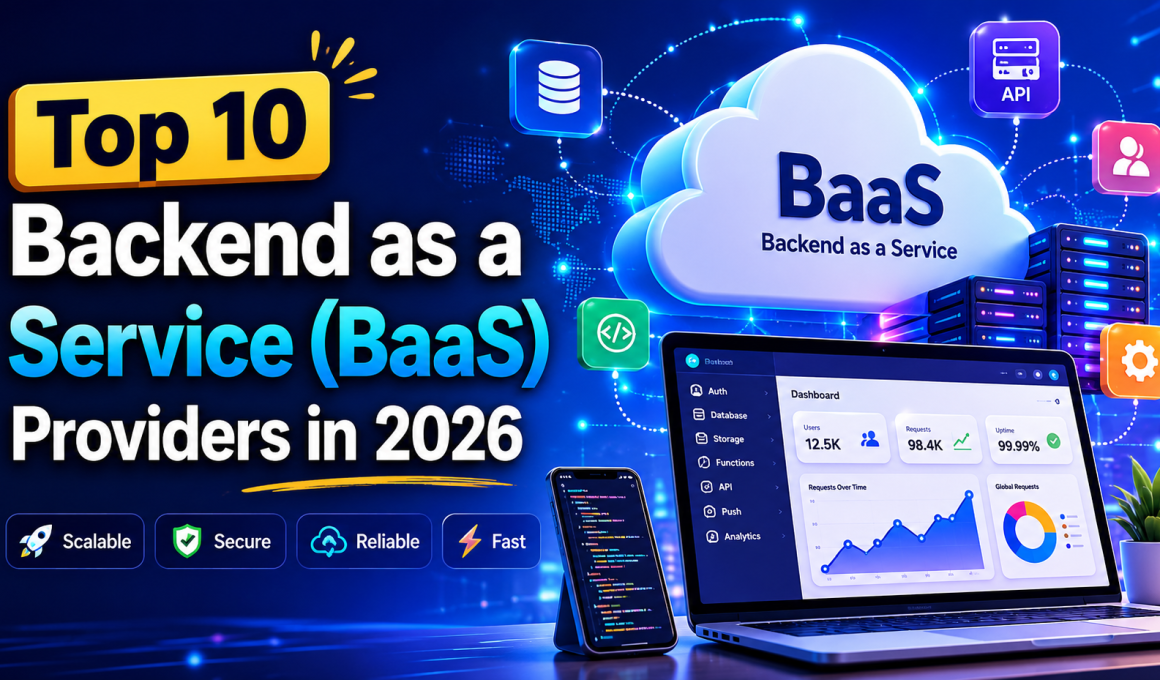
The way modern applications are built has changed dramatically over the last few years. Companies no longer want to spend months creating backend infrastructure, managing servers, configuring authentication systems, or maintaining APIs manually. Developers today focus more on building features and delivering better user experiences rather than handling complex backend operations.
This shift has made Backend as a Service (BaaS) one of the most important technologies in software development in 2026.
BaaS platforms provide ready-made backend infrastructure that developers can integrate directly into their applications. Instead of building databases, authentication systems, cloud storage, and realtime functionality from scratch, developers can use managed services that are already optimized for scalability and performance.
As startups move faster and AI-driven applications continue to grow, BaaS platforms are becoming essential for rapid product development. From solo developers launching MVPs to enterprises building large-scale systems, Backend as a Service is now a major part of modern cloud architecture.
What Is Backend as a Service (BaaS)?
Backend as a Service is a cloud computing model that allows developers to use prebuilt backend infrastructure instead of developing everything manually. These platforms typically provide databases, authentication, APIs, cloud storage, serverless functions, and realtime communication systems.
The biggest advantage of BaaS is speed. Developers can focus entirely on frontend experiences and product functionality while the provider manages infrastructure, scaling, security, and backend maintenance.
In 2026, BaaS platforms are commonly used for SaaS products, mobile applications, AI tools, ecommerce platforms, internal dashboards, and collaborative realtime apps.
Why BaaS Platforms Are Growing Rapidly
The increasing popularity of BaaS is closely tied to the changing priorities of modern software teams. Startups need faster release cycles, enterprises want scalable cloud infrastructure, and developers prefer tools that reduce operational complexity.
AI startups especially benefit from BaaS because they need backend systems that can scale quickly without requiring dedicated DevOps teams. Instead of spending time configuring infrastructure, teams can immediately begin building AI workflows, integrations, and user-facing features.
Another major reason behind BaaS growth is the rise of full-stack JavaScript frameworks like Next.js, Nuxt, and SvelteKit. These frameworks work extremely well with modern BaaS providers, creating highly productive development environments.
Open-source adoption is also influencing the market. Developers increasingly prefer platforms that provide transparency, portability, and self-hosting options. This trend has helped open-source BaaS providers compete directly against large cloud ecosystems.
Top 10 Backend as a Service Providers
1. Firebase
Firebase continues to dominate the BaaS ecosystem in 2026. Developed by Google, Firebase remains one of the most popular solutions for mobile applications, realtime systems, and rapid MVP development.
One of Firebase’s biggest strengths is its simplicity. Developers can quickly integrate authentication, cloud databases, push notifications, and hosting into applications with very little setup. Firestore and Realtime Database make Firebase especially attractive for chat apps, collaborative platforms, and live dashboards.
Firebase also integrates deeply with the Google Cloud ecosystem, making scaling relatively seamless for growing applications.
However, Firebase still faces criticism for vendor lock-in and pricing unpredictability at scale. Since it relies heavily on NoSQL architecture, it may not be ideal for applications requiring complex relational queries.
Despite these concerns, Firebase remains one of the fastest ways to launch production-ready applications.
2. Supabase
Supabase has emerged as one of the strongest open-source BaaS platforms available today. Often described as an open-source alternative to Firebase, Supabase is built on PostgreSQL and offers a more traditional SQL-based backend experience.
Developers prefer Supabase because it combines modern backend tooling with the reliability and flexibility of PostgreSQL. It provides authentication, realtime subscriptions, file storage, edge functions, and automatically generated APIs.
Unlike Firebase, Supabase gives developers more control over their data and infrastructure. Its open-source model has made it extremely popular among startups and SaaS companies that want to avoid long-term vendor dependency.
Supabase also benefits from excellent developer experience and strong integration with frameworks like Next.js and React.
In 2026, Supabase is widely considered one of the best choices for modern web applications and AI-driven platforms.
3. AWS Amplify
AWS Amplify is Amazon’s Backend as a Service solution designed for teams already working within the AWS ecosystem. Amplify simplifies access to AWS services while still allowing developers to leverage enterprise-grade infrastructure.
The platform supports authentication, GraphQL APIs, cloud storage, serverless functions, and CI/CD deployment pipelines. Because it sits on top of AWS infrastructure, Amplify offers exceptional scalability and reliability.
Large organizations often choose Amplify because it integrates seamlessly with other AWS services like Lambda, DynamoDB, S3, and Cognito.
The downside is complexity. Compared to Firebase or Supabase, Amplify has a steeper learning curve and more complicated pricing structures. Smaller teams may find it overwhelming without prior AWS experience.
Still, for enterprise applications requiring advanced cloud architecture, AWS Amplify remains a powerful option.
4. Appwrite
Appwrite has become increasingly popular among developers who prioritize self-hosting and infrastructure control. As an open-source BaaS platform, Appwrite allows developers to deploy backend systems on their own servers while still enjoying the convenience of managed backend features.
The platform includes authentication, databases, realtime APIs, file storage, and serverless functions. Its Docker-based deployment process makes setup relatively straightforward for self-hosted environments.
Privacy-conscious organizations and compliance-heavy industries often prefer Appwrite because it provides greater ownership over data and infrastructure.
Although Appwrite’s ecosystem is still smaller than Firebase or AWS, its growth in the open-source community has been impressive over the last few years.
5. Back4App
Back4App is a cloud platform built around Parse Server technology. It focuses heavily on simplicity and rapid backend deployment.
The platform provides APIs, authentication, cloud functions, realtime databases, and GraphQL support. Many startups choose Back4App because it offers predictable pricing and relatively straightforward scaling.
One of the platform’s strengths is its flexibility. Developers can customize backend systems while still benefiting from managed cloud infrastructure.
Back4App may not have the same ecosystem size as Firebase or Supabase, but it remains a reliable choice for MVPs and startup-focused applications.
6. Backendless
Backendless combines traditional BaaS capabilities with visual low-code development tools. It is designed for teams that want rapid application development without writing large amounts of backend code.
The platform includes user management, APIs, cloud databases, messaging systems, and visual backend builders.
Non-technical founders and internal development teams often prefer Backendless because it accelerates development timelines significantly.
While advanced engineering teams may find it less flexible than code-first platforms, Backendless remains valuable for rapid prototyping and low-code workflows.
7. Xano
Xano has become one of the fastest-growing backend platforms in the no-code and AI startup ecosystem.
Unlike traditional backend frameworks, Xano focuses heavily on visual backend creation and API automation. Developers can build scalable backend logic using minimal code while still benefiting from cloud scalability.
Xano is particularly popular among founders building AI products, automation systems, and SaaS tools.
Its PostgreSQL-based architecture provides better scalability than many lightweight no-code solutions. However, traditional backend engineers sometimes prefer platforms with more direct infrastructure control.
In 2026, Xano continues to bridge the gap between no-code development and enterprise scalability.
8. Nhost

Nhost is a GraphQL-focused Backend as a Service platform built on PostgreSQL and Hasura.
The platform offers authentication, storage, serverless functions, and realtime GraphQL APIs. Developers who prefer GraphQL architectures often choose Nhost because of its strong API-centric design.
Nhost also supports open-source deployment models, giving developers more flexibility over infrastructure ownership.
Although it serves a more niche audience compared to Firebase or Supabase, Nhost has built a strong reputation among modern frontend developers.
9. Parse Platform
Parse Platform remains one of the most respected open-source backend frameworks in the industry. Originally developed by Facebook, Parse continues to power thousands of applications worldwide.
The platform supports REST APIs, GraphQL, realtime subscriptions, cloud functions, and authentication systems.
Many experienced developers still prefer Parse because it provides extensive backend customization without forcing teams into proprietary cloud ecosystems.
However, Parse requires more manual management compared to fully managed BaaS providers. Teams often need stronger backend expertise to maintain and optimize deployments effectively.
Even so, Parse remains highly relevant for companies wanting full backend flexibility.
10. PocketBase
PocketBase has gained massive popularity among indie developers and small teams because of its simplicity.
The platform packages authentication, database functionality, file storage, and realtime APIs into a lightweight single executable. This allows developers to launch backend systems extremely quickly with minimal infrastructure overhead.
PocketBase is especially attractive for side projects, prototypes, and smaller SaaS applications.
Although it is not designed for massive enterprise-scale deployments, its speed and simplicity make it one of the most developer-friendly lightweight BaaS solutions available in 2026.
Which BaaS Platform Should You Choose?
The best BaaS provider depends heavily on your project requirements.
Firebase is ideal for mobile applications and realtime products where rapid development matters most. Supabase is a strong option for startups and SaaS platforms that prefer SQL databases and open-source infrastructure. AWS Amplify works best for enterprises already invested in AWS services.
Developers focused on privacy and infrastructure ownership often choose Appwrite, while no-code founders frequently prefer Xano or Backendless.
Smaller projects and indie developers may find PocketBase to be the perfect lightweight backend solution.
There is no universal winner because every platform serves different types of applications and development teams.
Final Thoughts
Backend as a Service platforms have fundamentally transformed software development in 2026. What once required dedicated backend teams and complex infrastructure management can now be achieved with a few integrations and cloud services.
The competition among BaaS providers is also pushing the industry forward. Open-source ecosystems are growing rapidly, AI-focused backend infrastructure is becoming common, and realtime capabilities are now expected by default.
Firebase continues to dominate mobile development, Supabase leads the open-source movement, AWS Amplify powers enterprise infrastructure, and newer platforms like Appwrite and PocketBase are attracting developers who want greater control and simplicity.
As applications continue to become more complex, BaaS platforms will likely become even more central to modern development workflows.
For startups, enterprises, and independent developers alike, Backend as a Service is no longer just a convenience — it has become a core foundation of modern software architecture.
Want to Learn More About Java ?, Kaashiv Infotech Offers, Full Stack Java Course, Java Course, Data Science Course, Internships & More, Visit Their Website www.kaashivinfotech.com.