

Key Highlights 📌
- ✅ Understand what recursion in Python really means.
- ✅ Learn how a recursive function in Python works.
- ✅ Discover why the base case is the most important part of recursion.
- ✅ Explore beginner-friendly recursion examples in Python.
- ✅ Compare recursion vs iteration with practical examples.
- ✅ Learn common mistakes and how to avoid them.
- ✅ Find real-world applications of recursive algorithms.
- ✅ Practice with simple coding examples you can run immediately.
Recursion in Python: A Comprehensive Guide
Recursion in Python: A Comprehensive Guide is exactly the article I wish someone had shared with me when I first started learning Python. Back then, recursion felt mysterious. Every tutorial kept saying, “A function calls itself,” but nobody really explained why anyone would want to do that.
If you’re feeling confused too, don’t worry. You’re not alone.
In this Recursion in Python: A Comprehensive Guide, I’ll explain recursion in the simplest way possible—with examples, personal experiences, and practical use cases. By the end, you’ll understand not only how recursion works in Python, but also when you should (and shouldn’t) use it.
Let’s jump right in! 😊
What is Recursion in Python? 🤔
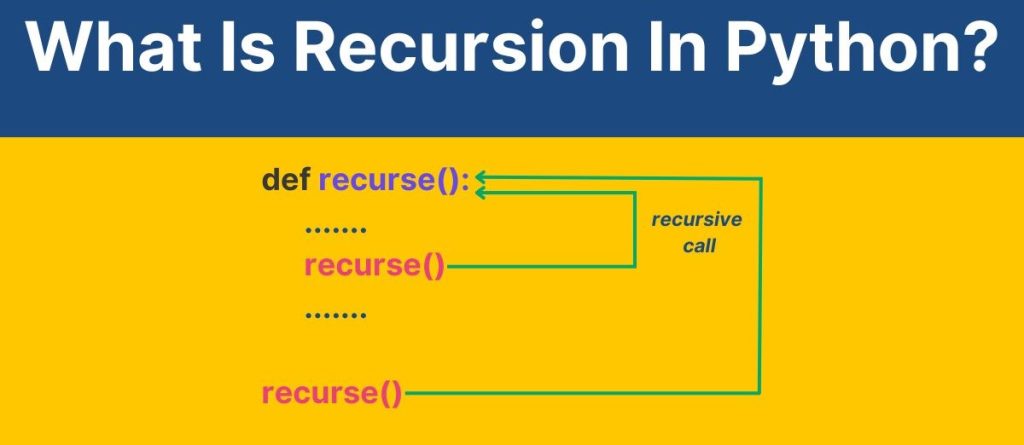
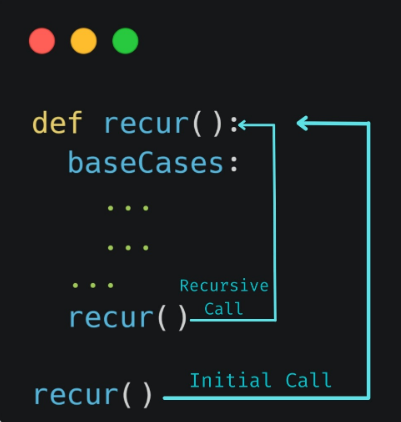
At its core, recursion is a programming technique where a function calls itself to solve a smaller version of the same problem.
Think about climbing a staircase.
Instead of thinking about climbing all ten steps at once, you simply climb one step and repeat the same action until you reach the top.
That’s exactly how recursion works.
Every recursive function breaks a large problem into smaller pieces until there’s nothing left to solve.
A recursive function has two important parts:
- Base Case
- Recursive Case
Without these two parts, recursion won’t work properly.
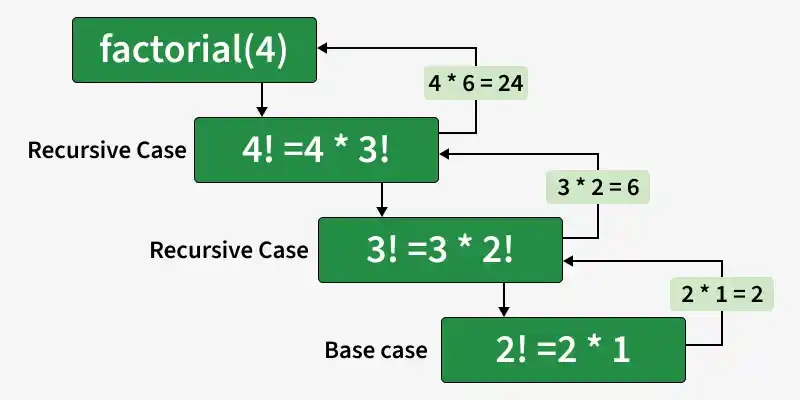
Understanding the Base Case in Recursion
The base case tells the function:
“Stop calling yourself now.”
This is probably the most important concept in Recursion in Python: A Comprehensive Guide.
Without a base case, Python will continue calling the function forever until it throws an error called:
RecursionError: maximum recursion depth exceededSo always remember:
Every recursive function must have a base case.
Your First Recursive Function in Python
Let’s look at the simplest example.
def countdown(n):
    if n == 0:
        print("Done!")
        return

    print(n)
    countdown(n - 1)

countdown(5)
Output
5
4
3
2
1
Done!
Here’s what happens:
- The function prints 5.
- Then it calls itself with 4.
- Then again with 3.
- Then 2.
- Then 1.
- Finally it reaches 0.
- The base case stops the recursion.
Simple, right?
How Does a Recursive Function in Python Work?
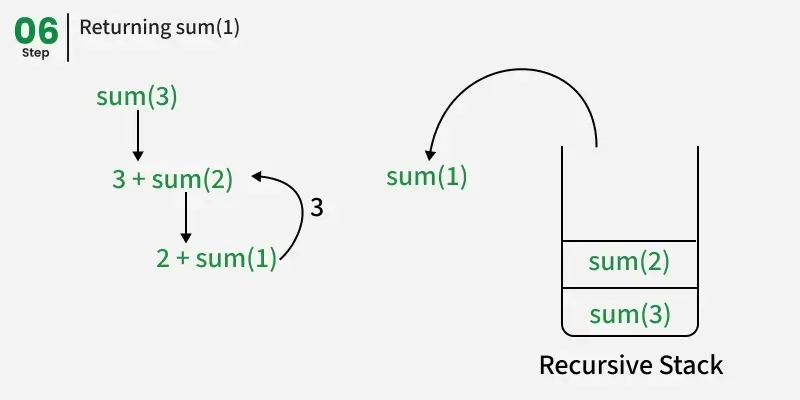
When I first learned Python recursion, I imagined the function magically jumping back and forth.
That’s not what happens.
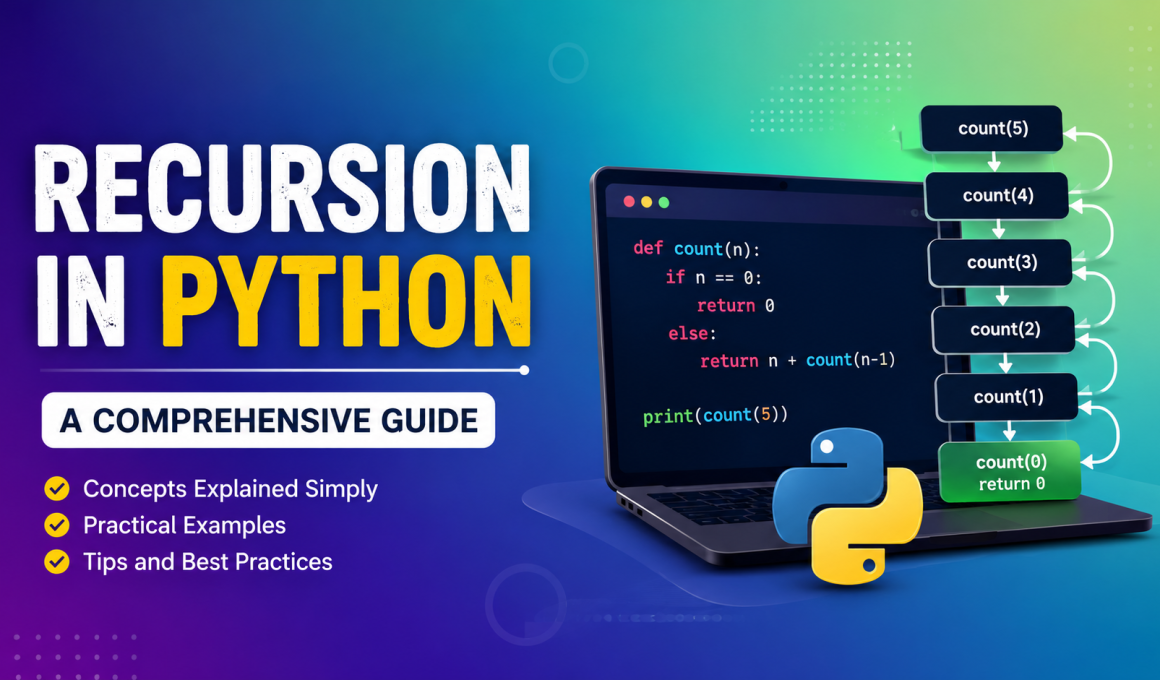
Instead, Python keeps every function call in memory using something called the call stack.
Imagine stacking books.
Every time the function calls itself, another book is placed on top.
Once the base case is reached, Python starts removing one book at a time until the stack becomes empty.
This process explains why recursion uses more memory than a simple loop.
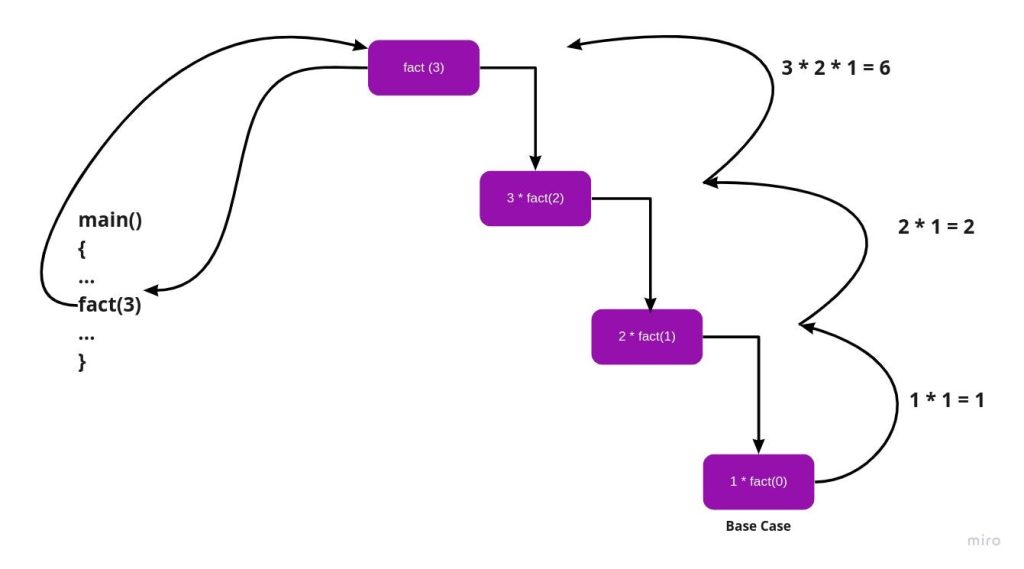
Recursion Example in Python: Finding the Factorial
The factorial problem is one of the most common recursion examples in Python.
Mathematically,
5! = 5 × 4 × 3 × 2 × 1Here’s the code:
def factorial(n):
    if n == 1:
        return 1

    return n * factorial(n - 1)

print(factorial(5))
Output
120Let’s understand it.
factorial(5)

= 5 × factorial(4)

= 5 × 4 × factorial(3)

= 5 × 4 × 3 × factorial(2)

= 5 × 4 × 3 × 2 × factorial(1)

= 5 × 4 × 3 × 2 × 1
Each function waits until the smaller problem is solved before returning the answer.
That’s the beauty of recursion.
Another Recursion Example in Python: Fibonacci Series 🌱
The Fibonacci sequence looks like this:
0 1 1 2 3 5 8 13 ...Here’s the recursive solution.
def fibonacci(n):

    if n <= 1:
        return n

    return fibonacci(n - 1) + fibonacci(n - 2)

print(fibonacci(6))
Output
8Although this example is famous, it isn’t the most efficient solution because many values are calculated repeatedly.
For larger inputs, programmers usually improve it using memoization or use an iterative approach.
Why Do We Use Recursion?
When I started solving coding problems, I tried using loops for everything.
Eventually, I realized some problems become much cleaner with recursion.
Some common applications include:
- 🌳 Tree traversal
- 📁 Searching folders inside folders
- 🧩 Divide-and-conquer algorithms
- 🔍 Binary Search
- 🧮 Calculating factorials
- 🕸️ Graph traversal
- 📂 Parsing nested data structures
Whenever a problem naturally breaks into smaller versions of itself, recursion often becomes an elegant solution.
Recursion vs Iteration
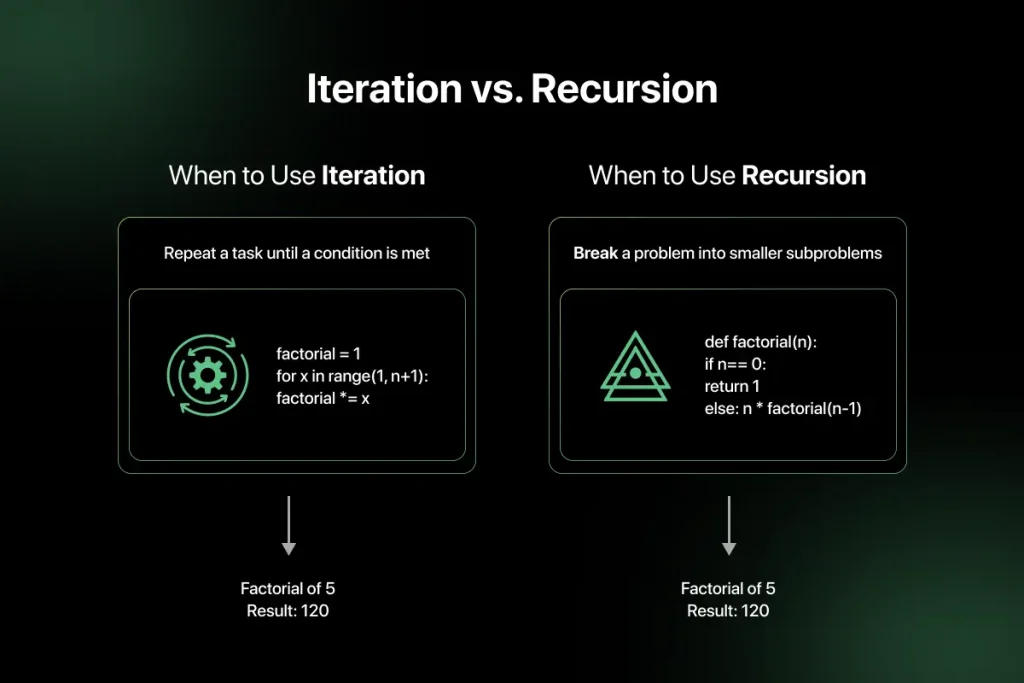
Many beginners ask:
Should I use recursion or loops?
Here’s an easy comparison.
| Recursion | Iteration |
|---|---|
| Function calls itself | Uses loops |
| Easier for tree-like problems | Better for repeated counting |
| Uses more memory | Uses less memory |
| Can be easier to read | Usually faster |
| Needs a base case | Needs a loop condition |
Neither is universally better.
Choose the one that makes your code simpler and easier to understand.
Common Mistakes Beginners Make 😅
I’ve made almost every recursion mistake imaginable.
Here are the biggest ones.
Forgetting the Base Case
This causes infinite recursion.
def hello():
    print("Hello")
    hello()
Python eventually stops with a RecursionError.
Changing Nothing
Sometimes beginners call the same function again without making progress.
For example:
factorial(n)instead of
factorial(n-1)The input must move closer to the base case.
Using Recursion Everywhere
Recursion is powerful.
But that doesn’t mean every problem needs it.
Sometimes a simple for loop is faster, easier, and uses less memory.
Advantages of Recursion
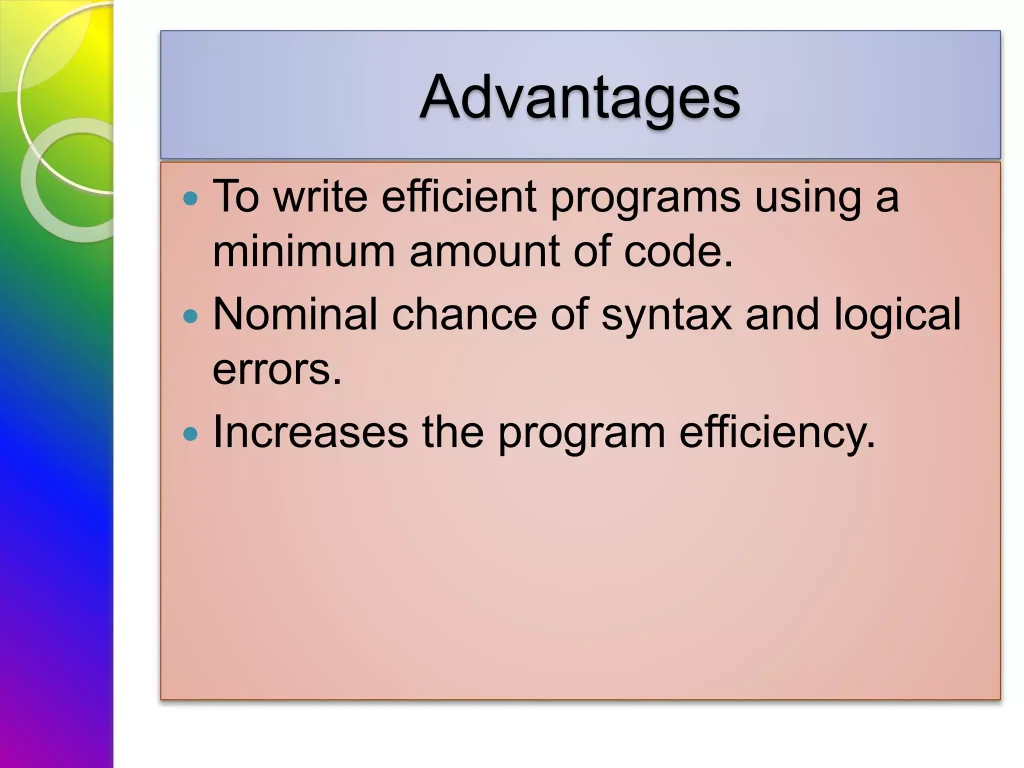
Here are a few reasons programmers like recursive algorithms.
- ✔ Cleaner code
- ✔ Easier to solve tree problems
- ✔ Excellent for divide-and-conquer algorithms
- ✔ Natural solution for nested structures
- ✔ Reduces complicated looping logic
Disadvantages of Recursion
Recursion also has drawbacks.
- ❌ Higher memory usage
- ❌ Can be slower
- ❌ Risk of RecursionError
- ❌ Harder to debug for beginners
- ❌ Not ideal for every problem
Understanding both sides will help you become a better Python developer.
Tips to Master Python Recursion 💡
These are the habits that helped me finally understand recursion.
- Start with small examples.
- Draw the function calls on paper.
- Always identify the base case first.
- Ask yourself whether the problem becomes smaller after each call.
- Trace the call stack manually.
- Practice one recursion problem every day.
Trust me—it feels confusing at first, but after solving a handful of examples, recursion starts making sense.
Real-Life Example of Recursion
Imagine opening folders on your computer.
You open one folder.
Inside it, you find another folder.
Inside that folder, there’s another one.
You keep opening folders until there are no more folders left.
That’s recursion in real life.
Each folder is handled exactly the same way.
This is why file explorers often use recursive algorithms behind the scenes.
Frequently Asked Questions (FAQs)
Is recursion difficult to learn?
Not really. It feels strange initially because the idea of a function calling itself is unfamiliar. Once you understand the base case and follow a few examples step by step, it becomes much easier.
Is recursion faster than loops?
Usually, no. Recursive functions often have additional function call overhead and use more memory. However, for some problems like tree traversal, recursion can produce cleaner and more maintainable code.
What happens if there is no base case?
Without a base case, the function keeps calling itself until Python raises a RecursionError.
Can every recursive problem be solved using loops?
Many recursive problems can be rewritten using loops, but some—especially those involving trees or nested structures—are often simpler and more intuitive with recursion.
Final Thoughts ❤️
I hope this Recursion in Python: A Comprehensive Guide made recursion feel less intimidating and more approachable. When I first encountered recursive functions, I thought they were reserved for advanced programmers. Over time, I realized that recursion is simply another way of thinking about problem-solving.
Start with small examples like countdowns and factorials. Trace each function call on paper if you need to. With consistent practice, concepts like the base case, the call stack, and recursive functions in Python will become second nature.
Remember, becoming a better programmer isn’t about memorizing every concept. It’s about understanding why something works. Once recursion clicks, you’ll be ready to tackle many algorithms and data structures with much more confidence.
Happy coding! 🚀
Want to Learn More About Python & Artificial Intelligence ???, Kaashiv Infotech Offers Full Stack Python Course, Artificial Intelligence Course, Data Science Course & More Visit Their Website course.kaashivinfotech.com.