
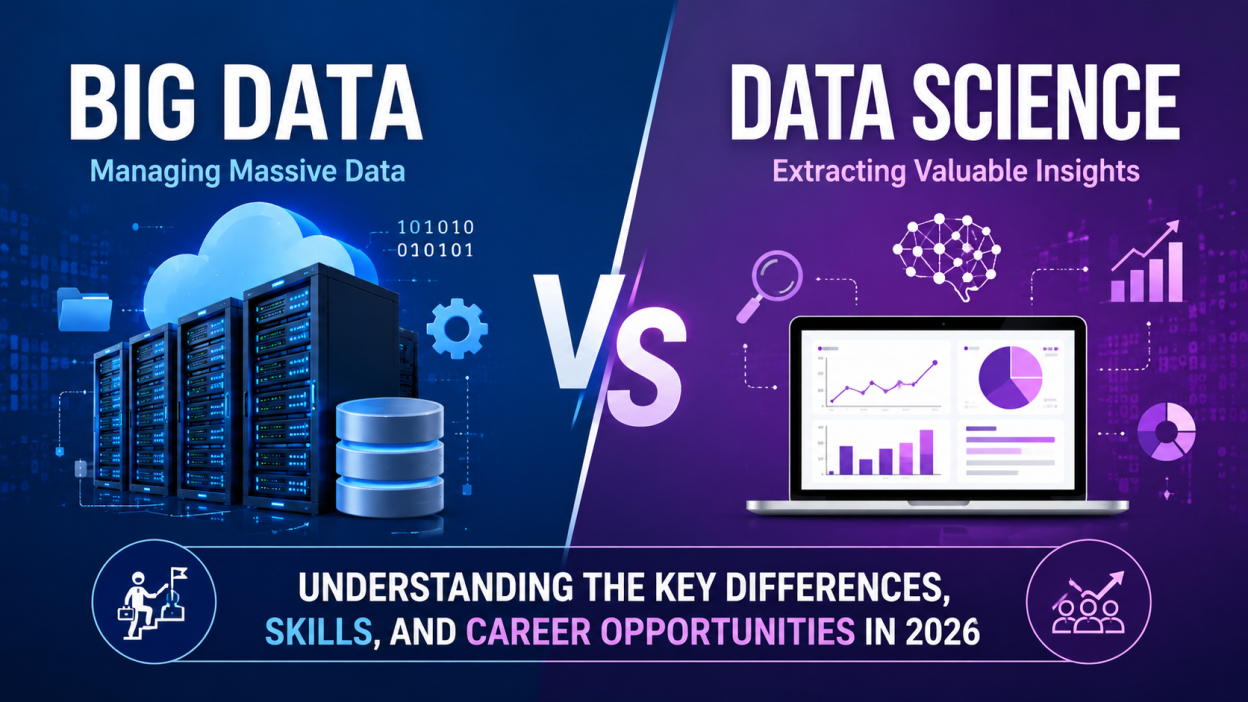
Data has become one of the most valuable resources for modern businesses. From online shopping and social media to banking, healthcare, cloud platforms, and IoT devices, organizations generate enormous amounts of information every day. Two terms that frequently appear in this data-driven world are Big Data vs Data Science.
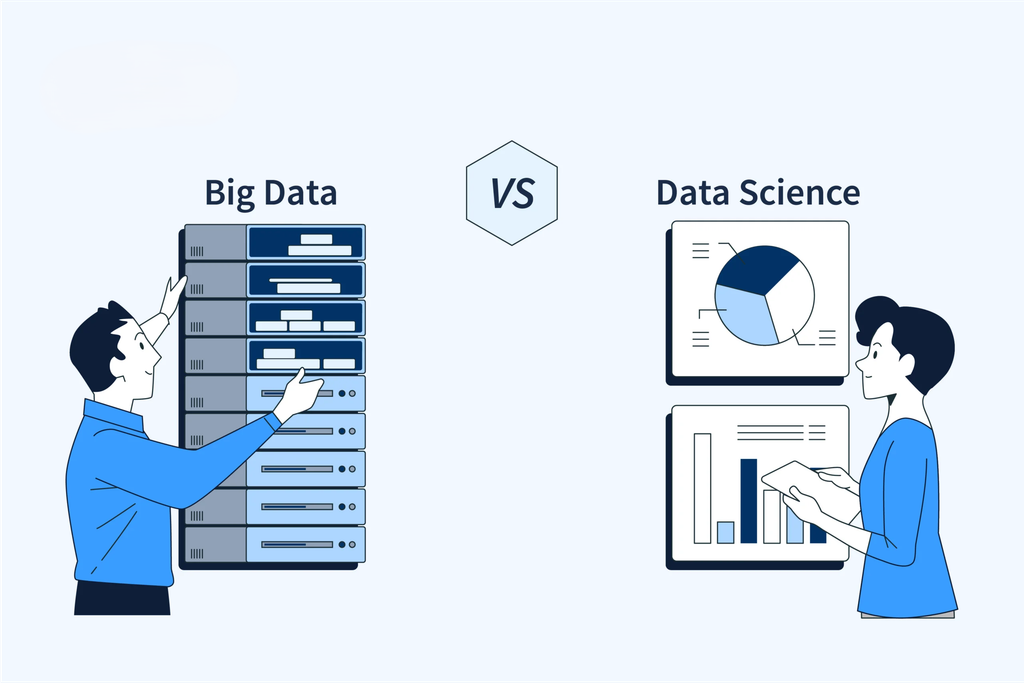
Although these fields are closely connected, they are not the same. Big Data primarily focuses on handling, storing, processing, and managing massive and complex datasets, while Data Science focuses on using statistics, programming, machine learning, and domain knowledge to extract meaningful insights from data.
For students and professionals planning a career in technology, understanding the difference between Big Data and Data Science is important. This guide explains their definitions, key differences, technologies, applications, career opportunities, and how they work together in 2026.
What Is Big Data?
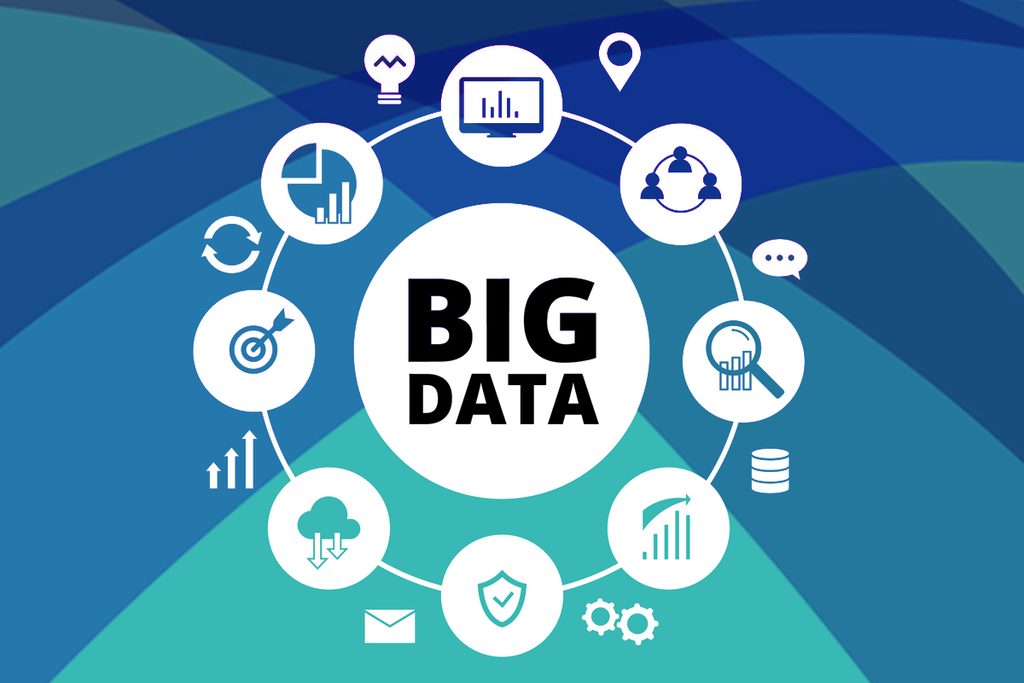
Big Data refers to extremely large, complex, and rapidly generated datasets that traditional data-processing systems may struggle to store or process efficiently. These datasets can come from websites, mobile applications, IoT devices, social media platforms, financial transactions, sensors, videos, and many other sources.
Big Data is commonly explained through the 5 Vs:
1. Volume
Volume represents the enormous amount of data generated and stored by organizations. Modern businesses may deal with data ranging from gigabytes and terabytes to petabytes and beyond.
2. Velocity
Velocity refers to the speed at which data is generated, transferred, and processed. For example, social media interactions and financial transactions can generate data continuously in real time.
3. Variety
Big Data can contain different formats, including structured, semi-structured, and unstructured data. Text, images, videos, log files, JSON documents, and database records can all be part of a Big Data environment.
4. Veracity
Veracity refers to the quality, accuracy, and reliability of data. Poor-quality or incorrect data can lead to misleading results.
5. Value
Value represents the useful business outcomes organizations can obtain from their data. Data becomes valuable when it helps companies improve operations, understand customers, reduce costs, or make better decisions.
Big Data technologies such as Apache Hadoop, Apache Spark, NoSQL databases, cloud storage, and distributed processing systems help organizations manage these large datasets.
What Is Data Science?

Data Science is a multidisciplinary field that combines mathematics, statistics, programming, data analysis, machine learning, artificial intelligence, and domain expertise to discover useful insights from data.
A Data Scientist may start with a business problem, collect and clean relevant data, explore patterns, develop statistical or machine learning models, evaluate the results, and communicate recommendations.
For example, an e-commerce company may want to answer:
- Which products are customers likely to purchase?
- Which customers may stop using the platform?
- What products should be recommended?
- How can sales be forecast?
- Which transactions may be fraudulent?
Data Science uses techniques such as predictive analytics, machine learning, statistical modeling, data visualization, natural language processing, and deep learning to answer these types of questions.
Big Data vs Data Science: Key Differences
The simplest way to understand the difference is this:
Big Data is mainly concerned with handling data at scale, while Data Science is concerned with extracting knowledge, predictions, and insights from data.
| Feature | Big Data | Data Science |
|---|---|---|
| Main Focus | Storage, processing, and management of massive datasets | Analysis, modeling, prediction, and insights |
| Primary Goal | Handle data efficiently at scale | Turn data into useful knowledge |
| Data Size | Usually very large | Can work with small, medium, or large datasets |
| Data Types | Structured, semi-structured, and unstructured | Usually uses prepared and relevant datasets |
| Technologies | Hadoop, Spark, Kafka, NoSQL | Python, R, SQL, TensorFlow, Scikit-learn |
| Major Skills | Distributed computing and data engineering | Statistics, programming, ML, and analytics |
| Output | Processed and accessible data | Insights, predictions, models, and recommendations |
| Common Roles | Big Data Engineer, Data Engineer | Data Scientist, ML Engineer, Data Analyst |
| Main Concern | Scalability and performance | Business questions and predictive analysis |
The distinction is not absolute. Data Scientists can work with Big Data platforms, and Big Data professionals often support analytics and machine learning workloads.
Technologies Used in Big Data
Big Data requires technologies designed to process information across large-scale infrastructure.
Apache Hadoop is a distributed computing ecosystem designed to store and process large datasets across clusters of computers.
Apache Spark is widely used for fast large-scale data processing and analytics. Its ability to perform in-memory processing makes it useful for many data-intensive workloads.
Apache Kafka is commonly used for handling real-time data streams.
NoSQL databases such as MongoDB and Cassandra can be useful when organizations need flexible approaches to storing large amounts of varied data.
Cloud platforms also play an important role. Organizations can use cloud-based storage, computing, data warehouses, data lakes, and lakehouse architectures to scale their data infrastructure.
Technologies Used in Data Science
Data Scientists use a different combination of tools depending on their project.
Python is one of the most popular programming languages for Data Science because of its extensive ecosystem of libraries.
Common Python libraries include:
- Pandas for data manipulation
- NumPy for numerical computing
- Matplotlib for visualization
- Scikit-learn for machine learning
- TensorFlow and PyTorch for deep learning
SQL is also an essential skill because Data Scientists frequently need to retrieve and manipulate information stored in databases.
Other technologies include R, Jupyter Notebook, Tableau, Power BI, Spark, cloud platforms, and machine learning frameworks.
Data Scientists may also work with Big Data platforms such as Hadoop and Spark when their datasets become too large for conventional processing environments.
Big Data and Data Science: How Do They Work Together?
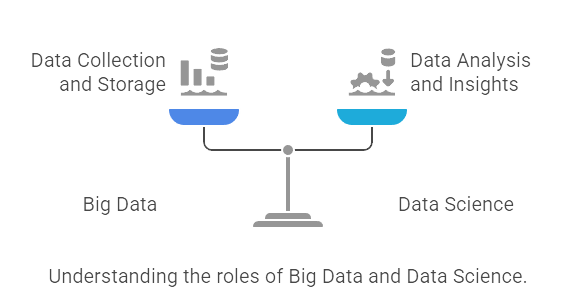
Big Data and Data Science should not always be viewed as competing technologies.
Instead, they often work together.
Imagine a large online shopping platform. Millions of customers generate information through searches, purchases, product reviews, clicks, and browsing behavior.
A Big Data infrastructure can collect, store, and process this information efficiently. Once the data is available, Data Scientists can analyze it and develop machine learning models.
For example:
Customer activity → Big Data infrastructure → Data preparation → Data Science analysis → Machine learning model → Business decision
The Big Data environment provides the scale, while Data Science helps turn the available information into actionable insights.
This relationship becomes particularly important for AI applications because modern AI and machine learning systems can require large quantities of high-quality data.
Real-World Applications
Big Data Applications
Big Data is used extensively in:
Banking: Processing large numbers of transactions and detecting unusual activity.
Healthcare: Managing medical records, imaging information, research data, and monitoring data.
E-commerce: Processing customer activity, product interactions, orders, and inventory information.
Social Media: Handling enormous quantities of posts, images, videos, comments, and engagement data.
IoT: Processing data generated continuously by connected devices and sensors.
Data Science Applications
Data Science is used for:
Recommendation Systems: Suggesting products, movies, music, or content based on user behavior.
Fraud Detection: Identifying suspicious transaction patterns.
Predictive Maintenance: Predicting when machines or equipment may require maintenance.
Customer Churn Prediction: Identifying customers who may stop using a service.
Demand Forecasting: Predicting future product demand.
Healthcare Analytics: Supporting research, risk analysis, and predictive modeling.
Big Data analytics itself can involve statistical analysis, machine learning, data mining, and predictive techniques to identify patterns in massive datasets.
Big Data vs Data Science: Which Career Is Better?
There is no single answer because both career paths offer different opportunities.
If you enjoy programming, statistics, mathematics, machine learning, experimentation, and solving analytical problems, Data Science may be a good choice.
If you are more interested in databases, distributed systems, cloud platforms, data pipelines, scalability, and infrastructure, Big Data or Data Engineering may be more suitable.
Big Data Career Roles
Common roles include:
- Big Data Engineer
- Data Engineer
- Big Data Developer
- Data Architect
- Data Platform Engineer
- Data Infrastructure Engineer
Data Science Career Roles
Common roles include:
- Data Scientist
- Machine Learning Engineer
- Data Analyst
- AI Engineer
- Machine Learning Scientist
- Applied Data Scientist
Modern organizations often require these professionals to collaborate. Data engineers build reliable pipelines and infrastructure, while Data Scientists use that data for analysis and modeling.
Skills You Should Learn in 2026
For a Big Data career, focus on:
Programming: Python, Java, or Scala
Databases: SQL and NoSQL
Big Data: Hadoop, Spark, Kafka
Cloud: AWS, Microsoft Azure, or Google Cloud
Data Engineering: ETL/ELT, data pipelines, data lakes, warehouses, and distributed systems
For a Data Science career, focus on:
Programming: Python and SQL
Mathematics: Statistics, probability, and linear algebra
Data Analysis: Pandas, NumPy, and visualization
Machine Learning: Regression, classification, clustering, and model evaluation
AI: Deep learning and modern AI techniques
Communication: Explaining technical findings to non-technical stakeholders
Learning some skills from both areas can be especially valuable because modern data teams increasingly combine data engineering, analytics, machine learning, cloud computing, and AI.
Which One Should Beginners Choose?
Beginners should first understand their interests.
If you enjoy working with numbers and finding patterns, start with Data Science fundamentals.
If you enjoy building systems and working with databases and cloud infrastructure, explore Big Data and Data Engineering.
However, you do not necessarily need to choose immediately. Learning Python, SQL, databases, basic statistics, and cloud fundamentals provides a strong foundation for both paths.
After building these fundamentals, you can specialize in Data Science, Big Data Engineering, Machine Learning, or another data-focused career.
Future of Big Data and Data Science in 2026
The relationship between Big Data, Data Science, Machine Learning, and AI is becoming increasingly important. Organizations are generating data from cloud applications, connected devices, digital platforms, mobile applications, and AI-powered systems.
At the same time, modern AI systems depend heavily on data quality, data availability, and scalable computing infrastructure. Big Data provides the infrastructure and processing capabilities, while Data Science provides methods for understanding data and developing predictive solutions.
Data platforms are also evolving. Data lakes, warehouses, and lakehouses are increasingly used depending on an organization’s storage, analytics, governance, and performance requirements.
This means professionals who understand both data infrastructure and data analytics can have a strong advantage in the modern technology industry.
Final Thoughts
Big Data and Data Science are closely related but serve different purposes. Big Data focuses on collecting, storing, processing, and managing huge and complex datasets, whereas Data Science focuses on analyzing data and transforming it into insights, predictions, and business solutions.
The two fields are most powerful when they work together. Big Data provides the foundation for handling information at scale, while Data Science uses statistical methods, machine learning, AI, and domain expertise to extract value from that information.
For anyone planning a technology career in 2026, learning Python, SQL, statistics, cloud computing, data engineering fundamentals, and machine learning can provide a strong foundation. From there, you can specialize according to your interests—whether that is Big Data Engineering, Data Science, Machine Learning, or AI.
In simple terms: Big Data helps organizations handle massive amounts of information, while Data Science helps them understand and use that information.
Want to learn more ??, Kaashiv Infotech Offers Data Analytics Course, Data Science Course, Cyber Security Course & More Visit Their Website www.kaashivinfotech.com.