
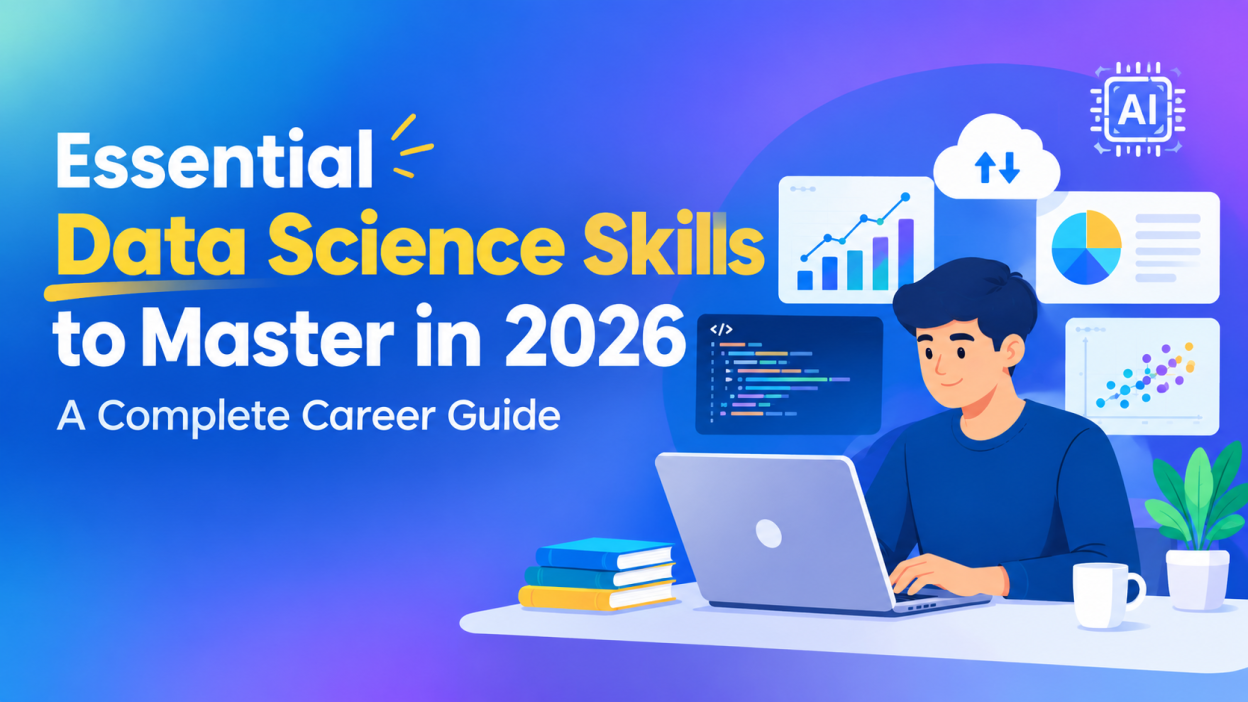
Data science is no longer limited to building models or writing a few lines of Python code. In 2026, successful data scientists are expected to combine programming, statistics, artificial intelligence, business understanding, and communication skills. As organizations increasingly depend on data-driven decisions, professionals who can collect, analyze, interpret, and transform data into practical solutions are becoming highly valuable.
If you are a student, beginner, career switcher, or aspiring data professional, understanding the most important data science skills in 2026 can help you build a stronger learning roadmap.
Why Are Data Science Skills Important in 2026?
The expectations for data professionals have changed significantly. Companies no longer look only for someone who can create reports or train a basic machine learning model. Modern data science roles increasingly combine Python, SQL, statistics, machine learning, cloud technologies, MLOps, Generative AI, and business communication.
Here are the essential skills you should focus on.
1. Python Programming
Python remains one of the most important programming languages for data science. Its simple syntax and powerful ecosystem make it useful for data cleaning, analysis, visualization, automation, machine learning, and AI applications.
A data science learner should become comfortable with:
- Variables, functions, loops, and data structures
- Object-oriented programming basics
- File handling and exception handling
- APIs and data collection
- Writing clean and reusable code
You should also learn popular Python libraries such as NumPy, Pandas, Matplotlib, and Scikit-learn. Python is often the foundation that connects different stages of a data science project, from collecting raw data to deploying an intelligent application.
2. SQL and Database Skills
A data scientist cannot depend entirely on pre-prepared Excel or CSV files. In real-world organizations, data is usually stored in databases and data warehouses.
That is why SQL remains a must-have skill in 2026.
Start with basic commands such as SELECT, WHERE, GROUP BY, and ORDER BY. Then move toward advanced concepts including:
- JOIN operations
- Subqueries
- Common Table Expressions
- Window functions
- Aggregations
- Query optimization
Understanding relational databases such as MySQL and PostgreSQL is valuable, while basic knowledge of NoSQL databases can also be helpful for working with flexible or semi-structured data. Strong SQL skills allow data scientists to independently retrieve, combine, and prepare data for analysis.
3. Statistics and Probability
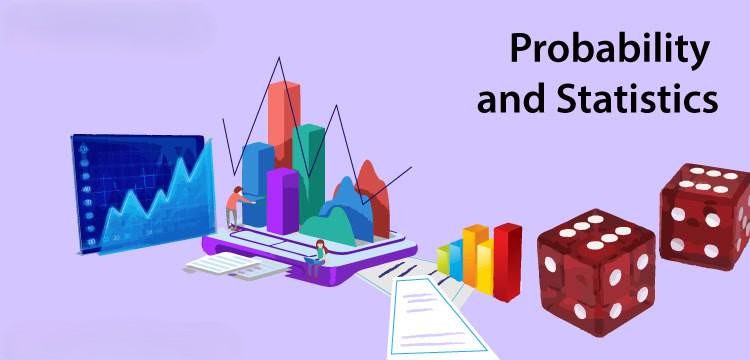
Artificial intelligence tools can help write code and build models, but they cannot replace a data scientist’s ability to understand whether an analysis is actually meaningful.
Statistics provides that foundation.
Important concepts include probability, distributions, sampling, hypothesis testing, confidence intervals, correlation, causation, and statistical inference. You should also understand concepts such as bias, variance, and uncertainty.
For example, imagine that sales increased after a company launched a new advertisement. Statistics helps answer an important question: Did the advertisement actually cause the increase, or did another factor influence the results?
Without statistical thinking, it is easy to create impressive-looking charts or models that lead to incorrect conclusions.
4. Data Cleaning and Exploratory Data Analysis
Real-world data is rarely perfect. You may encounter missing values, duplicate records, incorrect formats, outliers, and inconsistent information.
Therefore, data cleaning is one of the most practical skills for every aspiring data scientist.
You should learn how to:
- Identify missing data
- Remove duplicates
- Handle outliers
- Convert data types
- Normalize or transform data
- Combine multiple datasets
- Detect unusual patterns
After cleaning the data, exploratory data analysis helps you understand patterns and relationships before building a model.
A strong data scientist does not immediately apply machine learning to every dataset. First, they explore the data, ask questions, identify trends, and understand the problem.
5. Machine Learning Fundamentals
Machine learning remains a core part of modern data science.
You do not need to memorize every algorithm. Instead, focus on understanding when and why to use a particular model.
Important machine learning concepts include:
- Linear and logistic regression
- Decision trees
- Random forests
- Support vector machines
- K-nearest neighbors
- Clustering
- Gradient boosting
- Feature engineering
- Cross-validation
You should also understand overfitting, underfitting, train-test splits, and model evaluation.
For example, a customer churn prediction system should not simply use the model with the highest accuracy. Depending on the business problem, precision, recall, F1-score, or another metric may be more appropriate. Choosing the right metric is an important data science skill.
6. Generative AI and Large Language Models
One of the biggest additions to the data science skill set is Generative AI.
Data scientists in 2026 increasingly benefit from understanding how Large Language Models work and where they can be useful. You do not necessarily need to build a foundation model from scratch, but you should understand concepts such as:
- Prompt engineering
- Large Language Models
- Embeddings
- Vector databases
- Retrieval-Augmented Generation (RAG)
- Fine-tuning basics
- AI model evaluation
Generative AI can support tasks such as document analysis, conversational analytics, summarization, content processing, and intelligent applications.
However, the important skill is not simply knowing how to use an AI chatbot. A good data scientist should understand when an LLM-based solution is appropriate and when a traditional machine learning or statistical solution is better.
7. Data Visualization and Storytelling
Finding insights is only half the job. You must also communicate those insights clearly.
A manager may not understand a complex machine learning algorithm, but they should be able to understand what the results mean for the business.
Useful visualization tools include:
- Power BI
- Tableau
- Matplotlib
- Plotly
Instead of creating complicated dashboards filled with unnecessary charts, focus on answering important questions.
For example:
- Why are sales decreasing?
- Which customers are most likely to leave?
- Which product generates the highest profit?
- What action should the company take?
This ability to transform numbers into a clear story can make a major difference in your career.
8. Cloud Computing and Big Data
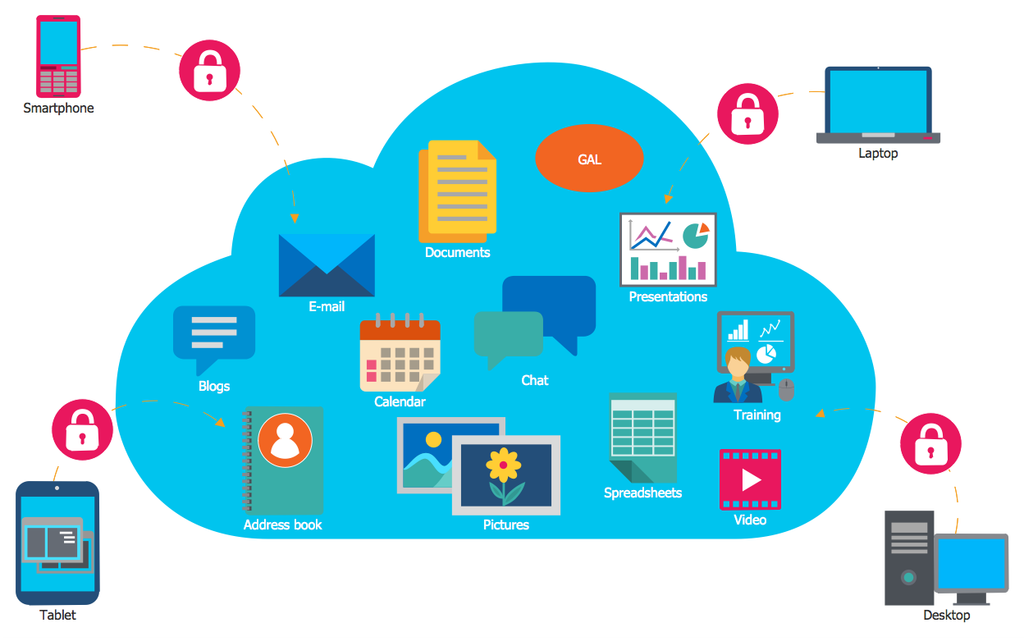
Modern organizations often work with data that is too large to manage on a single computer. This makes cloud and big data knowledge increasingly valuable.
You should become familiar with at least one major cloud platform, such as AWS, Microsoft Azure, or Google Cloud.
Useful concepts include:
- Cloud storage
- Data warehouses
- Computing resources
- Managed machine learning services
- Data pipelines
- Access and security basics
You do not need to master every cloud platform. Learning the fundamentals of one platform can help you understand how data science projects operate at scale. Cloud awareness and scalable data workflows are increasingly part of the modern data science toolkit.
9. MLOps and Model Deployment
Creating a model inside a Jupyter Notebook is not the end of a data science project.
A useful model must often be deployed, monitored, updated, and maintained.
This is where MLOps becomes important.
Basic MLOps knowledge can include:
- Git and version control
- Docker and containers
- APIs
- Model deployment
- Experiment tracking
- Model monitoring
- Data drift detection
- Model retraining
For beginners, you do not need to become an expert DevOps engineer immediately. However, understanding how a machine learning model moves from experimentation into a real application can make your portfolio much stronger.
10. Business Understanding and Communication
Technical knowledge alone does not guarantee success as a data scientist.
Suppose you build a highly accurate machine learning model, but it does not solve an actual business problem. The project may have little practical value.
That is why business understanding is one of the most underrated data science skills.
A good data scientist should be able to:
- Understand business objectives
- Identify meaningful KPIs
- Ask the right questions
- Measure the impact of a solution
- Explain technical results to non-technical people
- Recommend practical actions
Communication is equally important. You may need to explain your findings to managers, clients, developers, or other teams.
The best data scientists do not just say, “The model achieved 92% accuracy.” They explain what the result means and what decision the organization should make next.
A Simple Data Science Learning Roadmap for 2026
If you are a beginner, follow this order:
Step 1: Learn Python fundamentals
Step 2: Master SQL and databases
Step 3: Study statistics and probability
Step 4: Learn data cleaning and visualization
Step 5: Understand machine learning fundamentals
Step 6: Build real-world projects
Step 7: Explore Generative AI and LLM applications
Step 8: Learn cloud and deployment basics
Step 9: Understand MLOps concepts
Step 10: Improve communication and business knowledge
Do not try to learn everything at the same time. Build a strong foundation first and gradually move toward advanced technologies.
Final Thoughts
The definition of a successful data scientist is expanding. In 2026, knowing only Python or only machine learning is usually not enough. The strongest professionals combine technical knowledge with practical problem-solving and communication skills.
Start by mastering Python, SQL, statistics, data analysis, and machine learning. Once your foundation is strong, explore Generative AI, cloud computing, MLOps, and advanced specializations.
Most importantly, build projects. A project that takes messy data, solves a real problem, and clearly communicates the result can demonstrate your abilities better than simply listing tools on a resume.
The future of data science belongs to professionals who can combine data, AI, technology, and business thinking to create real-world impact.
Want to learn more ??, Kaashiv Infotech Offers Data Analytics Course, Data Science Course, Cyber Security Course & More Visit Their Website www.kaashivinfotech.com.