

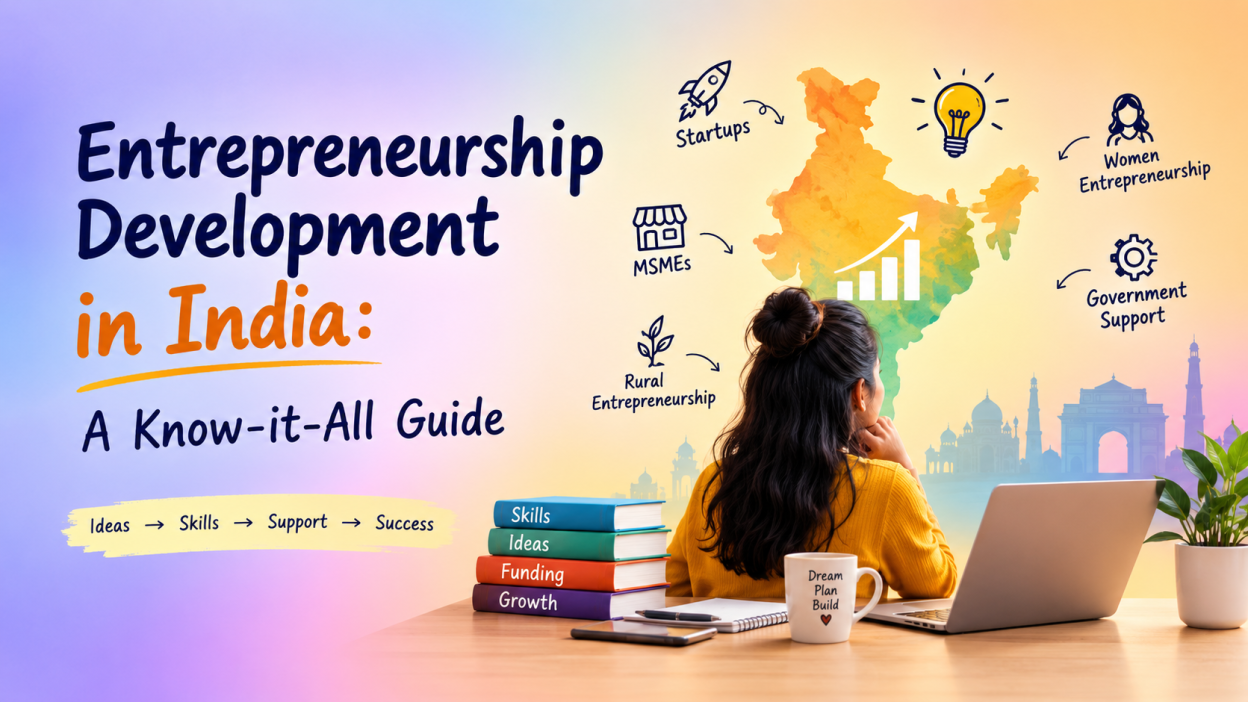
Entrepreneurship Development is no longer limited to people who have a big office, a huge investment, or a revolutionary business idea. In India today, entrepreneurship can start with something much smaller — a skill, a local problem, a simple product, or even a side hustle.
Entrepreneurship Development means helping people build the knowledge, skills, confidence, and resources needed to identify opportunities, start businesses, manage them, and eventually grow them.
And honestly, this topic has become much more interesting in India over the last few years.
If you look around, you’ll find startups solving problems in healthcare, education, finance, food delivery, agriculture, logistics, software, manufacturing, and even very ordinary day-to-day activities. The ecosystem has also expanded beyond the traditional startup hubs. Government data published in 2026 notes that around half of DPIIT-recognised startups originate from Tier-II and Tier-III cities.
So, if you’re wondering what Entrepreneurship Development means, why it matters, how entrepreneurship works in India, what government support is available, and how a beginner can get started, this guide covers it from the ground up.
🔑 Key Highlights
- Entrepreneurship Development helps people develop the skills needed to start and manage a business.
- India has built a large startup and entrepreneurship ecosystem.
- Startup India was launched in 2016 to encourage innovation and entrepreneurship.
- More than 2.12 lakh entities had received DPIIT startup recognition by January 31, 2026.
- Entrepreneurship isn’t limited to technology startups.
- MSMEs, small businesses, rural enterprises, women-led businesses, and innovative startups all contribute to entrepreneurship development.
- Government programmes provide different forms of support, including funding, training, incubation, mentorship, and easier compliance.
- A good business idea is important, but execution, customer understanding, financial planning, and adaptability matter just as much.
What Is Entrepreneurship Development?
Let’s keep the definition simple.
Entrepreneurship Development is the process of developing a person’s ability to identify a business opportunity and turn that opportunity into a sustainable business.
It isn’t just about teaching someone how to register a company.
It can involve:
- Finding business opportunities
- Developing entrepreneurial skills
- Understanding customers
- Creating business plans
- Learning financial management
- Understanding marketing
- Managing employees
- Taking calculated risks
- Learning from failure
- Using technology
- Building networks
- Growing a business
Think about someone who knows how to make beautiful handmade products.
Having that skill is one thing.
Knowing who will buy the product, how much they will pay, how to market it, how to manage costs, and how to turn it into a profitable business is something else.
That second part is where entrepreneurship development becomes important.
Why Is Entrepreneurship Development Important in India?
India has a huge population, a growing digital economy, a large workforce, and consumers with constantly changing needs.
That creates opportunities.
But opportunities alone don’t automatically create businesses.
People need skills and support to convert those opportunities into something useful.
That’s why Entrepreneurship Development in India has several important roles.
1. It encourages job creation
A successful entrepreneur doesn’t always remain a one-person operation.
As the business grows, they may hire:
- Developers
- Designers
- Salespeople
- Accountants
- Marketing professionals
- Customer-support employees
- Operations staff
In fact, as of December 31, 2025, DPIIT-recognised startups had reported more than 21.9 lakh direct jobs.
So entrepreneurship can contribute to employment in addition to self-employment.
2. It encourages innovation
Entrepreneurs often begin with a simple question: “Why are we doing this the difficult way?”
That question can lead to innovation.
For example, a startup might find a faster way to deliver healthcare services, simplify financial transactions, improve farming practices, or make education more accessible.
3. It supports local economies
Entrepreneurship isn’t only about companies worth billions.
A small bakery, tailoring business, digital marketing agency, software company, manufacturing unit, or home-based business can also contribute to the local economy.
This is especially important outside major metropolitan cities.
4. It encourages self-reliance
Instead of depending completely on traditional employment opportunities, people can create their own sources of income.
That doesn’t mean everyone should become an entrepreneur.
Not at all.
Entrepreneurship involves uncertainty, responsibility, and financial risk.
But for people with the right interests, skills, and opportunities, it can provide another career path.
Entrepreneurship Development in India: How the Ecosystem Has Changed
India’s entrepreneurial environment has changed significantly.
A major milestone was the launch of Startup India on January 16, 2016. The initiative was created to strengthen the startup ecosystem, encourage innovation, and support entrepreneurs.
The scale has grown considerably.
As of January 31, 2026, 2,12,283 entities had been recognised as startups by DPIIT, according to the Government of India. More than 1 lakh of these recognised entities had at least one woman director or partner.
That number alone tells us something important.
Entrepreneurship in India isn’t a small niche anymore.
It has become a significant part of the country’s economic and innovation ecosystem.
Startup India and Entrepreneurship Development
When discussing Entrepreneurship Development in India, it is difficult to ignore Startup India.
Startup India provides an ecosystem covering different stages of a startup journey — from ideation and validation to early traction and scaling. Its current portal also provides information about funding, mentorship, government schemes, startup policies, and other resources.
Some areas of support include:
- Startup recognition
- Funding information
- Mentorship
- Incubation
- Intellectual property support
- Government schemes
- Investor connections
- Market opportunities
- Startup challenges
For eligible businesses, DPIIT recognition can also provide access to benefits such as easier compliance, IPR-related support, and certain tax-related benefits, subject to the applicable rules and eligibility conditions.
Explore the official Startup India portal
Government Schemes Supporting Entrepreneurship Development
One thing I always tell beginners is this:
Don’t assume government support means free money.
Different programmes have different objectives, eligibility conditions, application processes, and forms of support.
The Government of India’s Startup India portal maintains information on central government schemes for startups. These cover areas such as finance, infrastructure, innovation, and regulatory support.
The Ministry of MSME also lists programmes covering areas such as:
- Prime Minister’s Employment Generation Programme (PMEGP)
- Credit guarantee support
- Entrepreneurship and Skill Development Programme
- Innovation and incubation support
- Cluster development
- Technology support
- Marketing assistance
- Training support
The Ministry’s 2026 schemes overview specifically includes Entrepreneurship and Skill Development Programme, PMEGP, innovation and incubation initiatives, and several forms of finance and market support.
Entrepreneurship Development Programmes
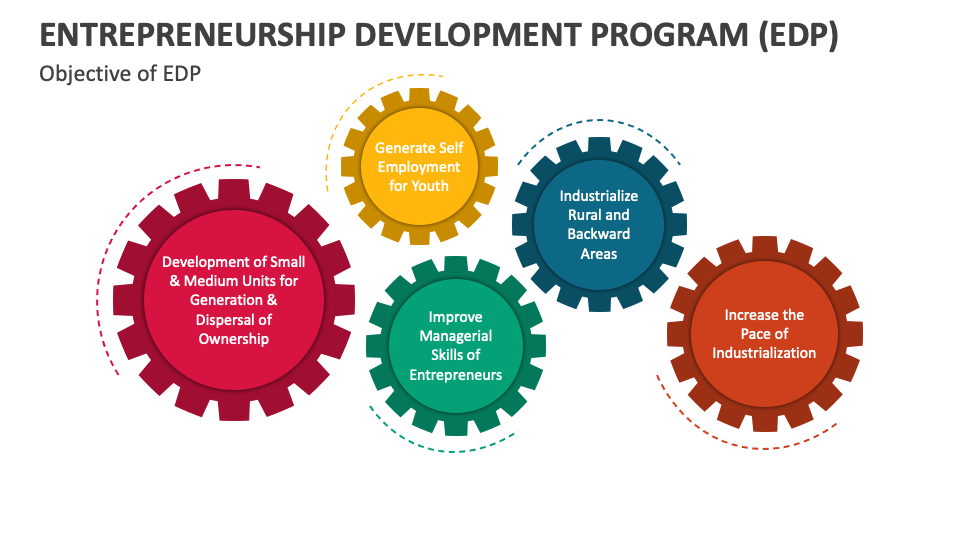
An Entrepreneurship Development Programme (EDP) focuses on helping individuals develop entrepreneurial capabilities.
These programmes may cover topics such as:
Business idea development
Participants learn how to identify opportunities and convert ideas into possible business models.
Market research
Before investing money, an entrepreneur should understand:
- Who are my customers?
- What problem am I solving?
- Who are my competitors?
- What price will customers accept?
- Is there enough demand?
Financial management
This is one area beginners sometimes underestimate.
You need to understand:
Revenue ≠ Profit
If your business earns ₹5 lakh but spends ₹4.5 lakh, your profit isn’t ₹5 lakh.
Basic financial knowledge can save entrepreneurs from painful mistakes.
Marketing
A great product isn’t automatically a successful product.
People need to know it exists.
That means entrepreneurs may need to understand:
- Social media marketing
- SEO
- Content marketing
- Advertising
- Branding
- Customer relationships
Leadership
As a business grows, the entrepreneur may need to build and manage a team.
That requires communication, delegation, decision-making, and problem-solving skills.
The Government of India has reported that institutions such as NIESBUD and IIE conduct Entrepreneurship Awareness Programmes and Entrepreneurship Development Programmes across the country.
Role of MSMEs in Entrepreneurship Development
When people hear “entrepreneurship”, they sometimes immediately think about startups.
But entrepreneurship is much bigger than startups.
MSMEs — Micro, Small and Medium Enterprises — play a major role in India’s entrepreneurial ecosystem.
Consider a small manufacturing unit.
It may not receive media attention like a technology startup, but it could employ dozens of people and supply products to other businesses.
The same applies to:
- Food-processing businesses
- Textile units
- Repair services
- Small manufacturers
- IT service companies
- Retail businesses
- Handicraft businesses
- Professional services
This is why MSME entrepreneurship development matters.
The goal isn’t always to build the next unicorn.
Sometimes the goal is to build a healthy business that provides income and employment for years.
And that’s valuable too.
Women and Entrepreneurship Development in India
Women’s participation is another important part of Entrepreneurship Development in India.
Women entrepreneurs operate businesses across technology, manufacturing, retail, education, healthcare, food, fashion, agriculture, and professional services.
Government data published in March 2026 stated that 1,02,054 DPIIT-recognised startups had at least one woman director or partner as of January 31, 2026.
There are also programmes specifically designed to encourage women’s entrepreneurship.
For example, the Government has highlighted initiatives aimed at building entrepreneurial awareness and skills among women and students.
This matters because entrepreneurship becomes stronger when more people can participate in it.
Rural Entrepreneurship Development
Here’s something I find particularly interesting.
Entrepreneurship doesn’t have to begin in Bengaluru, Mumbai, Hyderabad, Delhi, or another major city.
A business can start in a small town or village.
For example:
- Organic farming businesses
- Food processing
- Handicrafts
- Local tourism
- Dairy businesses
- Digital services
- Small manufacturing
- Rural logistics
- Agricultural technology
Government reporting has highlighted the growing contribution of Tier-II and Tier-III cities to India’s startup ecosystem.
This expansion is important because it can bring entrepreneurship, income opportunities, and innovation closer to local communities.
Key Skills Required for Entrepreneurship Development
So, what does an aspiring entrepreneur actually need to learn?
I would divide the important skills into a few simple categories.
Business skills
Understand:
- Business models
- Pricing
- Revenue
- Costs
- Profit
- Cash flow
Communication skills
You need to explain your idea clearly.
Customers, employees, investors, suppliers — everyone needs a different kind of communication.
Problem-solving
Entrepreneurs rarely get a perfectly smooth journey.
A supplier may delay an order.
A customer may complain.
Sales may suddenly drop.
Your website may stop working.
The ability to solve problems calmly becomes extremely important.
Digital skills
Today’s entrepreneur should have at least basic digital awareness.
Depending on the business, this could include:
- Websites
- Social media
- Digital payments
- SEO
- Analytics
- E-commerce
- Cloud tools
- AI tools
Financial skills
Even a basic understanding of accounting and budgeting can make a huge difference.
Leadership
Eventually, you may need people around you.
Learning how to hire, delegate, motivate, and communicate becomes important as the business grows.
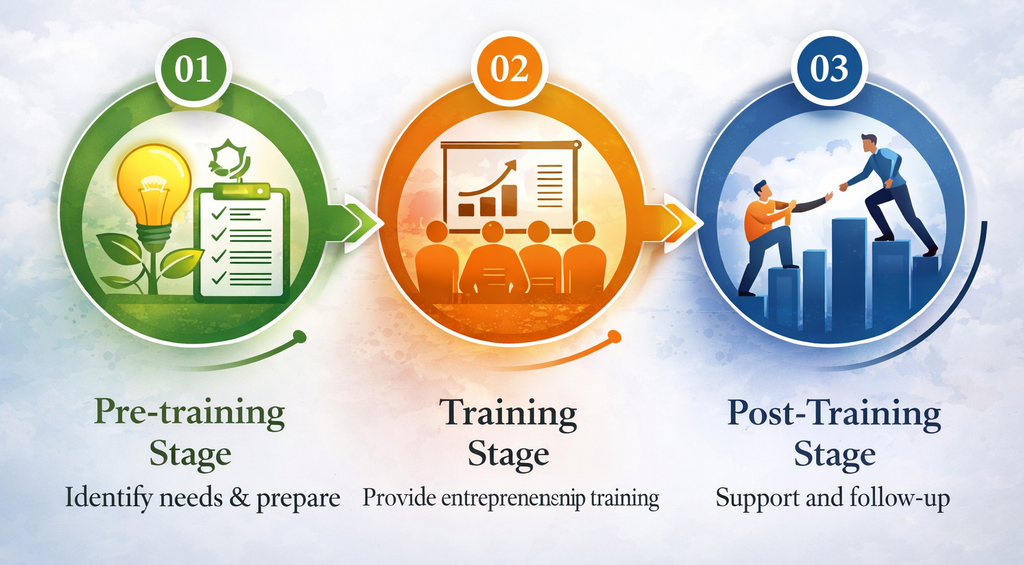
How to Start Your Entrepreneurial Journey in India
You don’t need to wake up tomorrow and register a company.
Start smaller.
Step 1: Find a problem
Look around you.
What frustrates people?
What takes too much time?
What is expensive?
What is difficult to access?
Problems can become opportunities.
Step 2: Talk to potential customers
This step is often skipped.
Don’t simply assume people want your product.
Ask them.
Listen.
You might discover that the problem you planned to solve isn’t actually their biggest problem.
Step 3: Create a simple solution
Build the smallest useful version of your product or service.
It doesn’t need to be perfect.
Step 4: Test the market
Can someone actually pay for it?
This is a much more useful question than: “Do people like my idea?”
People may say they love an idea and still never pay for it.
Step 5: Understand your finances
Calculate:
- Starting cost
- Monthly expenses
- Selling price
- Expected revenue
- Break-even point
- Profit margin
Step 6: Learn about registrations and schemes
Once you have a serious business plan, research the relevant legal registrations, taxation requirements, licenses, and government support.
The official Startup India and MSME portals are useful starting points.
Step 7: Build gradually
You don’t have to become a huge company immediately.
Get your first customer.
Then your tenth.
Then your hundredth.
Growth becomes easier to understand when you take it one stage at a time.
Challenges in Entrepreneurship Development
Of course, entrepreneurship isn’t a success story every single day.
There are challenges.
Access to finance
Some entrepreneurs struggle to raise enough capital to start or expand.
Lack of business knowledge
Someone may be technically brilliant but have little understanding of pricing, marketing, accounting, or sales.
Competition
Customers have choices.
A new business needs to give them a reason to choose it.
Regulatory requirements
Businesses may need to deal with registrations, taxation, licenses, labour requirements, and other compliance responsibilities depending on their activities.
Fear of failure
This one is less visible but very real.
Starting something new can feel uncomfortable.
What if nobody buys?
What if the business doesn’t work?
What if I lose money?
These are reasonable questions. Entrepreneurship development should therefore include not only business knowledge but also decision-making, adaptability, and resilience.
The Future of Entrepreneurship Development in India 🚀
I think the most interesting part of India’s entrepreneurial story is how broad it has become.
We’re seeing entrepreneurship across:
- Artificial intelligence
- FinTech
- HealthTech
- EdTech
- Clean technology
- Agriculture
- Manufacturing
- SaaS
- E-commerce
- Biotechnology
- Space technology
- Local businesses
- Social enterprises
Government initiatives are also evolving. Startup India’s current ecosystem includes areas such as seed funding, mentorship, investor connections, state policies, and startup support programmes.
And this doesn’t mean every business needs venture capital.
That’s an important distinction.
A profitable small business and a venture-backed startup follow very different paths.
Both can be examples of entrepreneurship.
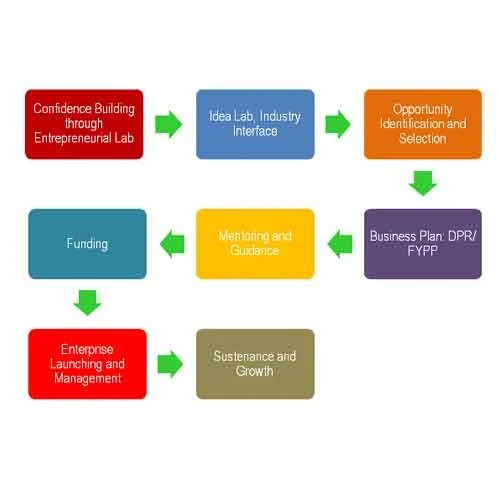
Entrepreneurship Development: Final Thoughts
Entrepreneurship Development is ultimately about more than starting companies.
It is about developing people who can identify opportunities, solve problems, make informed decisions, manage resources, and create value.
India’s entrepreneurial ecosystem has expanded significantly since the launch of Startup India in 2016. By early 2026, more than 2.12 lakh entities had received DPIIT startup recognition, showing the scale the ecosystem has reached.
But numbers tell only one part of the story.
Behind every small business and startup is usually someone who noticed a problem and thought:
“Maybe I can solve this.”
That’s where entrepreneurship often begins.
Not with a fancy office.
Not with a huge investment.
Just with an idea, a problem worth solving, and the willingness to learn.
And if you are considering becoming an entrepreneur yourself, my advice is simple: don’t wait until you know everything. Start learning, test your idea, listen to customers, understand the numbers, and improve as you go. 🌱
Want to learn More about Marketing Management Kaashiv Infotech Offers Digital Marketing Course & More, Visit www.kaashivinfotech.com.