

![Sorting in Data Structure Categories & Types [2026]](https://www.wikitechy.com/wp-content/uploads/2026/10/Sorting-in-Data-Structure-Categories-Types-2026-1248x702.png)
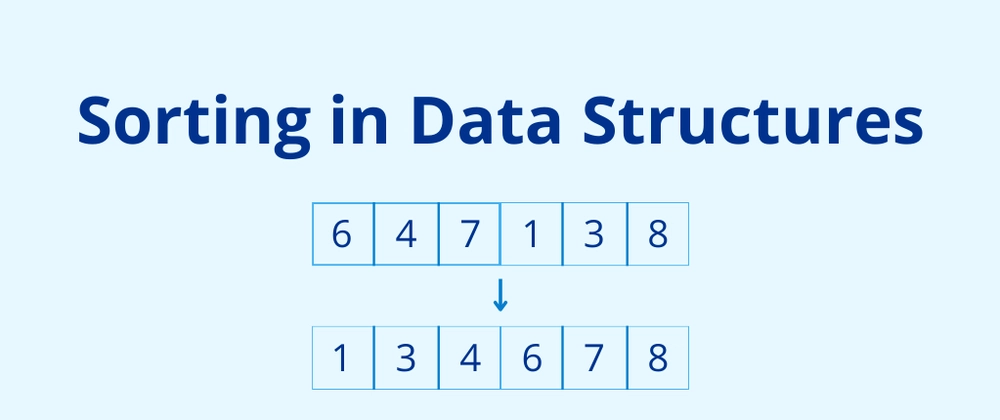
When I first started learning Sorting in Data Structure, I thought sorting simply meant arranging numbers from smallest to largest. Honestly, that is the basic idea—but there is much more happening behind the scenes.
Imagine you have these numbers:
45, 12, 89, 23, 7
After sorting:
7, 12, 23, 45, 89
Looks simple, right?
But what if you have 10 lakh records? What if you need to sort customer names, employee salaries, product prices, or millions of database records? Suddenly, the method you use for sorting matters a lot.
That is where Sorting in Data Structure becomes important.
In this guide, I’ll explain Sorting in Data Structure, its categories, popular sorting algorithms, their advantages and disadvantages, time complexity, and real-world applications in simple language.
🔥 Key Highlights of Sorting in Data Structure
- Sorting means arranging data in a particular order.
- Data can be sorted in ascending or descending order.
- Sorting makes searching and analyzing data easier.
- Bubble Sort, Selection Sort, and Insertion Sort are beginner-friendly algorithms.
- Merge Sort and Quick Sort are commonly discussed efficient comparison-based algorithms.
- Counting Sort, Radix Sort, and Bucket Sort use information about the input values rather than relying only on comparisons.
- The right sorting algorithm depends on the size and nature of the data.
- Understanding time complexity and space complexity is important when choosing an algorithm.
- Sorting is frequently used in databases, search systems, e-commerce, analytics, and software applications.
What Is Sorting in Data Structure?
Sorting in Data Structure is the process of arranging a collection of data according to a specific order.
Usually, we sort data in:
Ascending Order
Smallest to largest:
10, 20, 30, 40, 50
Descending Order
Largest to smallest:
50, 40, 30, 20, 10
But sorting isn’t limited to numbers.
We can sort:
- Names alphabetically
- Products by price
- Employees by salary
- Students by marks
- Files by date
- Customers by age
- Products by rating
For example, suppose I have a list of products:
Laptop - ₹60,000
Phone - ₹25,000
Tablet - ₹35,000
Monitor - ₹15,000
If I want to display the cheapest product first, I can sort the products by price:
Monitor - ₹15,000
Phone - ₹25,000
Tablet - ₹35,000
Laptop - ₹60,000
That’s Sorting in Data Structure in a real-world situation.
Hashing in Data Structure: 5 Essential Concepts You Need to Understand
Why Is Sorting Important?
You might wonder:
“Why should I spend time sorting data? Can’t I just search through it?”
Sometimes you can. But sorting can make many operations and user experiences much easier.
Imagine an online shopping website with thousands of products.
You want to see: Products from lowest price to highest price.
The application needs a way to arrange those products according to price.
Similarly, think about a student management system.
A teacher might want to see:
Students with highest marks
↓
Students with lowest marks
Sorting makes this possible.
Common benefits of sorting include:
- Makes data easier to understand
- Helps organize large datasets
- Can make searching more efficient
- Helps generate reports
- Makes ranking easier
- Helps compare records
- Improves data presentation
In my experience, understanding why sorting is needed makes learning individual algorithms much easier.
Categories of Sorting in Data Structure
We can broadly divide sorting algorithms into two important categories:
- Comparison-Based Sorting
- Non-Comparison-Based Sorting
Let’s understand both.
1. Comparison-Based Sorting
In comparison-based sorting, the algorithm determines the order of elements by comparing them with each other.
For example:
25 > 10
The algorithm compares values and decides where each element should go.
Popular comparison-based sorting algorithms include:
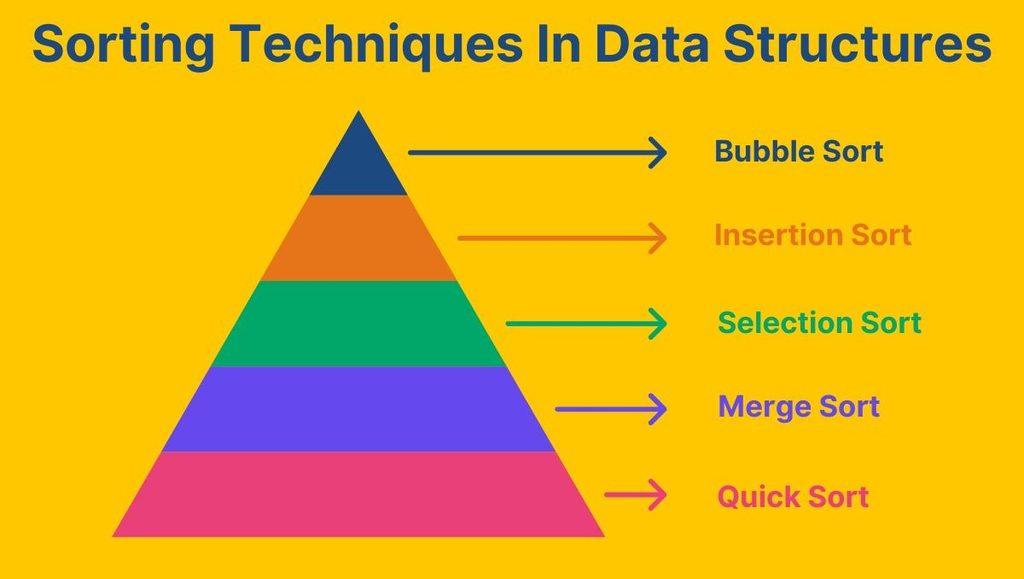
- Bubble Sort
- Selection Sort
- Insertion Sort
- Merge Sort
- Quick Sort
- Heap Sort
These algorithms are extremely important when studying Sorting in Data Structure.
For comparison-based sorting, there is a well-known lower bound of Ω(n log n) for the general comparison model. Algorithms such as Merge Sort achieve O(n log n) worst-case time, while non-comparison approaches can do better when the input has suitable properties.
2. Non-Comparison-Based Sorting
As the name suggests, these algorithms don’t rely only on comparing one element with another.
Instead, they use information about the values themselves.
Common examples are:
- Counting Sort
- Radix Sort
- Bucket Sort
These algorithms can be very efficient for certain types of input.
However, they are not automatically better than comparison-based algorithms. Their performance depends heavily on the type and range of the input data.
Types of Sorting Algorithms
Now let’s look at the major sorting algorithms in data structure.
1. Bubble Sort
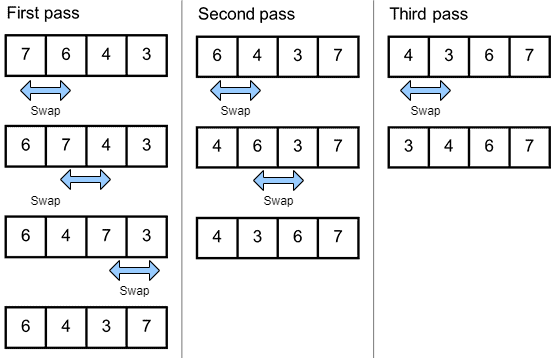
Bubble Sort is one of the easiest sorting algorithms to understand.
It repeatedly compares neighboring elements and swaps them when they are in the wrong order.
For example:
5 3 8 2
Compare:
5 and 3
Since 5 is greater than 3, swap them:
3 5 8 2
Continue comparing neighboring elements.
Eventually:
2 3 5 8
Bubble Sort is easy to learn, but it becomes inefficient for large datasets. Its typical worst-case time complexity is O(n²). It is also stable.
Best use
Bubble Sort is mainly useful for:
- Learning sorting concepts
- Understanding swapping
- Small datasets
- Educational examples
2. Selection Sort
Selection Sort works by repeatedly finding the smallest element from the unsorted portion and placing it in the correct position.
Consider:
64 25 12 22 11
First, find the smallest value:
11
Move it to the beginning:
11 25 12 22 64
Then find the next smallest value:
12
Continue until the entire array is sorted.
Selection Sort is simple, but it generally takes O(n²) comparisons.
Why learn Selection Sort?
I would definitely recommend beginners learn it because the basic idea is straightforward: Find the minimum → place it correctly → repeat.
3. Insertion Sort
Insertion Sort is another beginner-friendly sorting algorithm.
I like explaining it using playing cards.
Imagine you’re holding cards in your hand.
You receive a new card. You look at the cards you already have and insert the new card into its correct position.
That’s basically how Insertion Sort works.
Example:
5 3 4 1
Take 3 and insert it before 5:
3 5 4 1
Then insert 4:
3 4 5 1
Finally:
1 3 4 5
Insertion Sort is stable and works in-place. Its worst-case time complexity is O(n²).
It can perform nicely when the data is already mostly sorted.
4. Merge Sort
Now we move into a more efficient family of algorithms.
Merge Sort follows the divide-and-conquer approach.
The basic idea is:
Divide
   ↓
Sort smaller parts
   ↓
Merge them
Suppose we have:
8 3 5 4 7 6 1 2
We divide the array into smaller parts:
8 3 5 4
and
7 6 1 2
Then continue dividing until we reach smaller pieces.
After sorting those pieces, we merge them back together.
The result:
1 2 3 4 5 6 7 8
Merge Sort has O(n log n) time complexity in its standard form and is a classic example of divide-and-conquer sorting.
It is especially useful when we need predictable performance.
What is the Data Science Life Cycle? Stages, Frameworks & Workflow Explained
5. Quick Sort
Quick Sort is another famous sorting algorithm.
It also uses the divide-and-conquer idea.
The key concept is the pivot.
The algorithm selects a pivot and rearranges the elements around it.
For example:
40 20 60 10 50
Suppose 40 is selected as the pivot.
Values smaller than 40 move toward one side, while larger values move toward the other side.
Then the same process is applied recursively to the smaller sections.
Quick Sort has an average time complexity of O(n log n), but its worst case can reach O(n²) depending on the partitioning.
One important point students often miss:
Quick Sort is generally not stable.
That means equal-valued elements may not retain their original relative order.
6. Heap Sort
Heap Sort uses a data structure called a heap.
A heap helps organize elements so that the largest or smallest element can be efficiently identified.
Heap Sort generally provides O(n log n) time complexity and can be performed in-place.
It is useful when we want predictable O(n log n) performance without requiring the same auxiliary array structure used by standard Merge Sort.
For beginners, I suggest learning the basic heap concept before trying to understand Heap Sort.
Otherwise, it can feel like two difficult topics arriving at the same time!
7. Counting Sort
Counting Sort takes a different approach.
Instead of repeatedly comparing elements, it counts how many times each value appears.
For example:
2 1 3 2 1
We can count:
1 → 2 times
2 → 2 times
3 → 1 time
Then reconstruct the sorted output:
1 1 2 2 3
Counting Sort can run in O(n + k) time, where k represents the relevant range of values.
So it can be excellent when the value range is manageable.
But using it blindly for values with an enormous range can waste memory.
8. Radix Sort
Radix Sort sorts values by processing digits or positions rather than directly comparing complete numbers.
For example:
170
045
075
090
802
024
002
066
The algorithm processes the digits in stages.
Radix Sort can be useful for certain integer or fixed-format data and is often discussed with Counting Sort because Counting Sort can be used as the stable subroutine for each digit position.
Its complexity is commonly expressed using the number of digits and the value range/base, rather than simply as O(n log n).
9. Bucket Sort
Bucket Sort distributes elements into different buckets.
For example:
0–10
11–20
21–30
31–40
Values are placed into suitable buckets.
Each bucket is then sorted, and the buckets are combined.
Bucket Sort can be very effective when the input is distributed reasonably across the buckets.
But its performance can become poor if many values fall into the same bucket.
Sorting Algorithms Comparison
Here is a simple overview:
| Algorithm | Best Case | Average Case | Worst Case | Stable? |
|---|---|---|---|---|
| Bubble Sort | O(n) | O(n²) | O(n²) | Yes |
| Selection Sort | O(n²) | O(n²) | O(n²) | Usually No |
| Insertion Sort | O(n) | O(n²) | O(n²) | Yes |
| Merge Sort | O(n log n) | O(n log n) | O(n log n) | Yes* |
| Quick Sort | O(n log n) | O(n log n) | O(n²) | Usually No |
| Heap Sort | O(n log n) | O(n log n) | O(n log n) | No |
| Counting Sort | O(n+k) | O(n+k) | O(n+k) | Yes* |
| Radix Sort | Depends on input representation | Depends on input representation | Depends on input representation | Yes* |
*Stability depends on the implementation and the sorting procedure used.
The table is useful for interviews, but don’t try to memorize it blindly. First understand why each algorithm behaves differently.

Stable vs Unstable Sorting
This is another important concept in Sorting in Data Structure.
A stable sorting algorithm preserves the relative order of records that have equal sorting keys.
Let’s say we have:
Arun - 90
Priya - 90
Rahul - 80
If we sort by marks, Arun and Priya both have 90.
A stable sort keeps:
Arun - 90
Priya - 90
in the same relative order.
This becomes useful when sorting real-world records using multiple criteria.
For example, I might first sort employees by joining date and then by department. Stability can help preserve the earlier ordering among records with equal values. Python’s sorting tools guarantee stability, which is one reason stable sorting is useful in multi-step sorting operations.
In-Place vs Extra-Memory Sorting
Another term you will encounter is in-place sorting.
An in-place algorithm performs the sorting using little additional memory beyond the input structure, although exact memory usage depends on implementation.
For example, many implementations of:
- Insertion Sort
- Selection Sort
- Heap Sort
are considered in-place.
Merge Sort, on the other hand, commonly needs additional memory for merging when implemented for arrays.
This distinction matters when you’re working with large datasets.
Sorting in Data Structure in Real Life
Let’s forget textbooks for a minute.
Where do we actually use sorting?
Almost everywhere.
🛒 E-commerce
An online shopping application can allow users to sort products by:
- Price
- Rating
- Popularity
- Newest products
🎓 Education
A college application might sort students by:
- Marks
- Rank
- Attendance
- Name
🏦 Banking
Banks can sort transactions by:
- Date
- Amount
- Transaction type
📊 Data Analytics
Analysts frequently organize datasets to identify:
- Highest values
- Lowest values
- Rankings
- Trends
- Outliers
🔎 Search Systems
Sorting can help present results in an order that makes sense to users.
So when you learn Sorting in Data Structure, you’re not simply preparing for a coding interview. You’re learning an idea that appears in many real software systems.
Sorting in Programming Languages
Most programming languages provide built-in sorting functionality, so developers don’t always implement Bubble Sort or Merge Sort themselves.
For example, Python provides:
numbers = [5, 2, 8, 1, 3]

numbers.sort()

print(numbers)
Output:
[1, 2, 3, 5, 8]
Python also provides sorted(), which returns a new sorted result instead of modifying the original list. Python’s documentation also explains that its sorting is stable and that its implementation uses Timsort, which can take advantage of existing order in the data.
You can explore the official Python sorting documentation through Python Sorting Techniques.
How Should Beginners Learn Sorting in Data Structure?
If you’re completely new to Sorting in Data Structure, don’t start by memorizing nine algorithms.
That’s the fastest way to get confused.
I recommend this order:
Step 1: Understand the basic idea
Learn:
What is sorting?
Step 2: Learn Bubble Sort
Understand:
- Comparison
- Swapping
- Passes
Step 3: Learn Selection Sort
Understand:
- Minimum element
- Sorted portion
- Unsorted portion
Step 4: Learn Insertion Sort
Think about the playing-card example.
Step 5: Learn Merge Sort
Understand:
Divide → Sort → Merge
Step 6: Learn Quick Sort
Focus on:
Pivot → Partition → Recursion
Step 7: Learn Heap Sort
First understand:
Heap → Max Heap / Min Heap → Sorting
Step 8: Learn non-comparison sorting
Then move to:
- Counting Sort
- Radix Sort
- Bucket Sort
Once you understand these ideas, the complexity table becomes much easier to remember.
Final Thoughts
Sorting in Data Structure may look like a small topic when you first see it. But once you start coding, you realize how often sorting appears.
From a simple list of marks to millions of customer records, we constantly need data to be organized.
The important thing is not to memorize every algorithm on day one.
Start small.
Understand Bubble Sort. Then Selection Sort. Then Insertion Sort. Once those ideas become comfortable, move to Merge Sort, Quick Sort, and Heap Sort. Finally, explore Counting Sort, Radix Sort, and Bucket Sort.
And whenever you learn a new sorting algorithm, ask yourself three questions:
How does it work?
How much time does it take?
When would I actually use it?
Those three questions will take you much further than simply memorizing a table of complexities.
If you’re learning Data Structures and Algorithms for coding interviews in 2026, sorting is one of those topics I would not skip. It builds your understanding of algorithms, complexity, arrays, recursion, and problem-solving—all of which become useful as you move toward harder DSA problems. 🚀
Want to learn more ??, Kaashiv Infotech Offers Data Analytics Course, Data Science Course, Cyber Security Course & More Visit Their Website www.kaashivinfotech.com.

