
Importance of DSA – Data Structures and Algorithms (DSA) are fundamental concepts in software development. Whether you want to become a web developer, software engineer, mobile app developer, or data scientist, understanding DSA can help you write efficient, reliable, and scalable programs. Many beginners focus on learning programming languages such as Python, Java, C++, or JavaScript, but knowing a programming language alone is not enough to solve complex problems effectively.
DSA teaches developers how to organize data, solve problems logically, and improve program performance. It is also an important topic in technical interviews at many software companies. In 2026, as applications handle larger amounts of data and more complex operations, DSA continues to be an essential skill for developers who want to build successful careers in technology.
What Are Data Structures and Algorithms?

Data structures are methods of organizing and storing data so that it can be accessed and modified efficiently. Algorithms are step-by-step instructions used to solve problems or perform specific tasks.
For example, imagine building an online shopping website. The application needs to store product details, search for items, manage shopping carts, and process customer orders. Choosing suitable data structures and algorithms helps these operations work efficiently.
Common data structures include arrays, linked lists, stacks, queues, trees, graphs, hash tables, and heaps. Popular algorithms include searching, sorting, recursion, greedy methods, and dynamic programming.
Together, these concepts form the foundation of effective problem-solving in software development.
Why Is DSA Important for Developers?
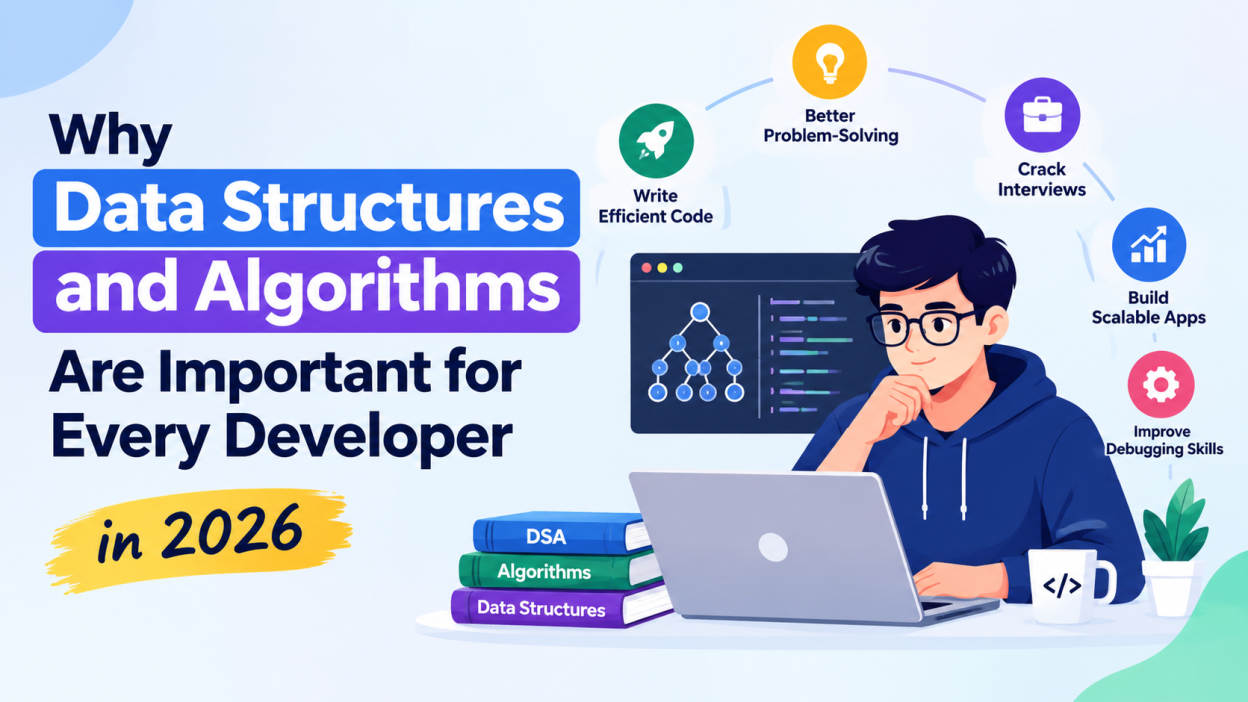
1. Improves Problem-Solving Skills
One of the biggest benefits of learning DSA is that it develops logical thinking and problem-solving abilities. Developers frequently face challenges that require breaking complicated tasks into smaller, manageable steps.
DSA helps you understand how to analyze a problem, identify possible solutions, compare different approaches, and select the most suitable method.
For instance, searching for a product in a small list can be done using linear search. However, when working with a large, sorted collection, binary search can reduce the number of comparisons significantly.
By practising DSA problems regularly, developers become more confident in handling unfamiliar programming challenges.
2. Helps Write Efficient Code
A program may produce the correct result but still perform poorly if it uses an inefficient approach. DSA helps developers understand how to improve code execution time and memory usage.
Consider searching for a name in a list containing one million records. A linear search may examine many elements before finding the required result. With a suitable data structure, such as a hash table, searching can often be performed much faster on average.
Efficient code improves application responsiveness, reduces unnecessary resource consumption, and creates a better user experience.
3. Essential for Technical Interviews

Many technology companies evaluate candidates’ problem-solving abilities through coding assessments and technical interviews. DSA questions are frequently included in these evaluations, particularly for software engineering positions.
Interview questions may cover arrays, strings, linked lists, trees, graphs, recursion, sorting, searching, and dynamic programming.
Candidates are often expected to explain their approach, write working code, analyse its complexity, and discuss possible improvements.
Learning DSA helps developers prepare for these assessments and demonstrate their ability to solve problems systematically. However, interview requirements vary depending on the company and job role.
4. Helps Understand Time and Space Complexity
Time complexity describes how an algorithm’s running time grows as the input size increases. Space complexity describes how its memory requirements grow.
Big O notation is commonly used to represent these growth patterns. Examples include O(1), O(log n), O(n), and O(n²).
Understanding complexity helps developers compare solutions before implementing them.
For example, an algorithm with O(n²) time complexity may work well for a small input but become slow when processing thousands of elements. An O(n log n) sorting algorithm may handle larger datasets more efficiently.
This knowledge allows developers to make informed decisions when designing applications.
5. Supports Scalable Application Development

Modern applications often manage thousands or millions of records. Without suitable data structures and algorithms, applications can become slow as their user base and data volume increase.
Developers use DSA concepts when building search features, recommendation systems, booking platforms, financial applications, and content management systems.
For example, a resort booking portal may need to search available rooms, compare prices, manage reservations, and prevent conflicting bookings. Appropriate data organization and efficient algorithms can help these operations perform reliably as demand increases.
DSA is not the only requirement for scalability, but it provides an important foundation for designing efficient systems.
6. Makes Developers Better at Debugging
DSA encourages developers to understand how data moves through a program and how individual operations affect the final result.
When a program produces an incorrect output or runs slowly, knowledge of arrays, pointers, recursion, trees, and other structures can help identify the underlying problem.
For example, understanding recursion makes it easier to recognize infinite recursive calls or missing base cases. Understanding linked lists helps developers identify incorrect pointer references.
These skills can reduce debugging time and improve overall code quality.
7. Builds a Strong Programming Foundation

DSA concepts are useful across different programming languages. Once you understand how a stack, queue, hash table, or binary search algorithm works, you can apply that knowledge in Python, Java, C++, JavaScript, and other languages.
This makes it easier to learn new frameworks, explore different development fields, and adapt to changing technology requirements.
Instead of memorizing language-specific solutions, developers learn reusable problem-solving techniques that remain valuable throughout their careers.
How to Start Learning DSA
Beginners should follow a structured learning path rather than attempting difficult problems immediately.
Start by learning the fundamentals of one programming language, including variables, loops, functions, arrays, and objects. Then study basic data structures such as arrays, strings, linked lists, stacks, and queues.
Next, learn searching and sorting algorithms, recursion, hash tables, trees, and graphs. After understanding these topics, explore advanced techniques such as greedy algorithms, backtracking, and dynamic programming.
Practise solving problems regularly on coding platforms and review solutions when you get stuck. Start with easy problems, gradually move to intermediate challenges, and revisit concepts that are difficult to understand.
Try implementing each data structure yourself and analyse the time and space complexity of your solutions. Consistent practice is more effective than memorizing answers without understanding them.
Conclusion
Data Structures and Algorithms are essential skills for developers who want to improve their programming abilities, solve complex problems, and build efficient applications. They strengthen logical thinking, improve code performance, support scalable development, and help candidates prepare for technical interviews.
Although DSA may seem challenging at first, learning it step by step makes the process manageable. Developers do not need to master every advanced algorithm immediately. Building a strong foundation and practising consistently can lead to steady progress.
In 2026, frameworks, programming languages, and development tools continue to evolve, but the fundamental principles of problem-solving remain valuable. Learning DSA is an investment in your long-term growth as a developer.
Want to learn more ??, Kaashiv Infotech Offers Data Analytics Course, Data Science Course, Cyber Security Course & More Visit Their Website www.kaashivinfotech.com.