

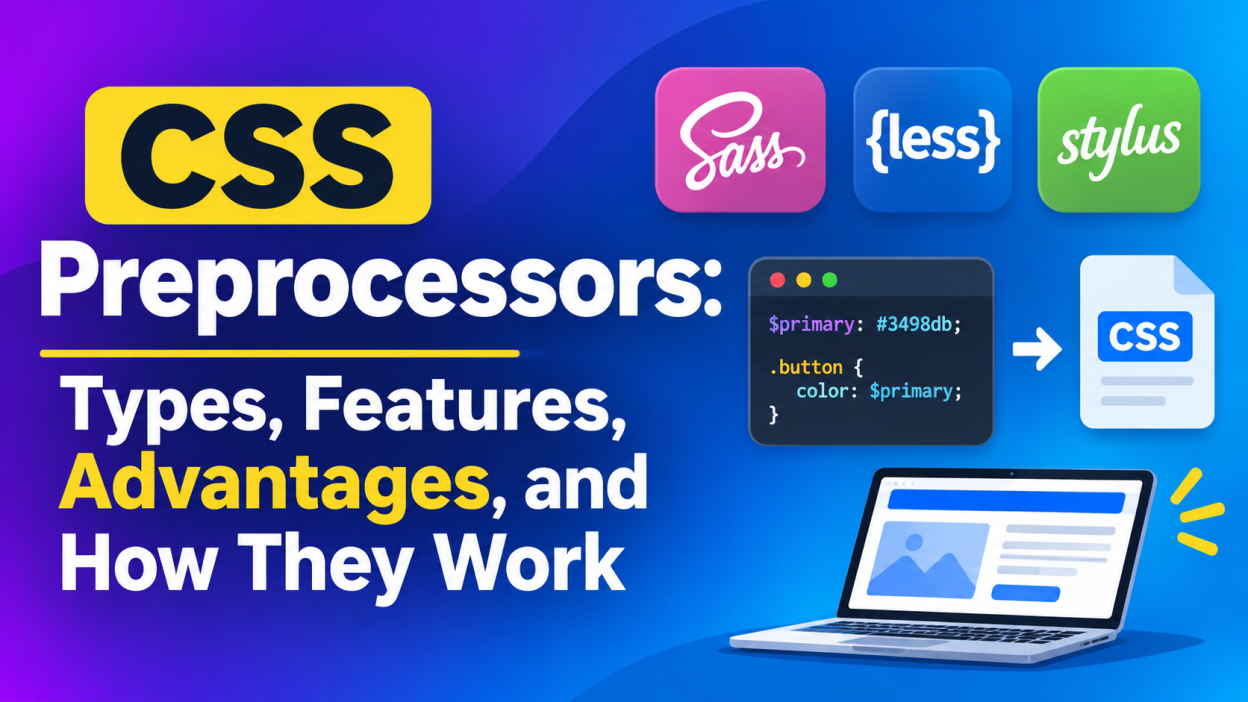
CSS (Cascading Style Sheets) is an essential technology used to design and style websites. It helps developers control website layouts, colours, fonts, spacing, animations, and responsive designs. However, when working on large websites or complex applications, managing regular CSS files can become difficult. Developers may face problems with repetitive code, maintenance, organisation, and scalability.
To solve these challenges, developers use CSS preprocessors. A CSS preprocessor is a scripting language that extends the features of traditional CSS. It allows developers to write CSS using advanced features such as variables, nesting, mixins, functions, and reusable code. The preprocessor converts the written code into standard CSS that browsers can understand.
CSS preprocessors make styling more organised, reusable, and easier to maintain. In this article, we will explore what CSS preprocessors are, their types, features, advantages, disadvantages, and how they work.
What Is a CSS Preprocessor?
A CSS preprocessor is a tool that allows developers to write stylesheets using additional programming features that are not available in traditional CSS. It extends CSS with features that help reduce repetitive code and improve development productivity.
Developers write code in a preprocessor language, and the tool compiles it into regular CSS. The generated CSS file can then be used directly in a website.
For example, developers can create a variable for a primary colour and reuse it throughout the stylesheet instead of writing the same colour value repeatedly.
CSS preprocessors are particularly useful for large projects where multiple developers work on different components of a website.
How Do CSS Preprocessors Work?
CSS preprocessors follow a simple compilation process. Developers write code using a preprocessor syntax and then convert it into standard CSS.
The general process includes:
- Write Preprocessor Code: Developers create stylesheet files using a preprocessor language such as Sass or Less.
- Use Advanced Features: They use variables, nesting, mixins, functions, and other features to organise the code.
- Compile the Code: A compiler processes the preprocessor file and converts it into standard CSS.
- Generate CSS Files: The compiler creates a regular CSS file.
- Apply Styles to Websites: Browsers read the generated CSS and apply the styles to HTML elements.
This process helps developers maintain cleaner stylesheets and improve development efficiency.
Types of CSS Preprocessors
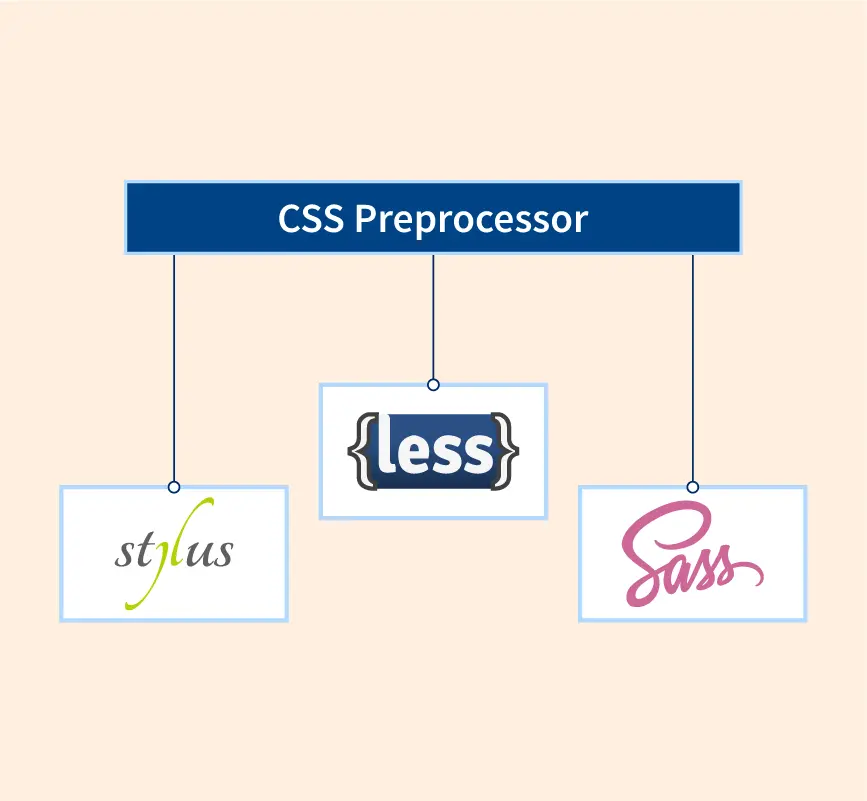
There are several CSS preprocessors available for web development. Each offers different features and advantages.
1. Sass (Syntactically Awesome Style Sheets)
Sass is one of the most popular CSS preprocessors used by web developers. It provides advanced features such as variables, nesting, mixins, inheritance, and functions.
Sass supports two syntax formats: SCSS and the original indented Sass syntax. SCSS looks similar to traditional CSS, making it easier for beginners to learn.
Key Features:
- Variables for storing reusable values.
- Nesting for organising CSS selectors.
- Mixins for reusing groups of styles.
- Functions for performing calculations.
- Inheritance for sharing styles between selectors.
Sass is widely used in modern web development projects because it makes large stylesheets easier to manage.
2. Less (Leaner Style Sheets)
Less is another popular CSS preprocessor that extends traditional CSS with additional features. It provides a simple syntax and allows developers to write reusable and organised stylesheets.
Less supports variables, nesting, mixins, operations, and functions. It is commonly used in projects that require flexible stylesheet management.
Key Features:
- Variables for storing colours and sizes.
- Mixins for sharing reusable styles.
- Nested rules for organising selectors.
- Mathematical operations for calculations.
- Functions for modifying values.
Less is suitable for developers who want to extend CSS without learning a completely different syntax.
3. Stylus
Stylus is a flexible CSS preprocessor that offers a powerful and minimal syntax. It allows developers to write stylesheets with or without brackets, semicolons, and colons.
This flexibility makes Stylus different from other preprocessors. Developers can choose a coding style that matches their preferences.
Key Features:
- Flexible syntax.
- Variables and functions.
- Mixins and reusable styles.
- Nested selectors.
- Conditional statements and loops.
Stylus is useful for developers who prefer a flexible coding environment and advanced stylesheet features.
Important Features of CSS Preprocessors
CSS preprocessors provide several features that make stylesheet development easier.
Variables: Variables allow developers to store reusable values such as colours, font sizes, and spacing. If a value changes, developers can update it in one place.
Nesting: Nesting allows developers to write CSS selectors inside other selectors. It improves readability and helps organise related styles.
Mixins: Mixins allow developers to create reusable groups of CSS declarations. They reduce repetitive code across different elements.
Functions: Functions help developers perform calculations and manipulate values within stylesheets.
Inheritance: Inheritance allows one selector to reuse styles from another selector, reducing unnecessary duplication.
Partials and Imports: These features allow developers to divide large stylesheets into smaller files and combine them into a single stylesheet.
Advantages of CSS Preprocessors
CSS preprocessors offer several benefits for website development.
- Code Reusability: Variables and mixins help developers reuse styles across multiple components.
- Easy Maintenance: Organised code makes it easier to update and manage large projects.
- Improved Productivity: Developers can write stylesheets faster using advanced features.
- Better Organisation: Nesting and partial files help organise complex stylesheets.
- Reduced Repetition: Reusable code reduces unnecessary duplication.
- Scalability: Preprocessors make it easier to manage styling in large websites and applications.
Disadvantages of CSS Preprocessors
Although CSS preprocessors provide many benefits, they also have some limitations.
- Compilation Required: Preprocessor code must be converted into standard CSS before browsers can use it.
- Learning Curve: Beginners may need additional time to understand variables, mixins, and other features.
- Debugging Challenges: Finding errors in compiled CSS can sometimes be difficult without source maps.
- Build Configuration: Some projects require additional tools and configuration to compile stylesheets.
- Extra Complexity: Using too many advanced features can make stylesheets difficult to understand.
CSS vs CSS Preprocessors
Traditional CSS and CSS preprocessors are both used to style websites, but they have different capabilities.
| Feature | CSS | CSS Preprocessors |
|---|---|---|
| Variables | Supported | Supported |
| Nesting | Supported in modern CSS | Supported |
| Mixins | Not natively supported | Supported |
| Functions | Built-in functions | Custom functions available |
| Compilation | Not required | Usually required |
| Code Reusability | Limited | Advanced |
| Maintenance | Can become difficult | Easier for large projects |
Modern CSS now supports several features that were previously available mainly through preprocessors. However, preprocessors still provide useful capabilities, particularly for mixins, modular workflows, and build-time processing.
When Should You Use CSS Preprocessors?
CSS preprocessors are especially useful when developing large websites, enterprise applications, and complex user interfaces.
They are helpful when developers need to manage multiple stylesheets, reuse common design elements, maintain consistent colours, and work with large development teams.
For small websites, regular CSS may be sufficient. However, for projects with multiple pages and reusable components, Sass or Less can improve stylesheet organisation and maintenance.
Conclusion
CSS preprocessors play an important role in modern web development by extending the capabilities of traditional CSS. Tools such as Sass, Less, and Stylus help developers write reusable, organised, and maintainable stylesheets.
Features such as variables, nesting, mixins, functions, and inheritance reduce repetitive code and improve development productivity. Although preprocessors require compilation and additional learning, they offer valuable benefits for managing complex web projects.
Developers who want to improve their frontend development skills should understand CSS preprocessors and practise using Sass or Less. Learning these tools can help them build cleaner, scalable, and professionally designed websites.
Want to Learn More About Java ?, Kaashiv Infotech Offers, Full Stack Java Course, Java Course, Data Science Course, Internships & More, Visit Their Website www.kaashivinfotech.com.