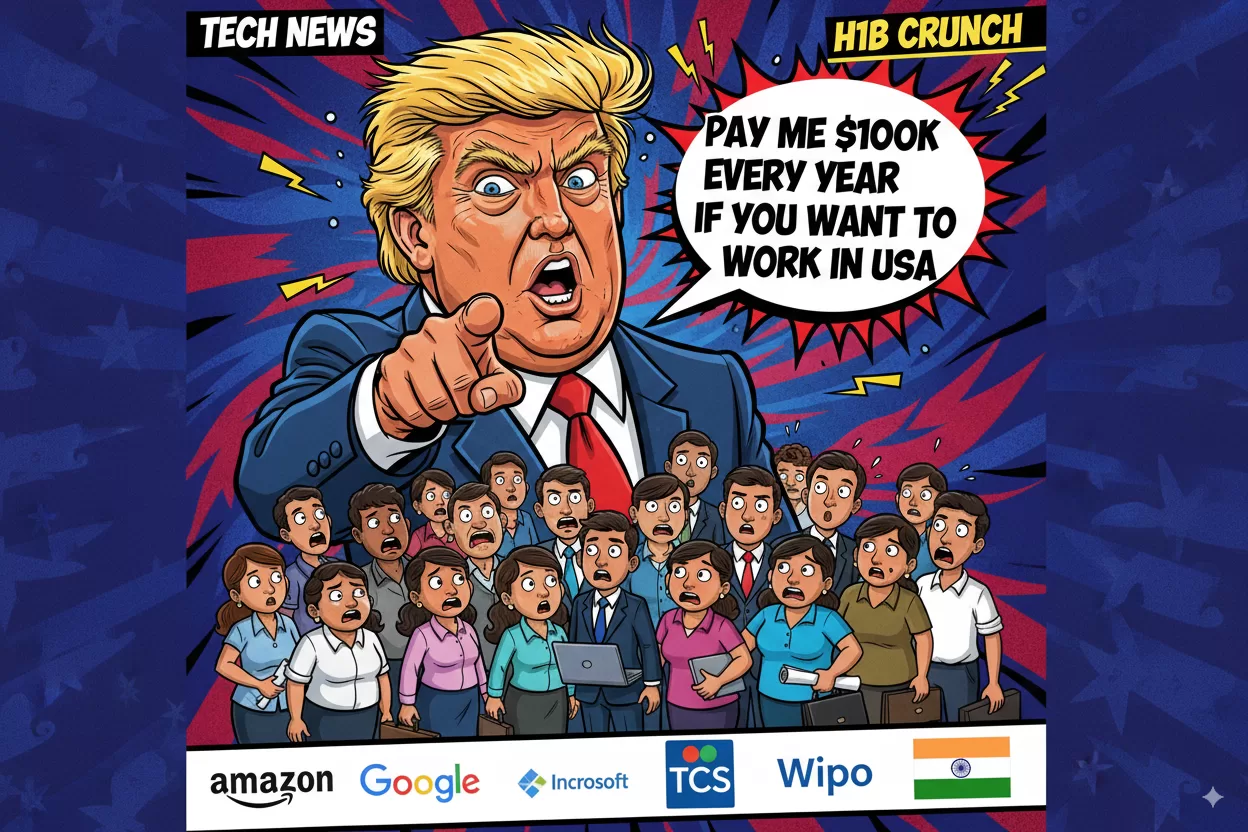
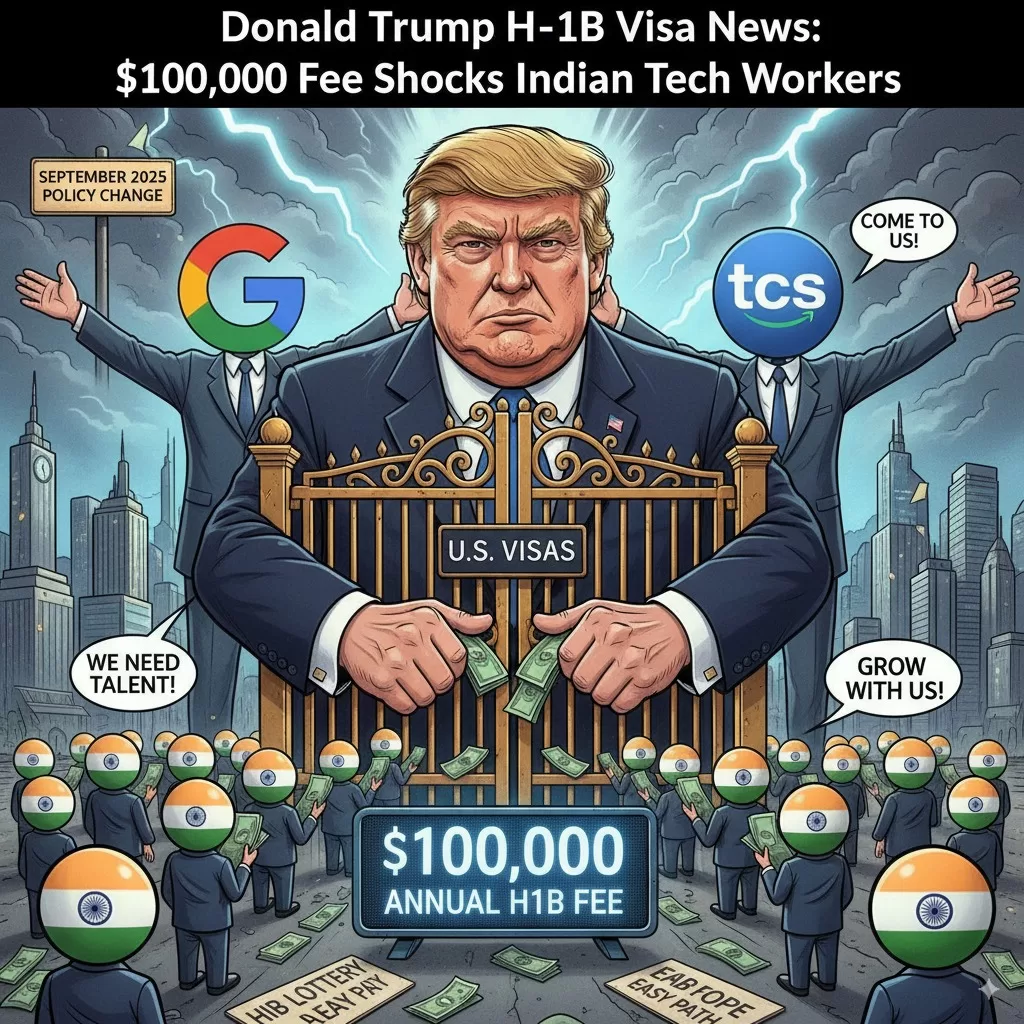
Donald Trump H1B visa news is shaking the tech world. On September 19, 2025, the White House announced a sweeping overhaul of the H-1B program that could cost companies $100,000 per year per foreign worker
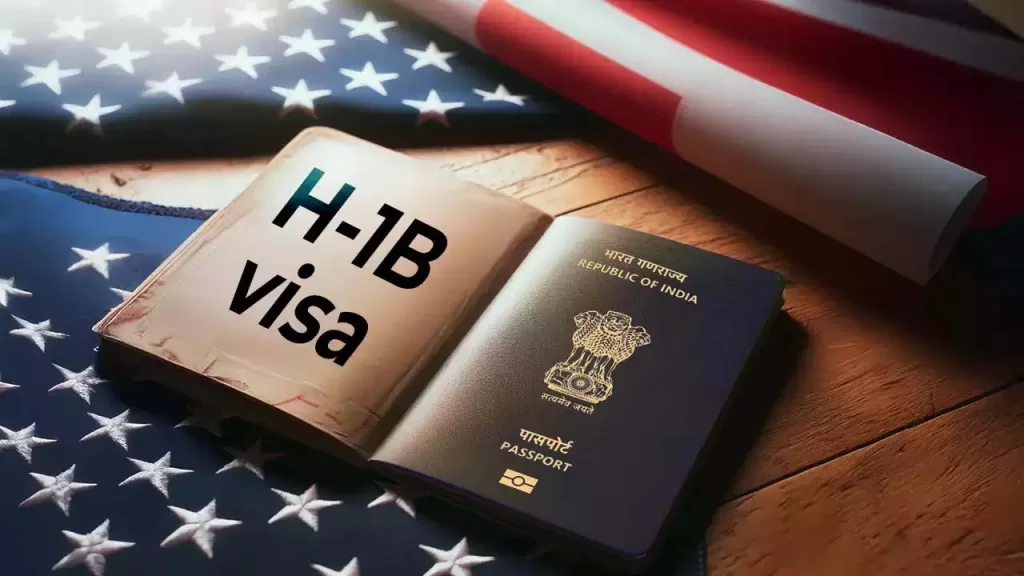
What Exactly Is the H1B Visa?
Let’s ground ourselves. H1B visa is not loophole or trick—it’s been a legal launchpad for millions of Indian careers in the U.S.
- It’s a temporary work visa for specialty occupations—think IT, software, finance, biotech.
- Annual cap: 85,000 new visas (65,000 general + 20,000 master’s cap).
- Valid for 3 years, renewable to 6.
- Lottery system: 85,000 visas yearly (65K regular + 20K for U.S. master’s grads). In FY2025, 470,000+ registrations chased those slots.
- Current pool: around 450,000–500,000 active H1Bs.
- 72–78% are Indian nationals, mainly from IT services (Infosys, TCS, Wipro) and Big Tech (Amazon, Microsoft, Google).
- Salary ranges: $120K–$150K median .Amazon ($152K), Google ($182K), and Apple ($167K) offering higher compensation for skilled roles compared to IT services firms like Infosys ($91K) and TCS ($85K)
What the New Trump H1B Visa News Really Means
Let’s strip away the panic and look at facts.
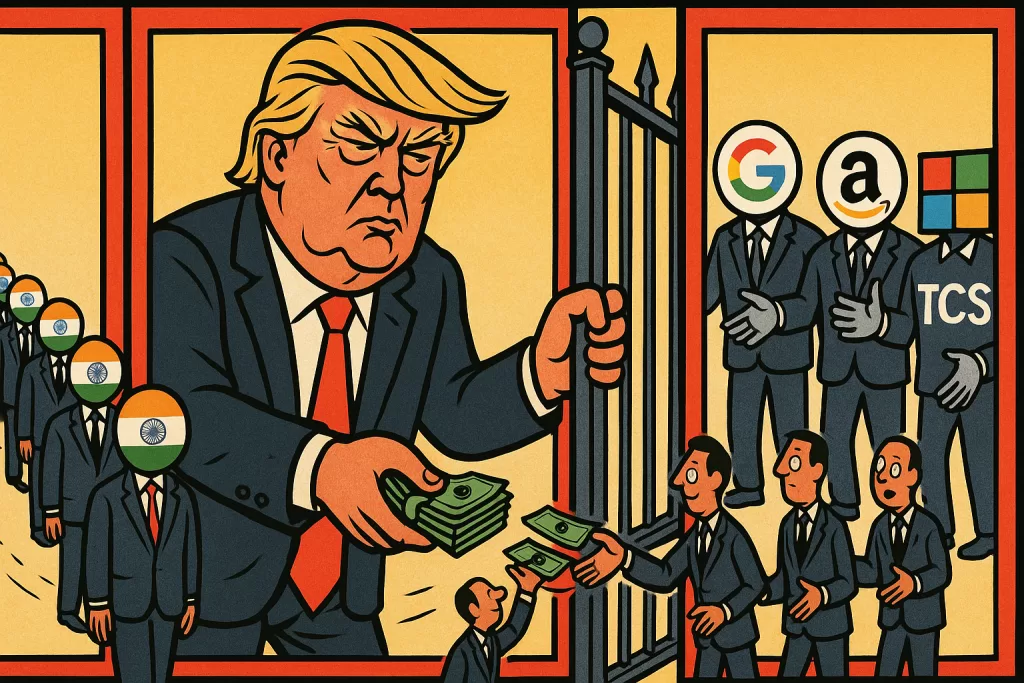
- The fee: Employers now must pay $100,000 annually per worker. In some discussions, a $300,000 upfront fee for 3 years is on the table.
- Applicability: New applications, extensions, renewals, and re-entries (if you travel abroad).
- No instant deportations: If your visa is valid, you stay until it expires. But travel abroad after Sept 21 triggers the new rule.
- Who suffers most:
- Indian IT outsourcing firms (Infosys, Wipro, TCS, Cognizant). Their business model is thin-margin → a $100K tax wipes it out.
- Startups can’t afford it. FAANG (Amazon, Google, Meta, Microsoft) will survive, but early-stage companies won’t.
- Healthcare—tens of thousands of Indian doctors in U.S. rural hospitals rely on H1B. They may face shortages now.
- Companies like Amazon and Microsoft to issue advisories urging H-1B employees to halt all international travel and return if abroad before 21 september.
- Wider ripple: Stock dips in Indian IT, nervous parents of fresh grads, and HR teams scrambling to rebook tickets before Sept 21.
The Indian Perspective: Careers and Companies at Risk
For Indian graduates, the H1B has been the holy grail. Every year, over 1 million engineering graduates come out of India, many with U.S. dreams. Until now, the H1B was the most realistic path.
Here’s what’s at stake:
- Placements abroad: Freshers joining Infosys, TCS, Wipro, Cognizant used to count on U.S. postings. Those may now shrink dramatically.
- IT exports: India’s IT industry earns $225 billion annually from U.S. contracts. A $100K visa tax + the proposed 25% outsourcing tax (HIRE Act) is a double punch.
- Family disruption: Long-term H1B holders (10–15 years in the U.S.) won’t be kicked out immediately—but renewals just got way more expensive and uncertain.
👉 Imagine a 35-year-old tech lead in Dallas, originally from Pune. His H1B is valid till 2027. If he travels home to India for Diwali 2026, re-entry might cost his employer $100K. Will they pay it?
👉 TCS pays its U.S.-based H1B employees an average salary of around $85,000. Paying an extra $100,000 per year, per worker, makes zero financial sense. Why would any company pay more in visa fees than the worker’s actual salary?
Immediate Fallout 📉
The shockwaves were instant.
- Big Tech Stocks Dip: Shares of Amazon, Microsoft, and Google fell 2–3% intraday as investors priced in higher hiring costs. (Reuters)
- Indian IT Hit Hardest: Infosys filed over 8,000 petitions in FY2025, TCS nearly 4,800, HCL and Wipro thousands more. At $100,000 each, that’s hundreds of millions in sudden costs.
- Project Costs Up 10–15%: Analysts warn Indian IT firms may cut U.S. on-site roles and accelerate offshore + remote delivery.
- NASSCOM Warning: India’s IT lobby said the move could “seriously dent competitiveness” but also noted it may push innovation back into India’s booming $245B export market.
- Human Impact: Indian developers on H1B/H-4 are rushing to book flights, terrified of being locked out or bankrupting their employers.
The Outsourcing Tax Punch 🥊
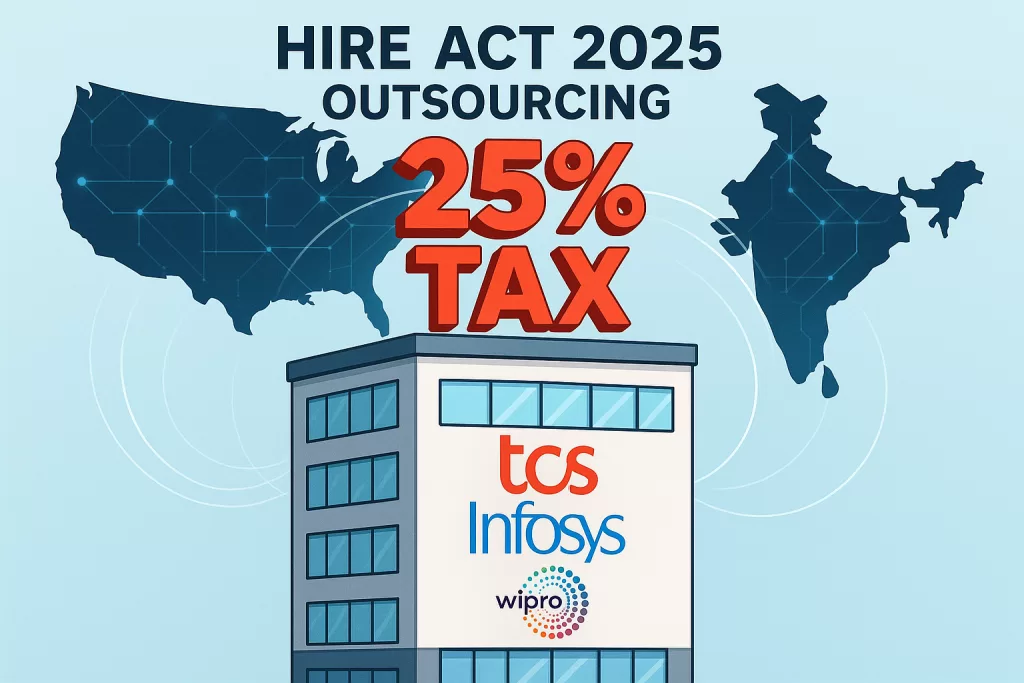
As if the $100K H1B fee wasn’t enough, the U.S. is also moving ahead with the HIRE Act—a proposed 25% tax on Indian IT companies providing “on-shore” services.
What does that mean in plain English?
- If a TCS or Infosys team is working remotely from India on a U.S. project, the client paying them could be hit with a 25% excise tax.
- Analysts say this would effectively raise costs by 40–46% once you factor in the lost tax deductions.
- India exports over $225 billion in IT services to the U.S. every year. That’s more than half of India’s entire IT revenue—directly in the firing line.
👉 For Indian IT firms, this is a double squeeze: higher costs to send workers onsite, and heavier taxes on keeping them offshore.
Is This the End of the H1B Dream? Not Necessarily.
Here’s where perspective helps. Trump isn’t careless—he’s calculated. He often rolls out bold, headline-grabbing policies as a strategic opening move, then adjusts once the pressure and negotiations kick in. Think of it like deal-making: start high, then land somewhere more “reasonable.”
Remember the travel bans, the student visa rules, even the trade tariffs? They all began with maximum shock value but eventually softened or adapted after talks with industry leaders and lawmakers. This $100K H1B fee could follow the same path.
Big Tech players like Amazon, Google, and Microsoft, alongside Indian IT lobby groups like NASSCOM, are already preparing legal and political battles. Lawsuits, negotiations, and lobbying are coming. If history repeats, expect a “discounted” or restructured version of this fee later—not a full wipeout of H1B opportunities.
Legal & Practical Uncertainties Remain
Even with Trump’s confident rollout, the fine print isn’t settled yet. Legal experts are debating whether the executive branch has the authority to impose a fee this steep without Congressional approval. Some argue it may eventually be capped or revised. (Reuters, The Guardian)
There’s also confusion around exemptions: Which categories might escape the fee? Will renewals and transfers be treated differently than new entries? Immigration law specialists at Manifest Law note that clarity could take weeks, leaving companies and applicants in limbo for now. (Manifest Law, Reuters)
Meanwhile, other nations are already moving in to capture this talent pool. Canada is fast-tracking work permits for tech workers, Australia is expanding its skilled migration program, and the UK has rolled out its Global Talent visa. And now, China is stepping in with its new K1 visa, hoping to lure the same high-skilled professionals who might look beyond the U.S. in the aftermath.

Beyond H-1B: Alternative Visa Routes
The $100K H1B fee doesn’t slam the door on U.S. opportunities—there are other legal tracks Indian tech talent and companies are already eyeing:
- L-1 Visa – Used by 75,000+ workers in FY2024 for intra-company transfers. A strong option for Indian IT majors with U.S. offices. (I’ll unpack this in detail next.)
- O-1 Visa – About 20,000 issued yearly to individuals with “extraordinary ability” in tech, science, or arts. Ideal for top engineers, AI researchers, or startup founders.
- F-1 + OPT/STEM OPT – Over 200,000 Indian students study in the U.S. each year; STEM grads can work up to 3 years after graduation, often as a bridge to H1B or O-1.
- EB-2/EB-3 Green Card – Employer-sponsored permanent residency. The backlog is brutal (1M+ Indians waiting), but it remains a long-term path.
- H-4 EAD – Nearly 100,000 Indian spouses hold this work authorization, though its future is politically vulnerable.
- Golden Visa (Gold Card Proposal) – A new proposal allows permanent residency for individuals paying $1M (~₹8.3 crore) or companies paying $2M (~₹16–17 crore). Unlike EB-5, this looks more like a direct fee/donation than a recoverable investment, aimed at raising $100B for U.S. finances.
👉 Among these, the L-1 visa may become the lifeline for Indian IT and Big Tech in the Trump era. Let’s break it down.
Got it — you want to make it clear that L-1 isn’t a shiny new invention, just that its importance is rising because H-1B became so expensive. Here’s a revised version of the section with that nuance:
L-1 Visa: The Corporate Lifeline, Maybe.
With the H1B suddenly priced like a luxury item, the L-1 visa is stepping into the limelight as the most realistic path for Indian IT and Big Tech talent to stay U.S.-bound.
Let’s be clear: the L-1 visa is not new. Global companies have been using it for decades to move managers and specialists to their U.S. offices. But until now, the H-1B was more flexible and had benifits for both employers and employees — so it was the preferred route.
With the $100K annual H1B surcharge, however, the math changes. Expect companies to ramp up their use of L-1s, even though it won’t fully replace the H-1B. It’s not a perfect substitute, but it’s suddenly a very attractive option.
What It Is
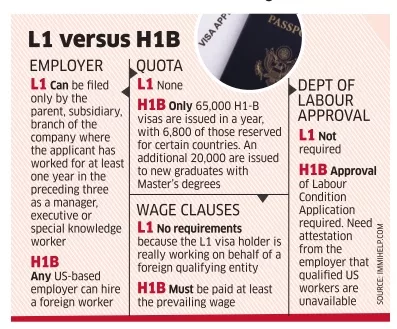
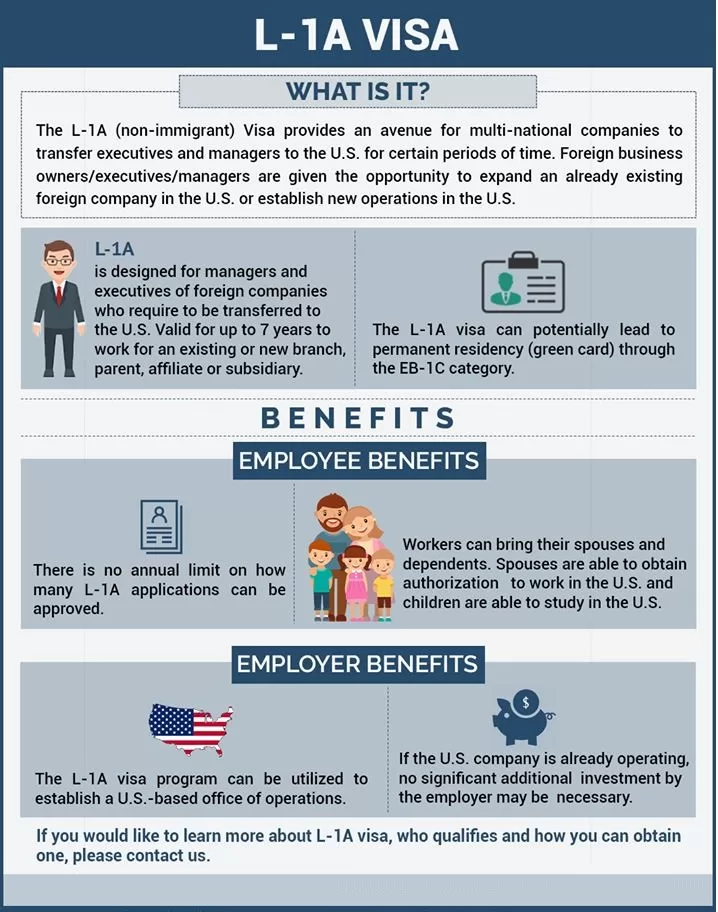
An intra-company transfer visa—if you already work for a multinational (Infosys, TCS, Accenture, Amazon, Google, etc.) abroad, you can be moved to its U.S. office under L-1, bypassing the H-1B lottery.
Two Flavors
- L-1A – For managers and executives (valid up to 7 years).
- L-1B – For employees with “specialized knowledge” (valid up to 5 years).
The Numbers
About 75,000 L-1 visas were issued in FY2024, with Indians representing nearly 40–45%. Those numbers are expected to rise as firms pivot away from H-1B dependence.
Why Companies Will Lean on It
✅ No lottery / no cap – More predictable than H-1B.
✅ Lower cost – Avoids the new $100K annual H-1B fee.
✅ Dual intent – You can still transition to a green card.
✅ Team mobility – Useful for relocating entire project teams or leadership.
But It Won’t Fully Replace H1B
L-1 has its own limits:
- Requires 1 year of prior employment with the company outside the U.S.
- Harder for fresh graduates or people switching employers.
- Subject to strict documentation and audits (especially L-1B “specialized knowledge” cases).
👉 Bottom line: L-1 visas were always part of the playbook — now they’re just becoming Plan A for many firms. H-1B won’t disappear, but its dominance will shrink as companies rebalance toward L-1 to keep talent flowing into the U.S.
Finding the Silver Lining 🌤️
Yes, Trump’s $100K H-1B move is a shock — but it doesn’t have to be the end of the dream. If history has taught us anything, the global talent market always adapts, and so can you.
Career Playbook for the New Era
Now is the time to future-proof your skills. Focus on domains where demand outpaces politics:
- Artificial Intelligence & Machine Learning – The hottest field globally.
- Cloud Computing & DevOps – AWS, Azure, GCP certifications are gold.
- Cybersecurity & Privacy Engineering – Talent shortages are global and growing.
- Data Engineering & Analytics – Every sector needs data talent.
Upskilling in these areas makes you too valuable to ignore — in any country.
Perspective Matters
This isn’t the first time U.S. immigration policy has rattled the industry — and it won’t be the last. Each time, new opportunities emerge. Big Tech, startups, and even governments respond by creating alternative paths and incentives for top talent.
👉 Bottom line: This is not the end of the world — it’s a call to adapt. Opportunities will shift, but they will not disappear. Your best strategy? Stay skilled, stay flexible, and stay ready.