

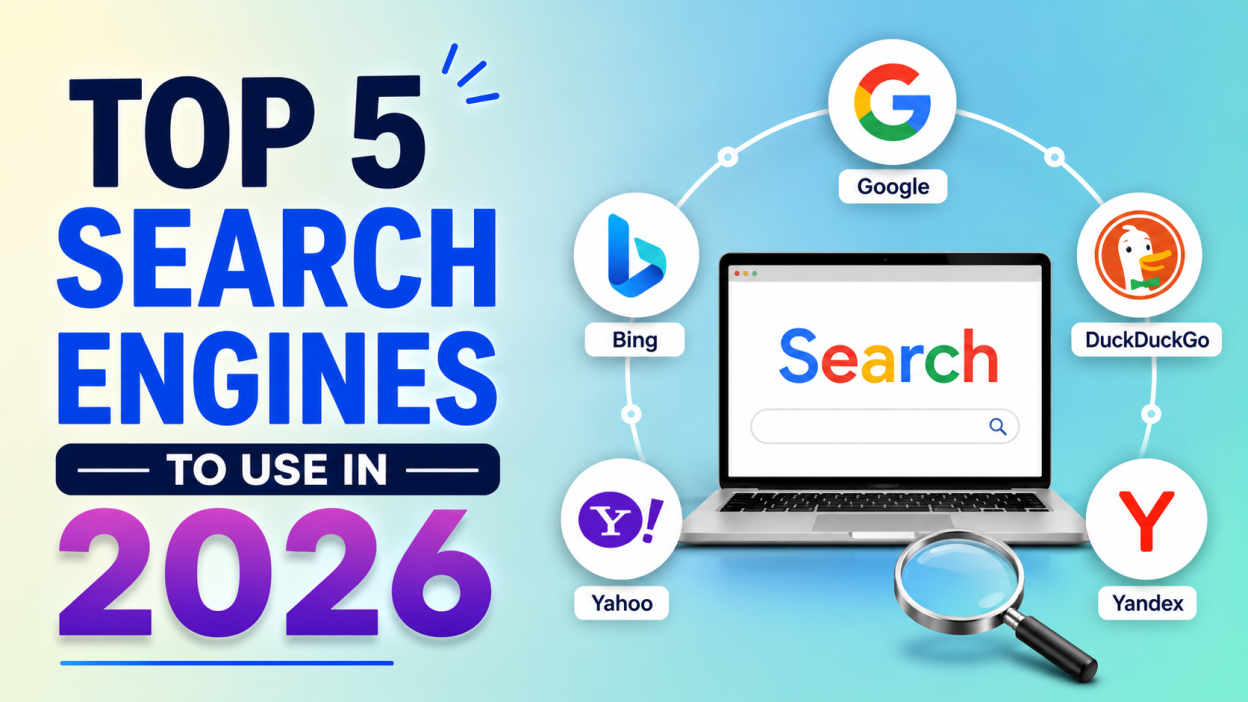
Search engines have become an essential part of everyday internet use. Whether you are looking for technical information, comparing products, researching a topic, finding local businesses, or simply answering a quick question, search engines help you find relevant information within seconds.
While Google continues to dominate the global search market, alternative search engines have become increasingly useful because they offer different features such as privacy, AI-powered results, regional content, and alternative search experiences. According to StatCounter, Google held 91.27% of worldwide search-engine market share in June 2026, followed by Bing at 4.68%, Yahoo at 1.28%, Yandex at 0.79%, and DuckDuckGo at 0.67%.
In this article, let’s explore the top 5 search engines in 2026, their key features, advantages, limitations, and who should consider using them.
What Is a Search Engine?
A search engine is an online tool that helps users discover information available on the internet. When you enter a query, the search engine searches its index and presents relevant webpages, images, videos, news, maps, products, and other information.
Modern search engines are also becoming more intelligent. AI-powered features can understand natural-language questions, summarize information, provide direct answers, and help users explore complex topics without relying only on traditional lists of links.
Top 5 Search Engines in 2026
1. Google
Google remains the most widely used search engine in the world in 2026.
Its biggest strength is the combination of a massive web index, sophisticated ranking algorithms, personalized results, maps, news, images, videos, shopping information, and other connected services.
Google is especially useful when you need to find information quickly or perform a broad search across different types of content.
Key features include:
- Fast and highly relevant search results
- Image, video, news, and shopping search
- Google Maps integration
- Voice search
- AI-powered search features
- Personalized results
- Advanced search operators
- Integration with other Google services
Google is also important for businesses and digital marketers because a large portion of organic website traffic still comes from Google Search.
Best for: General web searches, research, local searches, images, news, and everyday internet use.
2. Microsoft Bing

Microsoft’s Bing is the second-largest traditional search engine globally. StatCounter reported a 4.68% worldwide share in June 2026.
Bing has developed beyond being simply an alternative to Google. Microsoft has incorporated AI capabilities into its search experience, making it particularly interesting for users who want conversational answers alongside traditional search results.
Bing also works closely with Microsoft’s ecosystem, including Windows and Edge.
Key features include:
- Web, image, video, and news search
- AI-assisted search experiences
- Strong image-search capabilities
- Microsoft ecosystem integration
- Visual Search
- Rewards programs
- Search filters and advanced options
For some searches, Bing can provide different results from Google, which makes it useful when you want to compare information across search engines.
Best for: Windows users, image searches, AI-assisted searches, and users looking for an alternative to Google.
3. Yahoo

Yahoo is one of the oldest major names in internet search and continues to maintain a presence in the search market.
Although its market share is significantly smaller than Google’s and Bing’s, Yahoo remains useful because it combines search with other internet services such as news, finance, sports, and email.
StatCounter reported Yahoo with 1.28% of worldwide search-engine market share in June 2026.
Key features include:
- Web search
- News
- Finance information
- Sports updates
- Email integration
- Image and video search
- Personalized content
Yahoo can be particularly convenient for users who already use its broader ecosystem.
Best for: Users who want search combined with news, finance, sports, and other online services.
4. Yandex

Yandex is a major search engine particularly associated with the Russian-language internet and markets where its services have a strong regional presence.
It offers more than conventional web search, with services covering maps, images, videos, translation, and other online tools.
According to StatCounter, Yandex accounted for 0.79% of worldwide search-engine market share in June 2026.
One of Yandex’s biggest advantages is its ability to understand and serve regional and Russian-language queries effectively.
Key features include:
- Web search
- Image search
- Video search
- Maps
- Translation
- Local search capabilities
- Regional-language support
Best for: Russian-language searches, regional information, and users interested in alternatives to Western search platforms.
5. DuckDuckGo
DuckDuckGo has built its reputation around privacy-focused searching.
Unlike conventional search experiences that often emphasize personalization and user data, DuckDuckGo positions itself as a privacy-oriented alternative.
It has attracted users who want to reduce tracking while browsing and searching online. StatCounter reported DuckDuckGo at 0.67% worldwide search-engine market share in June 2026.
DuckDuckGo is particularly attractive for users who want a simple search experience without making personalization the central part of their search activity.
Key features include:
- Privacy-focused search
- Reduced tracking
- Simple interface
- Private browsing tools
- Bang shortcuts for quickly searching specific websites
- Web, image, and video search
Best for: Privacy-conscious users who want a straightforward alternative to mainstream search engines.
Why Are Search Engines Still Important in 2026?
Search behaviour is changing rapidly because of AI assistants and conversational search tools. However, traditional search engines remain extremely important because they provide access to a huge range of websites and information sources.
Search engines are useful for:
- Finding reliable sources for research
- Discovering websites and online services
- Finding local businesses
- Learning technical skills
- Comparing products and services
- Finding images and videos
- Reading news and current information
- Researching career opportunities
- Troubleshooting technical problems
AI may change how people search, but the need to discover and verify information on the web remains.
Search Engines vs AI Search
One of the biggest changes in 2026 is the growing overlap between traditional search engines and AI-powered search.
Instead of entering short keywords such as:
“best Python courses”
users can ask a more detailed question such as:
“Which Python skills should I learn to become a backend developer in 2026?”
AI-powered search can understand the context of the question and generate a more conversational response.
However, traditional search results still have an important advantage: they allow users to visit multiple sources and compare information themselves.
For important topics, it is often better to use AI-generated answers as a starting point and then verify important claims using reputable sources.
How to Choose the Right Search Engine?
The best search engine depends on what you need.
If you want the broadest and most familiar search experience, Google is the obvious choice.
If you use Microsoft’s ecosystem or want an alternative with strong AI integration, Bing is worth trying.
If you prefer an internet portal with news, finance, and sports content, Yahoo can be useful.
For Russian-language and regional searches, Yandex can provide a strong alternative.
And if privacy is your main concern, DuckDuckGo is one of the better-known options.
Final Thoughts
The search-engine landscape in 2026 is no longer limited to choosing between one or two platforms. Although Google remains overwhelmingly dominant, alternatives such as Bing, Yahoo, Yandex, and DuckDuckGo provide different approaches to discovering information online.
The right choice ultimately depends on your priorities. Google is the strongest all-purpose option, Bing offers a strong alternative with AI features, Yahoo combines search with online content and services, Yandex is valuable for regional searches, and DuckDuckGo focuses heavily on privacy.
Trying more than one search engine can also be useful. Different engines may return different sources and perspectives, which can help you conduct better research and discover information you might otherwise miss.
Want to Learn More About Java ?, Kaashiv Infotech Offers, Full Stack Java Course, Java Course, Data Science Course, Internships & More, Visit Their Website www.kaashivinfotech.com.