
Full-stack development has become more powerful and flexible than ever. Developers can now build complete web applications using frameworks that bring together frontend development, backend logic, routing, APIs, database integration, authentication, and deployment workflows.
In 2026, choosing the right full-stack framework depends on several factors, including programming language, project requirements, scalability, performance, developer experience, and ecosystem support. Current developer-survey data continues to show strong adoption for technologies such as React, Node.js, Next.js, Angular, Vue, ASP.NET Core, and Spring Boot.
Whether you are a beginner learning full-stack development, a college student working on projects, or an experienced developer building production applications, understanding the major frameworks can help you make better technology decisions.
What Is a Full-Stack Framework?
A full-stack framework provides tools and conventions for developing multiple layers of a web application within a connected ecosystem. Depending on the framework, this can include the user interface, server-side logic, routing, APIs, authentication, database interaction, rendering, and build or deployment workflows.
For example, Next.js can combine React-based user interfaces with server-side functionality, while frameworks such as Django, Laravel, and Ruby on Rails provide strong server-side development capabilities alongside application templating and database-oriented features.
A traditional approach might require developers to separately configure a frontend framework, backend framework, router, build system, and other tools. A full-stack framework can reduce some of this integration work.
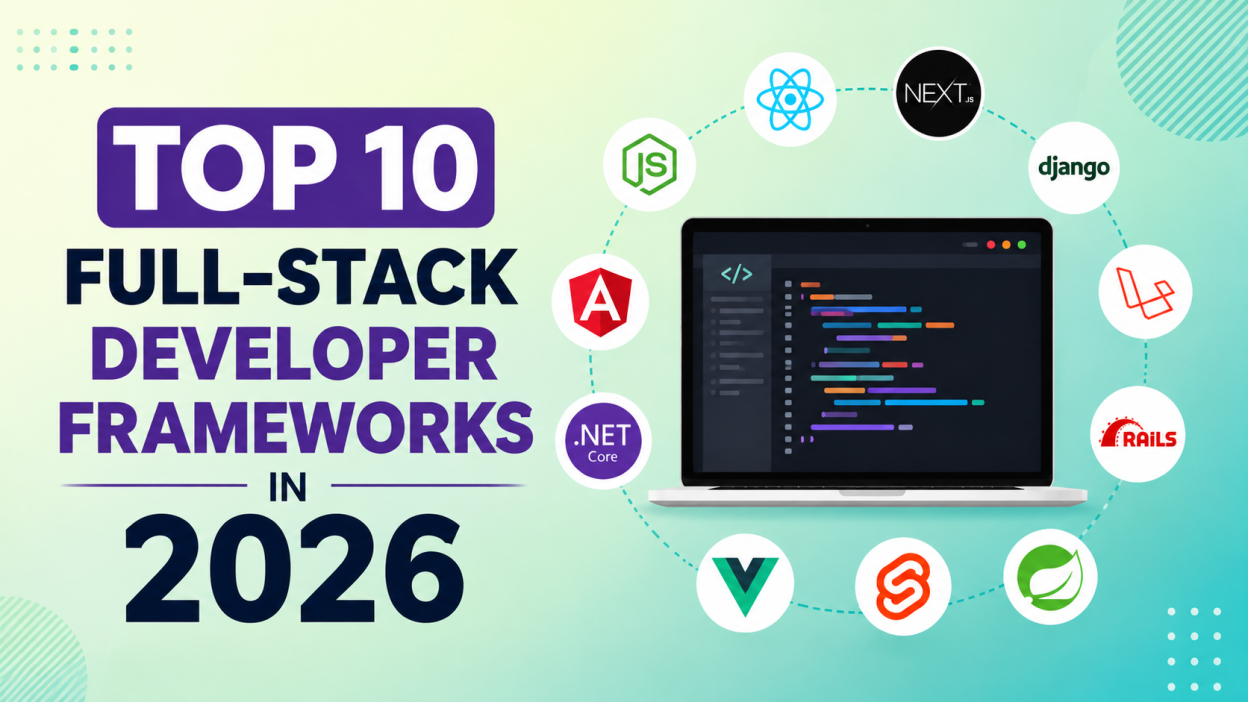
Top 10 Full-Stack Developer Frameworks in 2026
1. Next.js
Next.js remains one of the strongest choices for modern full-stack JavaScript and TypeScript development.
Built around React, Next.js provides features for building frontend interfaces and server-side functionality in the same application. It supports different rendering approaches, including server-side rendering and static generation, making it suitable for applications where performance and search engine visibility are important.
Developers can use Next.js to create websites, SaaS platforms, e-commerce applications, dashboards, blogs, and content-heavy websites.
One of its biggest advantages is that developers familiar with React can transition into full-stack development without completely changing their frontend ecosystem.
Best for: SaaS applications, e-commerce, dashboards, content websites, and modern web applications.
Why learn it in 2026?
Next.js continues to have strong adoption and is particularly attractive for developers who want to work with React and TypeScript while handling frontend and backend responsibilities within one project.
2. Django
Django is one of the most established full-stack frameworks in the Python ecosystem.
It follows a batteries-included philosophy, providing many features developers need for building web applications. Django includes URL routing, authentication, an object-relational mapper, administrative interfaces, templates, security features, and database integration.
Python’s popularity also makes Django attractive for developers working on applications that may eventually integrate data science, automation, or artificial intelligence functionality.
Django is particularly useful when developers want to build applications quickly without creating every backend component from scratch.
Best for: Business applications, data-driven platforms, content management systems, dashboards, and Python-based products.
Why learn it in 2026?
Django remains a mature and battle-tested framework with a large ecosystem and strong Python integration.
3. Laravel
Laravel is a popular PHP framework designed to make web application development cleaner and more productive.
It provides features such as routing, authentication, database migrations, ORM functionality, queues, caching, validation, and templating through Blade.
Laravel is especially useful for developers who want to build database-driven applications without managing every backend component manually.
Its developer-friendly syntax and extensive ecosystem make it a popular choice for SaaS products, business websites, e-commerce platforms, and content-driven applications.
Laravel can also be combined with modern frontend technologies when an application requires a richer client-side experience.
Best for: SaaS platforms, business applications, e-commerce, CMS platforms, and database-heavy websites.
Why learn it in 2026?
Laravel continues to be considered one of the mature full-stack options for PHP developers and remains particularly attractive for rapid application development.
4. Ruby on Rails
Ruby on Rails, commonly called Rails, is another mature full-stack framework.
Rails follows the principle of convention over configuration. Instead of forcing developers to make numerous architectural decisions, Rails provides established conventions for organizing applications.
It includes tools for routing, database interaction, migrations, authentication-related development, views, and application structure.
Rails is particularly effective when developers need to turn an idea into a working product quickly.
It has historically been popular for startups, SaaS applications, marketplaces, and internal business tools.
Best for: Startups, MVPs, SaaS applications, CRUD applications, and internal tools.
Why learn it in 2026?
Despite being older than many modern JavaScript frameworks, Rails remains a productive and mature choice for building complete web applications.
5. Angular
Angular is a comprehensive framework maintained by Google and is widely used for large-scale web applications.
Unlike React, which is primarily a UI library, Angular provides a more complete application development structure. It includes routing, forms, dependency injection, HTTP functionality, and other tools required for large applications.
Angular is built around TypeScript, which makes it particularly attractive for teams that want strong typing and structured application architecture.
It is commonly found in enterprise environments where applications need consistent patterns and long-term maintainability.
Best for: Enterprise applications, admin panels, large business applications, and complex frontend systems.
Why learn it in 2026?
Angular continues to maintain a strong professional developer presence. In the 2025 Stack Overflow Developer Survey, Angular was reported by 18.2% of all respondents and 19.8% of professional developers in the web frameworks category.
6. ASP.NET Core
ASP.NET Core is Microsoft’s modern framework for developing web applications and APIs using .NET.
It supports languages such as C# and provides a powerful environment for developing scalable web applications, APIs, enterprise systems, and cloud-based services.
ASP.NET Core is particularly popular in organizations already using Microsoft technologies.
Developers can use it with databases such as SQL Server and integrate it with authentication, cloud services, microservices, and enterprise infrastructure.
Best for: Enterprise applications, APIs, cloud applications, financial systems, and large-scale business platforms.
Why learn it in 2026?
ASP.NET Core continues to appear among the widely used web technologies in developer surveys, making it an important framework for developers interested in the .NET ecosystem.
7. Spring Boot
Spring Boot is a major choice for Java-based backend and full-stack application development.
It simplifies the Spring ecosystem by providing sensible defaults and reducing configuration requirements.
Developers commonly use Spring Boot to build REST APIs, enterprise applications, microservices, banking systems, e-commerce platforms, and distributed applications.
Spring Boot is particularly valuable for developers interested in Java enterprise development because Java remains widely used in large organizations.
Although frontend development may use technologies such as React, Angular, or Vue separately, Spring Boot can serve as the powerful backend foundation of a full-stack application.
Best for: Enterprise applications, banking systems, microservices, REST APIs, and large-scale platforms.
Why learn it in 2026?
Spring Boot remains one of the established technologies in the professional web development ecosystem.
8. Nuxt
Nuxt is a full-stack framework built around Vue.js.
It extends the Vue ecosystem with features such as routing, server-side rendering, static generation, and server-side functionality.
Developers who prefer Vue but want a more complete application framework can use Nuxt instead of manually combining multiple tools.
Nuxt is suitable for websites and applications where developers want Vue’s component-based development model along with server-side capabilities.
Best for: Vue-based applications, content websites, e-commerce, SaaS applications, and SEO-friendly websites.
Why learn it in 2026?
Nuxt provides a structured way to build full-stack applications using Vue and supports multiple rendering and deployment approaches.
9. SvelteKit

SvelteKit is the full-stack application framework built around Svelte.
Unlike traditional approaches that send large amounts of framework runtime to the browser, Svelte shifts much of the work into the build process. SvelteKit adds application-level capabilities such as routing, server-side rendering, static generation, and deployment adapters.
This makes it an interesting choice for developers who prioritize performance and a streamlined development experience.
Svelte also has strong developer satisfaction. The 2025 Stack Overflow survey reported Svelte with a higher admiration score than several mainstream frontend technologies, even though its overall usage is smaller.
Best for: Performance-focused websites, interactive applications, content platforms, and modern web projects.
10. Express.js with Node.js
Express.js is a lightweight and widely used backend framework for Node.js.
Strictly speaking, Express itself is primarily a backend framework rather than an all-in-one full-stack framework. However, it remains highly relevant to full-stack developers because it can be combined with frontend technologies such as React, Angular, Vue, or other JavaScript frameworks.
A common JavaScript full-stack architecture is:
Frontend: React or another UI framework
Backend: Node.js + Express.js
Database: MongoDB, PostgreSQL, or MySQL
This approach allows developers to use JavaScript or TypeScript throughout much of the application.
Best for: REST APIs, real-time applications, web backends, MERN-style applications, and custom server architectures.
Node.js was reported as the most-used web technology in the 2025 Stack Overflow Developer Survey, while Express also remains a widely used backend technology.
Full-Stack Frameworks Comparison
| Framework | Primary Language | Best For |
|---|---|---|
| Next.js | JavaScript / TypeScript | Modern full-stack web apps |
| Django | Python | Data-driven applications |
| Laravel | PHP | SaaS and business applications |
| Ruby on Rails | Ruby | Startups and MVPs |
| Angular | TypeScript | Enterprise applications |
| ASP.NET Core | C# | Enterprise and cloud applications |
| Spring Boot | Java | Large-scale enterprise systems |
| Nuxt | JavaScript / TypeScript | Vue-based applications |
| SvelteKit | JavaScript / TypeScript | Performance-focused apps |
| Express.js + Node.js | JavaScript / TypeScript | APIs and custom backends |
How to Choose the Right Full-Stack Framework
There is no single framework that is perfect for every project. Your choice should depend on what you are building and the skills you already have.
If you are comfortable with JavaScript or TypeScript, Next.js is an excellent starting point. React continues to have a particularly large ecosystem and developer adoption, making it a practical skill for many developers.
If you already know Python, Django is a strong option, especially when your project involves data processing or AI-related functionality.
For PHP developers, Laravel provides an excellent environment for developing database-driven applications.
If you want to enter enterprise Java development, Spring Boot is an important technology to learn. Similarly, ASP.NET Core is a strong choice if you are interested in C# and Microsoft’s development ecosystem.
Developers interested in Vue can consider Nuxt, while developers looking for a lightweight modern frontend experience can explore SvelteKit.
What Should Beginners Learn in 2026?
Beginners should avoid trying to learn all ten frameworks at the same time.
Instead, build a strong foundation in:
- HTML
- CSS
- JavaScript
- Git and GitHub
- HTTP and REST APIs
- SQL and databases
- Authentication
- Basic deployment
- One frontend framework
- One backend framework
A practical learning path could be:
HTML → CSS → JavaScript → React → Next.js → Node.js → Database → APIs → Authentication → Deployment
Alternatively, Python-focused learners can follow:
Python → Django → SQL → REST APIs → Authentication → Deployment
The important thing is not the number of frameworks you know. It is your ability to design, build, test, deploy, and maintain a complete application.
Future of Full-Stack Development in 2026
Full-stack development is increasingly moving toward frameworks that combine frontend and backend capabilities more closely. Modern frameworks are making server-side rendering, static generation, routing, data fetching, APIs, and deployment easier to manage within a single application.
At the same time, TypeScript continues to play an important role in modern web development, particularly for large applications where maintainability and type safety matter.
AI-assisted development is also changing how developers work. Instead of replacing the need to understand frameworks, AI tools are increasingly helping developers generate boilerplate code, debug applications, write tests, and explore unfamiliar APIs. Developers still need strong fundamentals to review and maintain AI-generated code.
Final Thoughts
The top full-stack developer frameworks in 2026 represent several different programming ecosystems and development philosophies. Next.js is a strong choice for React and TypeScript developers, Django is excellent for Python applications, Laravel remains a productive PHP framework, and Spring Boot and ASP.NET Core continue to be valuable for enterprise development.
For beginners, the best approach is to choose one ecosystem and learn it deeply rather than jumping between multiple frameworks.
If your goal is to become a modern full-stack developer in 2026, focus on understanding how frontend interfaces, backend services, APIs, databases, authentication, deployment, and security work together. Once you understand these fundamentals, switching between frameworks becomes much easier.
Want to Learn More About Java ?, Kaashiv Infotech Offers, Full Stack Java Course, Java Course, Data Science Course, Internships & More, Visit Their Website www.kaashivinfotech.com.