
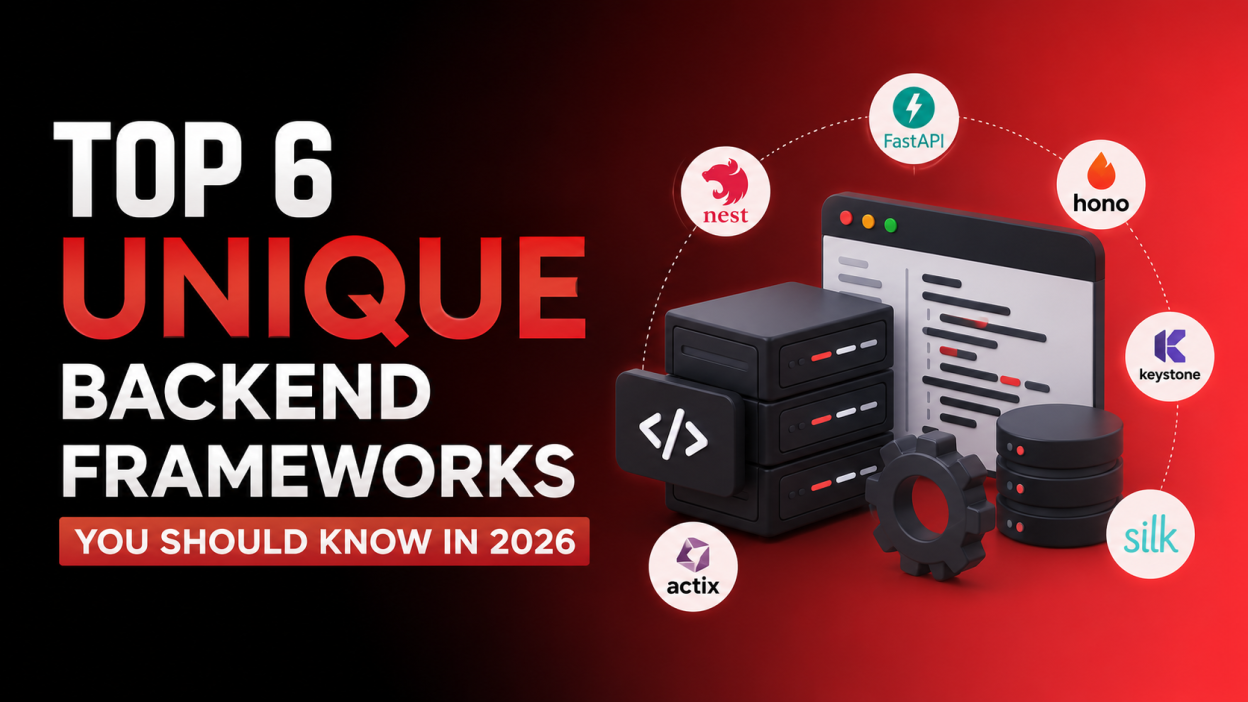
Backend development in 2026 is no longer just about handling requests and databases. It has evolved into building high-performance, scalable, cloud-native systems that power everything from AI applications to real-time platforms. Companies today expect developers to understand not just coding, but also architecture, performance, and deployment strategies.
If you want to stay ahead, learning the right backend frameworks is critical. In this guide, let’s explore six unique backend frameworks that are shaping the future—and understand why they matter, where they shine, and how they can boost your career.
⚡ FastAPI (Python) – The Future of High-Speed APIs

FastAPI has rapidly become one of the most loved Python backend frameworks, especially among developers working in modern tech domains like AI and machine learning. What makes it stand out is its ability to deliver incredible performance while maintaining simplicity.
Unlike traditional Python frameworks, FastAPI is built on asynchronous programming using async and await. This allows it to handle thousands of concurrent requests efficiently, making it ideal for real-time applications. It also automatically generates API documentation, which saves a huge amount of development time and improves collaboration between frontend and backend teams.
Another reason FastAPI is unique is how it leverages Python type hints. This not only improves code quality but also enables automatic validation and serialization. For developers who want clean, modern, and scalable APIs, FastAPI is a perfect choice.
In 2026, FastAPI is widely used in AI-driven applications, SaaS platforms, and microservices architectures, making it a must-learn framework for Python developers.
🟢 NestJS (Node.js) – Structured Backend for Scalable Apps
NestJS has brought a significant shift in how Node.js backend applications are built. While traditional Node.js frameworks like Express are flexible, they often lack structure. NestJS solves this by introducing a clean, modular architecture inspired by Angular.
The framework is fully built with TypeScript, which ensures better maintainability and scalability for large applications. Its dependency injection system makes it easier to manage complex projects, especially when working in teams.
What makes NestJS unique is its versatility. It supports REST APIs, GraphQL, WebSockets, and even microservices—all within a single unified framework. This makes it highly suitable for enterprise applications that require scalability and flexibility.
In real-world scenarios, companies use NestJS to build backend systems that need to scale rapidly, such as e-commerce platforms, fintech apps, and large SaaS products.
🦀 Actix Web (Rust) – Blazing Fast and Memory Safe
Actix Web is one of the fastest backend frameworks available today, and it is written in Rust—a language known for its memory safety and high performance. This combination makes Actix Web extremely powerful for systems where speed and reliability are critical.
What sets Actix apart is its actor-based architecture, which allows applications to handle multiple tasks concurrently without compromising performance. Unlike traditional frameworks, it minimizes runtime errors related to memory, making it highly stable.
Although Rust has a steeper learning curve compared to Python or JavaScript, the benefits it offers are significant. Developers who master Actix Web gain an edge in building high-performance applications such as trading platforms, gaming backends, and real-time analytics systems.
In 2026, Actix Web is gaining popularity among companies that prioritize performance and system-level efficiency.
🔵 Spring Boot (Java) – The King of Enterprise Backends
Spring Boot continues to dominate the enterprise backend space, and its relevance has only grown stronger in 2026. It simplifies Java development by providing a ready-to-use environment for building production-grade applications.
One of the biggest strengths of Spring Boot is its ecosystem. It integrates seamlessly with databases, messaging systems, security frameworks, and cloud platforms. This makes it a go-to choice for large organizations that require robust and secure backend systems.
The framework is also widely used in microservices architecture. With tools like Spring Cloud, developers can build distributed systems that are scalable and resilient.
While Spring Boot may feel heavy compared to newer frameworks, its reliability and industry adoption make it one of the most valuable skills for backend developers, especially those targeting corporate or enterprise roles.
🟣 Laravel (PHP) – Elegant and Developer-Friendly
Laravel has maintained its popularity because of its clean syntax and developer-friendly approach. It simplifies backend development by offering built-in features such as authentication, routing, and database management.
What makes Laravel unique is how quickly developers can build full-fledged applications. Its MVC architecture ensures a structured approach, while tools like Eloquent ORM make database interactions smooth and intuitive.
Laravel is particularly popular among startups and small to medium-sized businesses because it allows rapid development without sacrificing quality. It is also widely used for building REST APIs and web applications.
In 2026, Laravel continues to evolve with modern features, making it a strong choice for developers who want productivity and elegance in their workflow.
🟡 ASP.NET Core (.NET) – Powerful and Cloud-Ready
ASP.NET Core is Microsoft’s modern backend framework designed for building high-performance, cross-platform applications. It runs on Windows, Linux, and macOS, making it highly flexible for deployment.
One of its biggest advantages is performance. ASP.NET Core is optimized for speed and can handle large-scale applications efficiently. It also integrates deeply with Azure, making it ideal for cloud-native development.
The framework supports modern architectural patterns like microservices and containerization, which are essential in today’s development landscape. It also provides strong security features, making it suitable for enterprise-level applications.
For developers aiming to work in large organizations or cloud-focused roles, ASP.NET Core is a highly valuable skill in 2026.
🔥 Final Thoughts: Which One Should You Choose?
Choosing the right backend framework depends on your goals, interests, and the type of applications you want to build. There is no single “best” framework—only the one that fits your use case.
If you are starting your journey, frameworks like FastAPI and Laravel offer simplicity and faster learning curves. If your goal is to work in enterprise environments, Spring Boot and ASP.NET Core are excellent choices. For those who want to explore cutting-edge performance and stand out in the industry, Actix Web provides a unique opportunity.
In 2026, the most successful backend developers are not the ones who know just one framework, but those who understand how different frameworks solve different problems. Learning these six frameworks will give you a strong foundation and help you adapt to any backend challenge.
Want to Learn More About Java ?, Kaashiv Infotech Offers, Full Stack Java Course, Java Course, Data Science Course, Internships & More, Visit Their Website www.kaashivinfotech.com.