
How Block Hashes work in Blockchain
- A blockchain may be a concept of storing data digitally.
- This data comes in blocks. These blocks are chained together and make the data immutable. When a block of data is chained with the other blocks, its data can never be changed again.
- It'll be publicly available to anyone who wants to see it ever again and can be available within the same sequence in which it had been added to the blockchain. Nobody can change the information once it's added within the blockchain.
- We've learned how to build the block and therefore the cryptographic hashing ties into the entire process. You'll see how blockchain uses of these concepts together to preserve the integrity of a full blockchain.
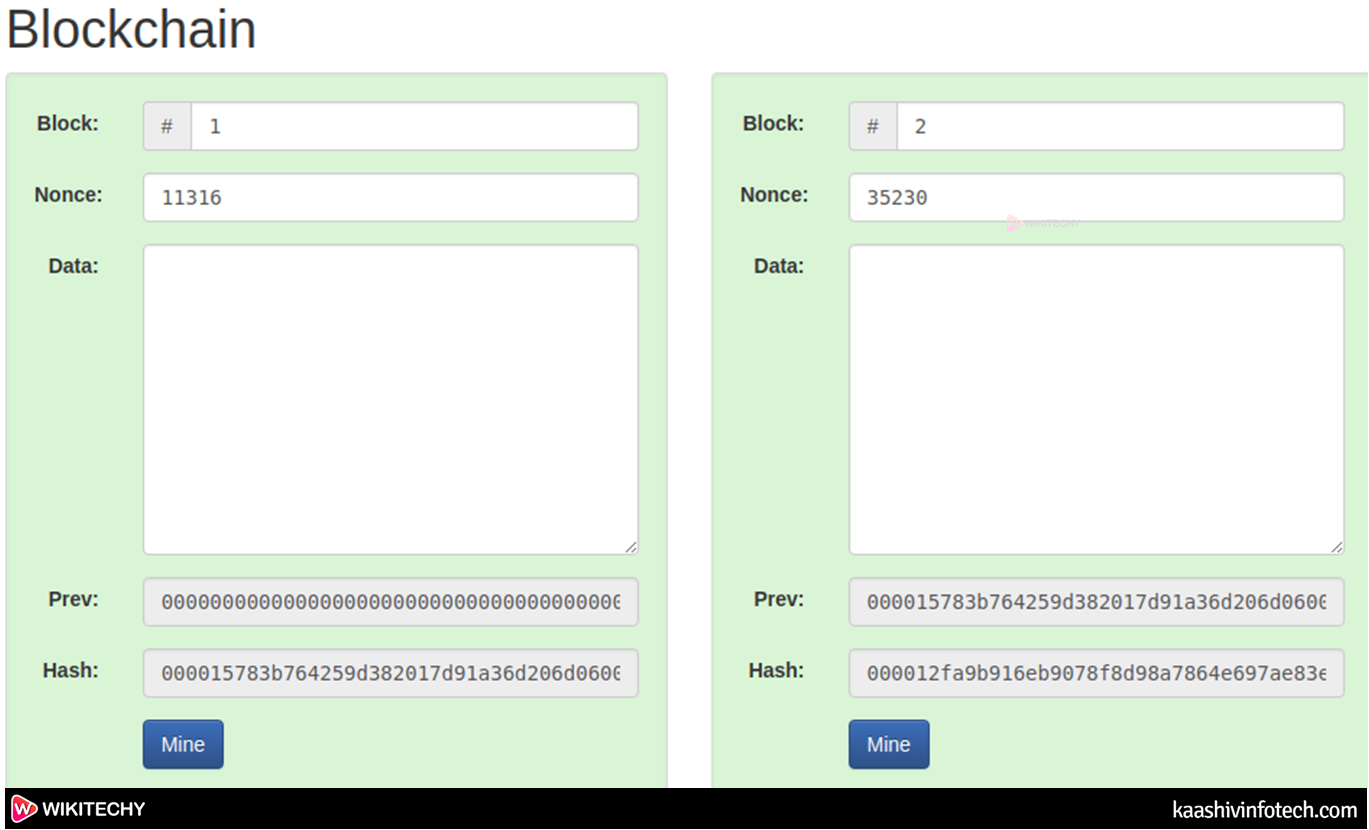
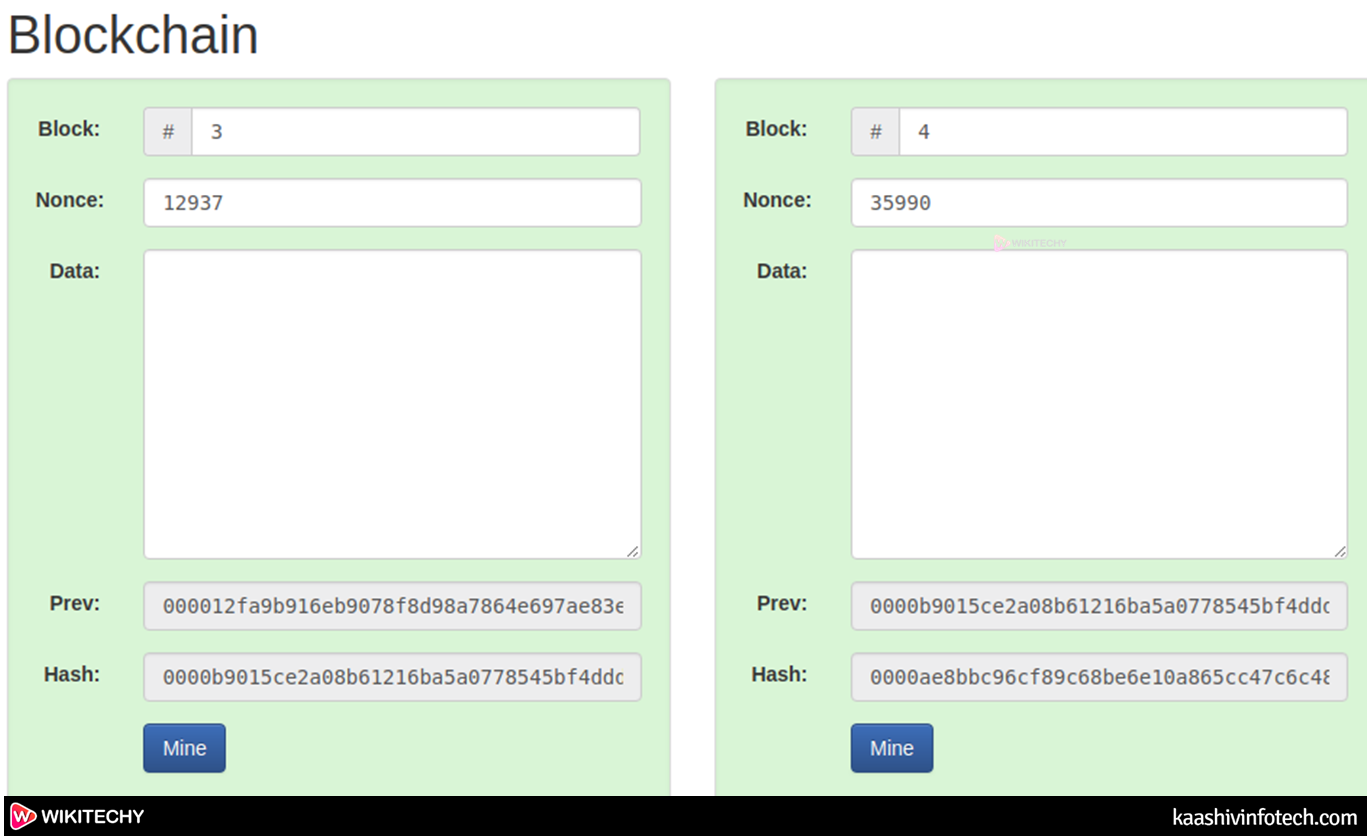
Imagine a bunch of blocks of transaction data as of the following image.
Block hashes work in Blockchain
Block hashes work in Blockchain
- You'll see that block assembles in chronological order. Block favorite is followed by block number two, then block number three, then block number four, and you'll continue it as long as you would like.
- Here, you'll find that there's a block number field, data field, nonce field, hash value field, and previous field. The previous field is like the hash value field of the previous block.
- We know that each block during a blockchain is cryptographically tied to subsequent block. Within the above example, the previous field in block one is zero because the block one doesn't have a previous hash value, so its value is zero.
- In block number two, you'll find that there's a hash value within the previous field, which references to the previous block hash value. This process is continuing until the last block.
- Now imagine if the data in any block is altered. Allow us to say that we've altered in block number 2, the data in block 2 is now different, and mining the block also gets a replacement signature. The signature that corresponds with this new set of data is not any longer chained to other blocks.
- It just breaks block number 2 because the hash is not any longer valid and it also invalidates every single block that comes after it to the top of the chain. It indicates to other users of this blockchain that some data in block 2 has been altered, and since the blockchain should be immutable, they reject this alteration by shifting back to a previous record of the blockchain where all the blocks are still chained together. This is often the most advantage of the blockchain.
- Now, if you are trying to repair it, the only way you'll within roll in the hay by deciding a nonce which is explained in the previous lesson. So we take simply one block and check out that.
- If it doesn't provides a valid hash, try with two, three, four, and if none of them will work, then simply mine it. Once you mine a block, the system figures out that there's a legitimate hash because it possesses four leading zeroes. But as you notice that once you attempt to hash block number two, this hash doesn't have four leading zeros.
- Therefore it's still an invalid block. So you'd need to mine this block also. Also, you've got to do that with every single block all the way to the front of the chain to fix the issue.
Read Also
Understanding the importance of 4 leading zeroes within the hash
- Now let's mention how important it's to have four leading zeroes. These four leading zeros are tied to something called difficulty level. The difficulty level are some things that's tied and built into the blockchain network which determines how difficult it's for you to get the equivalent cryptographic hash for a block. During this case, that difficulty level requires us to have a hash that's smaller than what we have within the target.
- For this specific purpose, we'll need a target that has a minimum of four leading zeroes. For instance, if the hash target is 0000a1b2c3d4e5f6, any hash but or equal to this number may be a valid block hash. Many hashes would satisfy this requirement, and anyone of these would be valid. However, it's a tough task to find such a hash. Lesser the hash target, the harder it's to find a valid hash.
- These difficulty levels keep increasing over time as new computers are added in additional cryptographic hashing to the bitcoin network. So, more hashing power means the difficulty level must go up.
- This difficulty level is adjusted in every two weeks to form sure that the pc which is really competing to solve these cryptographic problems take approximately a complete of 10 minutes to mine a replacement block.
- For example: If we were to find a hash but or equal to 0FFFF, we've 65,536 choices. However, if we were to find a hash but or equal to 000FF, we've only 256 choices. A lower target number means fewer choices. Usually, more leading zeros we require in our hash, much harder it's to find a valid hash.