
Blockchain Version
- The brief description of the evolution of blockchain technology and its versioning from 1.0 to 3.0 are explained below.
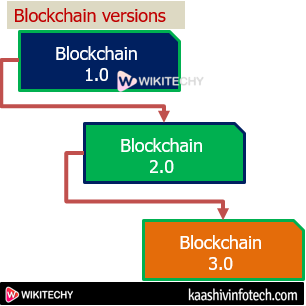
Blockchain Version
Blockchain 1.0: Currency
- The idea of making money through solving computational puzzles was first introduced in 2005 by Hal Finney, who created the primary concept for cryptocurrencies (The implementation of distributed ledger technology).
- It allows financial transactions depends on blockchain technology or DLT to be executed with Bitcoin.
- Bitcoin is the prominent example during this segment. It's being used as ”cash for the Internet” and seen as the enabler of an “Internet of Money”.
Blockchain 2.0: Smart Contracts
- The main issues that came with Bitcoin are wasteful mining and lack of network scalability. To avoid these issues, this version extends the concept of Bitcoin beyond currency. The new key concepts are Smart Contracts.
- Its small computer programs that "live" within the blockchain. They're autonomous computer programs which executed automatically and checked conditions which are defined earlier like facilitation, verification or enforcement.
- The large advantage of this technology that blockchain offers, making it impossible to tamper or hack Smart Contracts.
- A most prominent in this field is that the Ethereum Blockchain, which provides a platform where the developer community can build distributed applications for the Blockchain network.
- The blockchain 2.0 version is successfully processing a high number of daily transactions on a public network, where millions were raised through ICO (Initial Coin Offerings), and therefore the market cap increased rapidly.
Blockchain 3.0: DApps
- DApps is also referred to as a decentralized application. It uses decentralized storage and communication.
- Its backend code is running on a decentralized peer-to-peer network.
- In a DApp have its backend code hosted on decentralized storages like Ethereum Swarm
- A DApp can have frontend code and user interfaces written in any language which will make a call to its backend like a traditional Apps.