
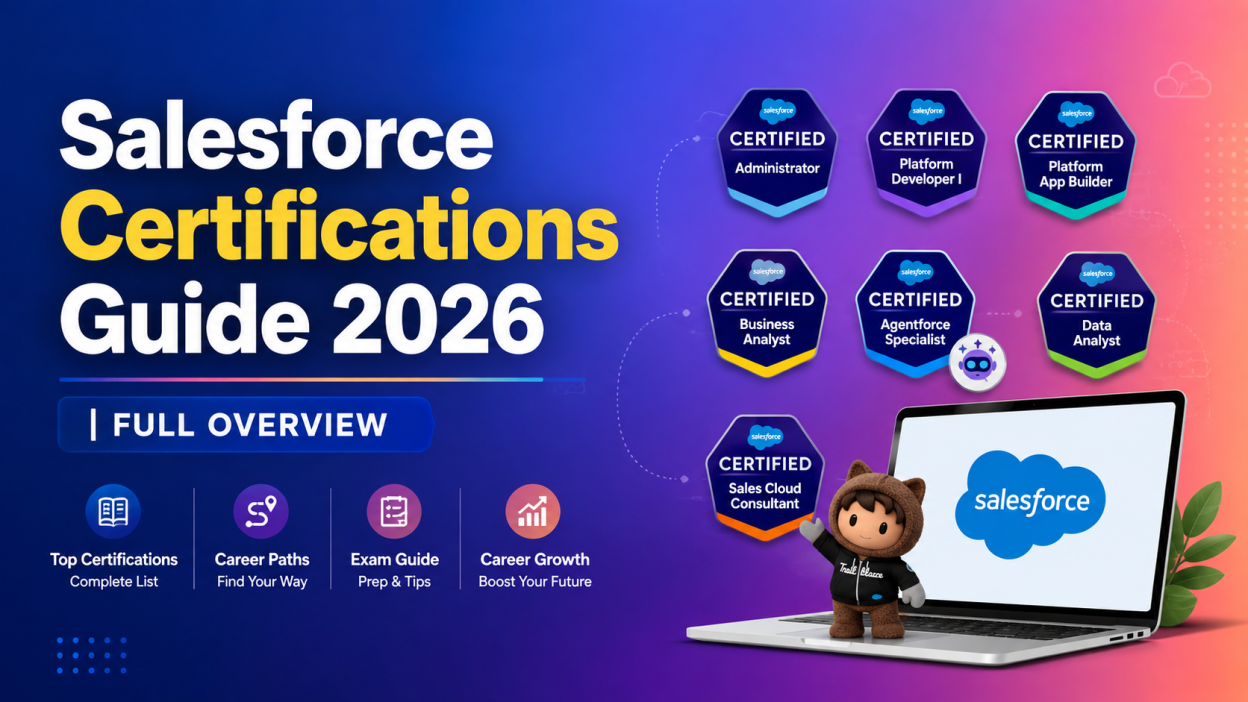
Salesforce Certifications Guide 2026 is a useful starting point if you’re thinking about building a career around Salesforce but don’t know which certification to choose first.
Salesforce Certifications Guide 2026 is also more important than ever because Salesforce is changing quickly, especially with Agentforce and AI becoming a bigger part of the platform. Salesforce currently organizes certifications around different career paths, including Administrators, Developers, Architects, Consultants, Data Analysts, Designers, Marketers, and Sales professionals.
If you are completely new to Salesforce, don’t worry. You don’t need to collect ten certifications just because they exist. I would rather choose one certification that matches my career goal, build practical skills around it, and then move to the next one.
So, let’s break the whole thing down.
🔑 Key Highlights
- Salesforce certifications validate your Salesforce knowledge and skills.
- Salesforce Certified Platform Administrator is one of the best starting points for beginners interested in administration.
- Salesforce Certified Platform Developer is a better fit if you want to become a Salesforce Developer.
- Agentforce Specialist is an important certification to watch in 2026 because Salesforce is putting more emphasis on AI.
- Salesforce has certification paths for Administrators, Developers, Architects, Consultants, Data Analysts, Designers, Marketers, and Sales professionals.
- Many certifications have no prerequisite, although advanced certifications can require earlier certifications.
- Salesforce certifications need maintenance because the platform changes through regular releases.
- Salesforce has announced that 24 certifications will retire on February 1, 2027, while a portfolio of 63 certifications will remain.
- You can take eligible exams online through Pearson OnVUE or at a Pearson VUE testing center.
What Are Salesforce Certifications?
Before talking about individual certifications, let’s answer the obvious question.
What exactly is a Salesforce certification?
A Salesforce certification is a professional credential that demonstrates your knowledge of a particular Salesforce role, product, or skill area.
Think of it this way.
Suppose I tell a recruiter, “I know Salesforce.”
That’s useful, but it’s still just a statement.
If I have a Salesforce certification, I have an industry-recognized credential that supports that claim.
Salesforce itself describes its certifications as a way to demonstrate knowledge and skills with Salesforce products.
However, I wouldn’t make the mistake of thinking that a certificate alone will get me a job.
It won’t.
The strongest combination is:
Certification + Trailhead practice + Projects + Real-world understanding
That’s what I would focus on.
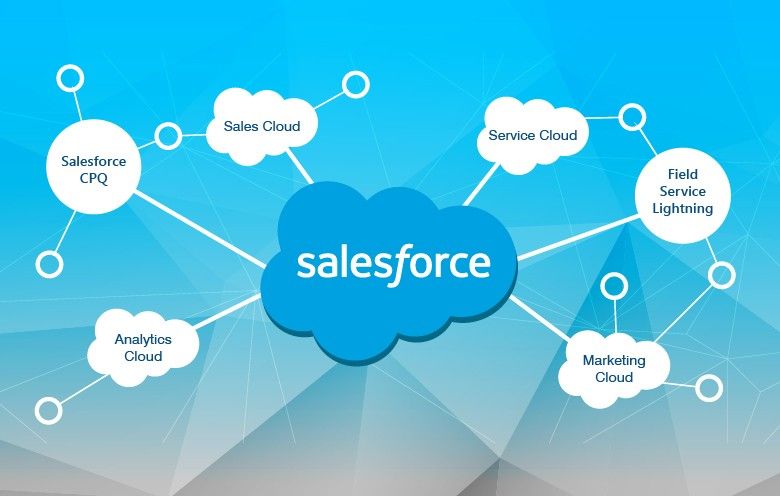
Salesforce Certifications Guide 2026: Main Certification Paths
Salesforce doesn’t have just one certification.
There are several career paths, and each one suits a different type of professional.
The major categories include:
- Administrator
- Architect
- Business Analyst
- Consultant
- Data Analyst
- Developer
- Designer
- Marketer
- Sales Professional
- Product-focused certifications
- Accredited Professional certifications
This is actually good news.
You don’t have to force yourself into development if you enjoy configuration or business analysis.
Similarly, if you love coding, you don’t have to stop at Administrator.
1. Salesforce Certified Platform Administrator 👩💻
If someone asked me, “Which Salesforce certification should a beginner consider first?”, Platform Administrator would be one of the first options I’d discuss.
A Salesforce Administrator works with users, data, configuration, automation, security, reports, dashboards, and other platform capabilities.
Salesforce currently lists Salesforce Certified Platform Administrator as an Administrator certification with no prerequisite.
And there’s an important 2026 update.
Salesforce refreshed the Platform Administrator exam effective December 15, 2025. The updated blueprint includes an Agentforce section worth 8% of the exam.
The current weighting includes:
- Configuration and Setup — 15%
- Object Manager and Lightning App Builder — 15%
- Sales and Marketing Applications — 10%
- Service and Support Applications — 10%
- Productivity and Collaboration — 10%
- Data and Analytics Management — 17%
- Automation — 15%
- Agentforce — 8%
That tells me something important: AI knowledge is no longer something Salesforce professionals can comfortably ignore.
2. Salesforce Certified Platform Administrator II
Once you have built a solid foundation, you can look at Platform Administrator II.
This certification targets more experienced Salesforce Administrators who can work with advanced platform functionality and solve more complex business problems.
There is a prerequisite here:
Salesforce Certified Platform Administrator
So I wouldn’t recommend jumping straight into Administrator II if you’re still learning Salesforce basics.
Build the foundation first.
3. Salesforce Certified Platform App Builder
Here’s another interesting option.
The Platform App Builder certification is aimed at people who design, build, and deploy custom applications using Salesforce’s declarative tools.
The word “declarative” can sound complicated.
It basically means building solutions using Salesforce’s configuration tools rather than writing everything from scratch with code.
If you enjoy solving problems visually and configuring applications, this path may suit you.
4. Salesforce Certified Platform Developer 👨💻
Now let’s talk about the coding side.
If your goal is to become a Salesforce Developer, the Platform Developer certification is a much more natural choice.
Salesforce says Platform Developers understand how to develop and deploy custom business logic and interfaces using the programmatic capabilities of the Lightning Platform. The certification also covers technologies such as Apex and Visualforce.
If you’re coming from a programming background, you may find this path more interesting.
You should become comfortable with concepts such as:
- Apex
- SOQL
- Data modeling
- Lightning Platform
- Business logic
- APIs
- Testing
- Deployment
- Lightning development
And don’t worry if Apex is completely new to you.
The syntax may feel strange initially, but the programming concepts themselves become easier once you understand Salesforce’s architecture.
5. Salesforce Certified Platform Developer II
This is where things become more advanced.
Platform Developer II is designed for developers with deeper experience in Salesforce’s programmatic capabilities. It also requires the Platform Developer certification first.
I would treat this as an advanced career milestone rather than a beginner certification.
A simple path would look like:
Salesforce basics → Platform Administrator/Developer → Practical projects → Platform Developer II
6. Salesforce Certified Agentforce Specialist 🤖
This is one certification I would definitely pay attention to in 2026.
Why?
Because Salesforce is heavily emphasizing Agentforce and AI.
The Agentforce Specialist certification focuses on managing and optimizing Agentforce and understanding how Agentforce capabilities work alongside Salesforce platform configuration.
The interesting part is that Salesforce lists Agentforce Specialist with no prerequisite.
That doesn’t mean you should blindly take it without learning Salesforce.
I’d still recommend understanding the Salesforce platform first.
But if you’re already comfortable with Salesforce and want to add AI-related skills to your profile, Agentforce is worth exploring.
7. Salesforce Certified Business Analyst
Not everyone wants to become a developer.
Some people are naturally better at asking:
“What problem is the business actually trying to solve?”
That’s where the Business Analyst path becomes interesting.
Salesforce says certified Business Analysts understand business needs, capture requirements, and collaborate with stakeholders to develop Salesforce solutions.
This can be a good fit if you enjoy:
- Requirement gathering
- Stakeholder communication
- Process analysis
- Documentation
- Problem solving
- Translating business needs into technical requirements
And yes, this can be a strong option for people who don’t want a heavily coding-focused career.
8. Salesforce Data and Tableau Certifications 📊
If you’re interested in analytics, Salesforce also has certifications around Tableau and data.
One example is Salesforce Certified Tableau Data Analyst.
The certification focuses on understanding business problems, identifying useful data for analysis, and delivering actionable insights.
This makes the path interesting for people coming from:
Data Analytics → Business Intelligence → Salesforce/Tableau ecosystem
If you already enjoy SQL, dashboards, data cleaning, and visualization, this is a direction worth considering.
9. Salesforce Marketing Certifications
Salesforce isn’t only about developers and administrators.
There are also certifications for marketing professionals.
Examples include:
- Marketing Cloud Engagement Administrator
- Marketing Cloud Engagement Consultant
- Marketing Cloud Engagement Developer
- Marketing Cloud Engagement Specialist
- Marketing Cloud Account Engagement certifications
These certifications are more suitable if your career interest is digital marketing, customer engagement, email marketing, marketing automation, or customer data.
10. Salesforce Consultant Certifications
Consultants work at a different level.
Instead of simply configuring Salesforce, consultants often help organizations understand their business requirements and implement Salesforce solutions.
Salesforce’s current certification catalog includes consultant paths around areas such as Data 360, Experience Cloud, Agentforce, Revenue Management, OmniStudio, Service, Sales, Slack, and Tableau.
Some consultant certifications require earlier credentials.
For example, Salesforce lists Agentforce Sales Consultant and Agentforce Service Consultant with Platform Administrator as a prerequisite.
So again, the message is simple:
Build the foundation before chasing advanced credentials.
Salesforce Certifications Guide 2026: Which Certification Is Best for Beginners?
This is probably the question you’re actually looking for.
If I were starting from zero today, I’d choose based on my career goal.
| Career Goal | Certification to Consider |
|---|---|
| Salesforce Administrator | Platform Administrator |
| Salesforce Developer | Platform Developer |
| Advanced Salesforce Developer | Platform Developer II |
| Salesforce Business Analyst | Business Analyst |
| Salesforce App Builder | Platform App Builder |
| Salesforce AI/Agentforce | Agentforce Specialist |
| Data/BI | Tableau Data Analyst |
| Salesforce Marketing | Marketing Cloud certifications |
| Salesforce Consulting | Relevant Consultant certification |
For most complete beginners, I would start with Platform Administrator.
For someone who already knows programming and wants development, I’d investigate Platform Developer.
For someone interested in AI within the Salesforce ecosystem, I’d learn the platform fundamentals and then explore Agentforce Specialist.
How to Prepare for Salesforce Certifications in 2026
Here’s where I would avoid a common mistake.
Don’t just memorize questions.
Salesforce changes.
The platform changes.
The exam blueprints change.
And Salesforce has been actively updating its certification portfolio to keep certifications aligned with current technology and industry needs.
My recommended learning approach
Step 1: Learn Salesforce fundamentals
Understand:
- Objects
- Fields
- Records
- Relationships
- Users
- Profiles
- Permissions
- Security
- Reports
- Dashboards
- Automation
Step 2: Use Trailhead
Salesforce Trailhead is one of the most useful places to build hands-on knowledge.
Instead of simply reading theory, you can work through guided learning modules and practical exercises.
Step 3: Build a small project
For example, I could create a simple Customer Support Management System.
I might create:
- Customer object
- Support Case object
- Case status
- Priority
- Assignment rules
- Reports
- Dashboard
- Automation
Suddenly, Salesforce stops feeling like a list of exam terms.
It becomes something I can actually explain.
Step 4: Study the official exam guide
Before booking an exam, check the current official exam guide.
Salesforce provides certification information, exam objectives, and prerequisite information through its official resources.
Step 5: Practice, don’t memorize
That question is much more useful than memorizing a definition.
Salesforce Certification Exam: Online or Test Center?
Salesforce currently provides two proctored exam options:
- Online proctored exam through Pearson OnVUE
- In-person exam at a Pearson VUE testing center
If you choose the online option, you’ll need a compatible device, webcam, internet connection, and a suitable testing environment.
If online delivery isn’t available for your account, Salesforce says you can use a testing center instead.
Always check the current exam registration information before paying because exam delivery policies can change.
Do Salesforce Certifications Expire?
This is something beginners often overlook.
Salesforce products evolve through regular releases. Salesforce states that it has three releases each year, which is why certification maintenance matters.
So earning the certificate isn’t necessarily the end of the journey.
You need to stay current with the platform and complete the applicable maintenance requirements.
I actually like this approach.
Why?
Because it stops a certification from becoming a certificate that simply sits on someone’s resume for ten years while their skills become outdated.
Salesforce Certification Changes You Should Know in 2026 ⚠️
There’s another important point for anyone researching Salesforce certifications this year.
Salesforce has announced that 24 certifications will retire on February 1, 2027. Salesforce says a portfolio of 63 certifications will remain across major roles in the ecosystem.
Salesforce is also updating certification names to align with its current product portfolio. Salesforce announced that 16 certification names were being updated effective July 24, 2026.
This is exactly why I wouldn’t rely on an old YouTube video or a random five-year-old blog post when planning my certification path.
Check the official Salesforce catalog before you start.
How Many Salesforce Certifications Should You Get?
Honestly?
You don’t need 10 certifications.
I’d rather see someone with:
1 certification + strong practical knowledge + 2 good projects
than someone with:
8 certifications + no idea how Salesforce actually works.
Once you’ve gained experience, you can add specialized certifications based on your career direction.
For example:
Beginner → Platform Administrator
Then:
Administrator → Platform App Builder / Agentforce / Consultant path
Or, for developers:
Developer → Platform Developer → Platform Developer II
The exact route depends on your role and experience.
Are Salesforce Certifications Worth It in 2026? 💡
Yes — but with one condition.
Don’t treat certification as a replacement for experience.
Treat it as proof that you’ve learned a structured set of skills.
A certification can help your resume stand out, give you a clear learning target, and show recruiters that you have studied a particular Salesforce area.
Salesforce itself positions certifications as a way to validate expertise and support career growth.
Your certificate won’t answer.
You will.
That’s why I would always combine certification preparation with hands-on practice.
Final Thoughts on the Salesforce Certifications Guide 2026
The Salesforce ecosystem can look overwhelming when you first see the huge certification catalog.
Administrator.
Developer.
Consultant.
Architect.
Marketing.
Data.
Agentforce.
So many names!
But once you connect each certification to a career path, it becomes much easier.
If you’re a beginner, start with the fundamentals. If you’re interested in administration, Salesforce Certified Platform Administrator is a logical starting point. If you’re a programmer, look toward Platform Developer. If AI is your interest, keep Agentforce Specialist on your radar.
And my biggest piece of advice?
Don’t collect certifications. Build skills.
Use Trailhead. Build projects. Understand why companies use Salesforce. Practice explaining what you’ve learned in simple words.
Then the certification becomes the proof of your knowledge—not the knowledge itself. 🚀
Want to learn more ??, Kaashiv Infotech Offers Data Analytics Course, Data Science Course, Cyber Security Course & More Visit Their Website www.kaashivinfotech.com.