
Learn Data Science — that phrase sounds exciting, but also a little intimidating when you’re starting from zero.
Learn Data Science in how many months? Three? Six? One year?
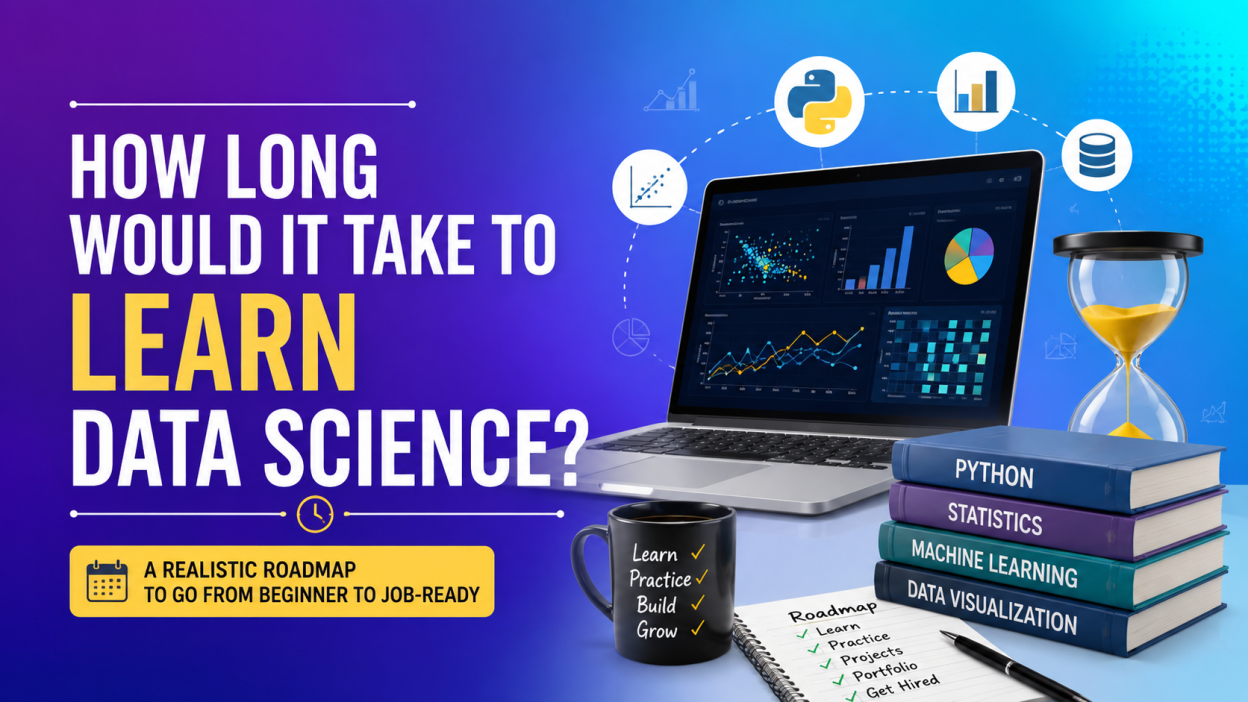
My honest answer is: it depends on how deeply you want to go and how many hours you can consistently spend each day. If you’re a complete beginner and study around 2–3 hours a day, I’d give yourself roughly 6 months to become job-ready for entry-level data roles, provided you practice consistently and build projects along the way.
You don’t need to become a mathematics expert first. You don’t need to memorize hundreds of machine learning algorithms. And honestly, watching 50 hours of tutorials without writing code won’t get you very far.
I’ve found that the better approach is simple:
Learn → Practice → Build → Make mistakes → Repeat.
In this guide, I’ll break down how long it can take to learn Data Science, what you should learn first, what usually takes the most time, and how I would structure the journey if I were starting today.
Key Highlights ⭐
- ⏱️ You can build basic Data Science skills in 2–3 months.
- 🎯 With consistent practice, 6 months is a realistic target for job-ready foundational skills.
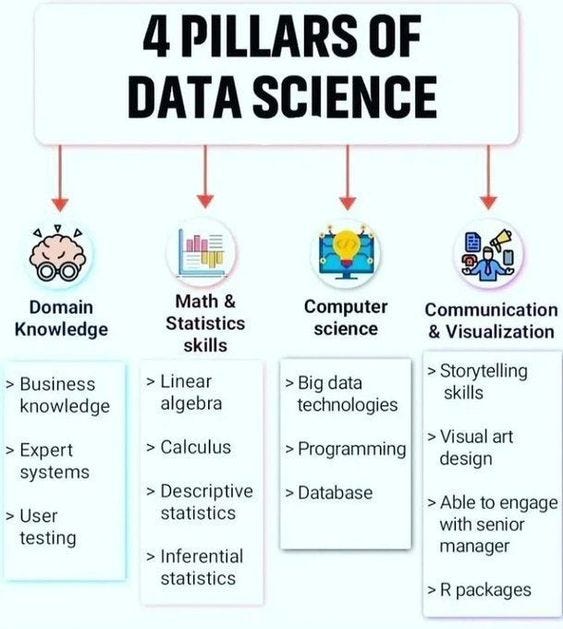
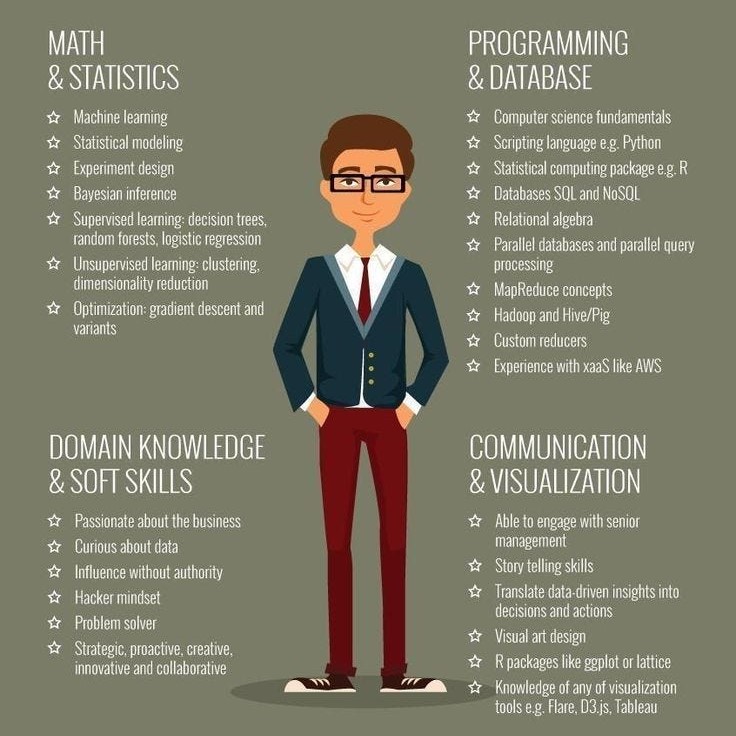
- 🧠 You need Python, SQL, statistics, data visualization, and machine learning fundamentals.
- 📊 Projects matter just as much as completing courses.
- 🐍 Python + Pandas + NumPy form an important part of the learning journey.
- 📈 You should understand statistics rather than simply memorizing formulas.
- 🤖 Machine learning comes after you understand data analysis fundamentals.
- 💼 Your timeline will depend heavily on your previous programming experience and study hours.
- 🚫 You do not need to learn every Data Science tool before applying for jobs.
- 🔥 Consistency beats trying to finish everything in one month.
How Long Does It Take to Learn Data Science?
If you ask me for one simple answer, I’d say:
Give yourself around 6 months if you are starting from scratch and can study 2–3 hours every day.
But let’s make that more realistic.
| Learning Goal | Approximate Time |
|---|---|
| Understand Data Science basics | 2–4 weeks |
| Learn Python for Data Science | 4–6 weeks |
| Learn SQL | 3–5 weeks |
| Learn statistics | 4–6 weeks |
| Data analysis & visualization | 3–4 weeks |
| Machine Learning fundamentals | 6–8 weeks |
| Projects & portfolio | 4–8 weeks |
| Overall beginner journey | 5–8 months |
These aren’t fixed deadlines. Some people move faster. Others need more time.
For example, someone who already knows Python, SQL, and basic mathematics may move through the fundamentals much faster than someone who has never written a line of code.
Even structured Data Science programs vary significantly in duration. For example, the University of Michigan’s Applied Data Science with Python specialization includes courses covering Python, visualization, and machine learning, while other programs focus heavily on statistics and statistical inference.
So don’t compare your learning speed with someone else’s.
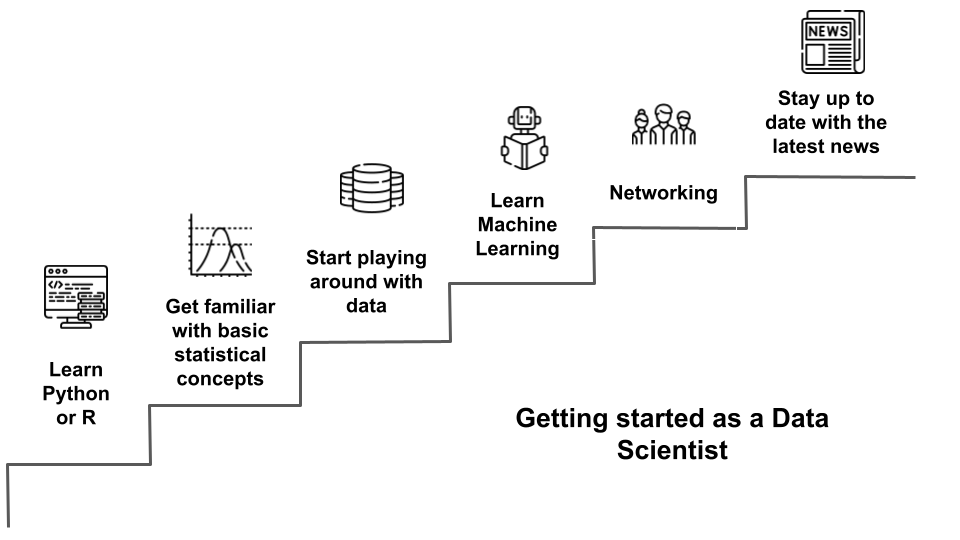
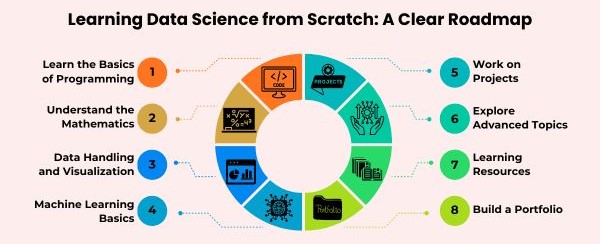
Learn Data Science in 6 Months: My Recommended Roadmap
If I were starting Learn Data Science from zero today, I wouldn’t jump directly into machine learning.
I’d follow this order.
Month 1: Learn Python for Data Science 🐍
Python is one of the most useful programming languages for Data Science.
But here’s where beginners sometimes make a mistake.
They spend three months learning every possible Python topic.
You don’t need that.
Focus on the Python concepts you’ll actually use for data work:
- Variables
- Data types
- Strings
- Lists
- Tuples
- Sets
- Dictionaries
ifstatementsforandwhileloops- Functions
- List comprehensions
- File handling
- Exception handling
- Basic object-oriented programming
Then move toward Data Science libraries:
- NumPy
- Pandas
- Matplotlib
- Seaborn
Pandas is particularly important because you’ll use it constantly for manipulating and analyzing tabular data.
A practical Python-for-Data-Science course today typically includes tasks such as filtering DataFrames, aggregation, merging datasets, data cleaning, and working with dates.
My advice
Don’t spend the whole month watching Python videos.
Write code.
For example:
students = ["Arun", "Priya", "Rahul"]

for student in students:
    print(student)
It looks ridiculously simple.
That’s okay.
You are building your foundation.
Month 2: Learn SQL and Data Analysis
This is the part I wouldn’t skip.
If you want to Learn Data Science seriously, learn SQL.
Data doesn’t magically appear in a neat Excel sheet waiting for you.
In real projects, data often lives inside databases.
You should understand:
SELECTWHEREORDER BYGROUP BYHAVINGJOIN- Subqueries
- Aggregate functions
CASE- CTEs
- Window functions
Start with simple questions.
“How many customers purchased something last month?”
Then make it harder.
“Which customers purchased more than the average customer?”
That’s where SQL starts becoming interesting.
Learn Data Analysis With Pandas
Once you understand SQL, start doing similar analysis with Pandas.
Learn how to:
- Import CSV files
- Clean missing values
- Remove duplicates
- Filter rows
- Sort data
- Group data
- Merge datasets
- Create calculated columns
- Analyze trends
This is where Learn Data Science starts feeling less theoretical.
You’re finally working with actual data.
Month 3: Learn Statistics for Data Science 📊
Statistics can scare beginners.
I get it.
You see words like standard deviation, probability distribution, hypothesis testing, p-value, confidence interval, and suddenly you wonder:
“Did I accidentally enroll in a mathematics degree?” 😅
Don’t panic.
You don’t need to become a statistician.
You need to understand the statistical concepts that help you make sense of data.
Start with:
Descriptive Statistics
Learn:
- Mean
- Median
- Mode
- Range
- Variance
- Standard deviation
- Percentiles
- Quartiles
Then move to:
Probability
Understand:
- Probability basics
- Conditional probability
- Random variables
- Probability distributions
- Normal distribution
Then:
Statistical Testing
Learn:
- Hypothesis testing
- Null hypothesis
- Alternative hypothesis
- p-value
- Confidence intervals
- t-tests
- Chi-square tests
- Correlation
- Regression
Current Data Science learning programs commonly include descriptive statistics, probability, hypothesis testing, correlation, and regression because these concepts help learners interpret data and evaluate models.
Don’t memorize formulas blindly
This is important.
Instead of memorizing:
“Standard deviation formula = …”
ask:
“What does standard deviation tell me about my data?”
That question is much more useful.
Month 4: Data Visualization and Exploratory Data Analysis
Now things get fun. 🎨📊
You have data.
You know Python.
You know SQL.
You understand basic statistics.
Now ask:
What is actually happening inside this dataset?
That’s where Exploratory Data Analysis (EDA) comes in.
You’ll learn to identify:
- Trends
- Patterns
- Outliers
- Missing values
- Relationships
- Distribution of data
- Correlations
You can use tools such as:
- Matplotlib
- Seaborn
- Plotly
- Power BI or Tableau
For example, imagine you have an e-commerce dataset.
Instead of simply saying:
“The company made ₹50 lakh.”
You could investigate:
- Which products generated the most revenue?
- Which month had the highest sales?
- Which customers purchased repeatedly?
- Which region generated the most revenue?
- Did discounts increase sales?
- Are there products with high sales but low profit?
That’s Data Science thinking.
You aren’t just producing numbers.
You’re asking better questions.
Month 5: Learn Machine Learning 🤖
This is where many beginners want to start.
I wouldn’t.
Machine learning makes much more sense once you understand data preparation, statistics, and analysis.
Start with the fundamentals.
Supervised Learning
Learn algorithms such as:
- Linear Regression
- Logistic Regression
- Decision Trees
- Random Forest
- K-Nearest Neighbors
- Support Vector Machines
Unsupervised Learning
Then explore:
- K-Means Clustering
- Hierarchical Clustering
- Principal Component Analysis (PCA)
You should also understand:
- Training data
- Testing data
- Validation
- Features
- Target variables
- Overfitting
- Underfitting
- Cross-validation
- Model evaluation
- Feature engineering
Libraries such as scikit-learn are widely used for practical machine learning with Python, including supervised learning, clustering, model evaluation, and handling issues such as overfitting.
Here’s a simple example
Imagine you’re building a model that predicts house prices.
Your features could include:
- House size
- Number of bedrooms
- Location
- Age of property
Your target is:
House price
The model learns patterns from historical data and uses them to make predictions for new houses.
That’s the basic idea.
You don’t need to understand neural networks on day one.
Month 6: Build Data Science Projects 💻
This is the month where I would stop collecting certificates and start building.
Because here’s something I’ve learned:
A completed project teaches you more than another five hours of passive watching.
Start with 3–4 projects.
Project 1: Sales Data Analysis
Analyze:
- Total sales
- Monthly sales
- Best-selling products
- Customer behavior
- Regional performance
Use:
Python + Pandas + Matplotlib/Seaborn + SQL
Project 2: Customer Churn Prediction
Build a machine learning model that predicts whether a customer may leave a service.
Use:
Python + Pandas + Scikit-learn
Project 3: House Price Prediction
Build a regression model to predict property prices.
This helps you understand:
- Regression
- Feature engineering
- Model evaluation
Project 4: Customer Segmentation
Use clustering to divide customers into groups based on purchasing behavior.
This gives you practical exposure to unsupervised learning.
How Many Hours a Day Should You Spend Learning Data Science?
You don’t need to study 10 hours every day.
In fact, I wouldn’t recommend it for most beginners.
Here’s a schedule I prefer:
If you have 1 hour/day
Expect roughly 9–12 months.
If you have 2 hours/day
Expect roughly 6–8 months.
If you have 3 hours/day
You could reach a strong beginner/job-ready foundation in roughly 5–6 months.
If you have 5+ hours/day
You may progress faster, but don’t assume five hours of watching tutorials equals five hours of learning.
Quality matters.
I’d rather spend:
1 hour learning + 1 hour coding
than:
3 hours watching tutorials.
Can I Learn Data Science in 3 Months?
Yes — but be careful about what “learn” means.
In three months, you can absolutely build a foundation.
You could learn:
- Python basics
- Pandas
- NumPy
- SQL
- Basic statistics
- Data visualization
- Introductory machine learning
But becoming genuinely comfortable with Data Science usually takes longer.
You need practice.
You need projects.
You need to get stuck.
And yes, you need to stare at an error message and wonder why your code suddenly hates you. 😄
That’s part of learning.
A structured statistics course, for example, can cover foundational statistics in a relatively short period, but that doesn’t mean someone has mastered the skill after finishing the videos.
Can I Learn Data Science Without a Mathematics Background?
Absolutely.
You don’t need advanced mathematics to begin.
But you should be comfortable with:
- Basic algebra
- Percentages
- Mean and median
- Probability
- Basic statistics
- Basic linear algebra concepts
Later, depending on how deeply you go into machine learning, you can learn more mathematics.
The goal isn’t:
“I must finish mathematics before starting Data Science.”
Instead:
“I’ll learn the mathematics when I need it.”
That’s a much less stressful approach.
What Takes the Longest to Learn in Data Science?
In my opinion, the hardest part isn’t Python.
It isn’t even SQL.
The challenging part is learning how to think with data.
For example, imagine a company says:
“Our sales dropped by 20%.”
A beginner might immediately start creating a graph.
Someone with stronger Data Science skills might ask:
Why?
Was there:
- A seasonal change?
- A pricing change?
- A product shortage?
- A marketing problem?
- A change in customer behavior?
- A data collection problem?
That mindset takes time.
You can’t download it.
You develop it by working with datasets again and again.
Learn Data Science Faster With This Simple Rule
Here’s the rule I’d follow:
30% Learning + 70% Practice
Don’t spend all your time consuming content.
For every concept you learn, try to use it.
Learn Pandas?
→ Analyze a dataset.
Learn SQL joins?
→ Solve 10 SQL problems.
Learn regression?
→ Build a prediction project.
Learn visualization?
→ Create a dashboard.
Learn statistics?
→ Analyze a real dataset.
This approach makes Learn Data Science much more practical.
Common Mistakes Beginners Make 🚫
1. Trying to Learn Everything
You don’t need:
Python + R + Java + TensorFlow + PyTorch + Spark + Hadoop + AWS + Azure + every ML algorithm on earth.
Not at the beginning.
Pick a stack.
I’d start with:
Python + SQL + Pandas + NumPy + Matplotlib/Seaborn + Scikit-learn
Then expand.
2. Ignoring SQL
Don’t do this.
SQL is extremely useful for working with structured data.
3. Skipping Statistics
You don’t need advanced mathematics, but completely ignoring statistics will make machine learning much harder to understand.
4. Watching Tutorials Without Practicing
This is probably the biggest one.
Watching someone solve a problem feels like understanding.
Then you open your own notebook.
Nothing works.
That’s why you need hands-on practice.
5. Building Only Titanic
The Titanic dataset is great for beginners.
But if your entire portfolio consists of Titanic projects, recruiters won’t see much variety.
Build projects around different problems.
When Should I Start Applying for Jobs?
Don’t wait until you know everything.
You never will.
Once you can comfortably:
- Write Python programs
- Query databases using SQL
- Clean datasets
- Perform EDA
- Create visualizations
- Explain basic statistics
- Build and evaluate basic ML models
- Complete 3–4 practical projects
you can start exploring entry-level roles.
Depending on your skills, you might look at:
- Junior Data Analyst
- Data Analyst
- Junior Data Scientist
- Business Analyst
- Reporting Analyst
- BI Analyst
- Machine Learning Intern
And remember: Data Analyst and Data Scientist are not exactly the same role.
If your immediate goal is to enter the data field, a Data Analyst role can sometimes be a more approachable starting point than aiming directly for a Data Scientist position.
My 6-Month Learn Data Science Checklist ✅
Month 1
Python
Month 2
SQL + Pandas + NumPy
Month 3
Statistics + Probability
Month 4
EDA + Data Visualization
Month 5
Machine Learning
Month 6
Projects + Portfolio + Interview Preparation
And while doing all of this:
Keep practicing SQL.
Don’t study SQL for one month and forget it.
Use it throughout your Data Science journey.
Final Answer: How Long Would It Take to Learn Data Science?
So, how long does it really take to Learn Data Science?
My realistic estimate is:
3 months → Strong foundation
6 months → Job-ready beginner foundation
9–12 months → Much stronger practical confidence
1–2+ years → Deeper professional-level experience
But don’t treat these numbers like a countdown timer.
Your goal shouldn’t be:
“I have to finish Data Science in six months.”
Your goal should be:
“In six months, I want to be able to take a messy dataset, understand it, clean it, analyze it, visualize it, build a basic model, and explain what I discovered.”
That’s a much better target.
If you’re starting today, I’d begin with Python, then move into SQL and Pandas, followed by statistics, visualization, and machine learning.
And please don’t wait until you “feel ready” to build projects.
You probably won’t.
Start while you’re still confused.
That is where the real learning happens. 🚀
Useful learning resources: Applied Data Science with Python – University of Michigan and Statistics for Data Science with Python – IBM can provide structured learning paths alongside hands-on practice.
Want to learn more ??, Kaashiv Infotech Offers Data Analytics Course, Data Science Course, Cyber Security Course & More Visit Their Website www.kaashivinfotech.com.