
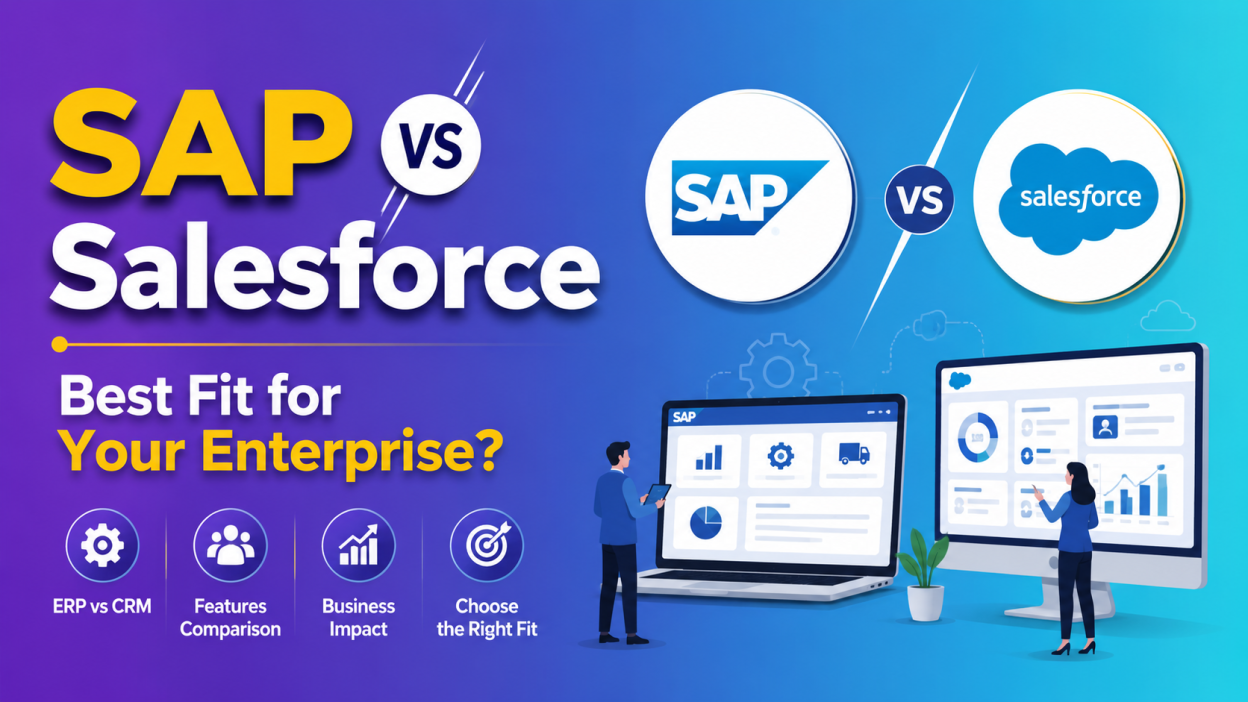
SAP vs Salesforce is not really a battle between two identical platforms. They solve different business problems, and choosing between them depends on what your enterprise actually needs.
SAP vs Salesforce becomes much easier to understand when I stop thinking about “which software is better?” and start asking a more useful question: Which platform fits my business better?
If I were choosing a platform for a growing company, I would look at business processes, customer management, finance, supply chain, scalability, integrations, budget, and the skills my IT team already has.
In this guide, I’ll break down SAP vs Salesforce in simple terms, compare their strengths and weaknesses, and explain which one makes sense for different types of enterprises.
🔑 Key Highlights
- SAP is best known for ERP and managing core business operations.
- Salesforce focuses heavily on CRM, sales, marketing, and customer service.
- SAP is a strong choice for businesses with complex finance, manufacturing, supply chain, and operations requirements.
- Salesforce is a strong choice for organizations that want powerful customer relationship management.
- Large enterprises may use both SAP and Salesforce rather than choosing only one.
- The right choice depends on your business goals, existing technology, budget, and implementation needs.
- SAP vs Salesforce isn’t simply about features; it’s about business fit.
SAP vs Salesforce: What Is the Main Difference?
Let me put it in a simple way.
SAP manages the business. Salesforce manages the customer relationship.
That isn’t the whole story, but it gives us a useful starting point.
SAP has a long history in enterprise resource planning (ERP). Companies use SAP to manage areas such as finance, procurement, supply chain, manufacturing, human resources, and other core business processes.
Salesforce started primarily as a customer relationship management (CRM) platform. It helps businesses manage sales opportunities, customer interactions, marketing activities, customer service, and related processes.
So when I compare SAP vs Salesforce, I don’t see two products fighting for exactly the same job.
Think about a manufacturing company.
It may use SAP to manage inventory, purchasing, production, suppliers, and financial transactions. At the same time, its sales team could use Salesforce to track leads, customer conversations, opportunities, and sales pipelines.
That is where things get interesting.
SAP vs Salesforce: Core Purpose
What Does SAP Do?
SAP is widely associated with ERP.
An ERP system brings important business processes together in one environment.
For example, imagine a company receives a customer order.
That order can trigger several business activities:
- The company checks inventory.
- The warehouse prepares the product.
- Procurement checks whether more materials are required.
- Finance records the transaction.
- Logistics handles delivery.
- Management can analyze the business data.
SAP can connect these processes.
That makes SAP particularly valuable for organizations with complicated internal operations.
What Does Salesforce Do?
Salesforce focuses strongly on customer-facing activities.
Imagine a salesperson receives a lead from a website.
The salesperson can use Salesforce to:
- Record the lead.
- Track communication.
- Schedule follow-ups.
- Manage opportunities.
- Monitor the sales pipeline.
- Create reports.
- Move the customer through different sales stages.
Customer service teams can also use Salesforce to manage support interactions and customer cases.
So, in the simplest SAP vs Salesforce comparison:
SAP → internal business operations
Salesforce → customer relationships and engagement
SAP vs Salesforce: Feature Comparison
Here’s the comparison I would use when explaining the two platforms to someone who is new to enterprise software.
| Area | SAP | Salesforce |
|---|---|---|
| Primary focus | ERP and enterprise operations | CRM and customer experience |
| Finance | ⭐⭐⭐⭐⭐ | ⭐⭐⭐ |
| Supply chain | ⭐⭐⭐⭐⭐ | ⭐⭐⭐ |
| Manufacturing | ⭐⭐⭐⭐⭐ | ⭐⭐ |
| Sales management | ⭐⭐⭐⭐ | ⭐⭐⭐⭐⭐ |
| Customer service | ⭐⭐⭐⭐ | ⭐⭐⭐⭐⭐ |
| Marketing | ⭐⭐⭐ | ⭐⭐⭐⭐⭐ |
| ERP capabilities | ⭐⭐⭐⭐⭐ | ⭐⭐ |
| CRM capabilities | ⭐⭐⭐⭐ | ⭐⭐⭐⭐⭐ |
| Customization | High | High |
| Cloud capabilities | Strong | Strong |
| Best suited for | Complex enterprises | Customer-focused organizations |
These ratings are only a simplified way of visualizing the difference. Actual capabilities depend on the specific SAP and Salesforce products, editions, integrations, and implementation.
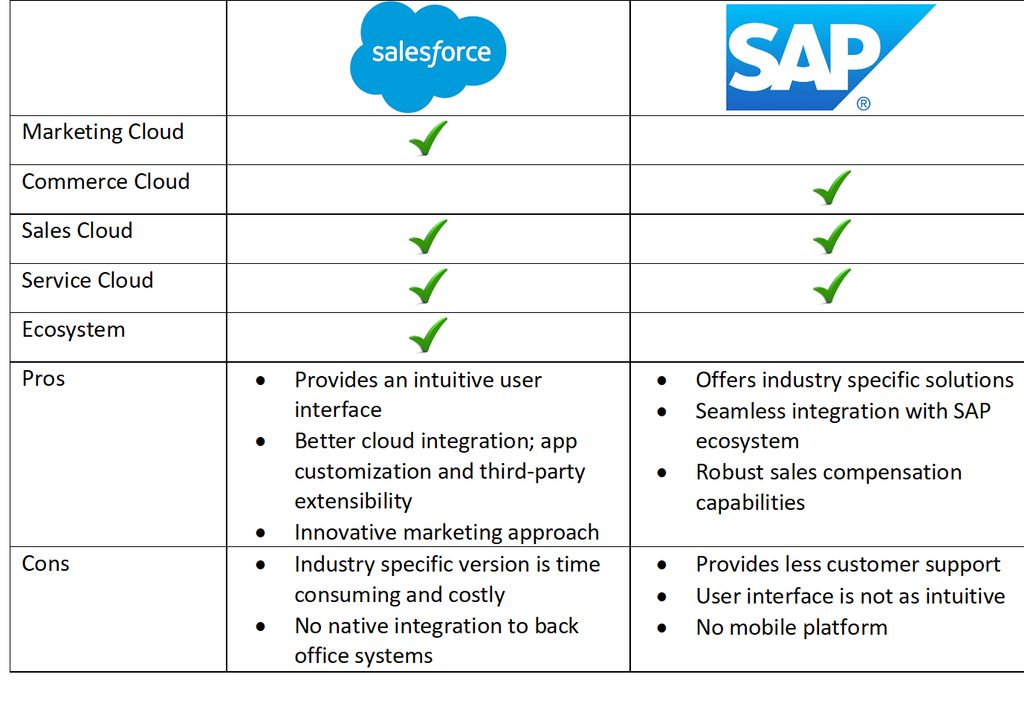
SAP vs Salesforce for Enterprise Businesses
This is where the comparison gets more practical.
A small company might not need a huge enterprise platform from day one. But as an organization grows, things become messy quickly.
More employees.
More customers.
More products.
More suppliers.
More transactions.
More data.
And suddenly, spreadsheets aren’t enough. 😅
For organizations with complicated operational requirements, SAP can provide a strong foundation for managing core business processes.
Salesforce, meanwhile, can be especially valuable when the organization wants to improve its customer-facing operations.
For example, a large company might use:
SAP + Salesforce
SAP could handle:
- Finance
- Procurement
- Inventory
- Supply chain
- Manufacturing
- Enterprise operations
Salesforce could handle:
- Leads
- Sales opportunities
- Customer service
- Marketing
- Customer interactions
This is why asking “SAP or Salesforce?” can sometimes be the wrong question.
The better question is:
“Do we need SAP, Salesforce, or an integrated combination of both?”
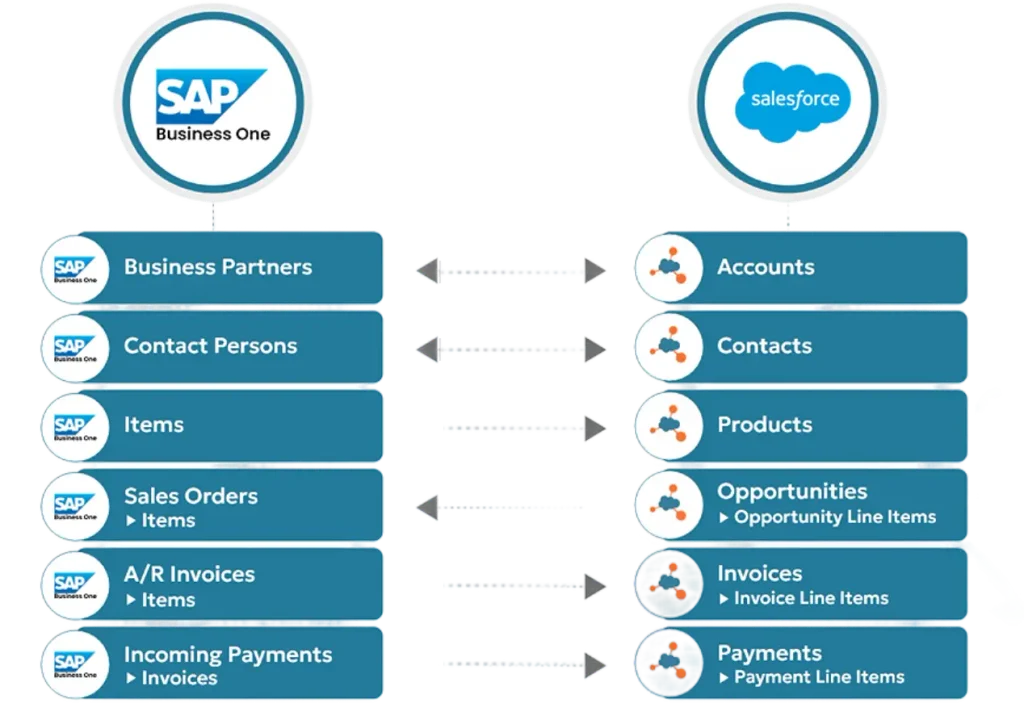
SAP vs Salesforce: Which Is Better for CRM?
If CRM is your main requirement, I would lean toward Salesforce.
Salesforce was built around customer relationship management, and its ecosystem is deeply connected to sales, service, marketing, analytics, automation, and customer engagement.
A sales manager, for example, may want to see:
- How many leads came in this month?
- Which opportunities are close to conversion?
- Which salesperson has the strongest pipeline?
- Which customers need follow-up?
- Where are deals getting stuck?
Salesforce is designed around these kinds of questions.
SAP also offers customer experience and CRM-related capabilities, so it would be inaccurate to say SAP cannot support CRM.
But if your main goal is CRM, Salesforce is usually the more natural starting point.
SAP vs Salesforce: Which Is Better for ERP?
Here, SAP has the advantage.
ERP is one of SAP’s biggest strengths.
If your enterprise needs to coordinate finance, procurement, supply chain, manufacturing, inventory, and other operational processes, SAP deserves serious consideration.
For example, imagine an automobile manufacturer.
It needs to know:
- What materials are available?
- Which suppliers are delivering components?
- How much inventory is sitting in warehouses?
- What is the production schedule?
- What are the financial implications?
- Where are delays occurring?
These aren’t simply customer relationship questions.
They’re enterprise operations questions.
That’s where SAP becomes particularly powerful.
SAP vs Salesforce: Ease of Use
This is an interesting area because “easy” depends on who is using the system.
A salesperson might find Salesforce intuitive because its workflows are closely connected to daily sales activities.
SAP can feel more complex because ERP systems often deal with complicated business processes, rules, permissions, and organizational structures.
I’ve seen this pattern with enterprise software in general: more power often brings more complexity.
That doesn’t mean SAP is “bad” or Salesforce is automatically “easy.”
It means the learning curve depends heavily on the implementation and the user’s role.
SAP vs Salesforce: Customization
Both platforms provide extensive customization options.
Salesforce allows organizations to configure applications, workflows, automation, objects, fields, reports, integrations, and other features.
SAP also supports significant configuration and customization for enterprise processes.
However, customization should be handled carefully.
Why?
Because I wouldn’t customize a business platform just because I can.
Every customization can create additional maintenance, testing, documentation, training, and upgrade considerations.
A good enterprise implementation asks:
“Do we really need to customize this?”
before asking:
“Can we customize this?”
That’s a small distinction, but it can save a company a lot of trouble later.
SAP vs Salesforce: Integration
Integration is another major consideration.
Most modern enterprises don’t run on one application.
They have websites, databases, payment systems, HR platforms, analytics tools, ERP systems, CRM systems, internal applications, and third-party services.
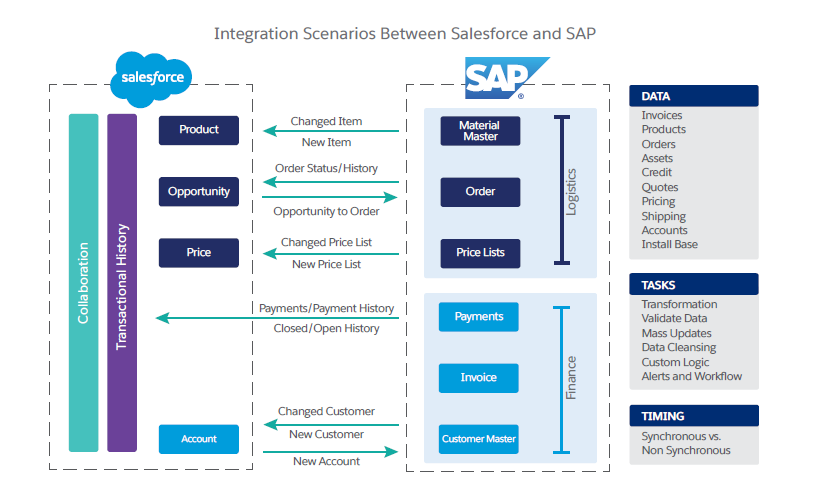
SAP and Salesforce can integrate with other systems, but the exact approach depends on the products and architecture involved.
For example, a company might connect Salesforce with SAP so that customer-facing teams can access relevant business information while core operational data remains managed by SAP.
This can create a powerful combination.
But integration isn’t magic.
You need to consider:
- APIs
- Data synchronization
- Security
- Authentication
- Data quality
- Error handling
- Monitoring
- Performance
A beautiful integration diagram means very little if the actual data keeps breaking. 😄
SAP vs Salesforce: Cost Considerations
This is one area where I would avoid giving a single “SAP costs X and Salesforce costs Y” answer.
Enterprise pricing can vary significantly depending on:
- Number of users
- Products selected
- Features
- Contract structure
- Implementation
- Customization
- Integrations
- Data requirements
- Support
- Training
The license or subscription cost is only one part of the total cost.
I would calculate Total Cost of Ownership (TCO) instead.
That includes implementation, consultants, development, maintenance, training, support, integrations, and future changes.
A platform that looks cheaper initially may become expensive if the implementation becomes complicated.
SAP vs Salesforce: Which One Should You Choose?
Here’s the decision I would make based on business needs.
Choose SAP if:
- Your company needs a powerful ERP platform.
- You have complex financial processes.
- Manufacturing is important.
- Supply chain management is a major requirement.
- Procurement and inventory need tight integration.
- You operate at significant enterprise scale.
- Your business has complex operational workflows.
Choose Salesforce if:
- CRM is your main requirement.
- Your sales team needs better pipeline management.
- Customer service is a major priority.
- You want strong sales automation.
- Marketing and customer engagement are important.
- You want a customer-focused platform.
- Your organization wants to improve the complete customer journey.
Consider Both if:
Your company is large and needs both complex enterprise operations and strong customer management.
This is probably the most important point in the entire SAP vs Salesforce discussion.
You don’t always have to choose one.
SAP vs Salesforce: Real-World Example
Let’s imagine a company called “GlobalTech Manufacturing.”
GlobalTech manufactures medical equipment and sells it to hospitals across several countries.
Its internal teams need to manage:
- Manufacturing
- Suppliers
- Inventory
- Procurement
- Finance
- Logistics
At the same time, its sales team needs to manage thousands of hospital customers.
If GlobalTech uses SAP for its core enterprise processes, it can manage the operational side of the business.
Salesforce could then support the customer-facing side.
A salesperson could track a hospital’s opportunity in Salesforce while the organization continues managing its operational processes through SAP.
In this situation, SAP vs Salesforce becomes SAP and Salesforce.
And that’s a much more realistic enterprise scenario.
SAP vs Salesforce: Career Opportunities
If you’re considering these technologies from a career perspective, both ecosystems can offer strong opportunities.
SAP careers can include roles such as:
- SAP Consultant
- SAP Developer
- SAP Functional Consultant
- SAP Basis Administrator
- SAP Business Analyst
- SAP Integration Specialist
Salesforce careers can include:
- Salesforce Administrator
- Salesforce Developer
- Salesforce Consultant
- Salesforce Business Analyst
- Salesforce Architect
- Salesforce Integration Developer
The important thing is not to learn a platform just because someone says it’s “in demand.”
I would first ask myself:
What type of work do I actually enjoy?
If you enjoy business processes, ERP, finance, supply chain, and enterprise operations, SAP may be worth exploring.
If you enjoy CRM, sales processes, automation, customer experience, and cloud application development, Salesforce may be a better match.
SAP vs Salesforce: My Final Verdict 🏆
So, which is better?
There isn’t one universal winner.
And honestly, I think that’s the most useful answer.
If I need ERP and complex business operations, I’d look closely at SAP.
If I need CRM and customer engagement, I’d look closely at Salesforce.
If I’m running a large enterprise that needs both sides, I’d seriously consider integrating the two rather than forcing one platform to do everything.
The best technology isn’t necessarily the one with the longest feature list.
It’s the one that solves my actual business problems without creating a bigger problem somewhere else.
Quick Decision Guide
👉 ERP, finance, manufacturing, supply chain → SAP
👉 CRM, sales, customer service, marketing → Salesforce
👉 Complex enterprise + strong CRM requirements → SAP + Salesforce
👉 Customer-first organization → Salesforce
👉 Operations-first enterprise → SAP
At the end of the day, SAP vs Salesforce isn’t really about picking a winner. It’s about understanding your organization well enough to choose the platform—or combination of platforms—that supports where your business is going.
And that’s the decision that matters. 🚀
Want to learn more ??, Kaashiv Infotech Offers Data Analytics Course, Data Science Course, Cyber Security Course & More Visit Their Website www.kaashivinfotech.com.