

Machine learning is one of the most exciting areas of technology, but simply completing tutorials is not enough to build strong practical skills. The best way to understand machine learning is to work on projects where you collect or prepare data, train models, evaluate results, and turn predictions into something useful.
A good machine learning project can also become an important part of your GitHub profile, resume, college project portfolio, or job interview preparation. Current project guides increasingly emphasize real-world problem solving, complete ML workflows, deployment, and originality rather than simply training a model on a popular dataset.
If you are a beginner, student, or experienced developer looking for something more interesting than the usual Titanic or Iris projects, here are 7 unique machine learning project ideas for different skill levels.
1. Smart Expense Categorization System

Difficulty: Beginner
Managing personal expenses manually can become difficult when there are hundreds of transactions. A smart expense categorization system can automatically classify transactions into categories such as food, transportation, shopping, entertainment, bills, healthcare, and education.
For example, if the input is:
“Swiggy order – ₹450”
the model could classify it as Food.
Similarly:
“Uber trip – ₹280”
could be classified as Transportation.
This project is a great introduction to machine learning because it combines data preprocessing, classification, and basic natural language processing.
How to Build It
Start by collecting a dataset containing transaction descriptions and their corresponding categories. Clean the text by removing unnecessary characters and converting everything into a consistent format.
You can then convert text into numerical features using techniques such as TF-IDF. After that, train classification algorithms such as Logistic Regression, Naive Bayes, or Random Forest.
For a more advanced version, you could allow users to upload a CSV containing their bank transactions and automatically categorize every transaction.
Skills You Can Learn
- Python
- Pandas and NumPy
- Data preprocessing
- NLP
- TF-IDF
- Classification
- Model evaluation
- Streamlit
This project becomes particularly impressive when you add a dashboard showing monthly spending patterns and category-wise expenses.
2. AI-Based Resume Skill Gap Analyzer

Difficulty: Beginner to Intermediate
Many students apply for jobs without knowing whether their skills actually match the job description. A Resume Skill Gap Analyzer can solve this problem using machine learning and NLP.
The system accepts two inputs:
- A candidate’s resume
- A job description
It then identifies the skills mentioned in both documents and highlights missing skills.
For example, suppose a job description requires:
Python, SQL, Machine Learning, AWS, Docker, Git
while the resume contains:
Python, SQL, Machine Learning, Git
The system could report:
Matched skills: Python, SQL, Machine Learning, Git
Missing skills: AWS, Docker
How to Build It
First, extract text from resumes and job descriptions. Use NLP techniques to clean and tokenize the text.
You can create a skill dictionary containing technical skills such as Python, Java, SQL, AWS, Azure, Docker, Kubernetes, TensorFlow, and PyTorch.
For a more sophisticated system, use sentence embeddings to calculate semantic similarity between the resume and job description.
The final application could provide a Resume Match Score, missing skills, and recommended learning areas.
Why It Is Unique
Resume screening is a practical NLP application and can demonstrate more than basic classification. Modern ML project recommendations also include resume matching and NLP-based applications as portfolio-worthy advanced directions.
3. Local Food Recommendation System
Difficulty: Intermediate
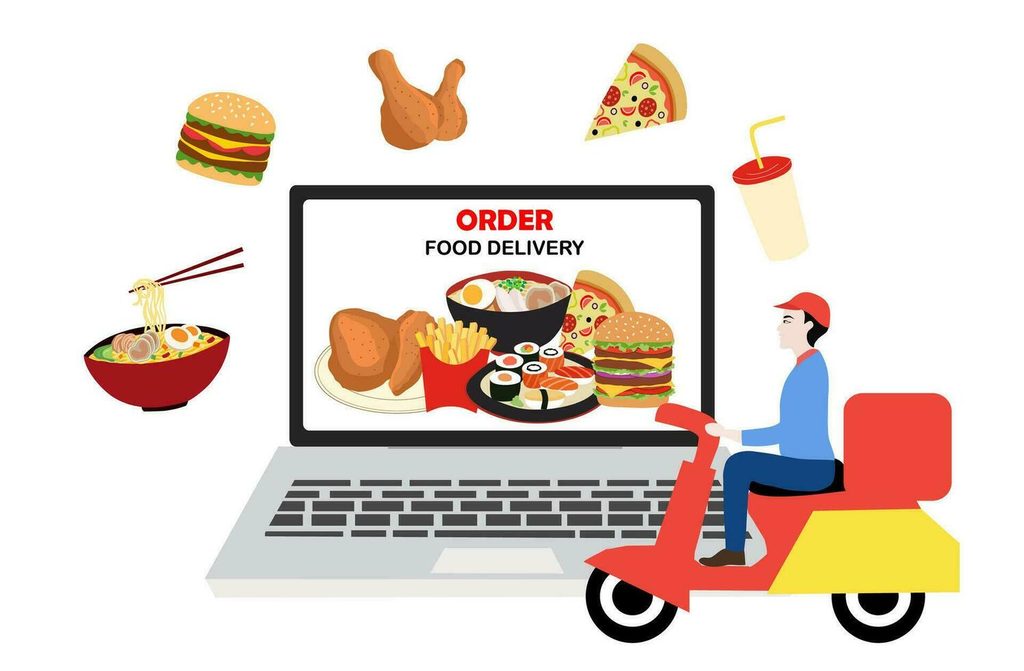
Recommendation systems are everywhere. Netflix recommends movies, Spotify recommends music, and e-commerce platforms recommend products.
You can build your own recommendation engine specifically for local food and restaurants.
Instead of simply recommending restaurants based on ratings, the system could consider:
- Cuisine
- Price range
- Location
- Ratings
- User preferences
- Previous choices
- Vegetarian/non-vegetarian preference
- Popular dishes
For example, if a user frequently selects South Indian vegetarian restaurants, the model could recommend similar restaurants.
How to Build It
Start with a dataset containing restaurant information and user ratings.
Use content-based filtering to recommend restaurants with similar characteristics. You can also implement collaborative filtering, where recommendations are based on the preferences of users with similar behavior.
Cosine similarity is a simple starting point for measuring similarity between items.
For an advanced version, combine content-based and collaborative filtering into a hybrid recommendation system.
Extra Feature
Create a web application where users enter:
“Affordable vegetarian restaurants within 5 km”
and receive personalized recommendations.
This project demonstrates practical machine learning, recommendation algorithms, data processing, and application development.
4. Electricity Consumption Forecasting

Difficulty: Intermediate
Energy consumption changes depending on factors such as time, temperature, weather, holidays, and human activity.
An Electricity Consumption Forecasting System can predict future energy usage based on historical data.
For example, the model could predict tomorrow’s electricity consumption using:
- Previous consumption
- Temperature
- Day of the week
- Month
- Holiday information
- Time of day
Time-series forecasting is already used in practical energy and business applications, making this a useful project beyond basic classification exercises.
How to Build It
Begin by collecting historical electricity consumption data.
Perform exploratory data analysis to identify seasonal patterns. Then create features such as:
- Previous day’s consumption
- Seven-day moving average
- Hour
- Day
- Month
- Weekend indicator
You can experiment with Linear Regression, Random Forest, XGBoost, or specialized time-series models.
Evaluate the predictions using metrics such as MAE, RMSE, and MAPE.
Advanced Version
Build a dashboard where users can select a date and view predicted electricity consumption.
You could also add anomaly detection to identify unusual spikes in electricity usage.
This project is excellent for students interested in machine learning, data science, IoT, or smart-city applications.
5. Road Damage and Pothole Detection
Difficulty: Intermediate to Advanced
Road maintenance is an excellent real-world computer vision problem.
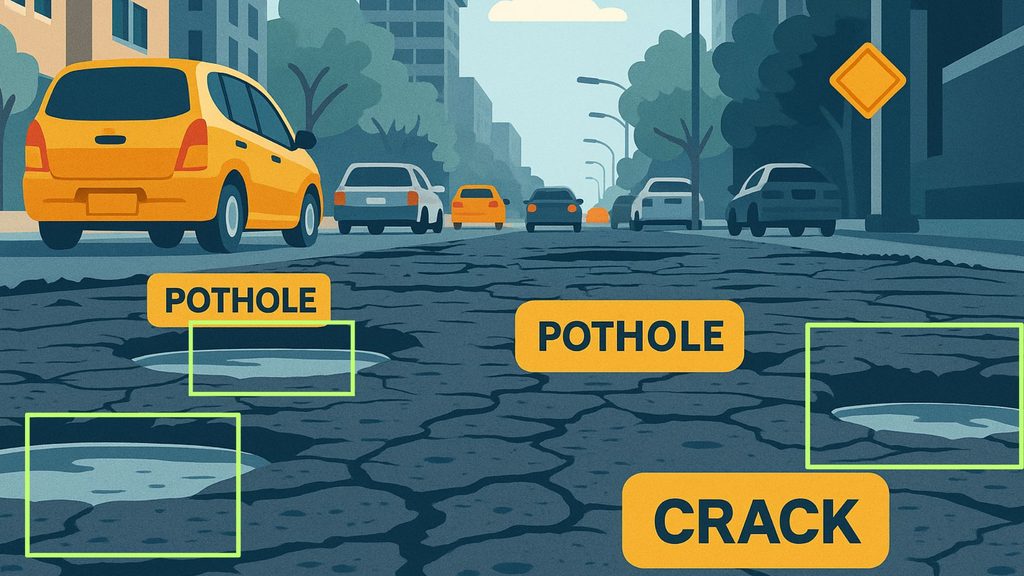
A Road Damage Detection System can analyze images or video captured from a vehicle and identify potholes, cracks, and damaged road surfaces.
Instead of manually checking thousands of road images, an AI system could automatically detect problematic areas.
How to Build It
Collect and label road images containing:
- Potholes
- Cracks
- Broken surfaces
- Normal roads
For a beginner computer vision version, use image classification.
For a more advanced version, use an object detection model such as YOLO to identify the exact location of damage within an image.
The output could display:
Pothole detected — Confidence: 94%
You can then save the location and image information for maintenance teams.
Advanced Features
A complete project could include:
- Real-time camera detection
- GPS coordinates
- Damage severity classification
- Automatic reporting
- Web dashboard
- Map visualization
Computer vision projects involving pothole detection and infrastructure monitoring are commonly used as examples of more advanced ML applications.
This project can be particularly impressive for a final-year project because it connects machine learning with a real-world infrastructure problem.
6. Fake Review Detection System

Difficulty: Advanced
Online reviews influence what people buy, where they eat, and which services they choose. Unfortunately, some reviews may be fake, duplicated, promotional, or generated to manipulate ratings.
A Fake Review Detection System can analyze reviews and estimate whether they are likely to be genuine or suspicious.
What the Model Can Analyze
The system could examine:
- Review text
- Review length
- Repeated phrases
- Rating patterns
- Number of reviews by the user
- Review frequency
- Sentiment
- Unusual activity
For example, if an account posts 50 highly similar five-star reviews within a few hours, the system could flag the behavior.
How to Build It
Use NLP techniques to process review text. Convert text into numerical representations using TF-IDF or embeddings.
Then experiment with classification algorithms such as:
- Logistic Regression
- Random Forest
- XGBoost
- Neural Networks
- Transformer-based models
The important part is not simply achieving high accuracy. You should also analyze precision, recall, F1-score, and false positives because incorrectly flagging genuine reviews can be problematic.
Make It More Unique
Create a dashboard that displays:
Review Status: Suspicious
Confidence: 87%
Reason: Highly similar wording and unusual posting frequency
This turns a simple NLP model into a complete practical application.
7. AI-Powered Document Question-Answering System

Difficulty: Advanced
One of the most interesting ML projects you can build today is an AI document question-answering system.
Instead of searching through a long PDF manually, users can upload a document and ask questions about its contents.
For example:
“What are the main objectives mentioned in this report?”
The system retrieves the relevant information and generates an answer.
This type of application uses Retrieval-Augmented Generation (RAG), where documents are processed, converted into embeddings, stored in a vector database, and retrieved when the user asks a question. RAG-based document Q&A systems are increasingly included in advanced ML project recommendations.
How to Build It
The basic workflow looks like this:
Upload Document → Extract Text → Split into Chunks → Generate Embeddings → Store in Vector Database → Retrieve Relevant Content → Generate Answer
You can experiment with tools and frameworks such as:
- Python
- Hugging Face
- LangChain or LlamaIndex
- FAISS or another vector database
- Streamlit
- An LLM
Advanced Features
You could add:
- Multiple document uploads
- Source references
- Conversation history
- Document summarization
- Automatic question generation
- PDF and Word support
- User authentication
This project demonstrates several modern skills at once, including NLP, embeddings, retrieval, vector databases, application development, and AI integration.
How to Choose the Right Machine Learning Project
Don’t choose a project simply because it sounds advanced. Choose one that matches your current skills and gives you room to improve.
If You Are a Beginner
Start with:
Smart Expense Categorization
You will learn data cleaning, feature engineering, classification, and basic NLP without dealing with overly complicated models.
If You Are an Intermediate Learner
Try:
Food Recommendation System or Electricity Consumption Forecasting
These projects introduce recommendation algorithms and time-series concepts while still being manageable.
If You Want an Impressive Final-Year Project
Consider:
Road Damage Detection or Fake Review Detection
Both can be expanded with dashboards, real-time prediction, APIs, and additional datasets.
If You Want a Modern AI Portfolio Project
Build:
AI-Powered Document Q&A
It combines machine learning concepts with current AI application development and can be turned into a complete web application.
Tips to Make Your ML Project Stand Out
Building the model is only one part of a good project. A strong portfolio project should demonstrate the complete machine learning workflow: data collection, preprocessing, exploratory analysis, feature engineering, model training, evaluation, and deployment.
Instead of uploading only a Jupyter Notebook, create a GitHub repository containing:
- Clear project description
- Problem statement
- Dataset information
- Data preprocessing steps
- Model selection
- Evaluation metrics
- Screenshots
- Installation instructions
- Results
- Future improvements
Most importantly, deploy at least one project. A simple Streamlit application or API allows recruiters and interviewers to actually interact with your model.
Also avoid focusing only on accuracy. Depending on the problem, metrics such as precision, recall, F1-score, MAE, RMSE, or ROC-AUC may provide a much better picture of model performance.
Conclusion
Machine learning becomes much easier to understand when you stop treating it as only a collection of algorithms and start using it to solve practical problems.
The 7 project ideas covered here provide a progression from basic classification and NLP to recommendation systems, forecasting, computer vision, fraud-like anomaly detection, and modern document Q&A applications.
Whether you are a beginner learning Python, a college student preparing a final-year project, or an aspiring ML engineer building a professional portfolio, choose one project and take it beyond the basic notebook. Add better data, meaningful evaluation, a user interface, and deployment. That depth will make your project far more valuable than simply having a large number of unfinished projects. Current 2026 guidance similarly emphasizes quality, real-world relevance, deployment, and clear documentation over project quantity.
Want to Learn More About Python & Artificial Intelligence ?, Kaashiv Infotech Offers Full Stack Python Course, Artificial Intelligence Course, Data Science Course & More Visit Their Website course.kaashivinfotech.com.
Related Reads:
Artificial Intelligence vs Human Intelligence: A Deep Dive into Minds Made and Minds Born
Top 10 AI Tools for Content Creation in 2026 You Shouldn’t Miss.