
Turning Ideas into Real Innovation
Brainstorming is where creativity truly comes alive inside Design Thinking. It’s not just about throwing random ideas into a room — it’s a structured yet free-flowing process that helps individuals and teams unlock innovative solutions to real-world problems.
If you’ve ever wondered why some teams consistently come up with breakthrough ideas while others struggle, the answer often lies in how they brainstorm. In this complete guide, we’ll go deep into the concept, psychology, techniques, real-world usage, and practical tips to master brainstorming in design thinking.
🧠 Understanding Brainstorming in Design Thinking
At its core, brainstorming is part of the Ideation phase, the third stage in the design thinking process. After deeply understanding users and clearly defining the problem, teams move into a creative exploration mode.
The concept of brainstorming was formalized by Alex Osborn, who believed that the human mind produces better ideas when it is free from criticism. His idea was simple but powerful: separate idea generation from evaluation.
When you apply this to design thinking, brainstorming becomes a safe space where ideas are not judged immediately but are allowed to grow, combine, and evolve. This shift in mindset is what transforms ordinary thinking into creative thinking.
In real-world scenarios, brainstorming is not about finding one perfect idea. Instead, it is about generating many possibilities, because innovation often hides among unexpected or unconventional thoughts.

🔄 The Role of Brainstorming in the Design Thinking Process
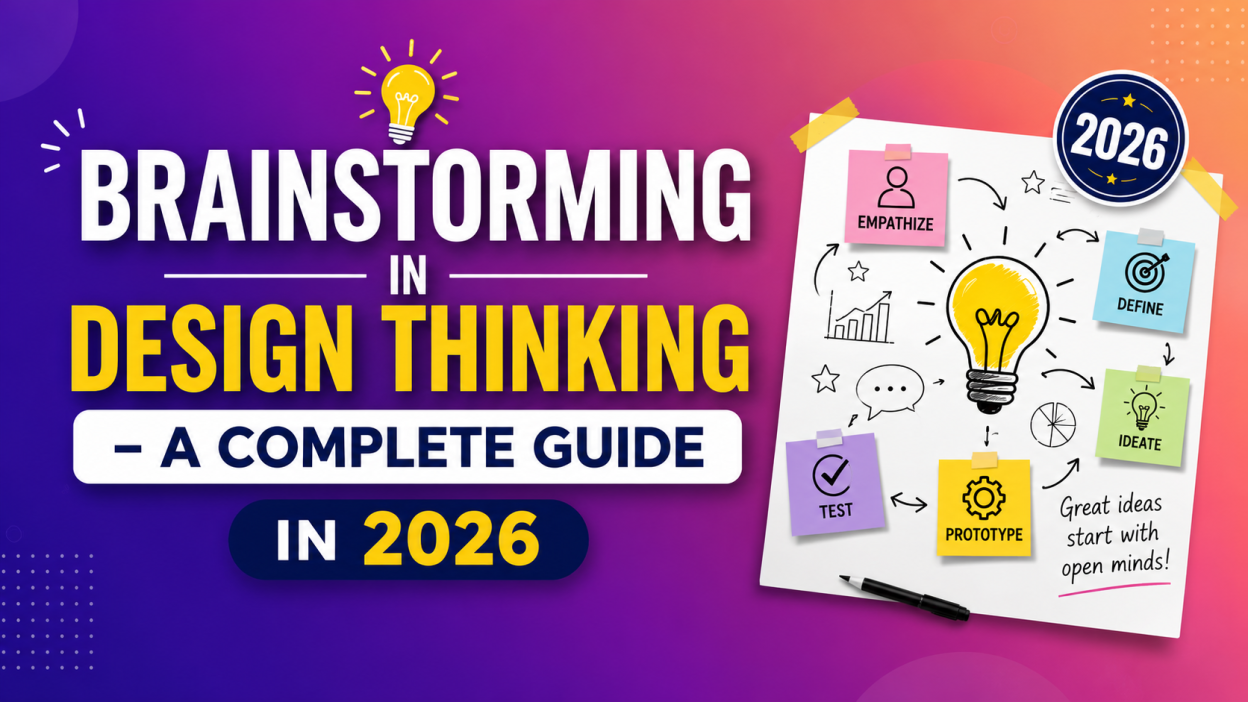
To truly understand brainstorming, you need to see where it fits in the bigger picture. Design thinking is a human-centered approach that follows a structured flow:
It begins with empathy, where teams try to understand users deeply—their needs, pain points, and behaviors. Then comes the definition stage, where these insights are narrowed down into a clear and meaningful problem statement.
Only after this clarity is achieved does brainstorming begin. This is important because without a clear problem, brainstorming can easily become directionless.
Once ideas are generated, they are turned into prototypes and then tested with users. This means brainstorming is not the end — it is the bridge between understanding and building.
💡 The Psychology Behind Brainstorming
Brainstorming works because it aligns with how the human brain naturally generates ideas. When people feel safe from criticism, their cognitive barriers reduce, allowing more creative thoughts to surface.
In traditional environments, people often filter their ideas before speaking. They think:
- “What if this sounds stupid?”
- “What if others judge me?”
This internal filtering kills creativity.
Brainstorming removes that fear. It encourages divergent thinking, where the goal is to explore as many directions as possible instead of narrowing down too early.
Organizations like IDEO have mastered this approach by creating environments where wild ideas are not just accepted but encouraged. Similarly, companies like Google invest heavily in creative workspaces and open discussions to fuel ideation.
Another interesting psychological aspect is idea association. One idea often triggers another. This is why group brainstorming can be powerful — a single thought can evolve into something much bigger when multiple minds collaborate.
🚀 Principles That Make Brainstorming Effective
Brainstorming may look informal, but the best sessions follow certain underlying principles.
The first principle is suspending judgment. When evaluation is delayed, creativity expands. Even unrealistic ideas can act as stepping stones toward practical solutions.
The second principle is focusing on quantity over quality in the early stage. The more ideas generated, the higher the chances of discovering something valuable.
Another key principle is building on ideas. Instead of rejecting a thought, participants are encouraged to expand it. This creates a chain reaction of creativity.
Equally important is staying problem-focused. While ideas should be free-flowing, they must still connect back to the user’s problem.
🛠️ Deep Dive into Brainstorming Techniques

🧩 Mind Mapping – Visual Expansion of Ideas
Mind mapping is one of the most intuitive brainstorming techniques. It starts with a central idea placed at the center, and related thoughts branch out like a tree.
This method is particularly useful when dealing with complex problems because it visually organizes thoughts and reveals connections that might not be obvious in linear thinking.
For example, if the problem is “improving online learning,” branches could include engagement, technology, accessibility, and personalization. Each of these branches can further expand into detailed ideas.
Mind mapping works exceptionally well for visual thinkers and helps teams see the bigger picture without losing individual idea depth.
⚡ Brainwriting – Silent but Powerful Ideation
Unlike traditional brainstorming, brainwriting removes verbal communication from the process. Participants write down their ideas and pass them to others, who then build on them.
This method solves a common issue in group brainstorming — dominance. In many sessions, a few outspoken individuals tend to control the conversation. Brainwriting ensures equal participation.
It also gives introverted participants the space to express ideas without pressure. Interestingly, studies show that brainwriting often produces more diverse and well-thought-out ideas compared to verbal brainstorming.
🔁 SCAMPER – Transforming Existing Ideas
SCAMPER is a structured method that helps improve or transform existing ideas. Each letter represents a different way of thinking about a product or problem.
Instead of starting from scratch, SCAMPER encourages you to question and modify what already exists. This makes it especially useful in product innovation.
For instance, a food delivery app could:
- Combine grocery delivery with meals
- Modify delivery speed using AI
- Eliminate unnecessary steps in ordering
This structured questioning leads to practical and innovative improvements.
🎭 Role Storming – Thinking from Different Perspectives
Role storming introduces empathy into brainstorming by asking participants to think from someone else’s perspective.
Instead of asking “What should we do?”, the question becomes:
- “What would a customer expect?”
- “How would a competitor approach this?”
- “What would a CEO prioritize?”
This shift in perspective often reveals insights that might otherwise be overlooked. It also aligns closely with the empathy-driven nature of design thinking.
⏱️ Crazy 8s – Speed Meets Creativity
Crazy 8s is a fast-paced ideation technique where participants sketch eight ideas in eight minutes. The time constraint forces quick thinking and reduces over-analysis.
This technique is widely used in design sprints because it pushes participants to go beyond their first few obvious ideas and explore deeper creativity.
Despite its simplicity, Crazy 8s often produces surprisingly innovative concepts because it bypasses perfectionism.
🧪 Real-World Application of Brainstorming
Consider the evolution of food delivery platforms like Swiggy and Zomato. Features such as real-time tracking, personalized recommendations, and subscription models didn’t appear overnight.
They are the result of continuous brainstorming, testing, and iteration.
A simple question like “How can we improve user convenience?” can lead to dozens of ideas — some small, some revolutionary. Over time, these ideas shape the product experience.
⚠️ Challenges and Mistakes in Brainstorming
While brainstorming is powerful, it is not foolproof. Many teams struggle because they misunderstand the process.
One of the most common issues is premature judgment. When ideas are criticized too early, participants become hesitant to share.
Another challenge is lack of direction. Without a clear problem statement, brainstorming can become chaotic and unproductive.
Group dynamics also play a role. Dominant personalities can overshadow others, while quieter members may hold back valuable insights.
Finally, many teams fail to convert ideas into action. Brainstorming should always be followed by evaluation, selection, and implementation.

🧭 How to Run a High-Impact Brainstorming Session
A successful brainstorming session doesn’t happen by accident. It requires preparation, facilitation, and follow-through.
Start by clearly defining the problem. The more specific the problem, the more relevant the ideas will be.
Create an open and comfortable environment where participants feel safe to express themselves. Encourage creativity, but keep the session focused.
Time management is also important. Sessions that are too long can lead to fatigue, while very short sessions may limit idea generation.
Most importantly, capture every idea. Use sticky notes, whiteboards, or digital tools to document thoughts. After the session, group similar ideas and identify the most promising ones.
Modern tools like Miro, Figma, and Notion have made it easier to run brainstorming sessions even with remote teams.
🔮 The Future of Brainstorming
Brainstorming is evolving rapidly with technology. Artificial intelligence is beginning to play a role in idea generation, helping teams discover patterns and suggestions they might not have considered.
Remote collaboration tools are also redefining how teams brainstorm, making it possible for global teams to ideate together in real time.
However, one thing remains constant — the human element. Creativity, empathy, and collaboration are still at the heart of brainstorming.
🏁 Final Thoughts
Brainstorming in design thinking is not just a technique — it’s a mindset. It’s about allowing ideas to flow freely, embracing creativity without fear, and working together to solve meaningful problems.
When done right, brainstorming transforms challenges into opportunities and ideas into impactful solutions.
The next time you face a problem, don’t rush to find the answer.
Take a step back, gather your ideas, and let creativity lead the way.
Want to learn more, Kaashiv Infotech Offers, UI UX Course, Front End Development Course, Full Stack Development Course & More, Visit Their Website www.kaashivinfotech.com.