
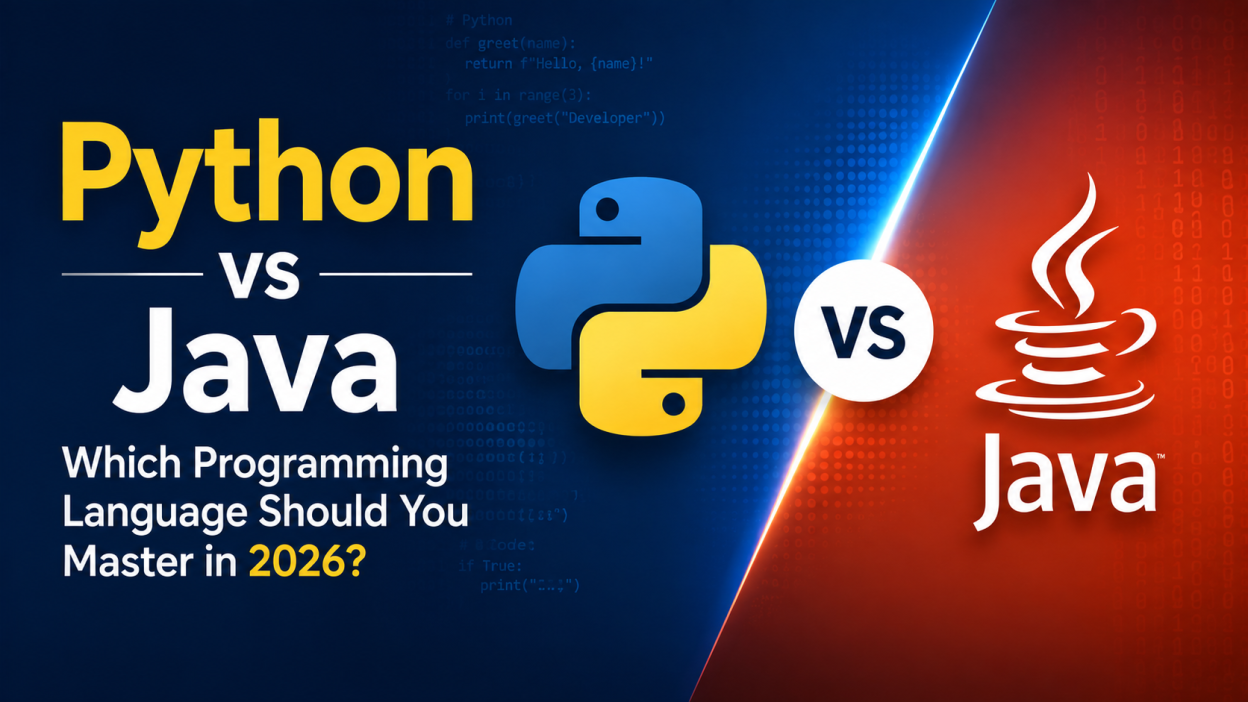
Choosing the right programming language can feel confusing, especially when two popular options like Python and Java offer excellent career opportunities. Both languages are widely used, have large developer communities, and support everything from web applications to enterprise software.
But they are built around different strengths.
Python is known for its simple syntax, rapid development, automation capabilities, data science, artificial intelligence, and machine learning. Java is famous for its performance, scalability, object-oriented programming model, and long-standing role in enterprise applications.
So, Python vs Java — which programming language should you master?
The answer depends mainly on your career goals.
According to the PYPL index, Python ranked first worldwide in August 2026 with a 47.49% share, while Java ranked second at 11.44%. In India, Python also ranked first, followed by Java.
Let’s compare both languages in detail.
What Is Python?
Python is a high-level, general-purpose programming language designed with readability and simplicity in mind. Its syntax allows developers to write programs using fewer lines of code compared with many traditional programming languages.
Python is dynamically typed and supports object-oriented, procedural, and functional programming styles. Its extensive standard library and third-party ecosystem make it useful for many different types of projects.
Python is widely used for:
- Artificial Intelligence
- Machine Learning
- Data Science
- Web Development
- Automation
- Scripting
- Cybersecurity
- Scientific Computing
- Data Analysis
- Backend Development
One of Python’s biggest advantages is its relatively gentle learning curve. Beginners can start creating useful programs without first dealing with a large amount of syntax.
Simple Python Example
name="Alex"print("Hello", name)
The syntax is short and easy to understand, which makes Python particularly attractive to beginners.
What Is Java?
Java is a general-purpose, object-oriented programming language designed to be portable across different platforms through the Java Virtual Machine (JVM).
Java has been widely adopted for enterprise software, backend systems, financial applications, large-scale platforms, and many other production environments.
Java’s ecosystem includes mature frameworks and tools such as Spring, Spring Boot, Hibernate, Maven, and Gradle.
Simple Java Example
publicclassMain {publicstaticvoidmain(String[] args) {Stringname="Alex";System.out.println("Hello "+name); }}
Compared with Python, Java generally requires more code for simple programs. However, its strong typing and structured approach can be valuable when building large applications.
Python vs Java: Quick Comparison
| Feature | Python | Java |
|---|---|---|
| Learning curve | Easier | Moderate |
| Syntax | Simple and concise | More verbose |
| Typing | Dynamically typed | Statically typed |
| Programming style | Multi-paradigm | Primarily object-oriented |
| Performance | Generally slower | Generally faster |
| AI & Machine Learning | Excellent | Limited compared with Python |
| Data Science | Excellent | Moderate |
| Web Development | Excellent | Excellent |
| Enterprise Applications | Good | Excellent |
| Automation | Excellent | Good |
| Android Development | Limited | Historically strong |
| Large-scale systems | Good | Excellent |
| Beginner friendly | Very high | Moderate |
| Development speed | Very fast | Moderate |
| Ecosystem | Huge | Huge |
| Best known for | AI, data, automation | Enterprise and backend systems |
1. Python vs Java: Syntax
One of the biggest differences between Python and Java is their syntax.
Python focuses heavily on readability. You can often accomplish the same task using significantly fewer lines of code.
For example:
Python
foriinrange(5):print(i)
Java
for (inti=0; i<5; i++) {System.out.println(i);}
Both programs perform the same basic task.
However, Python’s syntax is generally easier for beginners to understand.
Python’s official documentation specifically highlights readability and its simple syntax as important characteristics of the language.
Winner: Python
2. Learning Difficulty
If you are completely new to programming, Python is usually the easier language to start with.
Python allows beginners to focus more on programming concepts instead of complicated syntax.
You can learn concepts such as:
- Variables
- Conditions
- Loops
- Functions
- Lists
- Dictionaries
- Classes
- File handling
without writing large amounts of boilerplate code.
Java also provides a strong foundation for programming, but beginners need to understand concepts such as classes, objects, methods, types, and Java’s program structure earlier.
Winner: Python
3. Performance
Java generally has an advantage over Python in raw execution performance for many CPU-intensive workloads.
Java applications run on the JVM, which uses techniques such as Just-In-Time (JIT) compilation to optimize frequently executed code.
Python prioritizes developer productivity and flexibility rather than raw execution speed.
That doesn’t mean Python is unsuitable for high-performance applications. Python can use optimized libraries implemented in lower-level languages and can integrate with systems written in languages such as C and C++.
Still, when comparing the languages directly for many compute-heavy applications:
Winner: Java
4. Artificial Intelligence and Machine Learning
This is one area where Python has a major advantage.
Python has become a leading language for:
- Machine Learning
- Deep Learning
- Generative AI
- Natural Language Processing
- Computer Vision
- Data Analysis
- AI automation
Popular Python libraries include:
- NumPy
- Pandas
- Scikit-learn
- TensorFlow
- PyTorch
- Matplotlib
This ecosystem allows developers and researchers to move quickly from an idea to a working prototype.
If your goal is to become an AI Engineer, Machine Learning Engineer, or Data Scientist, Python is usually the better first choice.
Winner: Python
5. Web Development
Both languages are excellent choices for backend web development.
Python has popular frameworks such as:
- Django
- Flask
- FastAPI
Java has a particularly strong ecosystem around:
- Spring
- Spring Boot
- Jakarta EE
- Hibernate
Python is attractive when development speed and simplicity are priorities.
Java is especially strong when building large, structured enterprise applications that need long-term maintainability and scalability.
Winner: Tie
The better choice depends on the project and organization.
6. Enterprise Application Development
Java has traditionally been one of the strongest choices for enterprise software.
Large organizations use Java for systems involving:
- Banking
- Insurance
- E-commerce
- Healthcare
- Telecommunications
- Financial services
- Enterprise resource planning
- Large backend platforms
Java’s static typing, mature ecosystem, strong tooling, and extensive frameworks make it suitable for large development teams and long-lived applications.
Python can certainly be used for enterprise systems, but Java remains particularly strong in this area.
Winner: Java
7. Data Science

Python is one of the strongest programming languages for data science.
A typical Python data science workflow may involve:
Python ↓NumPy ↓Pandas ↓Data Cleaning ↓Visualization ↓Machine Learning ↓Model Deployment
Python’s large collection of data and scientific libraries makes it possible to perform everything from data cleaning to machine learning within one ecosystem.
Winner: Python
8. Automation and Scripting
Python is extremely popular for automation.
Developers can use Python to automate:
- File management
- Web scraping
- Report generation
- Testing
- Data processing
- System administration
- API requests
- Repetitive tasks
For example:
importosforfileinos.listdir("documents"):print(file)
This simplicity makes Python particularly useful for scripting and automation.
Python’s official documentation also describes the language as useful for scripting and rapid application development.
Winner: Python
9. Android Development
Java has a long history in Android development and remains important in existing Android codebases.
However, modern Android development has increasingly shifted toward Kotlin, which means choosing Java specifically for new Android development requires some additional context.
Python is not a primary language for native Android application development.
Therefore, between these two:
Winner: Java
But if your specific goal is modern Android development, learning Kotlin alongside Android development is worth considering.
10. Job Opportunities
Both Python and Java offer strong career opportunities.
Python’s current popularity has been strongly supported by the growth of AI, machine learning, data science, automation, and backend development.
Java continues to have substantial demand because many enterprises have large existing Java applications that require developers for new development, maintenance, modernization, and cloud migration.
Current popularity indicators also show strong demand for both languages. The July/August 2026 PYPL data places Python first and Java second worldwide.
Python career options
You can pursue roles such as:
- Python Developer
- Backend Developer
- Data Scientist
- Machine Learning Engineer
- AI Engineer
- Automation Engineer
- Data Analyst
Java career options
You can pursue roles such as:
- Java Developer
- Backend Developer
- Spring Boot Developer
- Enterprise Application Developer
- Software Engineer
- Cloud Backend Engineer
- Android Developer
Winner: Tie
Both provide strong career paths, but the opportunities are concentrated in different areas.
Python vs Java: Which Is Better for Freshers?
For beginners and college students, Python is usually easier to start with.
You can quickly build:
- Small applications
- Automation scripts
- Web applications
- Data projects
- AI projects
- College projects
This makes Python a particularly attractive first programming language.
However, Java can be an excellent choice if you already know that you want to enter enterprise software development.
Recommendation for freshers
Choose Python if:
- You are completely new to programming.
- You are interested in AI.
- You want to learn data science.
- You want to automate tasks.
- You want to build projects quickly.
Choose Java if:
- You want enterprise development.
- You are interested in Spring Boot.
- You want to work on large backend applications.
- Your target companies primarily use Java.
- You want to strengthen your object-oriented programming fundamentals.
Python vs Java for Career Growth
Choosing a language is only the beginning.
A successful developer needs more than knowledge of Python or Java.
For a Python career, you could build this skill path:
Python ↓Git & GitHub ↓SQL ↓Django / FastAPI ↓REST APIs ↓Cloud ↓AI / Data / Backend Specialization
For a Java career:
Java ↓OOP & DSA ↓SQL ↓Spring Boot ↓REST APIs ↓Microservices ↓Docker & Cloud
This is why simply learning syntax isn’t enough.
Employers usually look for people who can solve problems and build real applications, not candidates who only know the basics of a programming language.
Can You Learn Both Python and Java?
Absolutely.
In fact, learning both can be useful once you have a strong foundation in one language.
For example, you could start with Python to understand:
- Variables
- Loops
- Functions
- Data structures
- Algorithms
- Object-oriented programming
Then move to Java to understand:
- Static typing
- Advanced OOP
- JVM concepts
- Enterprise development
- Spring Boot
- Large-scale application architecture
Learning a second programming language becomes easier because many fundamental programming concepts are transferable.
Python vs Java: Advantages and Disadvantages
Advantages of Python
- Easy-to-read syntax
- Beginner friendly
- Excellent AI ecosystem
- Excellent data science ecosystem
- Great for automation
- Rapid development
- Large community
- Huge number of libraries
- Useful across many industries
Disadvantages of Python
- Generally slower than Java for many compute-heavy workloads
- Dynamic typing can allow certain errors to appear later
- Memory consumption can be higher for some workloads
- Mobile development is not its strongest area
Advantages of Java
- Strong performance
- Excellent scalability
- Mature ecosystem
- Strong object-oriented programming support
- Excellent enterprise adoption
- Large collection of frameworks
- Strong tooling
- JVM portability
- Well suited to large applications
Disadvantages of Java
- More verbose syntax
- Steeper learning curve for beginners
- More boilerplate for simple programs
- Can feel complex for small scripts
Python vs Java: Which One Should You Master?
There is no universal winner.
Python wins when simplicity, AI, data science, automation, and rapid development are the priority.
Java wins when performance, enterprise applications, structured large-scale systems, and mature backend ecosystems are the priority.
If you are a beginner in 2026 and don’t yet have a specific career direction, Python is probably the better first language. Current popularity data strongly favors Python, and its applications span AI, data, automation, and software development.
But if your goal is to become an enterprise backend developer, learning Java + Spring Boot + SQL + REST APIs + cloud technologies is an excellent career path.
Once you understand programming fundamentals, switching between languages becomes much easier.
Final Verdict
Choose Python if you want:
AI + Machine Learning + Data Science + Automation + Beginner-Friendly Development
Choose Java if you want:
Enterprise Software + Spring Boot + Large-Scale Backend Development + Strong OOP
Want to master both?
Start with Python, build a strong programming foundation, and then learn Java when you are ready to move into enterprise-level development.
Both languages are valuable in 2026. The better choice isn’t simply the language with the highest popularity—it is the one that matches the career you want to build.
Want to Learn More About Python & Artificial Intelligence ???, Kaashiv Infotech Offers Full Stack Python Course, Artificial Intelligence Course, Data Science Course & More Visit Their Website course.kaashivinfotech.com.