
Machine learning has become one of the most important technologies behind modern artificial intelligence. From recommendation engines and fraud detection to computer vision, chatbots, predictive analytics, and generative AI, machine learning models are now part of countless real-world applications.
However, building these models from scratch can be complex. This is where machine learning frameworks come into the picture. They provide developers and data scientists with ready-to-use tools, APIs, optimization techniques, and libraries for developing, training, evaluating, and deploying machine learning models.
In 2026, the machine learning ecosystem includes frameworks designed for everything from traditional machine learning to deep learning, large-scale AI, and high-performance computing. Choosing the right framework depends on your project requirements, dataset, hardware, model architecture, and deployment goals.
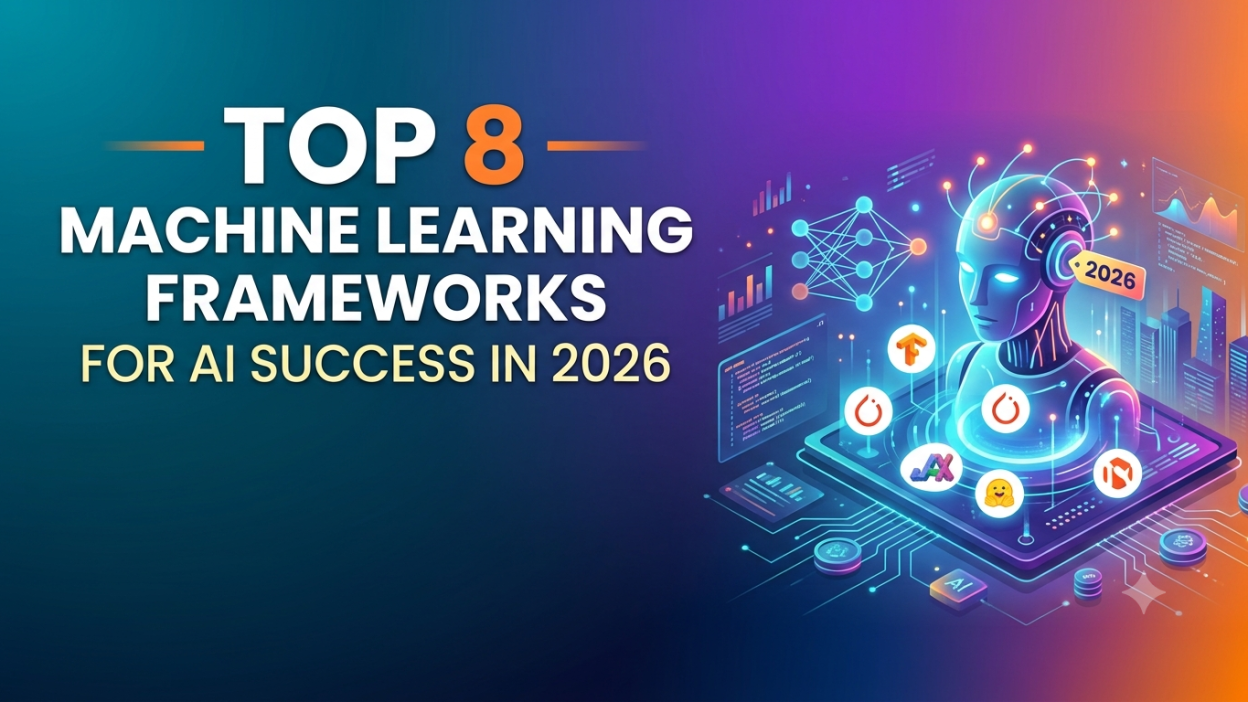
In this article, we explore the top 8 machine learning frameworks for AI success in 2026 and understand what makes each one useful.
What Is a Machine Learning Framework?
A machine learning framework is a software platform that provides tools and libraries for creating and deploying machine learning models.
Instead of implementing algorithms, mathematical operations, optimization techniques, and training procedures manually, developers can use framework APIs to build models more efficiently.
A good framework can help with:
- Data preprocessing
- Model development
- Model training
- Neural network creation
- GPU and accelerator computation
- Model evaluation
- Hyperparameter tuning
- Model deployment
- Large-scale AI development
The right framework can significantly reduce development time and make AI projects easier to maintain.
Why Are Machine Learning Frameworks Important?
Machine learning frameworks have transformed how developers build AI applications. They provide optimized implementations of complex mathematical operations and allow developers to concentrate on solving business problems rather than building every component from the ground up.
For example, frameworks such as PyTorch and TensorFlow are designed for deep learning, while scikit-learn is particularly useful for traditional machine learning. XGBoost and LightGBM are especially effective for structured and tabular datasets.
Modern AI development often combines multiple tools instead of relying on a single framework.
Top 8 Machine Learning Frameworks for AI Success
PyTorch
PyTorch is one of the most widely used frameworks for modern deep learning and artificial intelligence. It provides tensor computation, automatic differentiation, neural-network building blocks, and GPU acceleration.
One of PyTorch’s biggest advantages is its flexibility. Developers can create custom architectures and training workflows without fighting against rigid abstractions.
PyTorch is widely used for:
- Deep learning
- Computer vision
- Natural language processing
- Generative AI
- Large language models
- Research and experimentation
- Recommendation systems
Its Python-friendly design also makes it relatively comfortable for developers who already understand Python.
Best for: Deep learning, AI research, generative AI, and custom neural networks.
TensorFlow
TensorFlow is another major machine learning framework developed by Google. It provides tools for developing, training, and deploying machine learning and deep learning models.
TensorFlow has a large ecosystem that supports different stages of the machine learning lifecycle. Its production-oriented tools make it useful for organizations that need to deploy models across different environments.
TensorFlow can be used for:
- Image classification
- Object detection
- Natural language processing
- Recommendation systems
- Predictive analytics
- Large-scale machine learning
- Production AI applications
TensorFlow also works with the broader TensorFlow ecosystem and can be integrated into production pipelines through technologies such as TensorFlow Extended.
Best for: Production machine learning, scalable AI applications, and organizations already using the TensorFlow ecosystem.
Scikit-learn
Scikit-learn is one of the most popular Python libraries for traditional machine learning. Unlike deep-learning frameworks, it focuses primarily on classical machine learning algorithms and workflows.
It provides implementations for:
- Linear regression
- Logistic regression
- Decision trees
- Random forests
- Support vector machines
- Clustering
- Dimensionality reduction
- Model evaluation
- Data preprocessing
Scikit-learn is especially useful when working with structured datasets. It also provides pipelines that make it easier to combine preprocessing and model training.
It is important to understand that scikit-learn is not intended to replace specialized deep-learning frameworks. Its own documentation notes that deep learning and reinforcement learning are outside its primary design scope.
Best for: Beginners, data scientists, traditional machine learning, structured data, and rapid experimentation.
Keras
Keras is a high-level deep learning API designed to make neural network development easier and more intuitive.
One of the biggest changes in modern Keras is its multi-framework approach. Keras 3 can run on JAX, TensorFlow, or PyTorch, allowing developers to work with different backend ecosystems while using familiar Keras APIs.
This makes Keras particularly attractive for developers who want a simpler interface without giving up access to powerful deep-learning backends.
Keras can be used for:
- Image classification
- Computer vision
- NLP
- Generative AI
- Transfer learning
- Neural network experimentation
- Model deployment
Best for: Beginners, rapid prototyping, deep learning, and developers who want a high-level API.
XGBoost
XGBoost, short for Extreme Gradient Boosting, is a powerful framework for gradient-boosted decision trees.
It is particularly effective for structured or tabular data. Many business applications involve data stored in rows and columns, such as customer records, financial transactions, sales information, and user behavior. XGBoost can perform extremely well on these types of problems.
Common applications include:
- Fraud detection
- Credit risk prediction
- Customer churn prediction
- Sales forecasting
- Classification
- Ranking
- Business analytics
XGBoost is also popular because it provides strong predictive performance while supporting techniques such as regularization and efficient training.
Best for: Tabular data, classification, regression, ranking, and business prediction problems.
LightGBM
LightGBM is another gradient-boosting framework designed for efficient training, particularly on large datasets.
Developed by Microsoft, LightGBM uses tree-based learning techniques and focuses heavily on speed and memory efficiency.
It can be useful when organizations need to process large structured datasets while keeping training times manageable.
Typical applications include:
- Recommendation systems
- Customer analytics
- Fraud detection
- Financial prediction
- Classification
- Regression
- Ranking systems
LightGBM and XGBoost are often considered strong choices for structured business data, where traditional gradient-boosting methods can be highly competitive with neural networks.
Best for: Large tabular datasets, fast model training, recommendation systems, and enterprise analytics.
JAX
JAX is a high-performance numerical computing framework that has become increasingly important for advanced machine learning research.
It provides automatic differentiation and transformations that can help developers efficiently run numerical computations on CPUs, GPUs, and TPUs.
JAX is particularly interesting for researchers and teams working on:
- Large-scale neural networks
- Scientific machine learning
- Advanced optimization
- High-performance computing
- Custom AI architectures
- Research involving accelerators
Its approach gives developers considerable control over numerical computation and hardware acceleration.
JAX is also part of the modern Keras ecosystem because Keras 3 can use JAX as one of its backends.
Best for: High-performance machine learning, research, numerical computing, and accelerator-based workloads.
Apache Spark MLlib
Apache Spark MLlib is a machine learning library designed for distributed data processing with Apache Spark.
It becomes particularly useful when datasets are too large or computationally demanding for conventional single-machine workflows.
Spark MLlib supports machine learning tasks such as:
- Classification
- Regression
- Clustering
- Recommendation
- Feature engineering
- Model evaluation
One of its biggest strengths is its integration with Spark’s distributed computing capabilities.
For organizations processing massive amounts of data, this can make machine learning workflows more scalable.
Best for: Big data, distributed machine learning, enterprise analytics, and large-scale data processing.
Quick Comparison of the Top Machine Learning Frameworks
| Framework | Best For | Main Strength |
|---|---|---|
| PyTorch | Deep learning & Generative AI | Flexibility |
| TensorFlow | Production AI | Scalable ecosystem |
| Scikit-learn | Traditional ML | Simplicity |
| Keras | Deep learning | Easy development |
| XGBoost | Tabular data | Strong predictive performance |
| LightGBM | Large tabular datasets | Speed and efficiency |
| JAX | Advanced AI research | High-performance computing |
| Spark MLlib | Big data | Distributed processing |
How to Choose the Right Machine Learning Framework
Choosing a framework should depend on the problem you are trying to solve rather than simply selecting the most popular technology.
If you are learning machine learning for the first time, scikit-learn is a strong starting point because it provides straightforward APIs for many classical algorithms.
For deep learning and generative AI, PyTorch is an excellent option because of its flexibility and strong ecosystem.
If your organization already has a large TensorFlow-based infrastructure, continuing with TensorFlow can make sense, particularly for established production workflows.
For structured business datasets, consider XGBoost or LightGBM before automatically choosing a neural network.
If you need a simple high-level deep-learning interface, Keras can be a great choice. Its ability to work across JAX, TensorFlow, and PyTorch backends provides additional flexibility.
For very large datasets, Spark MLlib can be valuable because of its distributed processing capabilities.
Machine Learning Frameworks and the Future of AI
The machine learning ecosystem is no longer divided simply between traditional machine learning and deep learning. Modern AI development involves multiple layers, including classical ML, neural networks, foundation models, generative AI, deployment infrastructure, and MLOps.
As a result, developers may use several frameworks within the same project.
For example, a team could use scikit-learn for preprocessing and baseline models, XGBoost for structured prediction, PyTorch for deep-learning components, and specialized tools for deployment and monitoring. This combination-based approach is becoming increasingly common in practical AI development.
The rise of generative AI is also increasing the importance of flexible deep-learning frameworks. Developers need tools that can support large models, hardware acceleration, fine-tuning, inference, and experimentation.
Conclusion
Machine learning frameworks provide the foundation developers need to transform AI ideas into practical applications. From beginner-friendly tools to high-performance research platforms, each framework serves a different purpose.
PyTorch is a strong choice for modern deep learning and AI research, while TensorFlow remains valuable for scalable production ecosystems. Scikit-learn is excellent for traditional machine learning, and Keras makes deep-learning development more accessible. For structured data, XGBoost and LightGBM are powerful options, while JAX targets high-performance numerical and AI workloads. Finally, Spark MLlib is useful when machine learning needs to operate across massive datasets.
The best machine learning framework is ultimately the one that matches your data, model, hardware, development skills, and deployment requirements. Learning the fundamentals of more than one framework can also give developers greater flexibility as AI technology continues to evolve in 2026 and beyond.
Want to Learn More About Python & Artificial Intelligence ?, Kaashiv Infotech Offers Full Stack Python Course, Artificial Intelligence Course, Data Science Course & More Visit Their Website course.kaashivinfotech.com.
Related Reads:
Artificial Intelligence vs Human Intelligence: A Deep Dive into Minds Made and Minds Born
Top 10 AI Tools for Content Creation in 2026 You Shouldn’t Miss.