
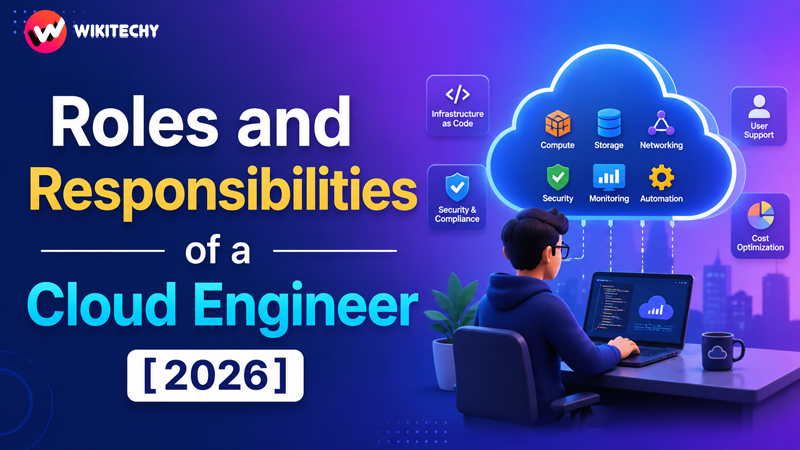
Cloud computing is the foundation of how modern businesses operate, innovate, and scale. In 2026, the role of a Cloud Engineer has evolved into something far more strategic than simple infrastructure management. Today’s cloud engineers are responsible for building intelligent, automated, and highly resilient systems that power everything from mobile apps to AI-driven platforms.
This detailed guide explores the expanded roles and responsibilities of a Cloud Engineer in 2026, explained in a practical, real-world context with deeper insights and minimal bullet points.
Understanding the Role of a Cloud Engineer
A Cloud Engineer is a technology professional who designs, builds, deploys, and maintains cloud-based infrastructure and applications. Unlike traditional system administrators, cloud engineers work in dynamic environments where scalability, automation, and cost optimization are critical.
In modern organizations, they act as a bridge between development, operations, and business teams. Their work ensures that applications are always available, systems are secure, and infrastructure can adapt instantly to changing demands.
What makes this role especially important in 2026 is the increasing reliance on distributed systems, AI workloads, and real-time data processing. Cloud engineers are no longer just managing servers—they are enabling innovation.
The Expanding Scope of Cloud Engineering in 2026
The responsibilities of a cloud engineer have significantly broadened over the years. Earlier, the focus was mainly on hosting applications in the cloud. Today, the role involves designing intelligent ecosystems that integrate automation, security, and performance optimization.
Organizations now expect cloud engineers to think strategically. Instead of simply deploying resources, they must understand business goals and design infrastructure that supports growth, reduces costs, and enhances user experience.
Cloud engineers also play a key role in sustainability by optimizing resource usage and reducing unnecessary compute consumption. Efficient cloud architecture is not just about performance anymore—it is also about responsibility.
Roles and Responsibilities of a Cloud Engineer
Designing Scalable and Resilient Cloud Architectures
One of the most critical responsibilities of a cloud engineer is designing cloud architecture that can handle real-world challenges. This involves creating systems that can scale automatically when traffic increases and remain stable even during failures.
In practice, this means building distributed systems where workloads are balanced across multiple servers and regions. If one component fails, another takes over without affecting the user experience. This level of resilience is essential for modern applications like e-commerce platforms, streaming services, and fintech systems.
Cloud engineers must also decide which services to use—whether it’s virtual machines, containers, or serverless computing. Each choice impacts performance, cost, and scalability.
Managing Cloud Infrastructure in Real Time
Once systems are deployed, cloud engineers are responsible for managing and maintaining them. This is not a passive task—it requires constant monitoring and optimization.
Engineers use monitoring tools to track system health, performance metrics, and usage patterns. When issues arise, they must quickly diagnose and resolve them to avoid downtime. This could involve fixing a misconfigured server, scaling resources, or debugging application errors.
In 2026, this process is heavily supported by automation and AI-driven monitoring systems. However, human expertise is still essential for decision-making and complex problem-solving.
Cloud Migration and Modernization
Many organizations are still transitioning from traditional systems to the cloud. Cloud engineers lead this transformation by planning and executing migration strategies.
This process involves analyzing existing systems, identifying dependencies, and choosing the best migration approach. Some applications can be moved as they are, while others need to be redesigned to fully benefit from cloud capabilities.
Modernization is equally important. Cloud engineers often refactor legacy applications into microservices or container-based architectures, making them more scalable and easier to manage.
Security as a Core Responsibility
Security has become one of the most important aspects of cloud engineering. With increasing cyber threats and data regulations, cloud engineers must ensure that systems are secure by design.
This includes implementing strict access controls, encrypting sensitive data, and continuously monitoring for vulnerabilities. Engineers must also ensure compliance with industry standards and legal requirements.
In 2026, security is deeply integrated into every stage of cloud development. It is no longer a separate task—it is a continuous responsibility that requires constant attention.
Automation and DevOps Integration
Automation is at the heart of modern cloud engineering. Manual processes are no longer practical in large-scale environments, which is why cloud engineers rely on Infrastructure as Code and DevOps practices.
Instead of manually configuring servers, engineers write code that defines the entire infrastructure. This code can be reused, version-controlled, and deployed automatically, ensuring consistency and reducing errors.
Continuous Integration and Continuous Deployment (CI/CD) pipelines allow teams to release updates quickly and safely. Cloud engineers build and maintain these pipelines, ensuring smooth collaboration between development and operations teams.
Performance Optimization and Cost Management
One of the unique challenges of cloud computing is balancing performance with cost. Cloud resources are billed based on usage, so inefficient systems can quickly become expensive.
Cloud engineers are responsible for optimizing both performance and cost. They analyze usage patterns, remove unused resources, and choose the most efficient configurations.
For example, they may implement auto-scaling systems that increase resources during peak traffic and reduce them during low usage. This ensures optimal performance without unnecessary spending.
Disaster Recovery and Business Continuity
Unexpected failures can occur at any time, whether due to system errors, cyberattacks, or natural disasters. Cloud engineers must prepare for these scenarios by designing robust disaster recovery strategies.
This involves creating backups, replicating data across regions, and setting up failover systems. The goal is to ensure that services can be restored quickly with minimal data loss.
In critical industries like banking and healthcare, even a few minutes of downtime can have serious consequences. Cloud engineers play a vital role in preventing such disruptions.
Supporting AI, Data, and Advanced Workloads
In 2026, cloud engineers are increasingly involved in supporting advanced technologies such as artificial intelligence and big data.
They build infrastructure capable of handling massive datasets and high-performance computing workloads. This includes setting up data pipelines, managing storage systems, and ensuring efficient processing.
AI applications, in particular, require scalable and flexible environments. Cloud engineers ensure that these environments can handle training models, running inferences, and processing real-time data efficiently.
Collaboration Across Teams
Cloud engineering is not an isolated role. Engineers work closely with developers, data scientists, security teams, and business stakeholders.
They help translate technical requirements into practical solutions and ensure that infrastructure aligns with application needs. Effective communication is essential, as cloud engineers often act as decision-makers in technical discussions.
Their ability to collaborate directly impacts the success of projects and the efficiency of teams.
Daily Life of a Cloud Engineer
A typical day for a cloud engineer is dynamic and problem-focused. It might begin with reviewing system dashboards to check for performance issues or unusual activity. From there, they may work on deploying new features, optimizing infrastructure, or improving automation processes.
Some days involve troubleshooting critical issues, while others focus on long-term improvements such as architecture redesign or cost optimization. The role requires adaptability, as priorities can shift quickly based on business needs.
Skills That Define a Cloud Engineer in 2026
To succeed as a cloud engineer, one must combine strong technical knowledge with practical experience. Understanding cloud platforms, networking, and system design is essential. Equally important is the ability to automate processes and work with modern tools like containers and orchestration systems.
Beyond technical skills, problem-solving ability and clear communication are crucial. Cloud engineers often deal with complex systems, and their decisions can have a significant impact on business operations.
The Future of Cloud Engineering
The future of cloud engineering is shaped by rapid technological advancements. Concepts like serverless computing, edge computing, and AI-driven automation are redefining how systems are built and managed.
Cloud engineers will need to continuously learn and adapt to these changes. The role will become even more strategic, with a greater focus on innovation, efficiency, and sustainability.
As businesses continue to embrace digital transformation, the demand for skilled cloud engineers will only increase.
Conclusion
In 2026, the role of a Cloud Engineer goes far beyond managing infrastructure. It is a multifaceted position that combines architecture design, security, automation, and strategic thinking.
Cloud engineers are the backbone of modern digital systems, ensuring that applications run smoothly, securely, and efficiently. Their work enables businesses to scale, innovate, and compete in an increasingly digital world.
For anyone looking to build a career in technology, cloud engineering offers one of the most exciting and future-proof opportunities available today.
Want Learn Cloud Computing Course, Cyber Security Course, Networking Course ?, Visit Our Website www.kaashivinfotech.com.