
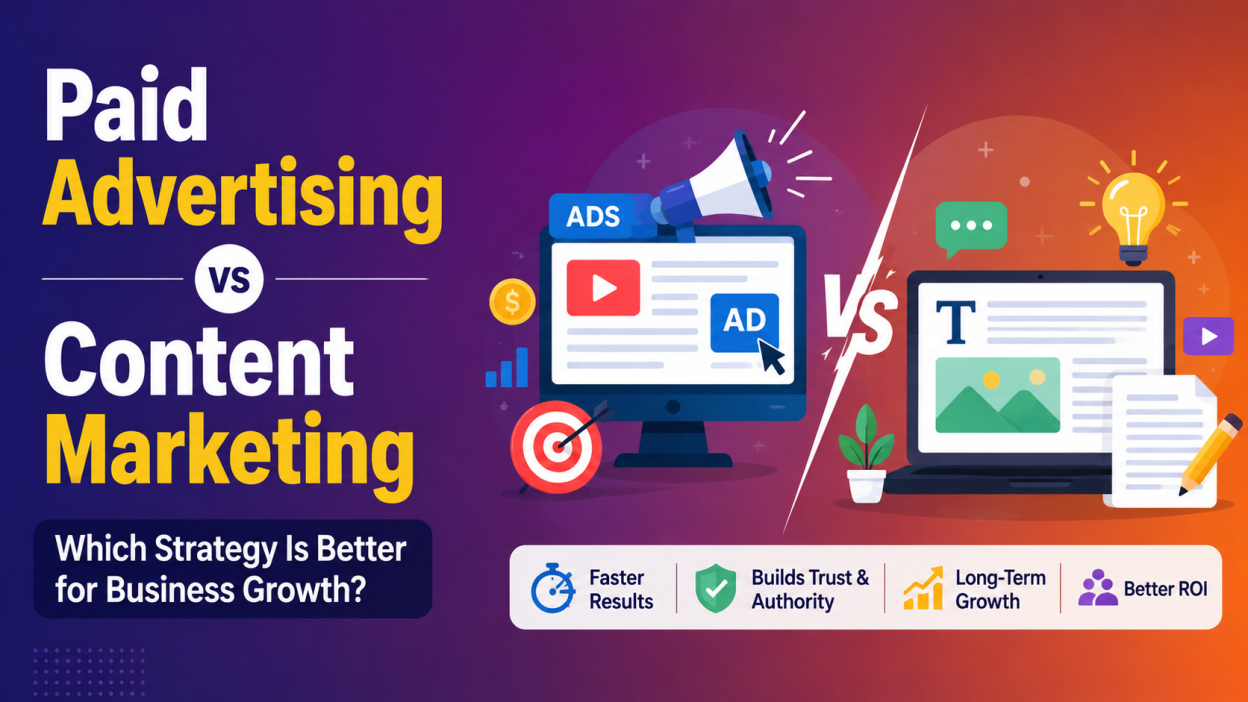
In today’s competitive digital landscape, businesses have many ways to reach potential customers. Two of the most popular approaches are paid advertising vs content marketing. Both can increase visibility, attract customers, and generate revenue, but they work in very different ways.
Paid advertising focuses on paying platforms to reach a targeted audience quickly. Content marketing focuses on creating useful and valuable content that attracts people organically and builds trust over time. Recent marketing discussions continue to highlight this fundamental difference: paid advertising offers speed, while content marketing creates longer-term assets that can continue working after publication.
So, which strategy is better? The answer depends on your business goals, budget, audience, and timeline. In many cases, the strongest approach is not choosing one over the other, but using both strategically.
What Is Paid Advertising?
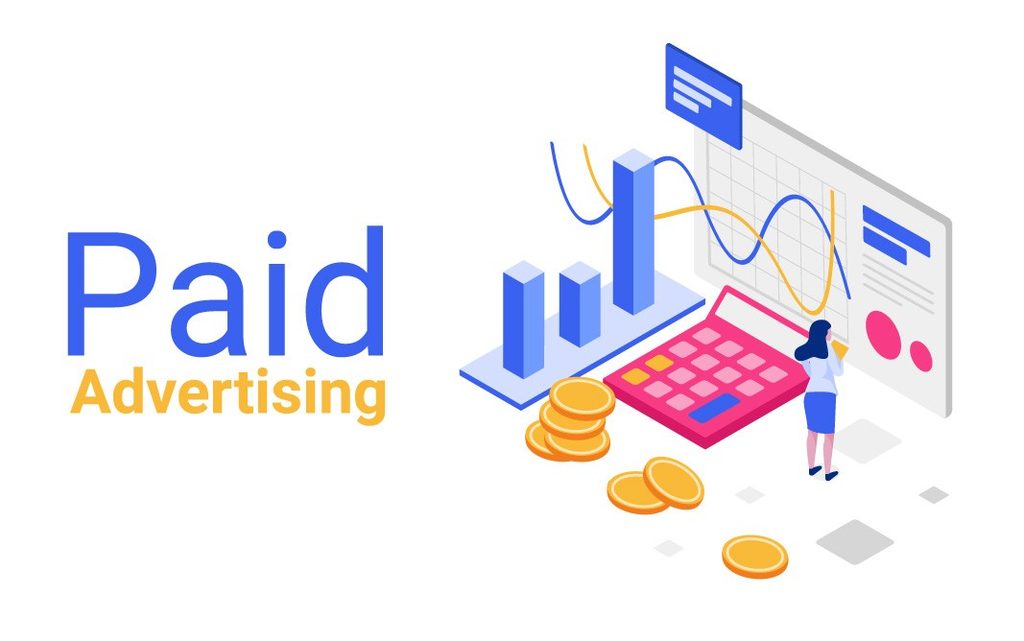
Paid advertising is a marketing method where businesses pay advertising platforms to display promotional messages to a specific audience. Common platforms include Google Ads, Facebook, Instagram, LinkedIn, YouTube, and other advertising networks.
For example, if you own an online clothing store, you can create an advertisement for a new collection and target people based on location, interests, demographics, search behavior, or previous interactions with your website.
One of the biggest advantages of paid advertising is speed. Once a campaign is approved and launched, it can begin generating impressions, clicks, website visits, leads, or sales relatively quickly.
Paid advertising can include:
- Search engine advertisements
- Social media advertisements
- Display advertising
- Video advertisements
- Shopping advertisements
- Retargeting campaigns
- Sponsored content
Businesses usually measure paid campaigns using metrics such as Cost Per Click (CPC), Cost Per Lead (CPL), conversion rate, customer acquisition cost (CAC), and Return on Ad Spend (ROAS).
What Is Content Marketing?
Content marketing is a strategy based on creating and distributing useful, relevant, and engaging content for a specific audience.
Instead of directly paying for every visitor, businesses create content that people want to discover. This can include blog articles, tutorials, videos, social media posts, case studies, ebooks, newsletters, podcasts, and guides.
For example, a cybersecurity training company could publish articles such as:
- What Is Ethical Hacking?
- How Does a Firewall Work?
- Beginner’s Guide to Network Security
- Best Cybersecurity Certifications in 2026
Someone searching for these topics may discover the company’s content through Google or social media. If the content provides genuine value, that visitor may eventually become a subscriber, lead, or customer.
Content marketing generally takes longer to produce results, but successful content can continue attracting visitors for months or even years.
Paid Advertising vs Content Marketing: Key Difference
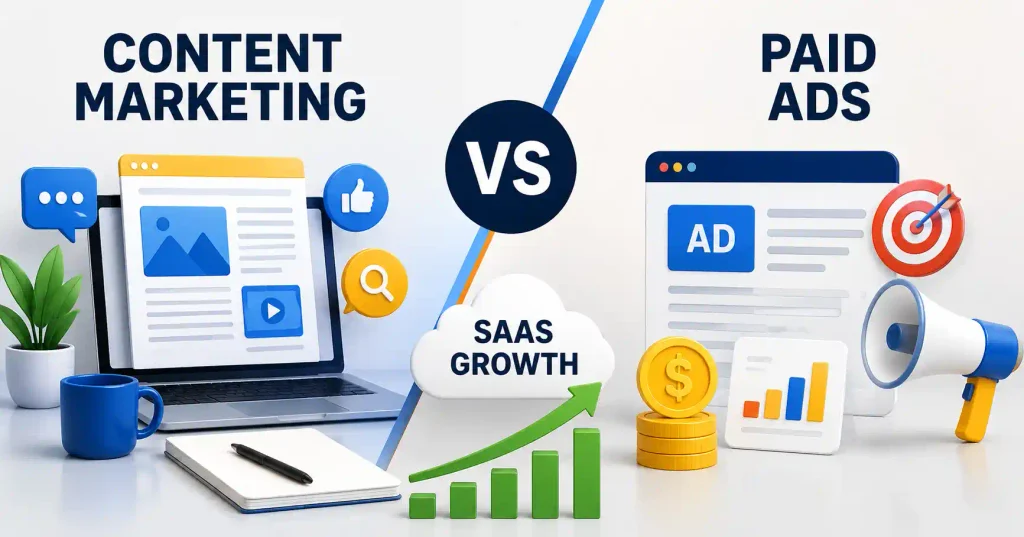
The easiest way to understand the difference is this:
Paid advertising buys attention, while content marketing earns attention.
With paid advertising, you pay a platform to put your message in front of potential customers. When your advertising budget stops, your campaign generally stops generating paid traffic.
With content marketing, you invest time and resources into creating content that can continue attracting organic traffic after publication.
This makes paid advertising similar to renting visibility, while content marketing is more like building a long-term digital asset.
| Factor | Paid Advertising | Content Marketing |
|---|---|---|
| Results | Fast | Gradual |
| Cost | Ongoing ad spend | Content production investment |
| Traffic | Paid | Mainly organic |
| Long-term value | Limited after campaign ends | Can continue over time |
| Main goal | Quick traffic and conversions | Trust, authority and organic growth |
| Targeting | Highly targeted | Based largely on audience needs and search intent |
| Best for | Launches and quick campaigns | Sustainable growth |
| Measurement | CPC, CPL, ROAS, conversions | Traffic, rankings, engagement, leads |
Benefits of Paid Advertising
1. Faster Results
The biggest advantage of paid advertising is speed. Businesses do not have to wait months for SEO rankings or organic visibility. A properly configured campaign can start bringing visitors soon after launch.
This makes paid advertising particularly useful for product launches, seasonal promotions, events, and limited-time offers.
2. Precise Audience Targeting
Advertising platforms provide sophisticated targeting options. Depending on the platform, businesses can target audiences based on factors such as location, interests, demographics, keywords, behavior, and previous interactions.
This allows marketers to put advertisements in front of people who are more likely to be interested in their products or services.
3. Easy Performance Tracking
Paid advertising provides extensive campaign data. Marketers can monitor impressions, clicks, conversions, spending, and revenue.
This makes it easier to identify which advertisements are performing well and which ones need improvement.
4. Easy to Scale
When a campaign generates profitable results, businesses can potentially increase their budget and reach a larger audience.
However, scaling should be done carefully. Increasing spending does not automatically guarantee the same return.
Benefits of Content Marketing
1. Builds Trust
People do not always want to see advertisements. They often want answers to their questions before making a purchase.
Helpful content allows businesses to educate their audience and demonstrate expertise. Over time, this can improve credibility and trust.
2. Supports SEO
High-quality content can help websites attract organic search traffic. Blog posts, guides, landing pages, and educational resources can target relevant keywords and answer users’ search questions.
This makes content marketing an important part of a long-term SEO strategy.
3. Creates Long-Term Value
A paid advertisement generally requires continuous spending to remain visible. Content can continue attracting visitors after its initial publication.
A well-optimized article can potentially generate traffic and leads long after it was created.
4. Supports Different Stages of the Customer Journey
Content can help customers at different stages.
For example:
Awareness:
“What Is Cloud Computing?”
Consideration:
“Cloud Computing vs Traditional Hosting”
Decision:
“Best Cloud Computing Course for Beginners”
This approach allows businesses to guide potential customers from awareness to purchase.
Which Is More Cost-Effective?
There is no universal answer.
Paid advertising can be expensive if campaigns are poorly optimized, but it can also generate strong returns when targeting, messaging, landing pages, and conversion tracking are effective.
Content marketing requires investment in research, writing, design, video production, SEO, and promotion. Its results can take longer to develop, but successful content may continue generating organic traffic without paying for every individual visit.
Therefore, businesses should not simply compare the initial cost. They should evaluate customer acquisition cost, conversion rate, lifetime customer value, and long-term return on investment.
When Should You Choose Paid Advertising?
Paid advertising is a good option when your business:
- Needs immediate traffic
- Is launching a new product
- Has a limited-time promotion
- Wants to test a new offer
- Needs quick lead generation
- Has a clearly defined target audience
- Wants measurable short-term results
For example, an education company launching a new course next month may use Google and social media advertisements to generate registrations quickly.
When Should You Choose Content Marketing?
Content marketing is particularly useful when your business:
- Wants sustainable organic traffic
- Is building brand authority
- Has a long-term growth strategy
- Wants to improve SEO
- Wants to educate potential customers
- Wants to reduce dependence on paid traffic
- Has valuable expertise to share
A technology company, for example, can create tutorials, guides, comparisons, and industry articles that attract potential customers throughout the year.
Why Businesses Should Combine Both
The real opportunity comes from combining paid advertising and content marketing.
Instead of treating them as competing strategies, businesses can make them work together.
Imagine you publish an in-depth article about “Best Cybersecurity Courses for Beginners.” You can optimize the article for SEO and attract organic visitors. At the same time, you can use paid advertising to promote the article to a targeted audience.
Visitors who read the article can then be introduced to your course or service. You can also retarget visitors who showed interest but did not immediately convert.
This creates a complete marketing funnel:
Content → Traffic → Engagement → Retargeting → Conversion
Paid advertising can provide the initial push, while content helps educate and build trust. This hybrid approach is increasingly relevant as marketers focus on combining immediate performance with long-term brand and audience development.
How to Create the Right Strategy
Start by identifying your primary goal.
If your goal is immediate sales, paid advertising may deserve more attention.
If your goal is long-term organic growth, invest heavily in content and SEO.
If you want both, create a balanced strategy.
For example, a business could:
- Research its target audience.
- Create useful SEO-focused content.
- Build optimized landing pages.
- Launch targeted paid campaigns.
- Promote high-performing content.
- Retarget interested visitors.
- Analyze conversions and revenue.
- Improve campaigns based on performance.
The exact budget split should depend on the company’s industry, margins, sales cycle, existing organic visibility, and growth objectives rather than following a fixed percentage for every business.
Final Thoughts
Paid advertising vs content marketing is not really about choosing a winner. Both strategies solve different marketing problems.
Paid advertising is the sprinter. It can deliver visibility and traffic quickly, making it valuable for launches, promotions, and immediate lead generation.
Content marketing is the long-distance runner. It takes time to build momentum, but strong content can create trust, authority, SEO visibility, and ongoing organic traffic.
For most businesses, the smartest strategy is to use both. Use paid advertising for speed and testing, while using content marketing for trust and sustainable growth. When these strategies are connected through strong landing pages, SEO, analytics, and retargeting, they can create a more complete digital marketing system.
In 2026, businesses should focus less on the question “Paid ads or content marketing?” and more on “How can we use both to achieve our business goals?” The right combination can help businesses generate immediate opportunities while building a valuable digital presence for the future.
Want to learn More about Marketing Management Kaashiv Infotech Offers Digital Marketing Course & More, Visit www.kaashivinfotech.com.