
Recursion Algorithms in DSA – is one of the most fundamental and intellectually satisfying concepts in Data Structures and Algorithms (DSA). It represents a way of solving problems where a function calls itself with smaller inputs, gradually reducing the complexity of the problem until it reaches a point that can be solved directly.
Instead of approaching a problem as one large task, recursion encourages breaking it down into smaller, identical subproblems. This divide-and-simplify approach is especially powerful when dealing with hierarchical data structures like trees and graphs, or when implementing algorithms that naturally follow repeated patterns.
At first glance, recursion might feel confusing because the function appears to “loop” within itself. However, once you understand the underlying logic and flow, it becomes a highly intuitive and elegant problem-solving tool.
The Core Logic Behind Recursion
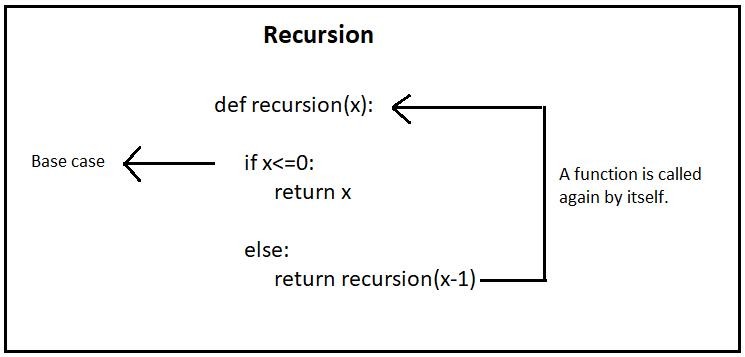
To truly understand recursion, it is important to internalize its two essential components: the base case and the recursive case.
The base case acts as the stopping condition. Without it, the function would continue calling itself indefinitely, eventually crashing due to memory overflow. The recursive case is where the function reduces the problem into a smaller version and calls itself again.
Let’s consider a simple example: calculating the factorial of a number.
def factorial(n):
    if n == 0:
        return 1
    return n * factorial(n - 1)
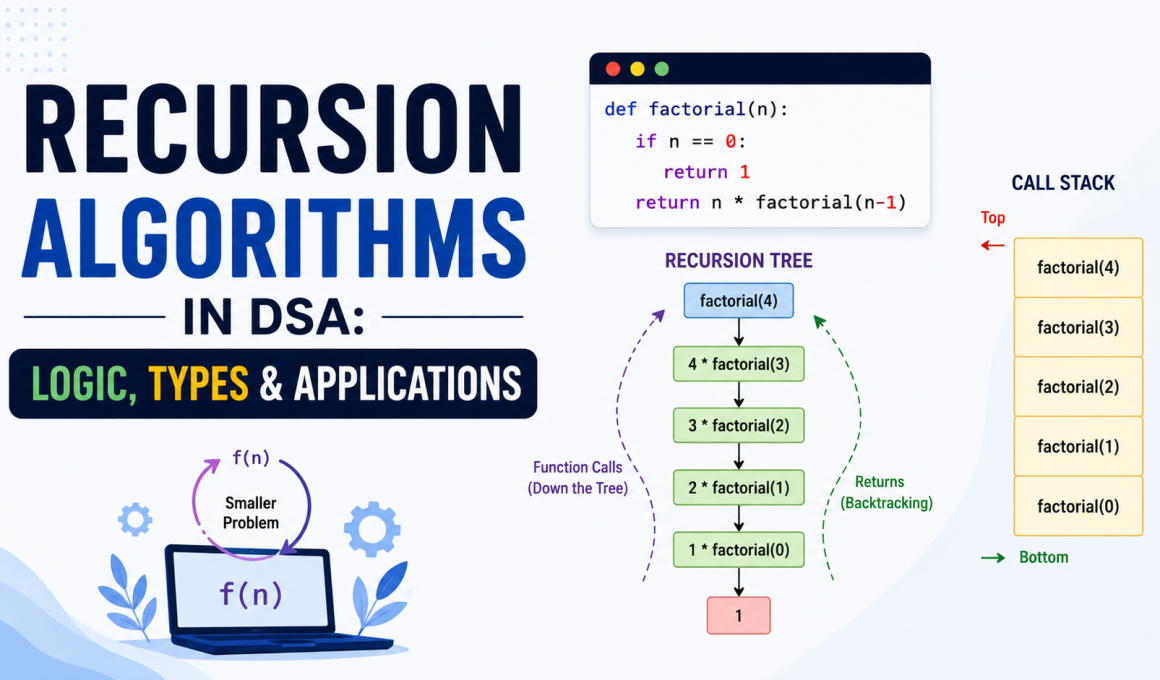
In this example, the function repeatedly calls itself, decreasing the value of n each time. Eventually, it reaches n == 0, which is the base case. At that point, the function stops calling itself and begins returning values back through the chain of calls.
This “going down” phase is known as recursion descent, while the returning phase is called recursion unwinding.
Understanding the Call Stack in Recursion
Every time a recursive function is invoked, the system stores its state in a structure called the call stack. Each function call is placed on top of the stack, waiting for its inner call to complete.
For example, when calculating factorial(4), the following happens internally:
- factorial(4) waits for factorial(3)
- factorial(3) waits for factorial(2)
- factorial(2) waits for factorial(1)
- factorial(1) waits for factorial(0)
Once the base case is reached, the stack begins to unwind:
- factorial(0) returns 1
- factorial(1) returns 1 × 1
- factorial(2) returns 2 × 1
- factorial(3) returns 3 × 2
- factorial(4) returns 4 × 6
This stack-based execution is what makes recursion powerful but also memory-intensive. If the recursion depth becomes too large, it may lead to a stack overflow error, which is one of the primary limitations of recursion.
Types of Recursion
Direct and Indirect Recursion
In direct recursion, a function calls itself directly within its body. This is the most common and easiest form to understand.
Indirect recursion, on the other hand, involves multiple functions calling each other in a circular manner. For instance, function A may call function B, and function B may call function A again. While less common, this type is useful in certain complex logical flows.
Tail Recursion and Non-Tail Recursion
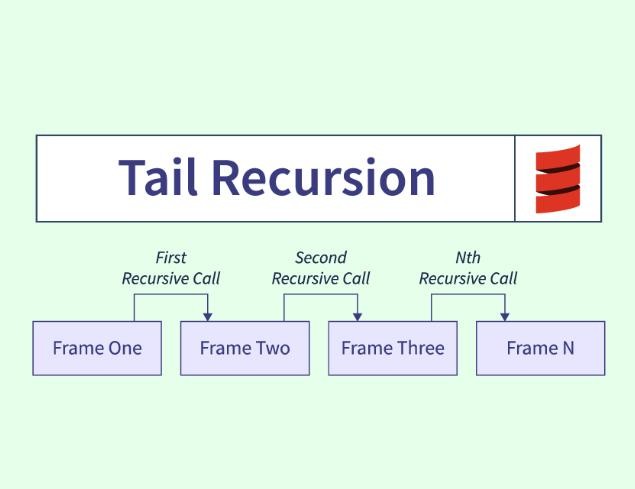
Tail recursion occurs when the recursive call is the final operation in the function. This means there is no additional computation after the recursive call returns.
def fact(n, result=1):
    if n == 0:
        return result
    return fact(n - 1, n * result)
Because the recursive call is the last step, some compilers can optimize this pattern by reusing stack frames, making it more memory-efficient.
Non-tail recursion, by contrast, involves additional computation after the recursive call. This prevents optimization and increases memory usage.
Linear, Tree, and Nested Recursion
Linear recursion is the simplest form, where each function call results in only one additional call. Problems like factorial calculation fall into this category.
Tree recursion is more complex, as each function call generates multiple recursive calls. A classic example is the Fibonacci sequence:
def fib(n):
    if n <= 1:
        return n
    return fib(n - 1) + fib(n - 2)
This creates a branching structure resembling a tree, which can lead to exponential time complexity if not optimized.
Nested recursion is a more advanced form where a recursive call is used as an argument to another recursive call. While rarely used in everyday programming, it demonstrates the depth and flexibility of recursion as a concept.
Recursion vs Iteration: A Deeper Perspective
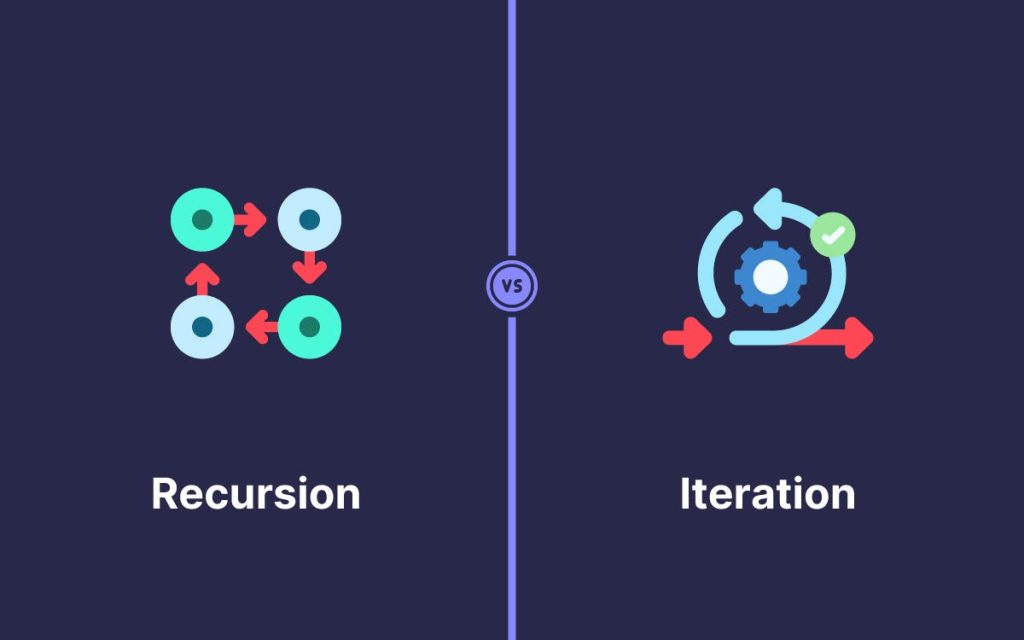
Recursion and iteration are two different approaches to solving repetitive problems, and each has its own strengths and weaknesses.
Recursion often leads to cleaner and more readable code because it aligns closely with mathematical definitions and logical structures. It is particularly effective for problems involving hierarchical relationships, such as tree traversal or divide-and-conquer algorithms.
Iteration, on the other hand, uses loops and typically consumes less memory since it does not rely on the call stack. It is generally faster and safer for large-scale computations.
In practice, many recursive solutions can be converted into iterative ones using stacks or loops. However, recursion remains the preferred choice when clarity and conceptual simplicity are more important than raw performance.
Applications of Recursion in DSA
Recursion is deeply embedded in many core algorithms and data structures. Its ability to simplify complex patterns makes it indispensable in computer science.
One of the most common uses of recursion is in tree traversal. Since trees are naturally recursive structures, operations like inorder, preorder, and postorder traversal are most easily implemented using recursion.
Another major application is in divide and conquer algorithms such as Merge Sort and Quick Sort. These algorithms split a problem into smaller subproblems, solve them recursively, and then combine the results.
Recursion is also essential in backtracking algorithms, where the solution is built step by step and invalid paths are discarded. Problems like the N-Queens puzzle, Sudoku solving, and maze navigation rely heavily on recursion.
In graph theory, recursion is used in Depth First Search (DFS), where the algorithm explores as far as possible along a branch before backtracking.
Additionally, recursion plays a key role in dynamic programming, especially when combined with memoization to optimize repeated calculations.
Advantages of Recursion
Recursion shines in scenarios where problems can be broken down into smaller, similar subproblems. It allows developers to write solutions that are not only concise but also closely aligned with the conceptual structure of the problem.
It reduces the need for complex loop constructs and auxiliary data structures, making the code easier to read and maintain. For problems involving trees, graphs, and combinatorial logic, recursion often provides the most natural solution.
Limitations and Challenges
Despite its elegance, recursion is not without drawbacks. The most significant issue is memory consumption, as each recursive call adds a new frame to the call stack.
Another challenge is debugging. Recursive functions can be harder to trace, especially when the depth of recursion is large. Without a clear understanding of the base case and flow, it is easy to create infinite recursion.
Performance can also be a concern in cases like naive Fibonacci computation, where redundant calculations lead to inefficiency. In such cases, optimization techniques like memoization or converting to iteration become necessary.
How to Master Recursion
Mastering recursion requires practice and a shift in thinking. Instead of focusing on the entire problem, you must learn to trust that the recursive call will handle the smaller subproblem correctly.
Start by identifying the base case clearly. Then define how the problem can be reduced step by step. Dry-running the function and visualizing the recursion tree can greatly improve understanding.
It is also helpful to practice common problems repeatedly, such as factorial, Fibonacci, binary search, and tree traversal. Over time, recognizing recursive patterns becomes second nature.
Real-World Analogy
Imagine a set of nested boxes, where each box contains a smaller box inside it. To find the smallest box, you open one box at a time. Once you reach the smallest box, you stop and begin closing them one by one.
This process perfectly mirrors recursion: breaking down a problem until the simplest case is reached, then building the solution back up.
Conclusion
Recursion is more than just a programming technique—it is a way of thinking about problems. It encourages breaking down complexity into simplicity and provides elegant solutions to some of the most challenging problems in computer science.
While it comes with certain limitations, a strong understanding of recursion is essential for mastering DSA. Whether you are working with trees, graphs, sorting algorithms, or backtracking problems, recursion will continue to be one of your most valuable tools.
Want to learn more ??, Kaashiv Infotech Offers Data Analytics Course, Data Science Course, Cyber Security Course & More Visit Their Website www.kaashivinfotech.com.