
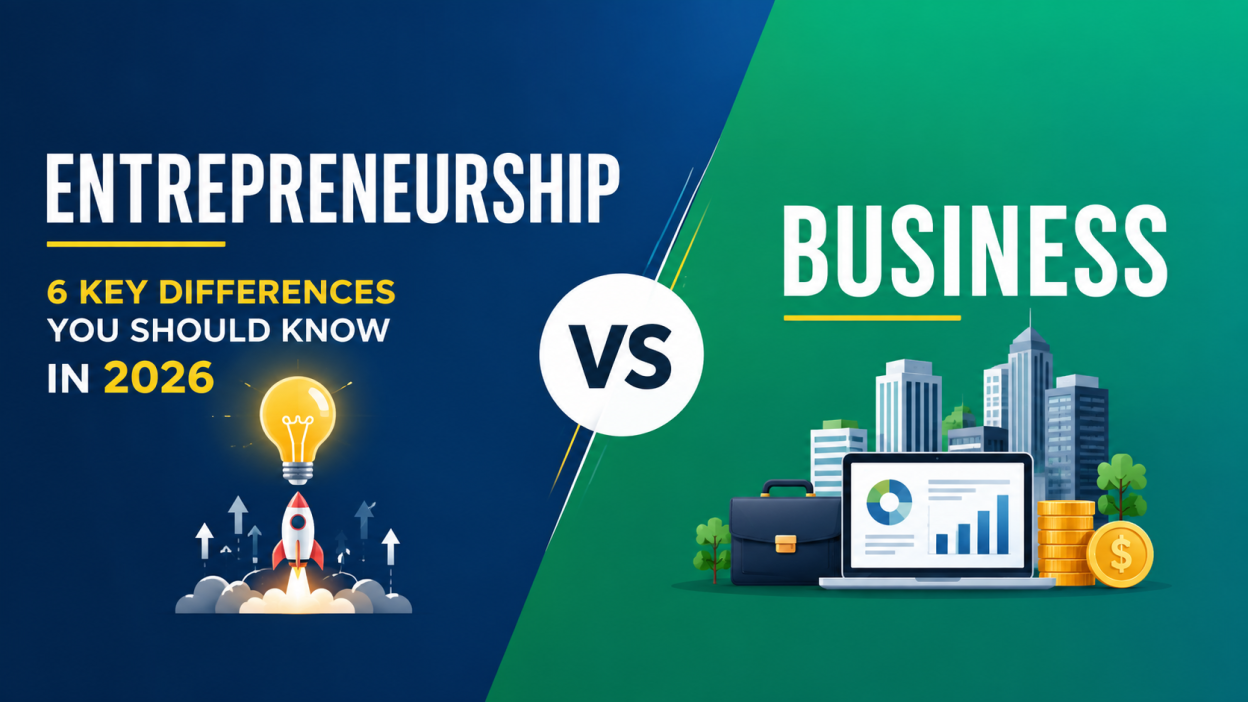
Entrepreneurship vs business are closely connected, but they are not exactly the same. Many people use these terms interchangeably, yet they represent different ideas, approaches, and goals. A business generally focuses on selling products or services and generating revenue, while entrepreneurship is more focused on identifying opportunities, creating innovative solutions, and building something new.
Whether you are a student, aspiring entrepreneur, working professional, or someone planning to start a company, understanding the difference between entrepreneurship and business can help you choose the right career path.
In this article, let us explore the top 6 differences between entrepreneurship and business and understand how they work in the real world.
What Is Entrepreneurship?

Entrepreneurship is the process of identifying a problem or opportunity and creating a product, service, or business solution around it. An entrepreneur takes risks to turn an idea into a sustainable venture.
Entrepreneurship is often associated with innovation. Entrepreneurs may introduce a completely new product, improve an existing service, or find a better way to solve a common problem.
For example, someone who notices that small businesses struggle to manage their social media and creates an AI-powered marketing platform is demonstrating entrepreneurship.
An entrepreneur usually focuses on:
- Identifying opportunities
- Creating innovative solutions
- Taking calculated risks
- Building a new venture
- Solving customer problems
- Creating long-term value
What Is Business?

A business is an organization or activity created to provide products or services to customers in exchange for money. The primary objective is generally to generate revenue and profit while maintaining sustainable operations.
Businesses can range from small local shops to large multinational companies.
For example, opening a bakery and selling cakes, bread, and snacks to customers is a business. The owner may use an existing business model rather than creating something completely new.
A business generally focuses on:
- Selling products or services
- Generating revenue
- Managing operations
- Serving customers
- Controlling costs
- Earning profits
Entrepreneurship vs Business: Top 6 Differences
Although entrepreneurship and business overlap in many areas, there are several important differences between them.
1. Meaning and Purpose
The first major difference is their purpose.
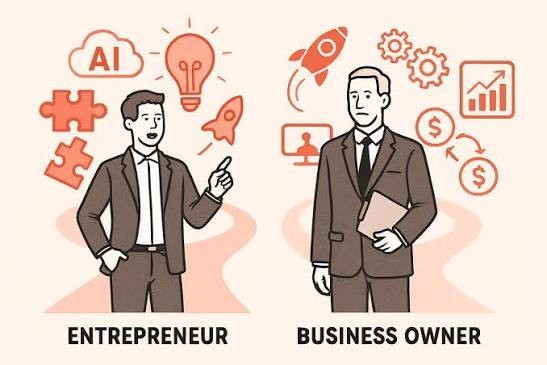
Entrepreneurship focuses on creating something new or finding innovative solutions to existing problems. Entrepreneurs look for opportunities and try to convert their ideas into successful ventures.
Business, on the other hand, focuses primarily on operating an organization that provides products or services to customers and generates revenue.
For example, developing a completely new educational technology platform can be considered entrepreneurship. Running a traditional coaching center using an established business model is a business activity.
In simple terms:
Entrepreneurship is about creating and pursuing opportunities, while business is about operating and managing commercial activities.
2. Innovation
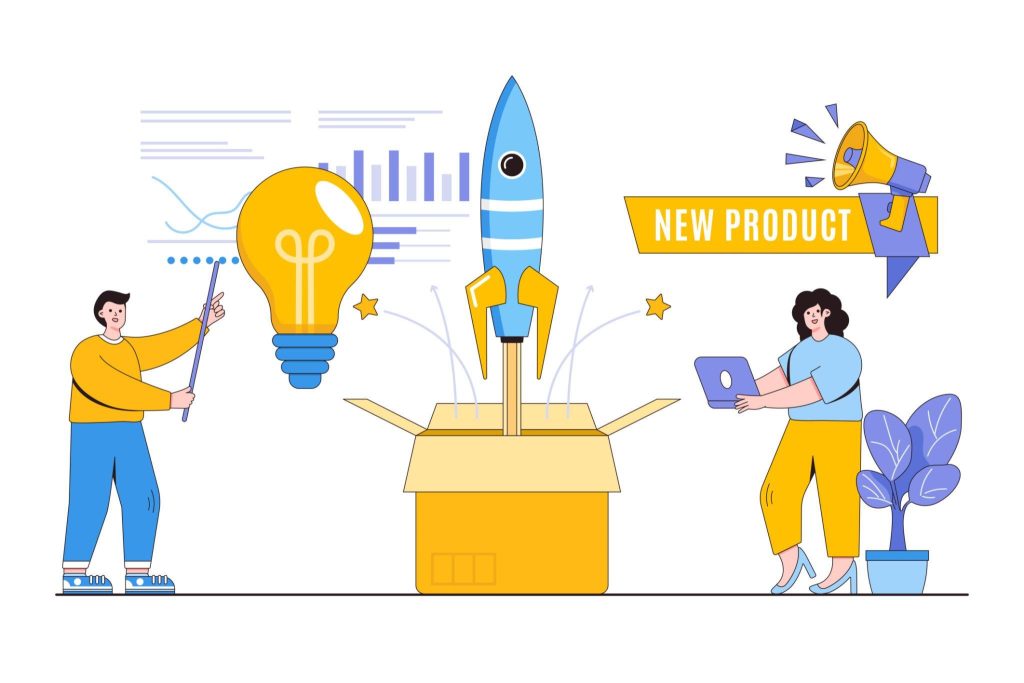
Innovation plays a major role in entrepreneurship.
Entrepreneurs often search for new technologies, products, services, processes, or business models. They try to solve problems in a different or more efficient way.
Businesses do not always need to be innovative. A business can successfully operate using an existing and proven model.
For example, opening another restaurant in a city is a business. Creating a food-delivery model that uses a new technology to significantly improve restaurant logistics could involve entrepreneurship.
However, this does not mean that every entrepreneur must invent something completely new. Entrepreneurship can also involve improving an existing idea or introducing it to a new market.
3. Risk-Taking
Entrepreneurship generally involves a higher level of uncertainty and risk.
Entrepreneurs may invest money, time, and resources into an idea without knowing whether customers will accept it. They may face financial losses, competition, changing market conditions, and product failures.
Traditional businesses can also involve risk, but established businesses often have more predictable operations and customer demand.
For example, starting a completely new software startup involves significant uncertainty. Opening a franchise with an established brand and business model may involve comparatively lower uncertainty.
Therefore, risk-taking is one of the defining characteristics of entrepreneurship, while business management often focuses more on controlling and reducing risks.
4. Approach to Growth
Entrepreneurship often aims for rapid growth and scalability.
Many entrepreneurs build products or services that can reach a large number of customers without increasing costs at the same rate. Technology startups are a common example.
A business may instead focus on steady and sustainable growth.
For instance, a local grocery store may expand gradually by opening additional branches. A technology startup could potentially serve customers across multiple countries through a digital platform.
This does not mean that every entrepreneur wants rapid growth or that every business grows slowly. The difference is mainly in the growth approach and scalability strategy.
5. Role of the Founder
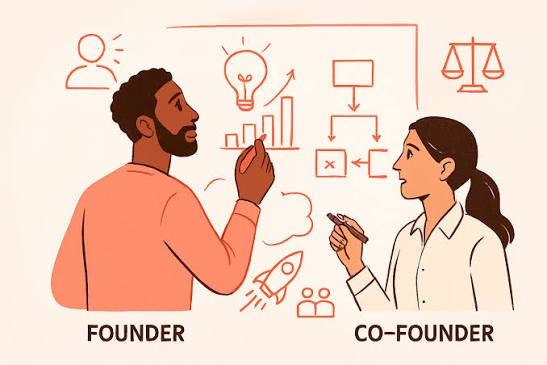
The founder’s role is another important difference.
In entrepreneurship, the founder is often deeply involved in identifying opportunities, developing ideas, building teams, attracting investors, and creating the overall vision of the venture.
In an established business, the owner or manager may focus more on operations, employees, marketing, finance, customer service, and maintaining profitability.
As the organization grows, entrepreneurs may move from day-to-day operations toward strategic decision-making.
For example, a startup founder may initially handle product development, marketing, hiring, and customer feedback. Later, they may build specialized teams to manage these responsibilities.
6. Main Objective
The objectives of entrepreneurship and business can also be different.
A business generally aims to:
- Generate revenue
- Earn profits
- Maintain customers
- Control costs
- Expand operations
Entrepreneurship may have broader objectives, including:
- Solving a customer problem
- Introducing innovation
- Creating a new market
- Building a scalable company
- Creating employment
- Generating economic and social value
Profit is important for entrepreneurs too, because a venture needs financial sustainability. However, entrepreneurs may initially prioritize product-market fit, innovation, customer growth, or market expansion before focusing heavily on profits.
Entrepreneurship vs Business: Comparison Table
| Factor | Entrepreneurship | Business |
|---|---|---|
| Meaning | Creating and developing new opportunities | Operating commercial activities |
| Primary Focus | Innovation and opportunity | Revenue and profitability |
| Risk Level | Generally higher uncertainty | Often more predictable |
| Innovation | Usually an important element | Not always required |
| Growth | Often focuses on scalability | Can focus on steady growth |
| Founder Role | Visionary and opportunity-driven | Owner or manager focused on operations |
| Goal | Create value and pursue opportunities | Generate sustainable revenue and profit |
Why Is Entrepreneurship Important?
Entrepreneurship plays an important role in economic and technological development.
Entrepreneurs identify problems and create solutions that can improve people’s lives. Successful ventures can also create employment opportunities and contribute to economic growth.
For example, technology entrepreneurs have contributed to the development of online payments, e-commerce, artificial intelligence, cloud computing, food delivery, and digital education.
Entrepreneurship can also encourage competition. When new companies enter a market with better products or services, existing businesses may need to improve their offerings.
Why Is Business Important?
Businesses are essential for providing products and services that people need every day.
From small retail stores and restaurants to software companies and manufacturing organizations, businesses support economic activity by creating jobs, generating income, paying taxes, and serving customers.
A successful business also provides a foundation for long-term financial sustainability.
Even innovative startups eventually need strong business practices involving finance, marketing, operations, sales, customer support, and management.
Can an Entrepreneur Also Be a Business Owner?
Yes.
An entrepreneur can become a business owner, and a business owner can also demonstrate entrepreneurial qualities.
For example, imagine someone starts an online learning platform to solve a specific problem faced by students. They identify an opportunity, develop a new solution, take financial risks, and build a company around the idea.
They are both an entrepreneur and a business owner.
The key difference is the approach. Entrepreneurship emphasizes opportunity, innovation, and risk-taking, while business emphasizes operations, customers, revenue, and profitability.
Entrepreneurship vs Business: Which One Should You Choose?
There is no single right choice.
If you enjoy creating new ideas, solving problems, taking calculated risks, experimenting with different approaches, and building something from scratch, entrepreneurship may be a suitable path.
If you prefer managing operations, serving customers, improving an existing business model, and building stable revenue, traditional business ownership or management may suit you better.
You can also combine both approaches. Many successful business owners use entrepreneurial thinking to introduce new products, adopt technology, enter new markets, and improve their operations.
Final Thoughts
Entrepreneurship vs business are closely related, but they are not identical. Entrepreneurship is mainly about identifying opportunities, creating innovative solutions, and taking calculated risks to build something valuable. Business is more focused on operating an organization, serving customers, generating revenue, and achieving sustainable profitability.
Understanding these differences can help students and aspiring professionals decide whether they want to build a startup, manage an existing business, or combine entrepreneurial thinking with business management.
In today’s competitive environment, having both entrepreneurial and business skills can be valuable. Innovation can help you discover opportunities, while strong business knowledge can help you turn those opportunities into a sustainable venture.
Want to learn More about Marketing Management Kaashiv Infotech Offers Digital Marketing Course & More, Visit www.kaashivinfotech.com.