
Customer relationship management systems are very important in helping nonprofit organizations to monitor the donors, campaign, and outreach arrangements. With the increase of digital interactions, several organizations are resorting to the use of Node.js to create API (application program interface) with flexibilities so that websites, fundraising applications, and third party applications can be linked to the CRM systems. Effective integration of data will make sure that the data flows in the right way and is secure and it will lessen the work by hand and enhance the transparency.
Table Of Content
When web developers integrate Node.js APIs and nonprofit CRM systems, there is a need to clearly understand the technical architecture as well as the objective of the organization. When properly implemented, it facilitates fundraising, volunteer management, and reporting and provides compliance and data integrity. The article will describe the practical aspects and considerations to be followed in developing a dependable integration.
Understandig CRM Requirements
It is good to review the CRM platform to be used when writing any code. CRM systems used by many nonprofits, including Salesforce Nonprofit Cloud, Blackbaud or Bloomerang, have REST or SOAP APIs, which can be used by external systems to create, read, update, and delete records. api documentation can assist in finding out authentication, rate limits and the necessary data format.
It is also important to map the business processes of the nonprofit organization with the CRM data structure. The records of donations, the contacts profile and the event registration and the recurring gifts should be in accordance with the schema of the CRM. Clear field mapping eliminates errors and the flow of information in a donation form or event signup to the right CRM objects will not be duplicated or lost.
Designing the Node.js API Layer
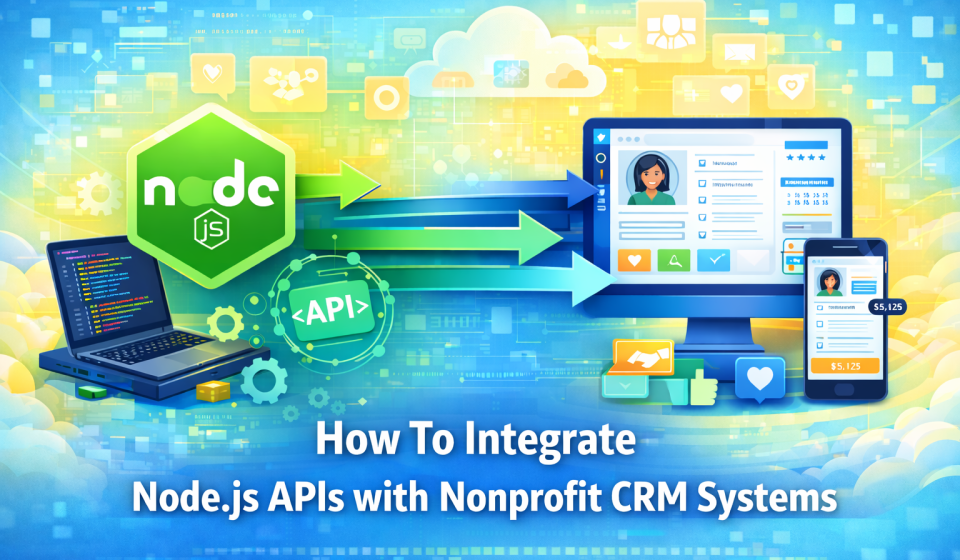
The Node.js API serves as a link between the external interfaces and CRM. With the help of frameworks like Express, developers may develop endpoints which get information out of websites, mobile applications or payment gateways. These endpoints validate the received data, convert them into the format needed by the CRM and transmit it using secure API calls.
An API layer is well designed in that it isolates business logic and presentation. To illustrate, a donation point is capable of receiving and sending payment confirmation, sanitizing the client input and pushing formatted information to the CRM. This separation facilitates scalability on a long term basis and enables any changes to be made to the nonprofit website design without disturbing the backend integrations.
Implementing Secure Authentication
Security is of the essence as far as nonprofit CRM systems are concerned as the information of donors and volunteers is sensitive. OAuth 2.0 or API keys have been used to authenticate most CRM platforms. The credentials must be stored in a secure manner through environment variables and they should not be displayed within the source code repositories as node.js applications.
The API should also have secure access controls in addition to authenticating with the CRM. JSON Web Tokens, HTTPS encryption, and input validation are some of the techniques that mitigate endpoints against unauthorized access. Profession logging and monitoring systems can also be used to monitor suspicious activity and ensure that privacy rules and regulations applicable in the running of the nonprofits are adhered to.
Managing Data Synchronization
Can ensure that the information is consistent between the CRM and CRM node.js application through data synchronization. Other integrations are based upon real time API calls as events like submitted forms. There are also those who utilize scheduled background jobs, which update records with regular intervals. The option will be based on performance needs and API limits.
It is also crucial to deal with mistakes in an elegant manner. In case the CRM API request fails because of a network failure or a validation error the Node.js app must record this failure and reattempt when necessary. The queues or message brokers would be useful in order to address the high transaction rates during peak fundraising times without overloading the CRM system.
Connecting Web Platforms and Forms
Most of the nonprofits gather information using online donations forms, event-registration forms and newsletters. These front end elements are usually found as a part of a larger nonprofit website design plan of engaging and gaining trust. These forms can be submitted to the Node.js API which can then be turned into structured CRM records.
During the construction of website design for nonprofits, developers must make sure that they develop forms only when this information is required and confirm the validity of the information prior to the form submission. The API is also able to clean and normalise the input, date formats, consistent address fields and matching existing contacts to avoid duplication. Such a joint effort in design and the backend integration enhances user experience and quality of data.
Testing and Deployment
Extensive testing makes data inconsistency less likely. The developers are supposed to develop staging environments that are similar to the production CRM and can be used to simulate real world situations. Unit tests will be used to ensure that data is passed correctly through various functions and integration tests will be used to ensure that API calls work to create or update CRM records.
The version control and continuous integration tools can be used to maintain the stability during deployment. Rolling updates enable the introduction of new features or changes by stages. Monitoring dashboards will help to monitor the response time and error rates of API responses that will provide an early notification that the integration is experiencing performance problems post-launch.
Maintenance and Future Improvements
Integration is not a single process. CRM systems are upgraded and nonprofits tend to increase their digital presence. It is ensured by regular reviews of API documentation and periodic audits of field mappings that further compatibility remains. Security vulnerabilities are also minimized by updating dependencies within the Node.js setting.
In the long term, an organization can decide to add an API to their application in order to enable analytics, marketing automation, or report dashboards. With proper documentation and flexible code, the Node.js integration will keep up with the mission and technological requirements of the nonprofit, which will keep the CRM a sound platform to outreach and expand.
Conclusion
The combination of the Node.js APIs with the nonprofit CRM systems enhances the accuracy of data, efficiency of operations, and interaction with the donors. With the knowledge of CRM needs, a built-in API layer design, and a safely established authentication, companies can establish a reliable connection between online platforms and their internal databases.
This integration helps with fund-raising campaigns, volunteer organization and communication with a thorough planning, continuous testing and maintenance. A considered strategy has been known to make sure that technology makes the mission, and nonprofits can concentrate on making an impact as their systems run smoothly under the scenes.