
AI isn’t just a trendy term anymore it’s now playing a big role in how products are planned, created, and improved.
Table Of Content
It’s doing more than just helping with everyday tasks. Today, AI can even come up with new ideas and help shape the product itself.
Product managers used AI mostly to streamline tasks like sprint monitoring, news reports, and roadmaps in the past.
However, these days, AI is also being applied more strategically and creatively, such as in feature suggestions, user experience design, or consumer input analysis to expedite product improvement.
It’s not just helping manage workflows it’s helping shape what gets built and how.
This blog examines how AI is changing the entire product development process, from coming up with concepts and creating code to testing and customizing user experiences, going beyond simple job handling.
To stay ahead and thrive in the future, product managers, designers, and developers must comprehend how AI is developing.
Product professionals must understand how AI is developing and impacting their work if they want to stay competitive in the years to come.
Traditional Use of AI in Product Management
Initially, AI in product management operated in the background. It can be thought of as a useful helper that handled monotonous, routine duties, conducted data analysis, and maintained organization.
It helped teams save time and avoid repeating the same tasks by making things like strategy organizing, monitoring projects, and keeping records far easier.
AI was also great at making predictions, like guessing how many users might leave, which features would be popular, or spotting trends early.
But even though these tools were useful, AI mostly stayed in the background helping teams work faster, but not really leading to big, new ideas.
It was a tool you consulted, not a partner you collaborated with.
The real strategic decisions? Still made entirely by humans.
But that’s quickly changing…
Emerging AI Applications Beyond Management
AI is evolving from a supportive tool to a strategic partner across the entire product lifecycle. Here’s how it’s making an impact:
- AI in Ideation & Innovation: By examining consumer habits, patterns, and competition activity, AI assist teams in developing new product concepts.
Idea generation can be sped up and cut down with the use of tools like ChatGPT, which can immediately offer user profiles or feature ideas.
- AI in UX & Design: AI driven design software such as Galileo or Uizard Simple prompts are transformed into wireframes and prototypes by AI, which also predicts customer behavior to recommend style and navigation changes.
- AI in Development & Testing: AI acts like a helpful assistant for developers. It suggests code as they type (like GitHub Copilot) and automatically checks for bugs or mistakes.
This helps reduce errors and makes the product ready for release much faster.
- AI in Customer Feedback Analysis: AI can read through thousands of reviews, surveys, and messages from users in seconds.
It finds common issues, spots what people are happy or unhappy about, and helps teams make better decisions based on real feedback.
- AI in Personalization & Product Growth: AI rapidly adapts features, advertising, and costing based on customer behavior to boost engagement, sales, and retention rates.
Benefits of AI Across the Product Life Cycle
Using AI in product development isn’t just helpful, it gives teams a big advantage over others.
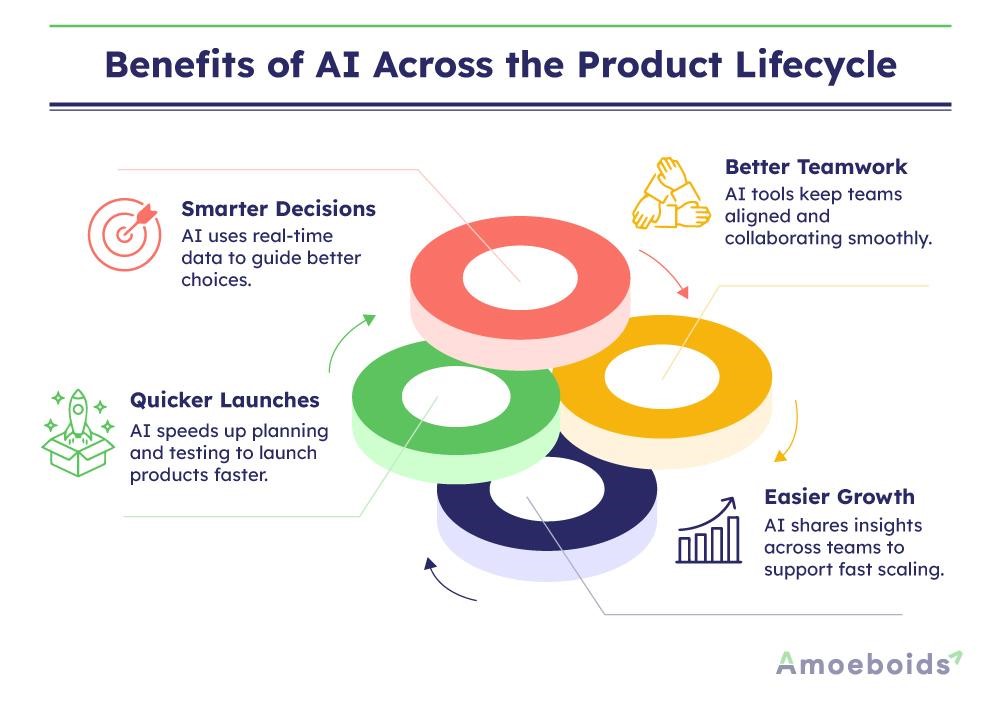
Here’s how AI helps:
Quicker Launches: Teams can complete work more quickly and release products earlier when AI assists with time consuming chores like planning and testing.
Smarter Decisions:AI looks at live, real-time data to help teams make clear and accurate choices, instead of just guessing.
Better Teamwork:Tools powered by AI, like Jira and Figma, help team members stay on the same page and work together more smoothly.
Easier Growth:AI can handle lots of data and share useful insights with many teams, helping the business grow quickly without slowing things down.
The Future: Human + AI Collaboration
AI won’t replace product managers, it will work with them as a helpful, fast assistant that still needs human guidance.
Today, product managers act like guides for AI. They use their ideas, experience, and knowledge of users to help AI do its job well.
Instead of just giving tasks, they create smart prompts, check AI’s suggestions, and make important choices that only people can make.

Product teams must pick up some new skills in order to collaborate effectively with AI:
- Recognize what AI is capable of: Let it do things like data sorting and analysis, but know when a human decision is still required.
- Learn how to talk to AI tools: The better you ask (prompt), the better answers you’ll get from AI. Clear instructions matter.
- Recognize data usage and ethics: Make sure your use of AI is responsible, equitable, and grounded in objective, clear data.
In other words, rather than AI vs people, the future of product creation will involve AI and humans collaborating to create quicker, more intelligent, and more easy to use solutions.
Conclusion
AI is evolving from a useful tool used in the background to a true collaborator in creating innovative things.
It helps at every stage, from coming up with fresh concepts and creating user friendly displays to developing code, correcting errors, and personalizing the experience for every client.
Product teams can work more quickly, make better decisions, and produce goods that actually satisfy consumer needs by utilizing AI tools.
So, why wait? Start using AI in your product work today. Your next big idea could be just one smart prompt away!